How to Build an Interior Design Portfolio Website on Squarespace That Attracts High-End Clients
Introduction
The interior design industry has fundamentally shifted. Fifteen years ago, a portfolio of good work and a local network were often sufficient to secure mid-market residential projects. Today, the designers attracting luxury clients—high-net-worth residential projects, boutique hospitality, premium commercial spaces—are those with polished, professional, strategically crafted online presences.
Your portfolio website is no longer simply a showcase. It is a positioning document. When a property developer with a £2.5 million townhouse renovation clicks on your site, they will spend between 90 seconds and 5 minutes forming a judgment about whether you understand their aspirations. Your interior design portfolio website on Squarespacethat attracts high-end clients serves as a filtering mechanism for both parties: it allows premium clients to self-select in, and it allows you to consistently communicate your design values, your process, and your positioning.
Squarespace, as a platform, offers interior designers a sophisticated, customisable foundation for this work. Unlike portfolio platforms that force a templated aesthetic, Squarespace allows you to build a branded environment that feels bespoke. This guide addresses the full spectrum of decisions—from which projects to feature, to how to photograph them, to how you structure your consultation narrative—that together create a digital presence capable of converting high-end enquiries.
Key Takeaways How to Build an Interior Design Portfolio Website on Squarespace That Attracts High-End Clients
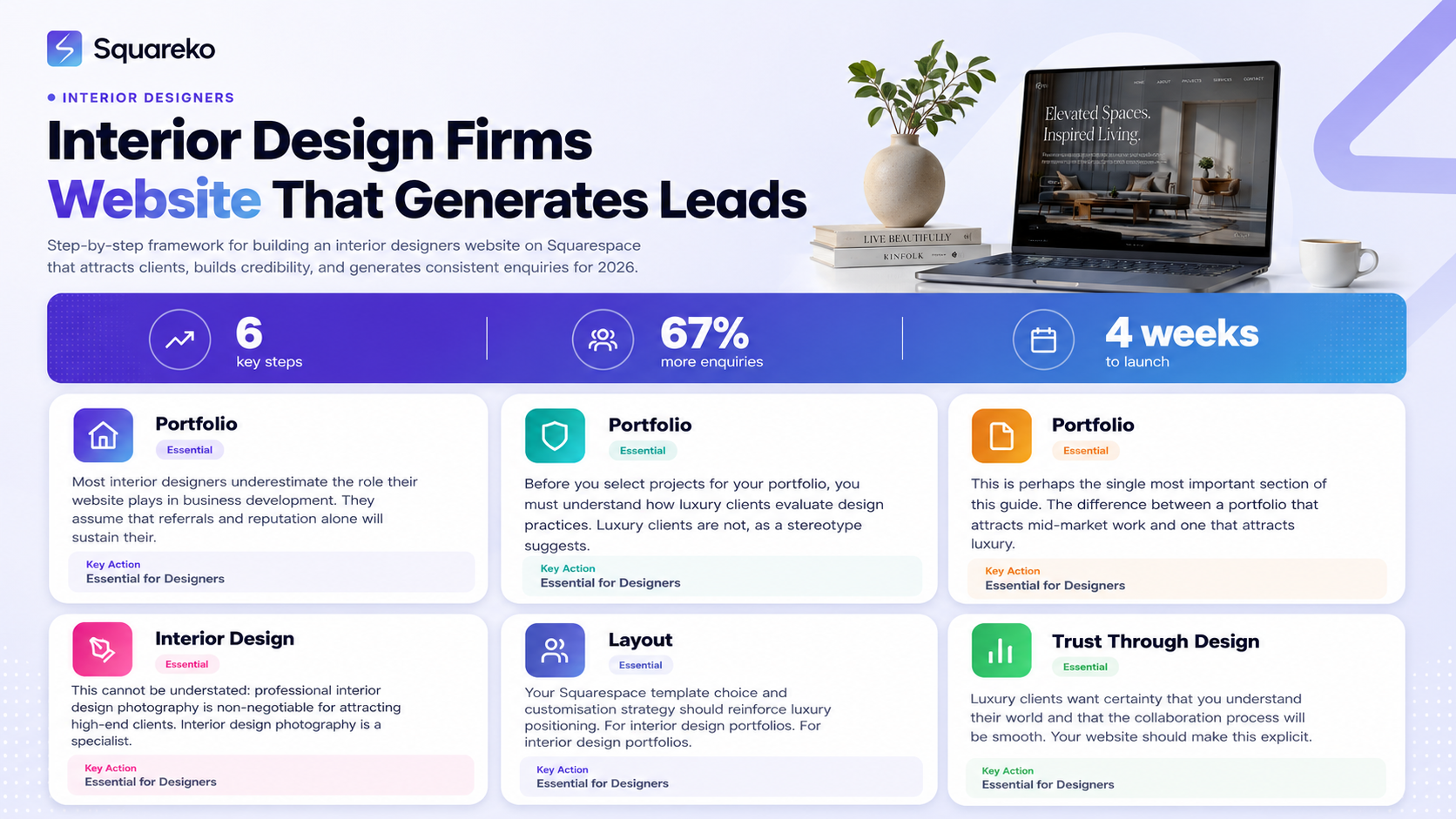
Luxury clients evaluate visual and conceptual depth: Your portfolio must showcase not just finished aesthetics, but your design philosophy, problem-solving approach, and understanding of premium materials and spatial planning
Strategic project sequencing matters: Leading with your strongest, most prestigious projects and grouping them by project type (residential, hospitality, commercial) creates a narrative arc that positions you for higher-calibre briefs
Professional interior design photography is non-negotiable: Investing in architectural photographers who understand lighting, styling, and space is essential; mediocre imagery will signal budget positioning regardless of your design quality
Squarespace's premium features serve luxury positioning: Clean typography, custom CSS, advanced image galleries, and client collaboration tools create the technical foundation for a sophisticated online presence
Your consultation process is part of your positioning: Demonstrating a rigorous, considered approach to initial meetings—outlined on your website—signals that you work with discerning clients
Press and recognition validate your positioning: Case studies that highlight publications, awards, or notable clients anchor your credibility within the high-end market
Why Your Portfolio Website Is Your Most Powerful Business Tool
Most interior designers underestimate the role their website plays in business development. They assume that referrals and reputation alone will sustain their practice. For some, this may be true—but only for those already operating at scale within an established network.
For designers moving from middle-market residential work into luxury territory, or those building a practice from less visible beginnings, your website is often your first and most significant opportunity to communicate your positioning. Here's why:
First, it establishes authority without conversation. A luxury client will research you before they call. They will spend time understanding your aesthetic sensibility, your technical competence, and your understanding of their world. Your website does this work silently. Every project image, every word you choose, every detail of your process section—these accumulate to form a complete portrait of your professional identity.
Second, it filters for alignment. When your website clearly articulates your design philosophy, your target project types, and your approach to fees and process, it naturally attracts clients aligned with those values. Conversely, it subtly discourages misaligned enquiries. A designer who is clear about working on high-end residential projects, with budgets above £150,000, in a specific aesthetic direction, will receive fewer "We have £20,000 and want a complete redesign" enquiries.
Third, it extends your reach beyond your immediate geography. Designers in secondary cities can now attract projects from major metropolitan areas if their work justifies it. This geographic arbitrage—demonstrating London-standard design from a practice based in the Cotswolds, for instance—is increasingly common and increasingly lucrative.
Your Squarespace website, properly built and curated, becomes your business development engine.
Understanding Luxury Client Psychology and Portfolio Expectations
Before you select projects for your portfolio, you must understand how luxury clients evaluate design practices.
Luxury clients are not, as a stereotype suggests, simply wealthy people with poor taste willing to spend money. Rather, they are discerning individuals who have invested significantly in property and seek partners who understand and respect their values. They evaluate designers across multiple dimensions:
Aesthetic coherence. Does the designer have a recognisable point of view? Luxury clients are often attracted to designers with a distinctive aesthetic, because this signals expertise and confidence. The designer who claims to do "all styles" sends a signal of commercial compromise rather than considered methodology.
Technical competence in materials and spatial planning. A luxury client recognises good proportions, understands the value of exceptional finishes, and can evaluate whether a designer truly grasps topics like acoustic design, thermal comfort, lighting layering, or the subtlety of colour selection. Your portfolio must demonstrate this depth.
Understanding of their lifestyle. Luxury residential clients want evidence that you understand how they live—or aspire to live. If they are professionals with demanding careers, do you understand how a home functions as a retreat? If they are collectors, does your design approach respect and enhance display and lighting? Your portfolio should subtly reflect this understanding.
Evidence of collaboration with other specialists. Luxury projects invariably involve architects, structural engineers, AV specialists, and lighting designers. A portfolio that references collaboration—through case studies that mention working relationships, or through detailed project narratives—signals maturity and scope.
Professional process and communication. Luxury clients want to understand how you work. They value transparency about fees, timelines, communication protocols, and decision-making processes. Your website should make these clear.
Your portfolio website must speak to all five dimensions. It is not enough to show beautiful final images; you must contextualise them within a framework of professionalism and understanding.
Luxury Portfolio Curation Strategy: Selecting and Sequencing Your Best Work
This is perhaps the single most important section of this guide. The difference between a portfolio that attracts mid-market work and one that attracts luxury projects is rarely the quality of the individual projects themselves. Rather, it is the curation strategy—the selection and sequencing of which projects appear, in what order, with what narrative.
Step 1: Audit Your Completed Projects
Begin by listing every completed project from the past 5–7 years. For each, note:
Project type (residential, hospitality, commercial, other)
Budget scale (estimate or actual, if comfortable)
Project complexity (technical challenges, scope of work)
Client sector (if hospitality: boutique hotel, restaurant, member's club; if residential: new-build apartment, period townhouse, country house)
Visual quality (be honest about photography quality)
Design risks taken (innovative solutions, experimentation, departure from your typical aesthetic)
Recognition received (press features, awards, social media engagement)
This audit creates a complete picture of your portfolio inventory.
Step 2: Identify Your Anchor Projects
Anchor projects are the 2–3 pieces of work that best represent your positioning for high-end clients. These are projects that demonstrate:
Scale (complexity and scope, not necessarily budget)
Aesthetic coherence with your intended positioning
Evident client satisfaction (evident from commissioning follow-up work, or from public recognition)
Strong visual content (professional photography, interesting spatial conditions, compelling design storytelling)
These anchor projects should lead your portfolio. They set the tone for everything that follows.
Step 3: Organise by Project Type and Narrative Arc
Rather than showing projects in chronological order, group them strategically:
Create separate portfolio sections for residential, hospitality, and commercial (if you work across all three)
Within each section, sequence projects from largest to smallest, or from most recent to oldest
Consider pairing a before-and-after project with a new-build or fit-out project to demonstrate range
Include one or two projects that show calculated risk-taking or aesthetic innovation—this signals creative confidence
The narrative arc matters. A visitor should finish reviewing your portfolio thinking not "This designer does nice work" but "This designer understands my world and consistently delivers sophistication."
Step 4: Be Ruthlessly Selective About What You Exclude
This is where many designers make mistakes. They include every project they've completed because "it shows range." In reality, including a project with mediocre photography, weak spatial conditions, or unclear conceptual thinking actively damages your positioning.
If a project does not advance your luxury positioning narrative, exclude it. You may have completed excellent work on a small budget or under challenging constraints, but if including it signals the opposite of your current positioning, leave it out. A luxury brand does not show every product in its range; it curates relentlessly.
Step 5: Create a Sequencing Framework
On your Squarespace site, your portfolio structure might look like this:
Featured Project (singular, rotating if you wish): Your absolute strongest recent work
Residential Projects: 6–8 projects grouped by sub-category (Mayfair townhouses, country estates, new-build penthouses, etc.)
Hospitality Projects (if applicable): 4–6 projects grouped by venue type
Commercial Projects (if applicable): 3–5 projects
Each section should flow logically. The first project in each category should be sufficiently strong to set the tone. Subsequent projects can show variation within the category.
Why This Matters for High-End Conversion
A luxury client arriving at your site should immediately recognise that you work at a scale and quality level relevant to their needs. If your portfolio shows 15 small residential projects and 0 larger-scale work, a boutique hotel owner will assume you lack experience in their sector. Conversely, a portfolio that clearly segments project types allows clients to see themselves reflected in your work.
Professional Interior Design Photography Standards for Squarespace
This cannot be understated: professional interior design photography is non-negotiable for attracting high-end clients.
Interior design photography is a specialist discipline. It is not the same as architectural photography, real estate photography, or lifestyle photography. A professional interior design photographer understands:
Lighting layering: How to photograph a space at different times of day, and how to balance natural light with artificial light to show a space as the designer intends
Styling for photography: How to stage a space for camera—placing books, flowers, objects on surfaces—so that the design intent is clear without appearing overly staged
Technical perspective: How to use tilt-shift or perspective correction to eliminate lens distortion and ensure walls appear truly vertical
Spatial narrative: How to photograph a space not just head-on, but from multiple angles that reveal materiality, spatial flow, and functional design decisions
A designer who photographs their own work, or who hires a general photographer, will produce images that, while technically competent, lack the refinement luxury clients expect.
Investment in Interior Design Photography
For a full portfolio refresh (8–10 projects), expect to invest £3,000–£8,000 in professional photography. For a new or updated single project, budget £1,500–£3,000. This is not an optional expense; it is a fundamental investment in your business.
When hiring a photographer, request their portfolio and specifically look for interior design work—not architectural photography or residential real estate. Ensure they have experience photographing the interior aesthetic you wish to project (contemporary, classical, eclectic, etc.).
Photographic Standards for Squarespace Portfolio
Once you have professional images, follow these standards when uploading to Squarespace:
Image resolution: Use high-resolution images (minimum 1920 × 1280 pixels) to ensure clarity on desktop and mobile
Colour grading: Ensure consistency in colour temperature and saturation across your portfolio. A 3,000K warm-toned shot next to a 5,000K cool-toned shot signals inconsistency
Ratio and framing: Maintain consistency in how images are framed—avoid mixing wide-angle dramatic shots with tightly cropped detail shots without clear editorial intent
Captions and context: Under each image, provide a brief project description (2–3 sentences) that references design intent, materials used, or spatial challenge solved
Squarespace's image handling is sophisticated. Use their advanced gallery options (Masonry, Slideshow, or Grid layouts) to present images at high quality. Avoid compressing images excessively; Squarespace compresses images automatically, but uploading high-quality source files ensures the platform can optimise effectively.
Designing Your Squarespace Layout for Premium Positioning
Your Squarespace template choice and customisation strategy should reinforce luxury positioning.
Template Selection
For interior design portfolios, consider Squarespace templates that offer:
Clean, uncluttered layouts (avoid overly decorative or text-heavy templates)
Large, prominent image galleries that do visual work the talking
Flexible navigation that allows custom portfolio organisation
Sophisticated typography options
Subtle, refined design elements rather than bold or playful aesthetic
Templates like York, Momentum, or Collin offer the premium aesthetic most suitable for luxury positioning. Avoid templates with heavy branding, strong colour palettes, or novelty design elements—these distract from your portfolio content.
Customisation Strategy
Even within a template, significant customisation strengthens positioning:
Colour palette: Limit your site to 2–3 complementary colours, typically neutral with one accent colour. This restraint signals sophistication
Typography: Squarespace offers excellent typeface pairings. Choose a refined serif font for headers (such as Playfair or Chronicle) and a clean sans-serif for body text (such as Montserrat or Freight). Avoid decorative or novelty typefaces
Whitespace: Use generous margins and whitespace around portfolio images. Crowded layouts feel cheap; spacious layouts feel premium
Custom CSS: If comfortable with code, use Squarespace's custom CSS editor to refine spacing, font sizing, or specific element styling. A subtle enhancement—slightly tighter line height in navigation, or a refined accent colour—signals attention to detail
Navigation and User Journey
Structure your Squarespace navigation to guide luxury clients toward conversion:
Homepage: Feature your strongest project with a compelling headline. Include a short value statement (2–3 sentences) that articulates your positioning
Portfolio: Organise into curated categories (by project type or aesthetic) rather than a single undifferentiated feed
About: Include a professional headshot and a biography that emphasises your design philosophy, relevant experience, and values
Process: Detailed section describing your design approach, timelines, and how you collaborate
Contact: Multiple pathways to contact (contact form, email, phone). Consider a preliminary consultation booking system
Blog (optional): If you publish design insights, case studies, or project narratives, this strengthens authority and SEO
This journey prioritises visual storytelling (portfolio) while building trust through process transparency and accessibility.
Building Trust Through Design Process and Consultation Details
Luxury clients want certainty that you understand their world and that the collaboration process will be smooth. Your website should make this explicit.
Detail Your Design Process
Create a dedicated page (or a substantial section of your About page) that outlines your design methodology. This might include:
Discovery phase: How you understand the client's lifestyle, functional needs, aesthetic preferences, and constraints. Reference the specific questions you ask (without needing to exhaustively list them).
Concept development: How you develop initial design directions and present options
Design refinement: How feedback is incorporated and iterated
Implementation: How you manage vendor selection, detailing, and site supervision
Project completion: How you support the client through installation and fine-tuning
This process section does several things simultaneously:
It signals that you employ a rigorous methodology (not ad-hoc problem-solving)
It sets client expectations (so they understand you require input and collaboration)
It subtly filters for alignment (clients who balk at detailed processes are likely to be challenging)
It builds confidence in your capability
Make Your Consultation Process Visible
Luxury clients want to understand what an initial conversation with you involves. Include details such as:
Duration: "Consultations typically run 60–90 minutes"
Location: "We meet on-site, typically over coffee, to understand the space and your vision"
Deliverables: "Following our conversation, we provide a brief written summary of your goals and our preliminary thoughts"
Investment and fees: Be transparent about your fee structure (hourly, project-based, percentage of construction costs, or a combination). Luxury clients respect clarity and are willing to pay for clear value. Vague or hidden fees generate suspicion
A booking link (using Squarespace's calendar integration or an embedded Calendly) makes scheduling simple. Alternatively, a straightforward contact form requesting preferred meeting times removes friction.
Case Study and Project Narratives
For 2–3 of your most significant projects, invest in detailed case studies. These should include:
Brief: The client's initial challenge or vision
Process: How you approached the project, any technical or conceptual challenges, and how you solved them
Execution: Timeline, collaboration with other specialists, key decisions made
Outcome: Final result, client feedback, and any recognition (press features, awards)
Images: 6–12 high-quality photographs showing the final design and specific details
These case studies transform your portfolio from a gallery into a narrative, demonstrating your thinking and capability. They also provide SEO value and are excellent for social media and PR.
Integrating Press, Awards, and Client Recognition
For high-end positioning, external validation matters considerably. Clients assume that if your work has been published, featured, or awarded, it meets a recognised standard of quality.
Publicise Your Achievements
Create a dedicated page or prominent section titled "Press & Recognition" or "Awards & Publications" that includes:
Magazine features: "Featured in The World of Interiors, Spring 2024"
Awards: "Winner, Restaurant & Bar Design Awards 2023, Best Boutique Hospitality Interior"
Social proof: "Trusted by [number of luxury clients] across residential and hospitality sectors"
Notable clients (with permission): If you have worked for well-known individuals, companies, or venues, this adds credibility
For each press mention, include a link (if publicly available online) or a PDF copy of the feature. For awards, include the award name, year, and category.
Build Your Press Presence
If you don't yet have significant press coverage, this becomes a business development priority:
Identify publications your target clients read (The World of Interiors, Dezeen, AD, Design Week, interior design trade publications, regional luxury lifestyle magazines)
Develop relationships with editors and writers
Pitch your projects with compelling narratives and high-quality images
Consider hiring a specialist PR consultant or publicist (typically £1,500–£4,000 per month) to build your media presence
Press features provide triple value: credibility on your website, content for social media, and backlinks that improve SEO.
Testimonials and Client Testimonials
Include 2–4 detailed client testimonials (not generic quotes, but specific feedback). Ideally, these should reference:
Your design sensibility and understanding of their vision
Your project management and communication
The transformation of their space and the impact on their daily life
Their willingness to recommend you
Example: "Sarah understood immediately what we were trying to achieve with the renovation—a contemporary approach that respected the period character of the house. Her attention to material selection and spatial planning transformed what could have been an overwhelming project into a genuinely collaborative process. We couldn't recommend her more highly." — Lord and Lady [Name], Cotswolds
Display testimonials with the client's name and, ideally, a photograph. This adds authenticity and credibility.
-
For luxury positioning, quality vastly outweighs quantity. Rather than showing 20 projects of varying calibre, curate 8–12 exceptional projects that clearly demonstrate your positioning. Each project should advance your narrative. Visitors to luxury designer portfolios—whether prospective clients or industry peers—expect focused, curated content rather than exhaustive project lists. If you have completed more than 12 significant projects, rotate your featured work seasonally or create sub-galleries organised by project type.
-
Luxury positioning on Squarespace is achieved through restraint, not embellishment. Use abundant whitespace, clean typography, and a limited colour palette. Ensure your imagery is professionally shot and consistently styled. Customise your template with subtle refinements (refined spacing, sophisticated font choices, restrained accent colours). Write copy that is clear and confident, avoiding clichés and hyperbole. Include detailed process information and client testimonials. The overall impression should be "this designer has considered every detail"—including the digital experience of their website.
-
This is context-dependent. If you work predominantly on project-based fees with a minimum project size (e.g., "Minimum project investment: £50,000"), including this on your site filters for appropriate-scale enquiries and saves time. If your fees vary significantly based on project scope, or if you work on hourly rates, state your approach without specific figures (e.g., "We offer flexible fee structures tailored to project scope. We discuss fees transparently during initial consultation"). Never display pricing if it undermines your positioning—vague or low-end pricing appears unprofessional. It's better to discuss fees in conversation with qualified prospects than to allow pricing to deter good clients before they engage.
-
Templates with clean layouts, large image galleries, and sophisticated typography are ideal. Consider York, Momentum, Collin, or Five. Evaluate templates based on how they display your portfolio work—do they provide options for full-width image displays, masonry galleries, or slideshow formats? Avoid heavily branded templates or those with built-in design elements that might clash with your aesthetic. Remember that your portfolio imagery should be the star; your template should support, not distract.
-
A combination is ideal. Your primary portfolio should showcase final, completed work in professional photography. However, case studies can include process work—mood boards, concept sketches, material samples, or before photos—to contextualise your thinking. This demonstrates expertise and design rigour. However, ensure any process imagery is of professional quality; rough sketches or phone photos undermine positioning.
-
Update your portfolio at least twice annually with new projects. After completing significant work, refresh your featured project and your portfolio sections within 3–6 months. Outdated portfolio content signals an inactive practice; regular updates signal a thriving business. Additionally, update your press and recognition sections as new features or awards come in, and refresh your blog with insights quarterly (if you maintain a blog).
-
Your portfolio website should be strategically optimised for search terms your ideal clients use: "luxury interior designer [your region]," "high-end residential design," "bespoke interior design," and similar terms. Include these keywords naturally in your About page, service pages, and case studies. Write blog content addressing interior design questions (e.g., "How to Choose an Interior Designer," "Interior Design Trends for High-End Residential Projects"). Ensure your site is mobile-responsive, loads quickly, and has clean URL structure—Squarespace handles most technical SEO well. Consider internal linking between related projects or blog posts. An SEO specialist can audit and recommend optimisations specific to your market and niche.
-
No. Luxury clients will recognise AI-generated imagery (or suspect it), and its inclusion signals either deceptive practices or inability to access real project work. Your portfolio must showcase actual completed projects photographed professionally. If you are early in your career and have limited completed work, focus on building a smaller, stronger portfolio rather than padding with AI imagery. This is non-negotiable for credibility.
Conclusion
Building an interior design portfolio website that attracts high-end clients is not a matter of technical sophistication or flashy design. Rather, it is a discipline of rigorous curation, professional presentation, and transparent communication. Your website must answer the unspoken questions a luxury client brings: Do you understand the standards of quality I expect? Do you have experience with projects at my scale? Will you collaborate thoughtfully and communicate clearly?
Your Squarespace portfolio, thoughtfully built, becomes a powerful business development tool. It establishes your positioning without conversation, filters for client alignment, and extends your geographic reach. It allows you to move from competing primarily on referral and reputation to attracting premium clients who discover you through research, recognise your positioning through your visual and conceptual presentation, and choose to engage because your website has made clear that you operate at their level.
The investment in professional interior design photography, in curating your project selection, in refining your Squarespace design, and in articulating your process and values is an investment in your practice's future trajectory. Designers who take this work seriously consistently report elevated client calibre, larger project budgets, and more satisfying collaborative relationships. Your website is not a business card or a brochure; it is a statement of your professional identity and your aspirations for your practice.
Call to Action
Ready to build your luxury interior design portfolio on Squarespace? Whether you're starting from scratch, refreshing an existing site, or refining your digital positioning, the specialists at Squareko.com can guide you through every decision—from template selection and customisation, to portfolio curation strategy, to integrating client booking systems and e-commerce features.
Squareko offers free 30-minute consultations for interior designers looking to establish or elevate their online presence. We specialise in portfolio positioning for designers targeting high-end residential, hospitality, and commercial sectors.
Schedule your free Squarespace consultation with Squareko today and discover how to position your practice for premium client growth.
From custom website design to SEO strategy, we help businesses launch a site that looks professional and performs better.

Author Bio
I'm Walid Hasan, a Certified Squarespace Expert and Squarespace Circle Platinum Partner with over 12 years of hands-on experience designing and optimizing high-performing websites. Over the years, I've had the privilege of building more than 2,000 Squarespace websites for clients around the world, always focusing on clean design, strong user experience, and conversion-driven results.