How to Build a Kids Clothing or Toy Brand Website on Squarespace That Parents Trust
Introduction
Building a kids clothing or toy brand website isn't just about showcasing beautiful products—it's about creating an environment where parents feel confident buying from you. Parents who purchase children's products are naturally cautious. They want reassurance that your brand prioritises safety, honesty, and their child's wellbeing. When you design a kids clothing toy brand website on Squarespace with trust as your foundation, you're not just building a shop; you're building a relationship with parents who will return again and again.
In this guide, we'll walk you through the essential elements that transform a standard Squarespace site into a trusted authority in the kids' market. From displaying safety certifications to writing transparent sizing guides, we'll cover everything parents look for when deciding whether to trust your brand with their children.
Key Takeaways
Trust signals are non-negotiable: Parents expect to see safety certifications (CE, ASTM, EN71), transparent materials lists, and verified reviews before making a purchase
COPPA compliance protects your brand and your young audience: You must understand children's data privacy laws and implement them across your Squarespace website
Sizing guides and honest product photography build credibility: Parents hate returns due to fit issues—detailed measurements and realistic photos prevent frustration
Your About page and founder story humanise your brand: Parents connect with the people behind products, not faceless companies
A clear returns policy and transparent ingredient disclosure are expectations, not luxuries: These reduce purchase anxiety and turn first-time buyers into loyal customers
Certification badges and security indicators belong front and centre: Parents notice these visual trust signals immediately
Parent testimonials and verified reviews outperform generic marketing claims: Real parent voices resonate far more than brand messaging alone
Why Parents Demand Trust from Kids Brands
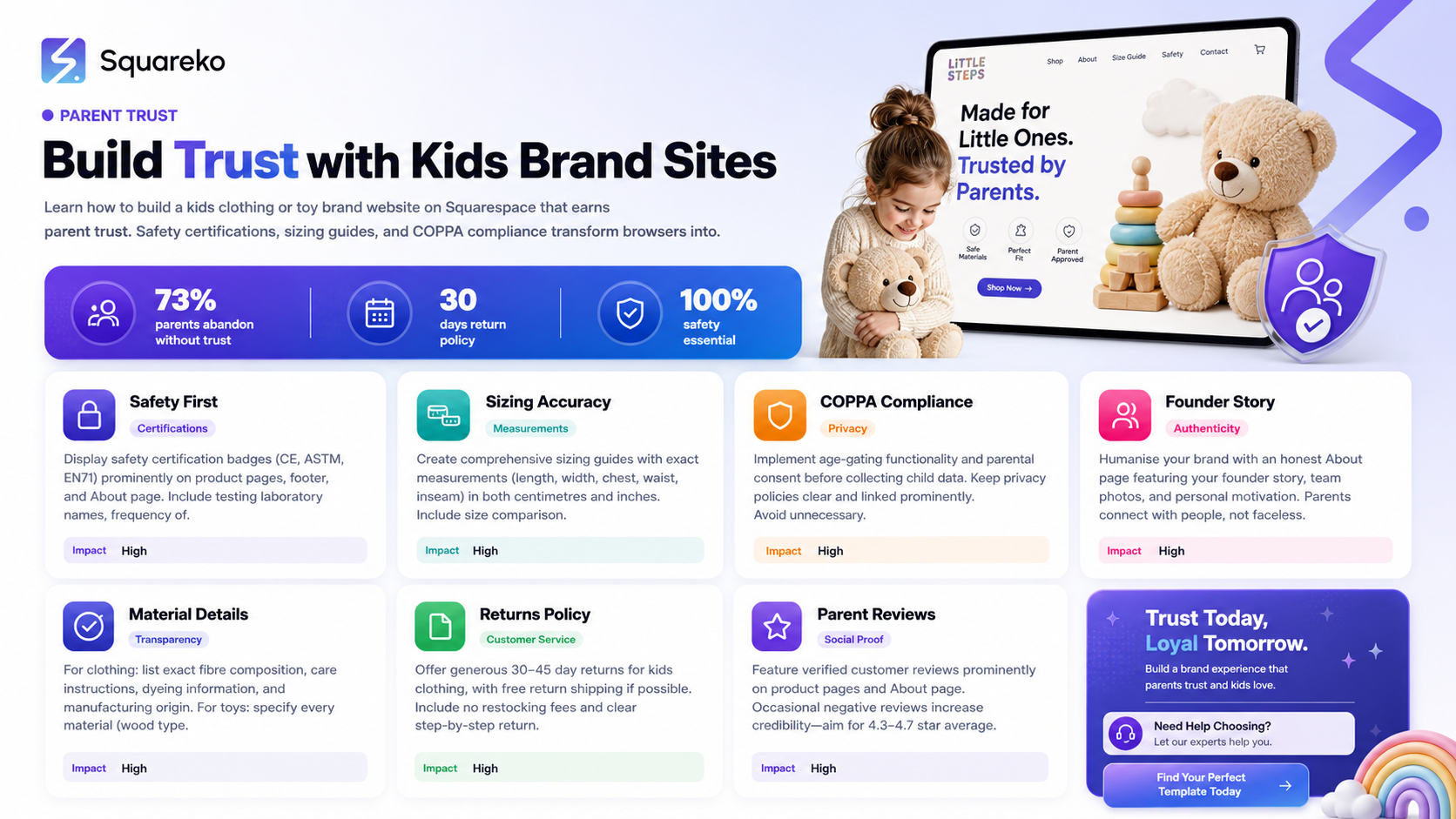
Parents purchasing children's clothing or toys aren't like other online shoppers. They're making decisions that affect their child's safety, comfort, and wellbeing. This means trust isn't a nice-to-have feature on your Squarespace website—it's the foundation of your entire business model.
Recent consumer research shows that 73% of parents will abandon an online purchase if trust signals are absent. They expect to find information about product safety, materials, sizing accuracy, and brand authenticity before adding items to their cart. A professional, trustworthy Squarespace website doesn't just list products; it answers the unspoken questions every parent has: Is this safe? Will it fit? What are you hiding?
The good news? You don't need a massive marketing budget to build parent trust. You need transparency, clarity, and a Squarespace website designed around parent psychology. When you understand what parents look for, you can design every page, every product description, and every image to address their concerns directly.
Parents appreciate brands that communicate honestly about what they make, how they make it, and why they make it that way. They reward transparency with loyalty.
Essential Trust Signals for Your Squarespace Website
Trust signals are visual and textual cues that communicate safety, reliability, and transparency. On a kids brand website, these signals work overtime. Parents are subconsciously scanning your Squarespace site for proof that you're a legitimate, safety-conscious business.
The key trust signals every kids brand needs:
Safety certification badges: CE, ASTM, EN71, and other relevant compliance marks
Clear About page with founder/team photos: Humanises your brand
Specific material and ingredient lists: Not vague descriptions
Detailed sizing guides with measurements: Preferably including video or comparison images
Published returns and refund policy: Make it obvious and straightforward
Customer testimonials and verified reviews: Real parent voices, not curated marketing
Privacy policy that specifically addresses children's data: Shows COPPA awareness
SSL certificate and security badges: Visible trust indicators (Squarespace includes these by default)
Contact information and response time commitments: Demonstrates accessibility
Product testing and quality assurance disclosures: Explain your testing process
On Squarespace, you can incorporate all these elements across your website. Place certification badges in the footer and product pages. Link prominently to your About page from the home page. Create a dedicated FAQ section addressing parent concerns. Use high-quality product photography that shows realistic fit and material texture.
The more trust signals you display, the more confident parents feel making purchases.
Displaying Safety Certifications and Testing Disclosures
Safety certifications are the single most important trust signal for kids product brands. Parents recognise abbreviations like CE (European Conformity), ASTM (American Society for Testing and Materials), and EN71 (European Standard for toy safety). If your products carry these certifications, you must display them prominently.
Where to Display Certifications on Your Squarespace Site
Product pages: Add certification information to the product description or specifications section. For clothing brands, mention that products meet OEKO-TEX standards if applicable. For toy brands, state clearly: "This product meets EN71 safety standards" or "ASTM F963 certified."
Footer: Include a row of certification badges in your website footer. This communicates legitimacy across every page. Squarespace's Footer section is perfect for this. You can upload badge images and link them to your testing documentation if you'd like.
About page: Explain your quality assurance process. Parents want to know you're serious about testing. Write something like: Every toy undergoes independent laboratory testing for lead content, small parts hazards, and material durability before release.
Checkout page: Reassure customers as they're about to purchase. A small trust seal or text saying "All products tested to international safety standards" can reduce checkout abandonment.
Testing Disclosures That Build Credibility
Don't just claim safety—explain how you verify it. Include:
Name of the testing laboratory if you use third-party verification
Frequency of testing (annual, per batch, per design)
Standards your products meet
Link to full test reports (if publicly shareable)
Recall history status (if applicable)
For example: "Our organic cotton range is tested annually by SGS for pesticide residues and meets OEKO-TEX Standard 100 certification. Test reports are available upon request."
This level of transparency separates trust-building brands from those cutting corners.
Writing Transparent Sizing Guides and Product Descriptions
Sizing frustration is one of the top reasons parents return kids' clothing online. A vague size chart creates anxiety and wasted delivery costs. Your Squarespace website needs sizing guides so detailed that parents can confidently order without worrying about fit.
Creating Comprehensive Sizing Guides
On Squarespace, use the Product Description or Specifications section to include:
Exact measurements: Length, width, chest, waist, inseam. Not just fits age 4-5 but chest: 56cm, length: 44cm. Include a size chart graphic showing how each size compares.
Fit philosophy: Explain your sizing approach. "Our clothing is designed for a relaxed fit with room to grow—we recommend choosing the size your child currently wears rather than going up. This prevents the too big complaint.
Comparison recommendations: If your child usually wears a UK size 5, try our size Medium. If between sizes, size up for longevity.
Video demonstrations: Consider adding a short video showing the garment on an actual child or dress form. Show how it sits, moves, and stretches. Squarespace allows embedded videos, and this simple step dramatically reduces returns and builds trust.
Model information: State the model's height, weight, and which size they're wearing. Concrete reference points help parents visualise fit.
Honest Product Photography
Parents can spot misleading product photography immediately. Use natural lighting, show products on dress forms and real children (with appropriate permissions), and include close-up shots of fabric, seams, and construction quality.
Display multiple angles of every product. If a fabric has a print or pattern, show it clearly. If there's stretch, say so. If colours vary slightly between dyes, mention it. Honesty builds trust; hidden problems destroy it.
COPPA Compliance and Protecting Children's Data
If your Squarespace website attracts users under 13 (or if you market to parents who have children under 13), you must comply with COPPA—the Children's Online Privacy Protection Act in the US, and similar regulations globally (GDPR in Europe, for example).
COPPA Essentials for Your Squarespace Site
Privacy policy for children: Your privacy policy must specifically address how you collect, use, and protect data from children. Use simple, clear language. State explicitly: We do not knowingly collect personal information from children under 13 without parental consent.
Data collection minimisation: Only collect data you genuinely need. Don't ask for unnecessary personal information during checkout. Squarespace's default form fields are generally COPPA-compliant, but review what you're requesting.
Parental opt-in for marketing: If you want to email parents marketing materials, include an opt-in checkbox (not pre-checked). Be clear about what you'll send and how often.
No third-party tracking for children: Be cautious with analytics, retargeting pixels, and cookies. Squareko can help you configure Squarespace to minimise unnecessary tracking while maintaining necessary functionality.
Verifiable parental consent: If you collect information from kids directly (unlikely for a product website, but relevant if you have a play area or educational content), document parental consent.
Data security: Implement SSL encryption (Squarespace includes this), regular backups, and secure password management for any user accounts.
Contact information for privacy concerns: Include a clear way for parents to contact you about data privacy. Your privacy policy should include an email address where parents can ask questions.
Why This Matters for Trust
Parents researching your brand may check your privacy policy. A comprehensive, COPPA-aware privacy policy signals that you take child safety seriously, not just product safety. It's a trust signal many brands overlook.
Building Your Brand Story and About Page
The About page is where parents decide if they trust you. A faceless brand selling kids' products raises red flags. An About page with a genuine founder story, team photos, and brand mission transforms perceptions dramatically.
Essential Elements of a Trust-Building About Page
Founder story: Why did you start this brand? What's your connection to children's products? Did you have a child of your own and become frustrated with existing options? This is where personal authenticity matters. Parents connect with people, not companies.
Team photos and bios: Use real photos. Include names, roles, and brief bios. If you're a solo founder/parent, say so proudly. Parents relate to juggling multiple responsibilities.
Quality commitment: Explain your approach to product development. We prototype every design with real children before manufacturing or We source organic cotton because we're parents too, and we understand your concerns.
Testing and safety philosophy: Outline your commitment to safety. Reference certifications and testing procedures. Parents want to know safety is built into your design, not an afterthought.
Company values: What does your brand stand for? Sustainability? Inclusivity in sizing? Supporting local manufacturing? State these clearly and back them with evidence.
Community involvement: Mention any charitable work, partnerships with children's organisations, or community initiatives. This builds further credibility.
Contact accessibility: Include a way for parents to reach you with questions or concerns. Response time matters. If you respond to all inquiries within 24 hours, say so. Quick, helpful responses build immense trust.
Squarespace's About page template gives you flexibility to blend text, images, and video. Use it fully. A short video of you or your team explaining why you do what you do can be far more persuasive than written text.
Returns Policies, Ingredients and Material Transparency
Two things make parents hesitant to buy from unknown brands: uncertainty about fit and uncertainty about materials. Address both directly on your Squarespace site.
Creating a Clear Returns Policy
Your returns policy should be:
Prominent: Link to it from the footer and checkout page. Use clear language: "We offer 30-day returns for unworn, unwashed items" rather than burying terms in legal jargon.
Generous: For kids clothing, consider offering 45-60 day returns. Parents often need time to assess fit across multiple wears and wash cycles.
Free returns shipping: If possible, offer free return postage. This removes a major purchase barrier. Even if you can't offer it globally, extend it to your primary market. This policy alone can increase conversion by 15-20%.
No restocking fees: Don't penalise parents for returning items that don't fit their child. The cost of a return is worth keeping a customer happy.
Clear process: Step-by-step instructions for returns. QR code linking to your returns portal. Minimal friction.
Material and Ingredient Transparency
For clothing brands:
Exact fibre composition: 100% organic cotton not just cotton. If it's a blend, state percentages.
Care instructions: Washing, drying, and storage guidance
Dyeing information: Certified low-impact dyes or natural plant-based dyes if applicable
Manufacturing origin: Made in [country] and any fair trade certifications
For toy brands:
Material list: Specify every material—wood type, plastic type (BPA-free?), paint or varnish type
Age recommendations: Not just 4+, but suitable for children 4 years and above who can follow simple instructions
Choking hazard warnings: If applicable, state clearly and include the small parts symbol
Batteries or electronics: Explain safety features, battery type, and disposal instructions
For both:
Ingredient/material sourcing philosophy: Why you chose these materials. Do they align with your brand values?
Testing for harmful substances: Tested for phthalates, Lead-free, Azo-dye free
Allergen information: If your products contain common allergens (latex, nuts, etc.), disclose prominently
Create a dedicated page or section on your Squarespace site titled "Our Materials" or "Product Safety." Link to it from product pages. Make transparency your competitive advantage.
Optimising Your Squarespace Site for Parent Trust
Beyond content, the design and functionality of your Squarespace website communicate trustworthiness.
Design Choices That Build Trust
Colour psychology: Your brand colour #4CAF50 (green) is excellent for kids brands—it evokes nature, safety, and growth. Use it consistently across your site for visual recognition and credibility.
Professional typography: Choose readable fonts. Avoid trendy or playful fonts that might undermine professionalism. Parents want to trust you, not be entertained.
High-quality imagery: Invest in professional product photography. Blurry, poorly lit photos signal a budget brand; sharp, well-composed photos signal quality.
Consistent branding: The same logo, colours, and tone across every page build recognition and trust.
Clear navigation: Parents should find what they need in three clicks maximum. Transparent navigation menus, prominent search functionality, and clear product categories are essential.
Functional Elements That Matter
Customer reviews section: Enable customer reviews on product pages. The occasional negative review actually increases credibility—perfectly-reviewed products seem fake. Aim for 4.3-4.7 star average.
FAQ section: Create an expanded FAQ addressing parent concerns: Is this safe for newborns? What's your sizing accuracy? How often do you release new products?, Do you offer samples?
Live chat or contact form: Offer quick customer support. Squarespace has built-in contact forms; consider adding a chat widget for real-time communication during business hours.
Trust badges: Display security seals (SSL certificate badge, for example) in the footer. Squarespace includes these automatically, but ensure they're visible.
Mobile optimisation: Most parents shop from mobile devices. Ensure your Squarespace site is fully responsive, with quick load times and easy mobile checkout.
Blog section: Share parenting tips, sizing advice, and product care guides. A blog full of helpful content establishes your brand as an authority, not just a shop.
Squareko can assist you in optimising your entire Squarespace site for conversion and trust. A Squarespace web design specialist understands exactly how to implement these elements effectively.
Frequently Asked Questions
-
A trusted kids brand website displays safety certifications (CE, ASTM, EN71), includes detailed product descriptions with exact measurements, shows founder/team information with photos, features verified customer reviews, clearly states materials and ingredients, provides a generous returns policy, displays security badges, and includes a comprehensive privacy policy addressing children's data. Additionally, include testimonials from real parents, detailed sizing guides with comparison images, and transparent information about testing and quality assurance. These signals work together to reassure parents that your brand prioritises safety and honesty above profit.
-
Yes, absolutely. Parents actively search for safety certifications before purchasing from unfamiliar brands. If your products meet CE, ASTM, EN71, OEKO-TEX, or other relevant standards, display these certifications on product pages, your footer, and your About page. Include the full certification name and the testing standards met. If you haven't obtained certifications yet, this is a worthwhile investment—certification costs vary from £200 for smaller brands to several thousand pounds for comprehensive testing, but they're essential for credibility. If certifications are pending, mention this transparently: "Our spring collection is currently undergoing ASTM testing; results will be published by April 2026."
-
Effective sizing guides include exact measurements (chest, length, waist, inseam in centimetres), comparison to age ranges ("fits children aged 4-5 approximately"), fit philosophy ("designed with room to grow"), recommendations for between-sizes, and visual size charts. Go further by including video demonstrations of products on dress forms or real children, photos of the garment from multiple angles, and reference models' heights and weights. In your Squarespace product description, use the Specifications section to list measurements clearly. Create a master sizing chart showing how each size compares across your full range. This reduces returns significantly and builds confidence.
-
COPPA (Children's Online Privacy Protection Act) compliance is legally required if you collect data from users under 13, and increasingly important even if you only market to parents. A COPPA-aware privacy policy signals responsible data practices. Include clear language about what data you collect, why, and how you protect it. State explicitly that you don't knowingly collect personal information from children without parental consent. Implement parental opt-in (not automatic opt-in) for marketing emails. This isn't optional—it's law in the US and similar regulations exist globally. Squarespace provides tools to help implement compliance, but consult a legal professional if you're unsure.
-
Customer reviews and parent testimonials are among the most influential trust signals available. Parents trust other parents' experiences more than brand marketing claims. Featured testimonials should mention specific products, fit accuracy, safety, and customer service. "This brand responded to my sizing question within 2 hours" or "My daughter wore these shoes daily for six months without issue" carry enormous weight. Enable customer reviews on your Squarespace product pages. The occasional negative review (4.3-star average is ideal) actually increases credibility because no brand is perfect. Share testimonials across your site—homepage, About page, product pages—and consider creating a dedicated testimonials page.
-
Use Squarespace's product specifications section to list exact materials, fibre content, dyes, and any testing information. For example: "100% organic cotton, certified OEKO-TEX Standard 100, low-impact dyes, made in Portugal." Create a master "Materials & Safety" page linking from your main navigation. Include certifications, testing reports, and explanations of why you chose specific materials. For toys, specify exact materials ("solid beech wood, water-based non-toxic varnish, BPA-free plastic components"). Use bullet points for easy scanning. If materials vary by product, clarify this. Never vague descriptions like "premium fabrics" without specifics. Parents appreciate transparency and will reward it with loyalty and repeat purchases.
-
Free returns are highly recommended for kids clothing brands, though not absolutely mandatory. Offering free return shipping removes a significant purchase barrier—many parents abandon carts specifically due to return shipping costs. If you can't offer globally free returns, extend this policy to your primary market. At minimum, offer a 30-45 day return window for unworn, unwashed items with clear instructions. Many successful kids clothing brands use free returns as a competitive advantage. The cost of a return is far less than the cost of acquiring a new customer. Free returns also reduce purchase anxiety, increase conversion rates, and build long-term customer loyalty, making them a worthwhile investment.
Ready to Build Your Kids Brand Website with Squarespace?
Building a kids clothing or toy brand website that parents trust requires more than attractive design. It demands intentional choices about transparency, safety information, and user experience. Every element—from your sizing guides to your privacy policy, from your certification badges to your founder story—works together to communicate that you're a responsible, trustworthy brand.
The good news is that Squarespace provides all the tools you need to implement these trust-building strategies. From detailed product specifications to flexible page layouts, Squarespace enables you to create a site that answers every parent's concern before they ask. The challenge isn't technical; it's about understanding what parents look for and designing your site around those priorities.
If you're ready to launch or redesign your kids brand website with trust as the foundation, Squareko.com specialises in helping children's product brands build Squarespace websites that convert parents into loyal customers. Our team understands the unique requirements of kids brands—from COPPA compliance to certification displays to crafting About pages that build genuine connection. We'll work with you to ensure every page, every image, and every word signals to parents that you're a brand worthy of their trust. Get in touch with Squareko today to discuss your project.

From custom website design to SEO strategy, we help businesses launch a site that looks professional and performs better.

Author Bio
I'm Walid Hasan, a Certified Squarespace Expert and Squarespace Circle Platinum Partner with over 12 years of hands-on experience designing and optimizing high-performing websites. Over the years, I've had the privilege of building more than 2,000 Squarespace websites for clients around the world, always focusing on clean design, strong user experience, and conversion-driven results.