How Solar Companies Use Squarespace to Generate Homeowner Leads and Educate Buyers
Introduction:
Solar installations represent a significant financial commitment for UK homeowners. The typical project cost ranges from £8,000 to £25,000 or more, depending on system size and roof complexity. Because of this investment level, prospects rarely move from initial awareness to a quote request without substantial education. Solar companies that recognise this reality and build educational content into their Squarespace websites convert more qualified leads.
This guide explores how solar installers use Squarespace to guide homeowners through the research-to-purchase journey, from understanding ROI to accessing government grants and reviewing completed installations. You'll discover the exact content strategy, page structures, and conversion tools that turn curious visitors into paying customers.
Key Takeaways
Solar companies must position themselves as educators first; ROI calculators and cost-benefit tools are essential trust-builders before quote requests
Government incentive guides (Federal Solar Tax Credit in the US, ECO4 and Smart Export Guarantee in the UK) build authority and answer the questions homeowners are already asking
Case study pages with before-and-after energy bills, installation timelines, and real savings figures create social proof that drives conversions
Squarespace's built-in forms, integrations, and mobile-responsive design make it a cost-effective platform for solar lead generation without extensive development
Content strategy for solar companies must align with the high-consideration purchase psychology: inform first, qualify through educational engagement, then invite survey requests
Section 1: Why Solar Companies Need an Education-First Website Strategy
Most small to medium-sized solar installers treat their websites as digital brochures: company overview, product gallery, contact form. This approach misses the opportunity to capture and nurture the homeowner who is genuinely interested but not yet ready to request a quote.
Research shows that high-ticket service purchases—and solar installation absolutely qualifies—follow a predictable pattern:
Awareness and curiosity: Homeowners notice rising energy bills or hear about solar tax credits.
Education and research: They search for information about costs, incentives, and whether solar makes financial sense for their specific property.
Comparison and evaluation: They review installers, read reviews, and want proof of results.
Qualification and decision: Only then do they request quotes or surveys.
A Squarespace website that supports all four stages captures more leads and sends higher-quality prospects to your sales team. Educational content builds trust, answers objections before they become deal-breakers, and establishes your company as an authority rather than just another installer chasing commissions.
Section 2: The Solar Homeowner Research Journey: What They Actually Want to Know
Before building content, understand what your prospects are actually searching for:
Cost and ROI questions:
How much does a solar system cost?
How long does it take to break even?
What is my potential monthly savings?
What is the payback period for solar in my area?
Government and financial questions:
What grants and incentives are available?
Am I eligible for the Federal Solar Tax Credit? (US)
What is Smart Export Guarantee? (UK)
Can I finance solar installation?
Are there any local council grants for solar?
Technical and product questions:
What size system do I need?
What is the difference between monocrystalline and polycrystalline panels?
How much roof space does solar need?
What is the difference between string inverters and microinverters?
Social proof questions:
How much did neighbours save with solar?
What is the experience of actual customers?
How long does installation take?
What warranty comes with solar systems?
Your Squarespace website should answer all these questions before a visitor ever fills out a contact form. This approach removes friction, builds confidence, and ensures that the leads you do receive are genuinely interested and reasonably educated.
Section 3: Building a Solar ROI Calculator Page on Squarespace
A solar ROI calculator is one of the most powerful conversion tools a solar company can offer. It transforms abstract promises (you'll save money) into personalised numbers that feel real and relevant to the homeowner.
The Psychology Behind Calculators
Homeowners who use a solar calculator spend more time on your website, provide contact information to access results, and are significantly more likely to request a quote. The calculator works because it:
Answers the primary question: What's in it for me?
Creates engagement: Interaction increases time on site and memory of your brand.
Collects zero-party data: Homeowners voluntarily share their address, roof orientation, and energy usage to get accurate results.
Qualifies leads automatically: Only serious prospects will use the calculator; curious browsers often don't.
Creating a Calculator on Squarespace
Squarespace itself doesn't have a built-in calculator feature, but you have several options:
Option 1: Embed a Custom Calculator via Third-Party Tools Use platforms like Calcy or Riddle Quiz to build a calculator, then embed it on your Squarespace page using the Code Block feature. The calculator can:
Ask for postcode (UK) or zip code (US)
Request current annual energy bill
Estimate system size needed
Calculate total system cost (using average regional pricing)
Project 25-year savings and payback period
Display results and invite the homeowner to schedule a survey
Option 2: Use a Solar Lead Generation PlatformServices like SolarLeads or EnergySage integrate with Squarespace and provide pre-built calculators. These typically take a commission per lead but handle qualification and CRM management.
Option 3: Link to an External Calculator Create the calculator on a dedicated platform and link from your Squarespace site. Include a strong CTA: Get Your Personalised Solar ROI Report.
Calculator Page Structure
Headline: See How Much You Could Save With Solar in [Your Region]
Subheading: Enter your details below for a free, personalised solar savings estimate.
Calculator widget (embedded or linked)
Trust signals:
- Over 5,000 UK homeowners have used this calculator
- Estimates based on actual system costs and historical weather data
- Takes less than 2 minutes
Post-calculator CTA:
- Schedule a free professional survey
- Download the full ROI report
- Speak to a solar specialist
Data You Should Collect
Keep the form brief to avoid abandonment, but collect enough to qualify leads:
Full name
Email address
Postcode or zip code (critical for regional incentive matching)
Current annual energy bill
Roof type and condition (simple dropdown)
Preferred contact method and best time to call
The more accurate your calculator's assumptions (regional install costs, local incentive information, average weather data for the area), the more trustworthy it appears. Never inflate savings projections; homeowners will verify your claims, and false promises destroy your credibility.
Section 4: Government Incentive Guides: UK and US Schemes Explained
Government schemes and incentives are among the most searched topics by solar prospects. By providing clear, authoritative guides on your Squarespace website, you establish expertise and answer questions that prospects are already asking elsewhere.
UK Government Solar Incentives Content Guide
Smart Export Guarantee (SEG)
The Smart Export Guarantee allows homeowners with solar panels to export unused electricity back to the grid and receive payment from suppliers. Your guide should explain:
How SEG rates are typically £0.05–£0.15 per kWh (rates vary by supplier)
How to calculate potential export earnings based on system size
How SEG complements reduced energy bills for maximum savings
Which suppliers offer the best SEG rates (with real examples)
That SEG is available to all homeowners, including renters in some cases
Include a simple table showing estimated annual SEG earnings for 4kW, 5kW, 6kW, and 8kW systems.
Energy Company Obligation (ECO4)
For lower-income households, ECO4 (ending March 2027) provides grants for energy-saving improvements, including solar installation in some cases. Your content should:
Explain income thresholds and eligibility criteria
Clarify how ECO4 can reduce or eliminate system costs for qualifying households
Provide a postcode checker link (if available from local authorities)
Explain that ECO4 applications require a registered installer
Mention that ECO4 funding is declining; homeowners should act soon
Self-Invested Personal Pension (SIPP) Investments
Some older homeowners consider solar as a pension investment vehicle. A dedicated guide explaining how SIPP rules apply to solar investment, including tax implications, will capture a valuable niche audience.
Local Authority Grants
Many UK councils offer small grants or loans for renewable energy. Create a simple lookup page where homeowners enter their postcode and see:
Local council name
Available solar grants (£500–£3,000 range, typically)
Application process and deadlines
Your installer's experience with that council's scheme
US Government Solar Incentives Content Guide
Federal Solar Tax Credit (Investment Tax Credit)
The Federal Solar Tax Credit is the single most important incentive for US homeowners. Your content must explain:
The credit is currently 30% of total system cost (through 2032)
It's claimed on federal income tax returns; not a rebate or grant
Homeowners must own the system to claim the credit (not available for leases)
The credit amount can be substantial (example: £10,000 system = £3,000 credit)
Recent tax law updates allowing rooftop equipment installation
Include a simple calculator: Enter your estimated system cost and see your tax credit amount.
State and Local Incentives
Create separate pages for each state you serve, covering:
State income tax credits (many states offer additional 10–30% credits)
Rebate programs (some utilities still offer £500–£2,000 rebates)
Net metering rules (critical to savings calculations)
Property tax exemptions for solar systems
Performance-based incentives (some states pay per kWh generated)
PACE Financing
Property Assessed Clean Energy financing allows homeowners to finance solar through property tax bills. Explain:
How PACE financing works (no traditional credit check)
That PACE liens are placed on the property
Typical terms and interest rates
The balance between accessibility and cost
Section 5: Product Comparison Content: Helping Homeowners Evaluate Options
Homeowners often arrive at your site with questions about solar panel types, inverter brands, and system configurations. Educational comparison content positions you as a trusted guide rather than just a salesperson.
Panel Technology Comparison
Create a page comparing monocrystalline versus polycrystalline panels:
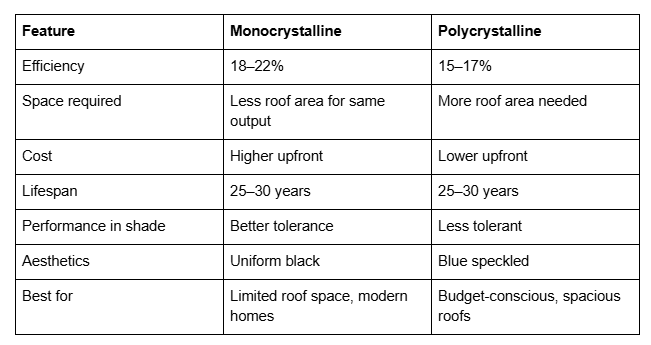
Key insight: Don't just list facts. Explain what the differences mean in practical terms. Example: If your home has limited roof space, monocrystalline panels are the better choice because they generate more power in a smaller area. If you have plenty of roof space and want the lowest upfront cost, polycrystalline offers strong value.
Inverter Types
Create separate explainers for:
String Inverters
Lower cost per system
Suitable for most residential installations
Single point of failure (if inverter fails, entire system is offline)
Works best on south-facing roofs with minimal shading
Microinverters
Higher cost per system
Each panel has its own inverter; no single point of failure
Better performance with partial shading (example: roof with trees nearby)
More complex monitoring and maintenance
Hybrid Inverters
Compatible with battery storage
Enables backup power during grid outages
Higher cost
Growing adoption as battery costs decline
Frame the choice clearly: For most UK homes without shading issues and without storage plans, string inverters are the cost-effective choice. If shading is a problem or you're considering battery backup, microinverters or hybrid inverters are worth the extra investment.
System Size Comparison
Create a page showing typical system sizes and their expected annual output:
3–4kW system: Suitable for small homes or flats; average annual output 2,400–3,200 kWh
5–6kW system: Most common for UK homes; average annual output 4,000–4,800 kWh
8–10kW system: Larger homes or high energy consumption; average annual output 6,400–8,000 kWh
Include a chart showing how system size correlates with annual savings for an average household using £1,200/year as a baseline energy bill.
Section 6: Case Studies and Before-and-After Content: Proof That Works
Case studies are the most effective trust-building tool for high-consideration purchases. A single compelling case study can convert more leads than pages of marketing copy.
The Structure of a Solar Case Study Page
A complete case study should follow this proven structure:
The Homeowner's Challenge
Name (first name only for privacy, or pseudonym)
Property type and location (postcode region)
Annual energy bill before solar (actual figure: £1,850 per year)
Primary motivation (energy bills rising, concerned about climate impact, exploring renewable alternatives)
Initial concerns or objections (worried about cost, unsure if solar was suitable for our roof, wasn't sure about payback period)
The Solution
System size and type (example: 5.5kW monocrystalline string inverter system)
Key product choices and reasoning (example: we chose string inverters because the roof had no shading issues and the lower cost helped keep the total system investment manageable)
Total system cost (actual figure: £13,500)
Government incentives applied (example: Federal Solar Tax Credit of £4,050 reduced net cost to £9,450)
Financing method (cash, loan, lease—be transparent)
Installation timeline (example: site visit to commissioning: 6 weeks)
The Results (12–24 Months Post-Installation)
Annual energy generation (actual kWh figures: 6,200 kWh per year)
Annual energy bill reduction (actual figure: £1,200 reduction; new bill £650 per year)
Annual Smart Export Guarantee earnings (UK) or net metering credits (US)
Total first-year savings (energy + export: £1,450 first year)
Payback period (example: 9.3 years at current rates)
25-year lifetime savings (example: £28,750 over system lifetime)
Homeowner Testimonial
Direct quote about the experience (example: The installation team was professional and minimally disruptive. Six weeks later, we were generating our own clean energy. Knowing exactly how much we're saving each month makes the investment feel tangible.)
Rating or recommendation (example: We'd recommend them to anyone considering solar)
Visual Elements
Before and after photos of the roof with panels installed
Screenshot of a month's generation and export data from the monitoring app
Energy bill comparison (circled figures showing old vs. new amounts)
Simple chart showing payback timeline and cumulative savings over 25 years
Creating Compelling Case Studies on Squarespace
Use Squarespace's portfolio or blog features to showcase multiple case studies:
One case study per page (easier to share and search-engine optimise)
Postcode region-specific pages (example: Solar Installation in Greater Manchester: £14,000 System, £1,300 Annual Savings)
Use before-and-after image blocks (Squarespace's gallery feature works well)
Include a downloadable PDF (create a one-page case study summary; offer it as a lead magnet)
Link related case studies at the bottom (increase time on site and demonstrate scale)
How Many Case Studies Should You Create?
Start with 5–10 case studies covering:
Different property types (semi-detached, detached, bungalow, flat)
Different regions (to serve local SEO goals)
Different system sizes (to show scalability)
Different customer profiles (young families, retirees, environmentally motivated, finance-focused)
A mix of UK and US examples (if you serve both markets)
Update case studies annually to reflect changes in incentives, costs, and savings figures. Case studies lose impact if they feature outdated incentive information.
Implementing Schema Markup for Solar Case Studies
Include SolarEnergySystem schema markup on case study pages to help search engines understand the structured data:
{
  "@context": "https://schema.org",
  "@type": "SolarEnergySystem",
  "name": "5.5kW Residential Solar Installation",
  "location": {
    "@type": "Place",
    "address": {
      "@type": "PostalAddress",
      "postalCode": "M1"
    }
  },
  "systemSize": "5.5kW",
  "panelType": "Monocrystalline",
  "inverterType": "String Inverter",
  "expectedAnnualOutput": "6200 kWh",
  "estimatedAnnualSavings": "£1450",
  "paybackPeriod": "9.3 years",
  "review": {
    "@type": "Review",
    "author": {
      "@type": "Person",
      "name": "Customer Name"
    },
    "ratingValue": "5",
    "reviewBody": "Testimonial text here"
  }
}
This markup helps your case studies appear in rich search results and signals to search engines that your content is authoritative.
Section 7: Free Solar Survey Request Process: Qualifying Leads on Squarespace
After you've educated prospects with calculators, incentive guides, and case studies, the next step is the free survey request. This is your transition from education to sales.
The Survey Request Form Strategy
Your survey request form should:
Be easy to find: Include a CTA button on every major page (header navigation, after the calculator, at the end of case studies)
Ask only essential questions: Too many fields cause abandonment
Explain the next step clearly: After we receive your request, a solar specialist will contact you within 48 hours to schedule a convenient time for a roof assessment.
Offer choice in contact method: Phone, email, or SMS (depending on your capacity)
Recommended Form Fields
Full Name (required)
Email (required)
Phone Number (required)
Postcode (required—for regional cost/incentive accuracy)
Property Type (dropdown: Semi-Detached, Detached, Bungalow, Flat, etc.)
Roof Type (dropdown: Tile, Slate, Flat, Metal, etc.)
Shading Issues (Yes/No)
Preferred Contact Method (Phone / Email / SMS)
Best Time to Contact (Morning / Afternoon / Evening)
How did you hear about us? (source tracking)
Optional advanced fields (only if you have the sales capacity to process them):
Current annual energy bill (helps pre-qualify high-value prospects)
Interest in battery storage (identifies upsell opportunities)
Integration with Squarespace and CRM
Squarespace forms integrate with common CRMs and email marketing platforms:
Zapier connects Squarespace forms to HubSpot, Pipedrive, ActiveCampaign, and hundreds of other tools
Native integrations are available for some platforms (check Squarespace's app marketplace)
Automate follow-up emails: Set up a welcome email confirming receipt and thanking the prospect for their interest. Include a link to your most relevant resource (example: In the meantime, read our guide to Solar Incentives in your region)
Managing Survey Request Leads
The speed of your follow-up significantly impacts conversion. Best practices:
First contact within 24 hours: Phone call or SMS (warmer than email for high-ticket purchases)
Provide a survey booking link: Use Calendly, Acuity Scheduling, or Squarespace's built-in booking feature to let prospects book their own time (reduces back-and-forth emails)
Qualify on the call: Use the survey as an opportunity to understand budget, timeline, and decision-making process
Send pre-survey materials: A day before the survey, email the homeowner a checklist of documents to gather (recent energy bills, roof photos) and a simple questionnaire about their goals
-
You have three primary options. First, use a third-party calculator platform like Calcy or Riddle Quiz to build your calculator, then embed it on your Squarespace page via a Code Block. Second, use a dedicated solar lead platform like SolarLeads or EnergySage, which provide pre-built calculators and integrate with Squarespace. Third, create the calculator on an external platform and link to it from your Squarespace site with a clear CTA. For most solar installers, embedding a third-party calculator strikes the best balance between functionality and ease of use.
-
Your content should address the full homeowner research journey: ROI and cost information (calculators, cost breakdowns), government incentives (tax credits, grants, rebates), product education (panel types, inverters, system sizing), social proof (case studies, customer testimonials, reviews), and clear next steps (free survey request forms). Avoid sales-focused copy in favour of educational guides that position your company as an authority. High-ticket services like solar installation succeed when prospects feel informed and confident before they ever speak to a salesperson.
-
Create a portfolio section (use Squarespace's built-in Portfolio feature or a dedicated blog category) featuring before-and-after photos of each installation. Include a brief case study for each project covering system size, total cost, incentives applied, annual savings, and customer testimonial. For maximum visual impact, include photos of the roof before installation, during installation, and after completion with the system active. Add generation data from the monitoring app (annual kWh output) to demonstrate results, not just aesthetics.
-
In the UK, cover the Federal Solar Tax Credit (30% of system cost), state-level incentives (if applicable), net metering rules, and Property Assessed Clean Energy (PACE) financing options. In the US, prioritise the Federal Solar Tax Credit, then add state-specific incentives based on your service area. Create separate pages for each state or region you serve so local homeowners find relevant information immediately. Update incentive pages annually as schemes change or expire.
-
Offer value in exchange for information: a personalised ROI report, a downloadable incentive guide, or a solar cost comparison worksheet. Position forms as the entry point to these free resources, not as hard sales tactics. Keep forms brief (5–7 fields maximum) and explain the next step clearly. Lead magnets work best when they genuinely answer questions the homeowner is already researching, not when they feel like bait for a hard sell.
-
A typical residential solar installation takes 6–12 weeks from initial survey to grid connection, though this varies by region, system size, and inspection schedules. Break the timeline into clear stages on your Squarespace site: site visit and assessment (1–2 weeks), design and permitting (2–4 weeks), installation (1–3 days), and inspection and commissioning (1–4 weeks). Use a simple infographic or Gantt chart to visualise the process. This transparency manages expectations and reduces anxiety about the unknown.
-
Publishing average system costs (example: "A typical 5.5kW residential system costs £13,000–£16,000 before incentives in the UK") builds trust and filters out prospects with unrealistic budget expectations. Avoid locking in specific prices, but offering ranges and cost-per-watt metrics helps homeowners self-qualify. Transparency about cost demonstrates confidence and reduces the barrier to requesting a survey.
-
Most modern solar systems include an app-based monitoring system allowing homeowners to track real-time generation, daily output, and export earnings. Highlight this feature on your site because it increases customer satisfaction and provides ongoing engagement (homeowners check the app regularly and see your brand). Include sample screenshots of monitoring dashboards and explain how data helps homeowners understand system performance and optimise energy usage around peak generation times.
Section 9: Conclusion
Solar installations are high-consideration purchases that demand a different approach from traditional home service marketing. Homeowners will not request a quote until they understand costs, benefits, government incentives, and evidence of results from similar customers. Squarespace provides all the tools necessary to build an education-first website: embedded calculators, blog platforms for detailed guides, portfolio galleries for case studies, and integrated forms for lead capture.
The solar companies that generate the most qualified leads are those that treat their websites as educational resources first and sales funnels second. By publishing clear, honest information about ROI, government schemes, product options, and real customer results, you remove friction from the research process, build trust, and position yourself as an authority. When prospects finally request a survey, they're already sold on the idea of solar; your survey is simply confirming that your company is the right choice to install it.
The structure outlined in this guide—ROI calculator, incentive guides, product comparisons, case studies, and survey request process—creates a complete funnel that captures, educates, and converts homeowners researching solar for the first time. Implement these strategies on your Squarespace site, and you'll see immediate improvements in both lead quality and conversion rates.
Section 10: Call to Action
Ready to transform your Squarespace website into a lead-generation machine for your solar installation business? Squareko specialises in building high-conversion websites for roofing and solar companies. We'll design your site around the education-first strategy outlined in this guide, implementing ROI calculators, government incentive guides, case study galleries, and automated lead qualification.
Schedule a free Squarespace consultation with Squareko to discuss your website's current performance and discover exactly what's holding you back from capturing more solar leads.

From custom website design to SEO strategy, we help businesses launch a site that looks professional and performs better.

Author Bio
I'm Walid Hasan, a Certified Squarespace Expert and Squarespace Circle Platinum Partner with over 12 years of hands-on experience designing and optimizing high-performing websites. Over the years, I've had the privilege of building more than 2,000 Squarespace websites for clients around the world, always focusing on clean design, strong user experience, and conversion-driven results.