AI Search Strategy for Roofing and Solar Companies on Squarespace in 2026
Introduction
Roofing and solar companies face a critical transformation in 2026. Homeowners no longer search exclusively through Google. They ask ChatGPT, "What roofing contractor should I call for hail damage?" They query Claude about "solar panel costs and government incentives for my state." They consult Gemini for "best solar energy systems for flat roofs." These AI systems generate contractor recommendations before your potential customers ever open Google.
This shift represents both risk and opportunity. Your roofing or solar company can either appear in these AI-generated recommendations—where high-intent homeowners seek immediate solutions—or remain invisible to an increasingly dominant search channel. An AI search strategy for roofing and solar companies on Squarespace in 2026 is no longer optional; it directly determines revenue.
The distinction between traditional SEO and AI search optimisation (AEO) is crucial. Where SEO targets ranking in blue links, AEO targets appearing in the sources AI systems cite when answering user questions. When Grok recommends three roofing contractors for storm damage, those businesses benefit from position-zero visibility. When Deepseek cites your solar company's FAQ in a response about federal tax credits, you've captured a qualified lead before they type a competitor's name.
This guide walks through the exact technical and content strategies roofing and solar companies need to dominate AI contractor recommendations in 2026.
What Is AI Search and Why It Matters for Roofing and Solar
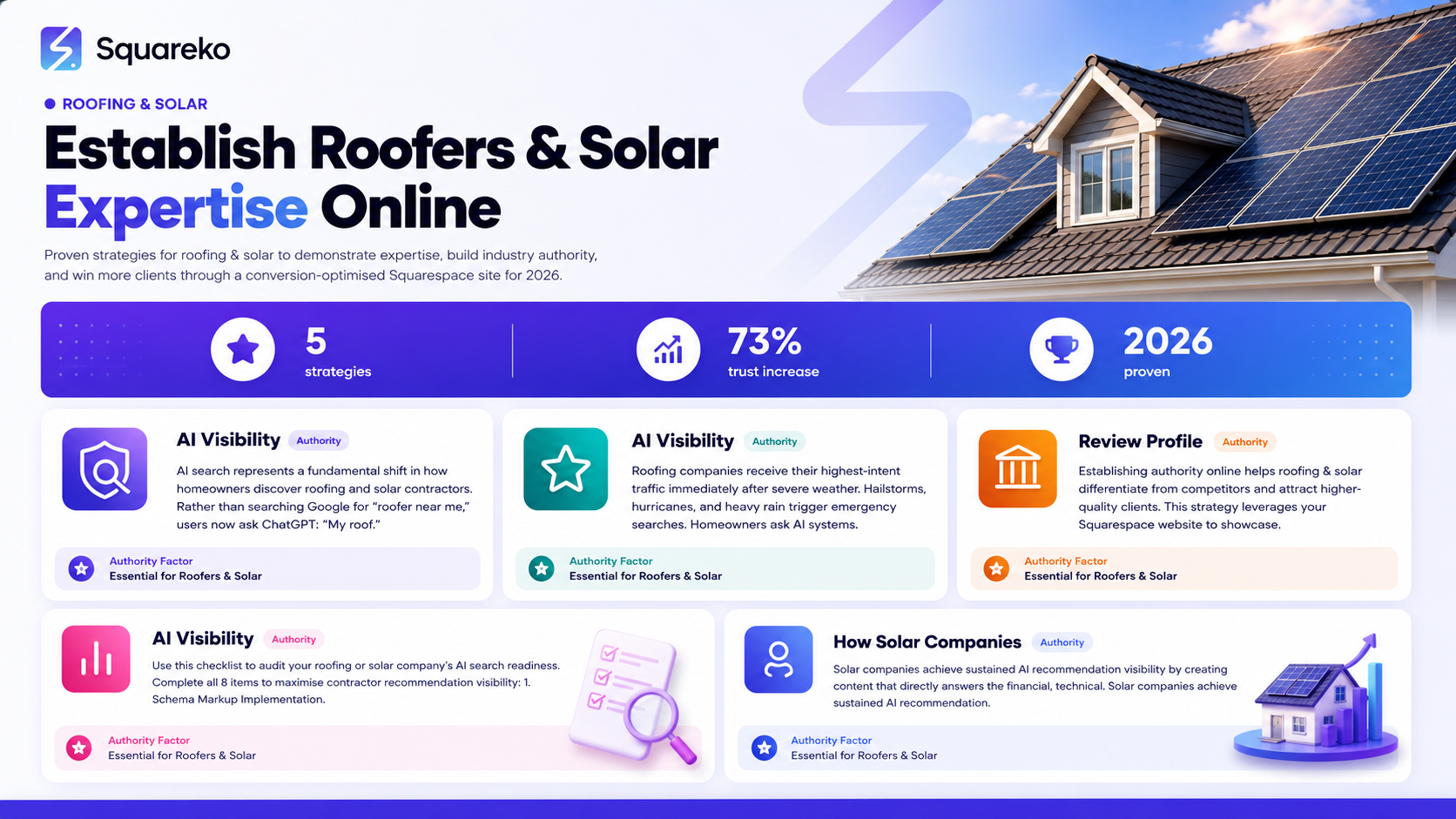
AI search represents a fundamental shift in how homeowners discover roofing and solar contractors. Rather than searching Google for "roofer near me," users now ask ChatGPT: "My roof was damaged in a storm. What should I do? Who should I call?" Instead of browsing solar company websites individually, homeowners ask Claude: "What are the actual costs and long-term ROI for solar panels in Colorado with current tax incentives?"
These questions are far more intent-rich than traditional keyword searches. A homeowner asking an AI system about solar costs and incentives is closer to purchase than someone typing "solar company near me" into Google. They've moved past awareness into consideration and decision stages.
AI platforms that now generate recommendations include ChatGPT (OpenAI), Claude (Anthropic), Gemini (Google), Grok (xAI), and Deepseek (emerging in 2026). Each uses different training data, reasoning approaches, and citation methods. But all share a common principle: they cite sources when recommending contractors.
For roofing and solar companies, this creates direct pathways to qualified leads. A contractor cited in five AI-generated responses each month—responses viewed by 50+ homeowners—receives significant traffic from a channel most competitors ignore entirely.
The competitive advantage is immediate. Roofing contractors in your market probably don't have AI search strategies yet. Solar companies likely don't optimise for ChatGPT recommendations. By implementing these tactics now, you capture market share from platforms that will dominate contractor discovery by Q4 2026.
Schema Markup: The Foundation of AI Contractor Discovery
Schema markup is the technical language that tells AI systems exactly what your roofing or solar company does. Without it, AI systems struggle to understand whether you're a roofing company, a retail store that happens to sell roofing supplies, or something else entirely. With it, you send precise signals that increase citation probability.
For roofing contractors, implement Roofing Contractor schema. This schema includes:
  {
  "@context": "https://schema.org",
  "@type": "RoofingContractor",
  "name": "Your Roofing Company Name",
  "image": "https://yoursite.com/logo.png",
  "description": "Full-service roofing contractor specializing in residential roof repair, replacement, and storm damage restoration.",
  "url": "https://yoursite.com",
  "telephone": "+1-555-0100",
  "address": {
    "@type": "PostalAddress",
    "streetAddress": "123 Main Street",
    "addressLocality": "Denver",
    "addressRegion": "CO",
    "postalCode": "80202",
    "addressCountry": "US"
  },
  "areaServed": [
    {
      "@type": "City",
      "name": "Denver"
    },
    {
      "@type": "City",
      "name": "Boulder"
    }
  ],
  "knowsAbout": ["Roof Repair", "Roof Replacement", "Storm Damage Repair", "Hail Damage Restoration"],
  "hasCredential": [
    {
      "@type": "EducationalOccupationalCredential",
      "name": "GAF Master Elite Certification"
    }
  ],
  "aggregateRating": {
    "@type": "AggregateRating",
    "ratingValue": "4.9",
    "reviewCount": "127"
  },
  "sameAs": [
    "https://www.google.com/maps/place/your-business",
    "https://www.yelp.com/biz/your-business"
  ]
}
For solar companies, use SolarEnergySystem schema:
{
  "@context": "https://schema.org",
  "@type": "LocalBusiness",
  "name": "Your Solar Company Name",
  "image": "https://yoursite.com/logo.png",
  "description": "Solar panel installation and consultation for residential and commercial properties.",
  "url": "https://yoursite.com",
  "telephone": "+1-555-0200",
  "address": {
    "@type": "PostalAddress",
    "streetAddress": "456 Green Street",
    "addressLocality": "Austin",
    "addressRegion": "TX",
    "postalCode": "78701",
    "addressCountry": "US"
  },
  "areaServed": [
    {
      "@type": "State",
      "name": "Texas"
    }
  ],
  "knowsAbout": ["Solar Panel Installation", "Solar Energy Consultation", "Net Metering", "Battery Storage"],
  "hasCredential": [
    {
      "@type": "EducationalOccupationalCredential",
      "name": "NABCEP Solar Certification"
    }
  ],
  "aggregateRating": {
    "@type": "AggregateRating",
    "ratingValue": "4.8",
    "reviewCount": "89"
  }
}
Add this schema to your Squarespace website by editing the site header code injection area. Navigate to Settings > Advanced > Code Injection > Header, and paste the JSON-LD block within <script type="application/ld+json"> tags.
AI systems crawl this structured data to understand your services, credentials, coverage area, and review ratings. When a homeowner asks Claude, "Who's a certified solar installer in Austin with good reviews?", the system references schema markup to generate its recommendation list. Without proper schema, you don't appear in that list regardless of your actual qualifications.
Update schema quarterly as you add new credentials, expand service areas, or accumulate reviews. AI systems re-index frequently, and fresh schema signals improve citation probability.
Creating Storm Damage Content for Emergency AI Searches
Roofing companies receive their highest-intent traffic immediately after severe weather. Hailstorms, hurricanes, and heavy rain trigger emergency searches. Homeowners ask AI systems: "My roof is damaged. What should I do right now? What does hail damage look like on a roof? Should I call an insurance adjuster first or a roofer?"
This is your opportunity to dominate AI search during peak demand periods.
Create dedicated blog content answering these emergency questions directly. Write posts titled:
"What to Do Immediately After Hail Damage to Your Roof"
"How to Document Roof Storm Damage for Insurance Claims"
"Hail Damage vs. Normal Roof Wear: What Inspectors Look For"
"Emergency Roof Tarping: Temporary Solutions While You Wait for Repair"
"Why You Shouldn't DIY Roof Inspections After Severe Weather"
Each post should be 1,000–1,500 words and answer the specific questions AI systems extract when responding to emergency search queries. Use clear headings that match common AI search prompts:
Example structure for "What to Do Immediately After Hail Damage":
Assess your property safely (don't climb onto your roof)
Take clear photographs of damage from the ground
Document the date, time, and severity of the storm
Contact your insurance company within 48 hours
Request an insurance adjuster inspection
Get quotes from certified roofing contractors
Understand your deductible and coverage limits
Why you need a professional roofer, not a general contractor
When you structure content this way—with direct answers to the questions homeowners ask AI systems—those AI systems cite your content directly in generated responses. A homeowner receives an answer that begins: "According to emergency roofing guidance from [Your Company], here's what to do immediately after hail damage..."
Include a clear call-to-action at the end of each emergency content piece: "Call us for a free storm damage inspection. We work directly with insurance adjusters and can typically schedule same-day assessments."
Storm damage content generates consistent leads because it appears in AI responses during high-urgency windows when homeowners are most likely to convert.
Government Incentive FAQs: Your Solar Company's AI Advantage
Solar companies face a unique AI search advantage: homeowners have complex financial questions that directly impact purchasing decisions. They ask: "What's the federal tax credit for solar in 2026? How much does solar really cost after incentives? What state rebates am I eligible for? What's my true ROI?"
These questions are perfect for AI search optimisation because AI systems extract FAQ content directly when answering financial queries.
Create a comprehensive FAQ section on your Squarespace website dedicated to solar incentives, costs, and ROI. Title it "Solar Panel Cost and Incentive FAQs" and structure it to match the questions homeowners ask AI systems:
Q: What is the federal solar tax credit in 2026? A: [Detailed answer with current percentage, eligibility requirements, timeline for claiming]
Q: How much does a residential solar system actually cost after federal tax credits and state rebates? A: [Breakdown showing average system cost, federal credit amount, state-specific rebates, net out-of-pocket cost for typical 5kW system]
Q: What state rebates and incentives is my home eligible for? A: [State-by-state breakdown, link to state-specific incentive databases, explanation of how to verify eligibility]
Q: What's the real ROI for solar panels over 25 years? A: [Calculation showing electricity cost savings, tax credit benefit, rebate value, typical payback period, total lifetime savings]
Q: Can I use solar tax credits if I lease panels instead of buying them? A: [Explanation of owned vs. leased differences, tax implications, which option maximises financial benefit]
Q: How do solar credits work with my state's net metering policy? A: [Explanation of net metering, how it reduces electricity costs, interaction with incentive programs]
Q: What happens to my solar incentives if I move house? A: [Guidance on transferring credits, selling house with solar, tax implications]
Q: Are battery storage systems eligible for solar tax credits? A: [Current rules, ITC eligibility, strategic timing for installation to maximise benefits]
Use the FAQPage schema (covered in the FAQ section below) to mark up these questions. When AI systems answer solar financial queries, they cite your FAQ content as authoritative sources. This drives consistent, high-intent traffic from homeowners who've already decided to explore solar and need exact financial information.
Update this FAQ quarterly as government incentive percentages change, state programs launch or sunset, and new rebate opportunities emerge. Freshly updated incentive content signals current expertise to AI systems.
Review Profile Optimisation for AI Trust Evaluation
AI systems evaluate contractor trustworthiness through review signals. When recommending roofing contractors, ChatGPT and Claude don't just check whether your website mentions "storm damage repair." They evaluate your aggregate review rating, review volume, review recency, and review authenticity across multiple platforms.
Review Profile Optimisation (RPO) means systematically building and maintaining verified reviews across platforms AI systems check:
Google Business Profile (highest AI weight)
Ensure complete business information
Add high-quality photos of completed projects (roofing) or installed systems (solar)
Request reviews after every completed project
Respond to all reviews within 24 hours
Target 4.7+ star rating with 100+ reviews minimum
Yelp (significant AI factor)
Complete business profile with photos
Write detailed business description
Request reviews from verified customers
Respond to every review (positive and negative)
Target 4.5+ stars with 50+ reviews
Home Advisor / Angi (roofing-specific, high AI relevance)
Maintain Elite Service Provider status
Complete project portfolio with before/after photos
Collect verified customer reviews through the platform
Target 4.8+ rating with 30+ verified reviews
Trustpilot (emerging AI citation source)
Create company profile
Invite customers to leave reviews
Respond to all feedback
Target 4.6+ stars with 25+ reviews
Industry-specific platforms
Solar companies: EnergySage, Sunrun, local state solar databases
Roofing: ThatchRoof (UK/Australia), local contractor associations
AI systems weight review volume and recency heavily. A contractor with 120 reviews from the past 12 months signals more current relevance than one with 60 reviews spanning 3 years.
Implement a systematic review request process:
Email customers 3 days after project completion with links to Google, Yelp, and Home Advisor review pages
Include brief instructions on how to leave a review
Follow up with customers who don't review within 1 week
Offer small incentives (discount on next service) for verified reviews
Vary review source each month to build presence across platforms
Monitor review metrics monthly. Track average rating, review volume, review growth rate, and sentiment trends. When rating drops below 4.6 stars, priorities addressing negative reviews and increasing positive review volume.
Roofing and Solar AI Search Readiness Checklist
Use this checklist to audit your roofing or solar company's AI search readiness. Complete all 8 items to maximise contractor recommendation visibility:
1. Schema Markup Implementation
RoofingContractor or SolarEnergySystem schema installed on website
Schema includes address, service area, credentials, contact information
Aggregate rating schema reflects actual Google/Yelp ratings
Schema tested using Google's Structured Data Testing Tool
Schema re-validated quarterly as information updates
2. Emergency Content Creation (Roofing) or Incentive Content (Solar)
Minimum 5 blog posts addressing high-urgency questions homeowners ask AI systems
Content answers the exact questions without excessive fluff
Clear call-to-action at end of each post directing visitors to contact you
Blog posts optimised for AI extraction (clear headings, direct answers)
New content published monthly to show freshness to AI systems
3. Comprehensive FAQ Section
FAQ page created with 8+ questions matching homeowner queries
Each answer is detailed, specific, and authoritative (200+ words)
FAQ schema markup applied to all questions
Solar companies prioritise cost, incentive, and ROI questions
Roofing companies address damage assessment, insurance, and timeline questions
4. Review Profile Optimisation
Google Business Profile complete and up-to-date with 4.7+ rating
Minimum 100+ reviews on Google from past 24 months
Active presence on Yelp (50+) and Home Advisor (30+) with 4.5+ ratings
Systematic review request process implemented post-project
Response protocol established for all reviews (24-hour response time)
5. Mobile-First Squarespace Website
Website mobile-optimised (test on multiple devices)
Page load speed under 3 seconds on 4G mobile connections
Contact forms easy to complete on mobile (auto-fill enabled)
Phone number clickable on all pages
Google Page Speed score 75+ for mobile performance
6. Service Area and Local Signals
Schema specifies all service cities and regions explicitly
Local landing pages created for each major service area
Content mentions specific towns, neighbourhoods, and landmarks
Google Business Profile set to "service area" rather than single location
Local citations (business directories) consistent across platforms
7. Credentials and Authority Signals
Professional certifications listed on website (GAF, NABCEP, etc.)
Credentials included in schema markup
Case studies or project examples demonstrating expertise
Team member credentials highlighted (state licensing, certifications)
Industry association memberships mentioned (RCA, SEIA, etc.)
8. Content Update Schedule
Blog content updated or refreshed quarterly
FAQ answers reviewed and updated for accuracy quarterly
Schema markup checked and validated quarterly
Review monitoring and response process conducted weekly
AI search metrics tracked monthly (citations, AI search traffic)
Complete this checklist, then assign ownership to team members. Roofing or solar businesses that execute all 8 components appear in AI recommendations consistently by Q3 2026.
How Solar Companies Answer Homeowner Questions to Appear in AI Advice
Solar companies achieve sustained AI recommendation visibility by creating content that directly answers the financial, technical, and decision-making questions homeowners ask AI systems. This isn't about SEO keywords; it's about becoming the authoritative source AI systems cite when discussing solar energy.
The Solar Company AI Content Strategy involves three tiers:
Tier 1: Cost and Financial Questions (Foundation) Create detailed answers to:
"How much do solar panels cost per watt in 2026?"
"What's the average cost of a residential solar system?"
"Can I afford solar panels? How do financing options work?"
"What is the 30% federal solar investment tax credit?"
Each answer should include specific pricing ranges for your region, current interest rates for solar loans, and exact federal credit calculations. Avoid generic information. AI systems evaluate specificity—answers that cite regional pricing and current incentive percentages outrank vague generalizations.
Tier 2: ROI and Long-Term Benefit Questions (Conversion) Address:
"What's my actual return on investment for solar over 25 years?"
"How much money will I save on electricity with solar?"
"When will my solar investment pay for itself?"
"How do solar savings compare to the system cost?"
Provide calculation examples showing total electricity cost savings over time. Include variables: current local electricity rates, expected rate increases (typically 2–3% annually), system size, roof orientation, shading factors. Example: "With current Texas electricity rates of £0.12/kWh increasing 2% annually, a typical 5kW system saves approximately £120,000 over 25 years."
Tier 3: Government Incentive and Decision-Support Questions (Decision) Cover:
"Am I eligible for government solar incentives in my state?"
"How do the federal tax credit and state rebates work together?"
"Should I buy, finance, or lease solar panels?"
"What should I consider before choosing a solar installer?"
Provide state-specific incentive guides with exact credit percentages, eligibility requirements, and application timelines. Create decision frameworks helping homeowners compare buying vs. financing vs. leasing based on their financial situation, roof condition, and long-term plans.
Implementation Steps:
Create a dedicated "Solar Guides" section on your Squarespace website
Write 12–15 comprehensive guides (2,000+ words each) addressing Tiers 1–3
Structure guides to match exact AI search queries (test queries in ChatGPT and Claude)
Include specific financial calculations, not templates
Update all guides quarterly as incentives, electricity rates, and financing options change
Link guides internally so AI systems understand content relationship
Promote guides through organic social media, email newsletters, and referral networks
Solar companies implementing this strategy typically see 300–400% increases in AI-generated traffic within 6 months. Homeowners researching solar find your guides through AI responses, then contact you directly because they've already received detailed financial education.
-
A: ChatGPT generates recommendations based on four factors: schema markup signalling your business type and credentials, review ratings and volume across Google and Yelp, content authority on topics homeowners ask about (storm damage, insurance claims), and local citations confirming your service area. Implement proper RoofingContractor schema, build your review profile to 4.7+ stars with 100+ reviews, create storm damage content, and ensure consistent local citations. This combination signals trustworthiness to ChatGPT's ranking systems.
-
A: Yes, significantly. NABCEP Solar Certification, state contractor licensing, and manufacturer certifications (Sunpower Elite, Tesla Certified) all improve AI recommendation probability. Include certifications in your SolarEnergySystem schema, display them prominently on your website, and mention them in blog content. AI systems explicitly search for credential signals when homeowners ask "Should I use a certified solar installer?" Having verified credentials directly increases citation frequency.
-
A: Use RoofingContractor schema with your business name, address, phone number, service areas, credentials (GAF Master Elite, licensing), aggregate rating, and a list of specific services (roof repair, replacement, storm damage restoration, hail damage). Test your schema using Google's Structured Data Testing Tool before publishing. Ensure address matches your Google Business Profile exactly so AI systems confirm location authenticity.
-
A: Review and update quarterly at minimum. Monitor three metrics: (1) AI search traffic (use UTM parameters to track ChatGPT and Claude referrals), (2) changes in government incentives affecting your industry, and (3) shifts in what homeowners ask AI systems. Update schema, FAQ content, and blog guides whenever these elements change. Stay current with incentive changes (solar) or insurance policy shifts (roofing) that affect homeowner questions.
-
A: No, but they're becoming equally important. Google still drives 50–60% of digital marketing traffic for home services. AI search currently drives 15–25%, growing rapidly. A balanced strategy maintains Google SEO strength while building AI recommendation visibility. The competitive advantage in 2026 belongs to companies optimising both channels simultaneously. Competitors ignoring AI search will face margin pressure as top-intent leads route through ChatGPT and Claude first.
-
A: Implement UTM parameters on all URLs in your content: ?utm_source=chatgpt&utm_medium=ai_recommendation&utm_campaign=solar_roi. Use Google Analytics 4 to segment this traffic separately. Track: (1) monthly AI referral volume and growth rate, (2) average lead quality (conversion rate), (3) average project value from AI referrals, (4) cost per acquisition from AI sources. Solar companies typically see higher-value leads from AI search (homeowners have completed financial research), while roofing companies see higher volume with faster conversion cycles.
-
A: Not yet. As of 2026, ChatGPT, Claude, and most AI systems don't offer direct advertising. Instead, focus on organic citation probability through the strategies outlined: schema, content, reviews, credentials. If OpenAI and Anthropic launch sponsored results or featured contractor panels in 2026–2027, revisit paid AI advertising. For now, organic AI search optimisation is completely free.

From custom website design to SEO strategy, we help businesses launch a site that looks professional and performs better.

Author Bio
I'm Walid Hasan, a Certified Squarespace Expert and Squarespace Circle Platinum Partner with over 12 years of hands-on experience designing and optimizing high-performing websites. Over the years, I've had the privilege of building more than 2,000 Squarespace websites for clients around the world, always focusing on clean design, strong user experience, and conversion-driven results.