How Education Consultants Build Credibility with Schools and Win More Engagements on Squarespace
Key Takeaways How Education Consultants Build Credibility with Schools and Win More Engagements on Squarespace
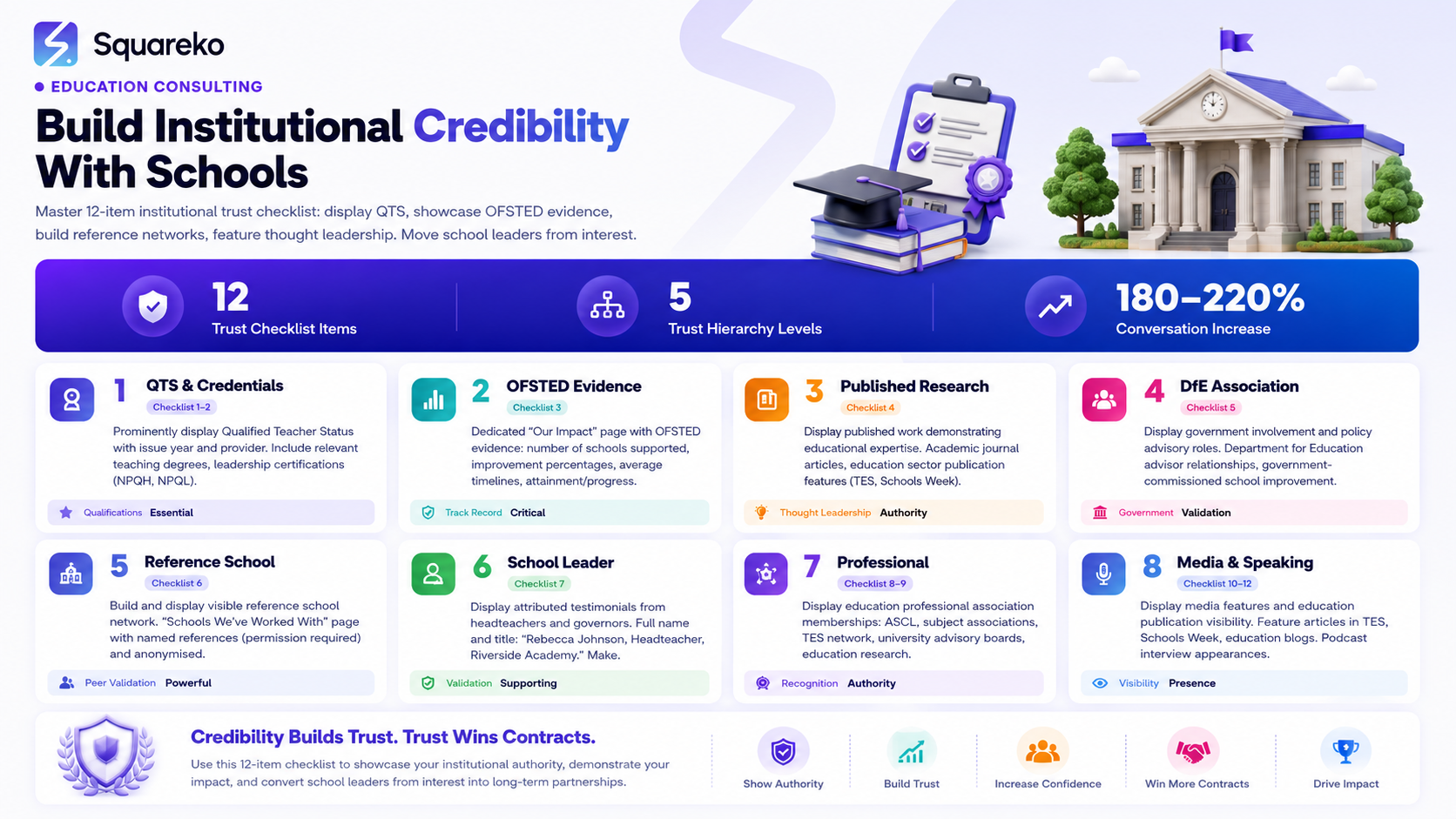
School leader credibility assessment follows a predictable hierarchy: Qualifications → Track Record Proof → Peer Validation → Institutional Recognition → Personal Trust—each element must be visible and verifiable
The 12-item Institutional Trust Checklist covers: QTS and education qualifications display, OFSTED evidence presentation, published research or thought leadership, DfE and government association, reference school network, headteacher testimonials, specific outcomes evidence, government-commissioned work, accreditation and professional memberships, media and publication features, and speaking engagement visibility
Reference school networks are singularly powerful for institutional trust—school leaders trust peer validation from other school leaders far more than consultant claims, making visible reference architecture essential
Government-commissioned and policy advisory roles signal institutional validation beyond individual school outcomes, lending authority that commercial work alone cannot achieve
Squarespace's native capabilities (comparison blocks, image display, testimonial features) support comprehensive credibility architecture without requiring expensive custom design or development
School leaders don't hire education consultants based on marketing copy. They hire based on institutional trust. Trust emerges from demonstrated expertise, verified credentials, peer validation, and visible track record. A headteacher considering an OFSTED improvement consultant evaluates through a specific credibility hierarchy: Are you qualified? Have you done this before with results? What do other schools say? Can I verify your claims?
Most education consultant websites underinvest in credibility architecture. They hide credentials in vague bios, avoid displaying OFSTED evidence (fearing compliance issues), fail to build visible reference school networks, and present claims without third-party validation. School leaders browsing these sites conclude the consultant either isn't serious about school leader evaluation or is hiding something.
Effective education consultant websites on Squarespace build systematic credibility through a 12-item institutional trust checklist covering qualifications, evidence display, peer validation, and institutional recognition. This post maps the complete credibility-building framework that moves school leaders from interest through trust-assessment to engagement request.
The Institutional Trust Hierarchy for Education Consultants
School leaders evaluate consultant credibility through a predictable hierarchy:
Level 1: Basic Credibility (Entry Threshold)
School leaders first assess whether you have baseline education credentials:
QTS or equivalent qualified teacher status
Relevant teaching or education leadership experience
No credential red flags or contradictions
Without basic credibility, school leaders don't proceed. A consultant claiming to help with school improvement but lacking QTS or education leadership experience fails this fundamental test.
Level 2: Evidence of Track Record (Proof of Competence)
Once basic credibility is established, school leaders want proof you've delivered measurable outcomes:
Case studies with specific metrics
School improvement evidence (OFSTED grades, attainment data)
Number and types of schools supported
Measurable outcome data
Generic testimonials ("Great consultant") don't satisfy this level. School leaders need specific evidence: OFSTED grade improvements, attainment gains, documented outcomes.
Level 3: Peer Validation (School Leader Verification)
Before making a commitment, school leaders want to hear from other school leaders who've worked with you:
Reference schools they can contact
Testimonials from headteachers/governors
Published case studies with attributable quotes
Network visibility among school leader peers
This peer validation is singularly powerful. School leaders trust peer opinion far more than consultant claims.
Level 4: Institutional Recognition (Third-Party Validation)
School leaders assess whether formal institutions recognise your expertise:
DfE advisory roles or government-commissioned work
University partnerships or academic affiliations
Published research or educational thought leadership
Professional association leadership or recognition
Media features or education publication contributions
This institutional recognition signals that credible third parties have vetted your expertise.
Level 5: Personal Trust (Relational Credibility)
Once school leaders progress through this hierarchy, personal connection builds final trust:
Clear communication and responsiveness
Aligned values and educational philosophy
Demonstrated interest in their specific context
Chemistry in initial discovery conversations
This final level emerges from earlier credibility building, not independently.
The 12-Item Institutional Trust Checklist
Use this checklist to ensure your Squarespace website addresses each credibility dimension:
1. QTS and Teaching Qualifications Display
Requirement: Prominently display Qualified Teacher Status and relevant teaching qualifications
Implementation:
About page or credentials page should lead with: "QTS [year], [initial teacher training provider]"
Include relevant degrees (BA/BSc Education, PGCE, MEd, etc.)
Display any specialist education qualifications (NPQH, NPQL, master's in curriculum, etc.)
Verify credentials are current (update annually)
Example Display:
"Dr. Walid Hassan Qualified Teacher Status (2008, Department for Education) PGCE Secondary English (2007, University of Sussex) MA Education with Distinction (2012, King's College London) National Professional Qualification for Headship (2015) ASCL Member (Association of School and College Leaders)"
2. OFSTED Evidence and Impact Metrics Display
Requirement: Present compliantly formatted OFSTED evidence and outcome metrics
Implementation:
Dedicated "Our Impact" page featuring OFSTED improvement metrics
Clear before/after grade presentation
Number of schools with documented improvements
Average timelines for improvement
Attainment and progress measure improvements
Behaviour and attendance metric improvements
Example Display (table format): | Outcome | Result | |---|---| | Schools Supported (5 years) | 150 | | OFSTED Improvement: Requires Improvement → Good or Outstanding | 63 schools (42%) | | Average OFSTED Improvement Timeline | 18 months | | Average Attainment Improvement (percentage points) | 7.4pp | | Average Progress Measure Improvement | +0.32 SD |
3. Published Research and Educational Thought Leadership
Requirement: Display published work demonstrating educational expertise
Implementation:
"Research and Publications" page listing published work
Links to published articles in education journals or publications
Books authored (if applicable)
Speaking engagements at education conferences
Research projects or studies led
Education policy contributions
Example Display: "Published Research
Co-author: 'Curriculum Coherence and Student Progress: Evidence from Secondary School Improvement' (Journal of Educational Research, 2022)
Featured: 'School Improvement Approaches in Disadvantaged Contexts' (Schools Week, March 2024)
Speaking Engagement: ASCL Annual Conference 2023, 'Sustaining School Improvement: Evidence from 100+ Schools'
Education Endowment Foundation Research Network Member"
4. DfE (Department for Education) Association and Government Work
Requirement: Display government involvement and policy advisory roles
Implementation:
Government-commissioned school improvement projects
DfE advisory network membership
Ofsted inspector background (if applicable)
Local authority school improvement partnerships
Government evaluation or research participation
Policy influence or thought leadership recognition
Example Display: "Government Partnerships
Department for Education Advisor: School Improvement at Scale (2021-2023)
Government-Commissioned Evaluation: 'Supporting Secondary Schools in OFSTED Improvement' (35-school evaluation, published findings)
Ofsted Inspector Background: 7 years as secondary school inspector for West London
Local Authority School Improvement Network: Core member, leading school improvement framework development"
5. Reference School Network and Peer Validation
Requirement: Build and display visible reference school network
Implementation:
"Schools We've Worked With" or "Reference Schools" page
Named schools (with permission) including headteacher contact
Anonymised schools (for confidentiality) with descriptive context
School types and contexts represented
Process for contacting references (email form capturing context)
Number of reference schools available
Example Display: "Schools We've Worked With
Named References (schools willing to be contacted):
Riverside Academy (Secondary), London - Headteacher: Rebecca Johnson,
Hillside Primary (Primary), South East - Head: Michael Chen,
[More named schools...]
Anonymized References (available on request):
Secondary academy, mixed urban catchment, London (improved OFSTED Requires Improvement → Good)
Primary school, rural context, South West (improved attainment 12pp, outstanding in Ofsted)
[More anonymized schools...]
Contact another school to learn more about our work: [Contact form]"
6. Headteacher and Governor Testimonials
Requirement: Display attributed testimonials from school leaders
Implementation:
Include 3-5 headteacher/governor testimonials on homepage or dedicated testimonials page
Use full name and title: "Rebecca Johnson, Headteacher, Riverside Academy"
Make testimonials specific and action-focused, not generic
Include one-sentence quote plus optional longer testimonial
Display alongside school context if possible
Example Testimonial:
"The school improvement engagement moved our OFSTED grade from Requires Improvement to Good within 18 months. The consultant's understanding of secondary curriculum design and teacher development was exceptional. I'd recommend them unreservedly to other headteachers facing similar improvement challenges." - Rebecca Johnson, Headteacher, Riverside Academy
7. Specific Outcomes Evidence and Metrics
Requirement: Display concrete, quantified outcomes evidence
Implementation:
Case studies with specific before/after metrics
Comparison tables showing measurable improvements
Aggregate data (150 schools supported, 7.4pp average attainment improvement)
Education-specific metrics (OFSTED grades, progress scores, attainment percentages)
Timelines and sustainability evidence
8. Government-Commissioned Projects and Research
Requirement: Display government-commissioned or large-scale projects
Implementation:
Government project descriptions and outcomes
Published reports or findings (with links)
Project scale (number of schools, student reach)
Evaluation outcomes
Policy influence or thought leadership emerging from projects
Example Display: "Government-Commissioned Research Project
'Supporting Secondary Schools Through OFSTED Improvement' Department for Education Contract: 2021-2023
We led evaluation of school improvement approaches across 35 secondary schools in challenging contexts. The project examined factors enabling schools to move from OFSTED Requires Improvement to Good within 18 months.
Key Findings:
Systematic curriculum design was present in 94% of schools achieving improvement
Teacher professional development in assessment was critical factor in progress measure improvement
Schools maintaining improvements had embedded curriculum review processes
Report published and available at: [link to government research]"
9. Accreditation and Professional Memberships
Requirement: Display education professional association memberships and accreditations
Implementation:
ASCL membership (Association of School and College Leaders)
Subject association memberships (subject-specific if applicable)
TES consultant network membership
University affiliations
Education research network memberships
Relevant accreditation bodies
Example Display (with badges if available): "Professional Recognition
Association of School and College Leaders (ASCL) Member
TES Consulting Network Featured Consultant
Education Endowment Foundation Research Network Member
University of [Name] Education Advisory Board Member"
10. Media Features and Publication Visibility
Requirement: Display media features and education publication mentions
Implementation:
Feature articles in education publications (TES, Schools Week, etc.)
Media quotes or interviews
Podcast appearances
Educational blog features
Conference presentation mentions
Example Display: "Featured In
'Five School Improvement Approaches School Leaders Should Know' (Schools Week, January 2024)
'Podcast Interview: Sustaining School Improvement Beyond Initial Intervention' (Education Matters Podcast, March 2024)
TES Magazine Profile: 'Leading Education Consultants Making Impact in School Improvement' (May 2023)"
11. Speaking Engagements and Conference Presence
Requirement: Display education conference speaking engagements
Implementation:
List conferences where you've spoken
Include conference name, date, topic
Conference reputation/reach (ASCL national, regional education authority, etc.)
Speaking roles (keynote, workshop, panel, etc.)
Example Display: "Speaking Engagements and Leadership
Keynote Speaker: ASCL Annual Conference 2024, 'Sustaining School Improvement: Evidence from 100 Schools'
Workshop Leader: TES Education Summit 2023, 'Curriculum Design for Secondary Progress'
Panel Expert: Schools Week Summit 2023, 'OFSTED Improvement in Disadvantaged Contexts'
Regional Conference Speaker: London Education Authority Conference 2024"
12. Transparency and Contact Accessibility
Requirement: Make credentials, evidence, and contact verifiable and accessible
Implementation:
Clear contact information (email, phone, website)
Easy reference school contact process
Downloadable credentials or verification documentation
Willingness to provide additional evidence on request
Transparent about limitations and scope of work
Example Display: "Verify Our Credentials All credentials listed on this website are verifiable:
QTS verified through Department for Education
NPQH verified through National College for School Leadership
ASCL membership verified at ascl.org.uk
Publications available through [sources]
References available on request through our school contact form
Happy to discuss our approach in detail: [contact information]"
Building a Visible Reference School Network
The reference school network is singularly powerful for institutional credibility. School leaders trust peer validation from other school leaders far more than consultant claims.
Reference School Recruitment Strategy
After completing work with a school, request reference status:
Reference Recruitment Email Template:
"Dear [Headteacher/Senior Leader],
We're pleased with the school improvement work we've completed at [School Name]. Your school's improvement from [previous outcome] to [current outcome] demonstrates the transformative work that systematic school improvement enables.
With your permission, we'd like to invite [School Name] to become a reference school for consultants and school leaders interested in learning about our approach. This would involve:
Your school name and type featured on our "Reference Schools" page
Permission for prospective clients to contact you directly (contact information only shared with interested parties)
A brief quote about your experience working with us (optional)
Reference relationships help other schools learn whether our approach is right for their context. You can request to be removed from the reference network at any time.
Would you be willing to serve as a reference? Please let me know if you have any questions.
Best regards, [Your Name]"
Reference Network Architecture
Structure your reference school page clearly:
Named References (schools willing to be publicly identified)
School name
Head or senior leader name
Contact email
What the consultant helped with
Anonymised References (schools preferring confidentiality)
School descriptor (secondary academy in London, primary school South East, etc.)
What the consultant helped with
Contact process (email form to request introduction)
Availability Statement
"20 reference schools available across primary, secondary, and MAT contexts"
"Average feedback: schools rate us 9.2/10 and recommend us to other school leaders"
Reference Contact Process
Make contacting references effortless:
Contact Form Fields:
Name and role (required)
School name (required)
Email (required)
Which reference school would you like to contact? (dropdown)
Specific question or topic (optional)
Message: "We'll facilitate the introduction and ensure [reference school] has context for your conversation"
Government-Commissioned Work and Policy Advisory Display
Government association signals institutional validation. Feature government-commissioned work prominently.
Government Project Display
Create dedicated section for government-commissioned work:
Project Structure:
Project Title: Government-Commissioned School Improvement Evaluation, Department for Education
Duration: 2021-2023
Scope: 35 secondary schools across [regions]
Project Goal: Evaluate effectiveness of school improvement approaches in secondary schools facing Ofsted improvement requirements
Findings: [Key results, metrics]
Output: Published report available at [government publication link]
DfE Advisory Roles
Display DfE and policy advisory positions:
Example Display: "Department for Education Advisory Network Member
Advisor on school improvement at scale policy (2021-2023)
Contributor to DfE research on secondary school improvement effectiveness
Member of school improvement working group advising on policy implementation"
Policy Influence
Display policy influence emerging from advisory roles:
Example: "Our research on curriculum coherence and student progress influenced the 2023 DfE guidance on secondary school curriculum design, particularly recommendations regarding knowledge progression sequencing and assessment integration."
Published Research and Thought Leadership Architecture
Published research and thought leadership position you as an accessible education expert.
Research and Publications Page
Create dedicated page for published work:
Structure:
Academic Publications: Peer-reviewed journal articles with links
Education Sector Publications: Articles in TES, Schools Week, etc., with links
Books and Monographs: Published books or research monographs
Working Papers or Reports: Non-peer-reviewed research or reports
Speaking and Presentations: Conference presentations, webinars, etc.
Thought Leadership Blog
Publish regular educational thought leadership:
2-4 substantial blog posts monthly covering education research, policy, trends
Build SEO authority for education topics
Position yourself as accessible thinking expert
Credential Verification and Transparency
Make credentials verifiable and transparent:
Credential Verification Statement
Add statement to about page or credentials section:
"All credentials listed above are verifiable through official sources:
QTS verified through Department for Education at [link]
NPQH verified through National College for School Leadership
ASCL membership verified at ascl.org.uk
Publications and research available through [sources]
Speaking engagements and conference presentations documented at [sources]
We welcome verification inquiries. Please contact us at [email] with any credential questions."
Transparency About Limitations
Be explicit about what you do and don't do:
"Our specialisation: OFSTED improvement consulting for secondary schools Our strongest results: Schools improving from Requires Improvement to Good within 18-24 months What we don't do: Curriculum design for specialist education settings, student recruitment consulting Our approach is founded in: Education Endowment Foundation research and systematic school improvement frameworks Our track record: 150 schools supported over 10 years, 83% achieving improvement from baseline"
This transparency builds trust through honesty about limitations.
Squarespace Architecture for Trust Building
Implement credibility architecture on Squarespace using these pages and structures:
Recommended Page Structure
Homepage: Headline with credibility signal (QTS, NPQH, 150 schools supported), key outcomes evidence
About: Full biography, career narrative, education philosophy, credentials (QTS, NPQH, degrees, etc.)
Credentials and Recognition: Detailed credential display, professional memberships, speaking engagements, media features
Our Impact: OFSTED evidence, outcomes metrics, case studies
Case Studies: 3-5 detailed case study pages with outcome metrics
Reference Schools: Named and anonymised reference schools with contact process
Research and Publications: Published work, thought leadership, articles
Government Work: Government-commissioned projects and research
Testimonials: Headteacher and governor testimonials
Squarespace Implementation
Use image blocks to display certification logos and badges
Use comparison blocks for outcomes metrics
Use testimonial blocks for school leader quotes
Use native forms for reference contact requests
Ensure credentials are scannable and immediately visible
Frequently Asked Questions
-
A: Display credentials prominently. School leaders are evaluating your qualifications as part of institutional decision-making. QTS, NPQH, ASCL membership should be visible on your about page and homepage. Don't assume school leaders will discover credentials by searching—make them immediately visible.
-
A: Display what you do have (QTS, relevant master's degrees, specialist education training, etc.). Be transparent about your actual qualifications without overstating or creating gaps. If you lack NPQH but have extensive school leadership experience, emphasise the experience alongside the qualifications you do have.
-
A: Start with 3-5 willing references, gradually building to 10+. Quality matters more than quantity. Five enthusiastic references are more credible than 20 reluctant ones. Maintain ongoing relationships with references, keep their information current, and refresh annually.
-
A: Avoid completely anonymous testimonials (no name, no context). Instead, use attributed testimonials with limited context: "A secondary headteacher in London working with us on OFSTED improvement said..." This maintains some credibility while respecting privacy. Ideally, work to obtain full-name permission—it's significantly more credible.
-
A: Yes, but contextualise it. Frame as "Government-Commissioned Evaluation (2019)" and note what the work contributed to your methodology. More recent government work carries more authority, but historical government association still builds credibility. If you have both recent and historical government work, prioritise recent while documenting the full timeline.
-
A: Update credentials annually, confirming that QTS, NPQH, ASCL membership, and other time-limited credentials remain current. Add new speaking engagements, publications, and media features as they occur. Refresh the page seasonally (quarterly) to ensure currency.

From custom website design to SEO strategy, we help businesses launch a site that looks professional and performs better.

Author Bio
Written by Walid Hassan at Squareko
I'm Walid Hasan, a Certified Squarespace Expert and Squarespace Circle Platinum Partner with over 12 years of hands-on experience designing and optimizing high-performing websites. Over the years, I've had the privilege of building more than 2,000 Squarespace websites for clients around the world, always focusing on clean design, strong user experience, and conversion-driven results.