How Business Consultants Use Case Studies to Win More Contracts on Squarespace
Key Takeaways Business Consultants Use Case Studies to Win More Contracts
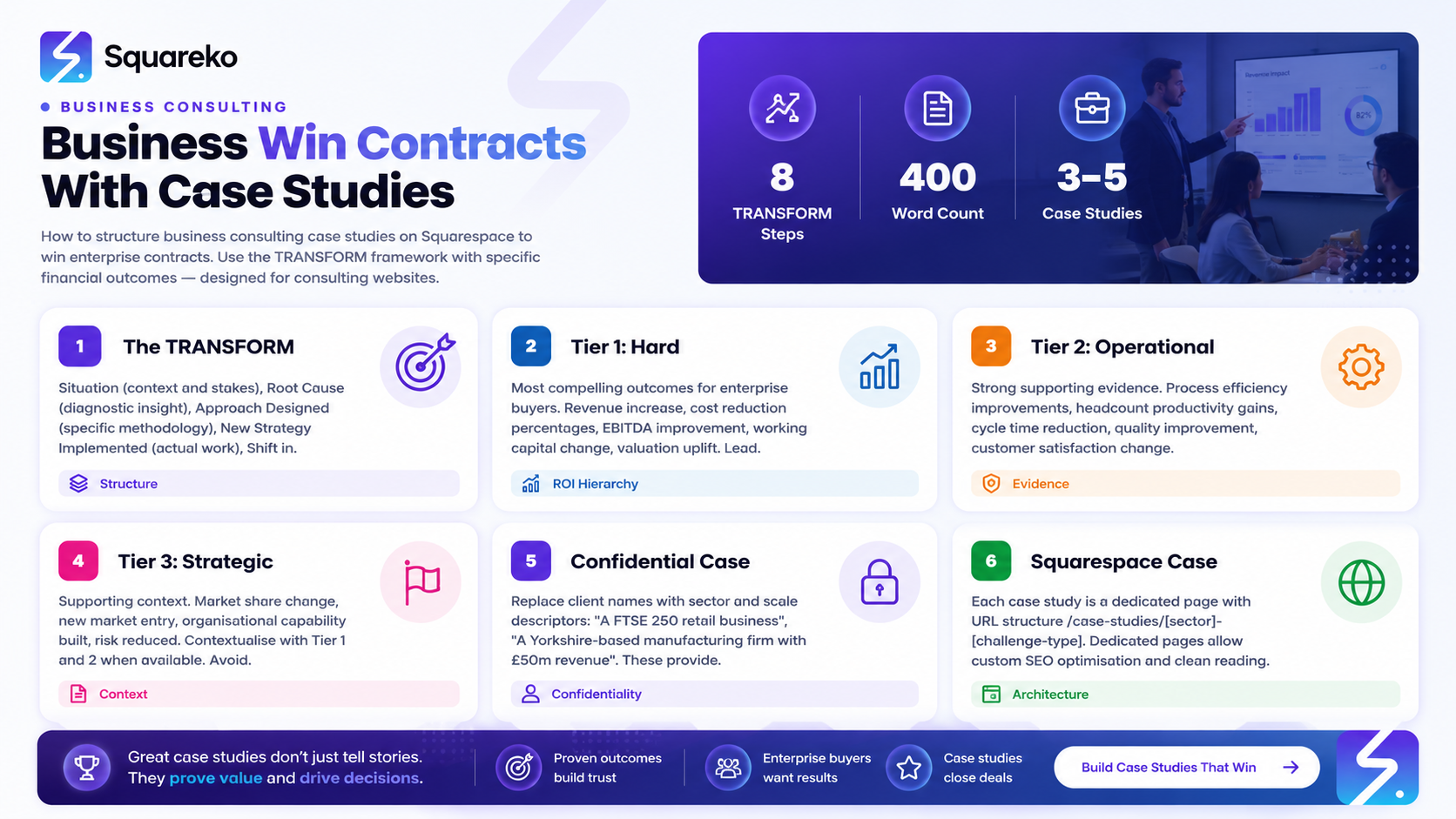
Case studies are the primary conversion tool for enterprise and senior executive consulting buyers
Vague outcomes ("improved performance", "better results") actively undermine credibility — specific metrics convert
The TRANSFORM Framework provides a consistent narrative structure that works for all management consulting case studies
Confidentiality doesn't prevent compelling case studies — sector and scale context substitutes for client names effectively
Squarespace's dedicated page structure is superior to blog post format for case studies
If there's a single piece of content that moves management consulting prospects from "interesting" to "proposal conversation," it's the case study.
Not testimonials. Not service descriptions. Not even your methodology page — though that comes close. The well-structured, ROI-specific transformation case study is the content that enterprise and senior executive buyers evaluate most thoroughly before deciding whether to reach out.
And yet most management consulting case studies are poorly structured, vague on outcomes, and almost entirely missing from the websites of consultants who urgently need more enquiries.
This guide covers how to structure business consulting case studies on Squarespace for maximum conversion — including the TRANSFORM Case Study Framework, the specific ROI metrics that convert enterprise buyers, and how to present case studies when clients prefer confidentiality.
Why Case Studies Convert Management Consulting Clients
Business consulting clients make high-stakes decisions. A management consulting engagement might cost £50,000 to £500,000 or more — the kind of investment that requires justification at board level. Before committing to even a discovery conversation, senior executive buyers want to know the answer to one question: "Has this firm solved problems like mine, at my scale, and can they prove it?"
Nothing answers that question more directly than a well-structured case study with specific, measurable outcomes.
Testimonials answer a different question: "Did previous clients like working with this firm?" That's valuable but secondary — enterprise buyers assume you're not publishing negative testimonials. Case studies that show the work, the challenge, the approach, and the specific numerical outcome are far harder to fabricate and therefore far more credible.
The three case study failures that most often cost management consultants enterprise contracts:
Vague outcome language. "We helped the client improve operational performance" is meaningless. "We reduced operational costs by 34% within 18 months through process redesign and management capability building" is specific, credible, and compelling.
No challenge context. Without understanding what the client faced before the engagement, the outcome has no meaning. The before-and-after structure isn't just storytelling — it's the logical framework that makes outcomes believable.
Generic approaches. "We analysed the problem and provided recommendations" describes every consulting engagement ever. The specific diagnostic insight, the counterintuitive finding, the specific intervention — these are what differentiate your approach from every other management consulting firm.
The TRANSFORM Case Study Framework
The TRANSFORM framework provides a consistent narrative structure for business consulting case studies that serves both human readers and AI search extraction:
T — The Situation
Describe the client context without naming them (unless they've given explicit permission): sector, approximate scale, market position, and the leadership or operational challenge they were facing. Include the stakes — why this challenge mattered to the organisation at that time.
Example: "A Yorkshire-based manufacturing business with £45m annual revenue was preparing for its first institutional investor process. The management team had no prior M&A experience, and the existing financial reporting infrastructure wasn't investor-ready."
R — Root Cause Analysis
The diagnostic insight — what you found when you investigated the presenting challenge. This is the intellectual content of the case study: the counterintuitive finding, the systemic issue behind the surface problem, the management blind spot the client couldn't see from inside the organisation.
Example: "The core issue wasn't the financial reporting — it was a management accounting function that had never been rebuilt after a rapid growth phase three years earlier. The business had grown, but the financial intelligence infrastructure hadn't."
A — Approach Designed
How your specific methodology was applied to this challenge. Name the framework or approach if you have one. Describe what made your approach specifically suited to this client's situation, and why alternatives would have been less effective.
N — New Strategy Implemented
The actual work: key interventions, stakeholder management, change management required, obstacles encountered and resolved. This is the "we actually did the hard work" section — specificity here builds credibility.
S — Shift in Performance
The first evidence of impact — leading indicators that showed the engagement was on track before the final outcomes were measurable. This stage demonstrates your ability to measure and manage progress, not just deliver a report.
F — Financial Outcome
The specific financial impact with numerical precision: cost reduction percentage, revenue improvement figure, efficiency gain quantification, risk reduction value. This is the section enterprise buyers read first and return to last. Make it specific. Make it real.
Example: "Within 18 months of engagement completion, the business completed a successful institutional raise at a valuation 40% above comparable sector transactions. The improved financial reporting infrastructure contributed directly to investor confidence in the management team's capability."
O — Organization Impact
The structural or capability change embedded beyond the financial metrics: the management capability built, the system implemented, the culture shifted, the team capability created.
R — Results Maintained
Evidence of sustainability what prevented regression and what the organisation can now do independently that it couldn't do before the engagement. Long-term outcome sustainability is one of the most compelling enterprise differentiators, particularly for transformation-type consulting.
M — Metrics Summary Box
A compact summary at the top of the case study page:
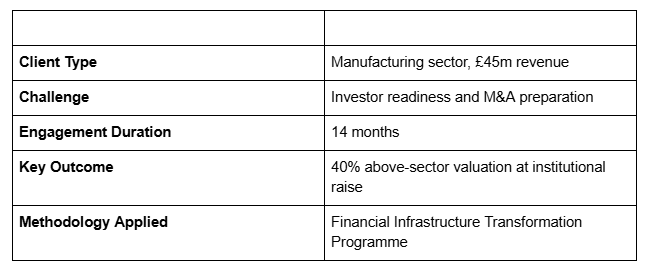
Enterprise buyers scan this box first. It tells them in 15 seconds whether the case study is relevant to their challenge.
The ROI Metrics Hierarchy for Business Consulting
Not all ROI metrics convert enterprise buyers equally. This hierarchy reflects what C-suite and procurement buyers find most credible and compelling:
Tier 1: Hard Financial Metrics (most compelling)
Revenue increase (£ amount or percentage)
Cost reduction (£ amount or percentage)
EBITDA improvement (percentage points)
Working capital improvement (£ amount)
Valuation change (multiplier or percentage)
Tier 2: Operational Metrics (strong)
Process efficiency improvement (percentage)
Headcount productivity improvement (output per FTE)
Cycle time reduction (percentage or absolute)
Quality improvement (defect rate reduction)
Customer satisfaction improvement (NPS or satisfaction score change)
Tier 3: Strategic Metrics (supporting)
Market share change
New market entry achievement
Organisational capability built
Risk reduced or eliminated (quantified where possible)
When presenting case study outcomes, lead with Tier 1 metrics where available, support with Tier 2, and contextualise with Tier 3. A case study with only Tier 3 metrics ("we helped them clarify their strategy") without financial or operational outcomes will underperform significantly.
Handling Confidential Business Consulting Case Studies
Many management consulting clients — particularly at enterprise level — won't allow their name to be used in case studies. This is a genuine challenge, but it's solvable.
Sector and Scale Substitution
Replace client names with sector and scale descriptors that provide the relevance context without the identification:
"A FTSE 250 retail business" (not "Marks & Spencer")
"A Yorkshire-based manufacturing firm with £50m revenue" (not the specific company)
"A PE-backed healthcare services business undergoing operational restructuring"
These descriptors tell prospective clients everything they need to know about whether the case study is relevant to their situation — which is all they actually need from the client identification.
Tiered Disclosure for Enterprise Prospects
For your most commercially significant case studies, offer tiered disclosure: the anonymized version publicly on your website, and a named (under NDA) version available to pre-qualified prospects in the proposal process. This approach combines public credibility-building with the deeper evidence that enterprise procurement requires.
Squarespace Case Study Page Architecture
Each case study should be a dedicated page on your Squarespace website — not a blog post, not a section on your services page. Dedicated pages allow for custom URL structure, individual SEO optimisation, and a clean reading experience without blog navigation.
Case Study Page URL Structure
Use a consistent URL format: /case-studies/sector-challenge-type Examples:
/case-studies/manufacturing-operational-transformation
/case-studies/retail-post-merger-integration
/case-studies/healthcare-financial-restructuring
These URLs are simultaneously SEO-optimised and human-readable.
Case Study Squarespace Layout
Build each case study page with:
Metrics summary box at top (table or styled summary block)
TRANSFORM narrative with clear H3 headings for each stage
Pull quote from the client testimonial (even anonymised testimonials carry weight)
Methodology reference with internal link to methodology page
Related case studies — three relevant cases at the bottom
CTA — "Does your business face a similar challenge? Let's discuss."
Want your business consulting case studies structured to convert enterprise buyers? Squareko builds case study architecture specifically for management consulting firms.
Case Study Index Page Design
Your case studies index page — the page that lists all your case studies — should be designed for executive evaluation, not just case study navigation.
Index Page Best Practices
Filter by sector and challenge type. Enterprise buyers don't want to read every case study — they want to find the ones most relevant to their specific challenge. Sector filters and challenge-type filters (transformation, integration, efficiency, growth) help them self-select.
Show the metrics summary prominently. The index page should display the metrics summary box for each case study — not just the title and a generic description. This allows executives to evaluate relevance from the index without clicking through.
Include outcome headlines. Format case study titles as outcome headlines: "How a Manufacturing Firm Reduced Operational Costs by 34% in 18 Months" is more compelling (and more SEO-friendly) than "Manufacturing Case Study."
FAQs
-
Use the TRANSFORM framework: Situation → Root Cause → Approach → New Strategy → Shift in Performance → Financial Outcome → Organisation Impact → Results Maintained → Metrics Summary. Lead with specific financial outcomes (cost reduction %, revenue improvement, EBITDA change) rather than vague results language. Include sector and scale context even without client names, and reference your specific methodology.
-
Name clients when you have explicit permission — named case studies carry more credibility weight. Where clients prefer confidentiality (common at enterprise level), sector + scale descriptors ("A FTSE 250 manufacturing business", "A PE-backed healthcare services firm") provide sufficient relevance context. Never fabricate or exaggerate outcomes — sophisticated enterprise buyers will probe case study details in discovery conversations.
-
Lead with hard financial metrics where available: revenue increase, cost reduction, EBITDA improvement, working capital change, or valuation uplift. Support with operational metrics: efficiency improvement, productivity gains, cycle time reduction. The harder and more specific the metrics, the more credibility the case study carries with enterprise buyers — "34% cost reduction" converts significantly better than "improved operational efficiency."
-
A minimum of three, ideally five to eight. Three case studies covering different challenge types (transformation, growth, integration, or restructuring) provides initial credibility. Five to eight case studies covering different sectors and challenge types demonstrates breadth without diluting the sense of specialisation. Each case study should be a dedicated page, not condensed into a single page.
-
Absolutely — and most enterprise management consulting clients will actually prefer their cases remain anonymous. Sector and scale context ("A mid-market manufacturing firm with £60m revenue") provides all the relevance information prospective clients need. Named testimonial quotes (even without company identification) add an additional layer of social proof. For your most significant cases, offer named disclosure under NDA to pre-qualified prospects in the proposal process.
-
400-700 words for the narrative body, plus the metrics summary box and a short client quote. This length provides enough detail for thorough evaluation without overwhelming the reader. The metrics summary box at the top allows executives to quickly assess relevance — those who want depth will read the full narrative; those doing initial screening get the key information in under 30 seconds.
Case Studies Are Your Best Business Development Tool — Use Them Properly
The management consultants who consistently win enterprise contracts aren't always the most experienced — they're often the ones who've done the disciplined work of documenting, structuring, and presenting their past successes in a way that makes it easy for new clients to say yes.
Your case studies are the single most powerful tool you have. The TRANSFORM framework, the ROI metrics hierarchy, and the Squarespace page architecture in this guide give you everything you need to build a case study library that converts.
From custom website design to SEO strategy, we help businesses launch a site that looks professional and performs better.

Author Bio
Written by the Squareko team
I'm Walid Hasan, a Certified Squarespace Expert and Squarespace Circle Platinum Partner with over 12 years of hands-on experience designing and optimizing high-performing websites. Over the years, I've had the privilege of building more than 2,000 Squarespace websites for clients around the world, always focusing on clean design, strong user experience, and conversion-driven results.