Business Consulting Website SEO on Squarespace: How to Rank for Management Consulting Keywords in 2026
Key Takeaways Business Consulting Website SEO on Squarespace: How to Rank for Management Consulting Keywords in 2026
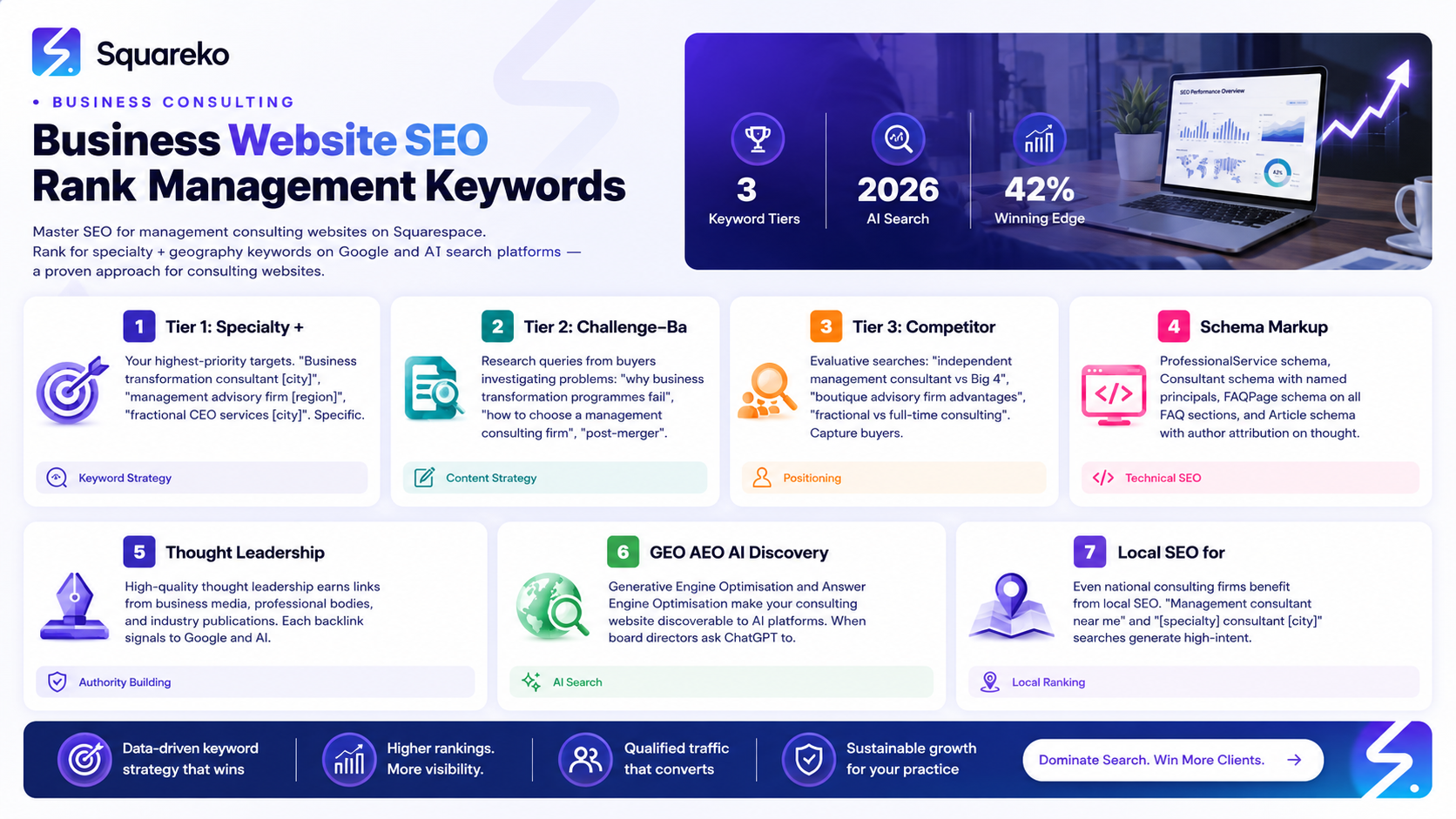
Business consulting SEO requires a different keyword strategy than most professional services — long-tail specialty and geographic combinations are the winning approach
AI search platforms increasingly recommend management consultants — Consultant and Professional Service schema are the primary visibility levers
Thought leadership content is both a backlink acquisition strategy and the primary AI citation mechanism for consulting recommendations
Squarespace handles the technical SEO foundations for management consulting well — the competitive advantage comes from content strategy and schema implementation
Local SEO (including Google Business Profile) matters for management consultants serving geographic markets — even when operating nationally
Management consulting SEO is genuinely different from most professional service SEO — and most SEO guides haven't caught up with that reality.
Competing for "business transformation consultant in Manchester" or "management advisory firm for post-merger integration" isn't the same challenge as competing for "solicitor near me" or "financial advisor London." Management consulting keywords sit at the intersection of high commercial intent, sophisticated buyer research behaviour, and a competitive landscape that includes both large established firms and sharp independent practitioners.
In 2026, there's a second dimension: AI search. When a board director asks ChatGPT "find me a strategy consultant with manufacturing sector experience" or a PE-backed CEO asks Perplexity "what management consulting firm specialises in operational turnaround for mid-market businesses," the AI is pulling from structured, authoritative content on consulting websites. Most management consulting websites aren't built for this.
This guide covers the complete SEO strategy for business consulting websites on Squarespace — combining Google and Bing optimisation with the GEO (Generative Engine Optimisation) and AEO (Answer Engine Optimisation) techniques that make you visible to executive buyers using AI search platforms.
The Business Consulting SEO Landscape in 2026
Before diving into tactics, it's worth being clear about the competitive landscape you're navigating.
Management consulting is a highly competitive search category. You're potentially competing with:
Global management consulting firms (McKinsey, BCG, Bain, Deloitte, KPMG) for broad category keywords
National boutique consulting firms for specialty keywords
Independent management consultants for individual practitioner searches
Content sites and aggregators for informational consulting queries
The practical implication: no independent management consultant or boutique advisory firm can compete head-to-head with Big 4 firms for generic keywords like "management consulting firm" or "business consultant." But that's not the right competitive strategy anyway.
The winning approach for independent and boutique management consulting SEO is precision targeting: specialty + challenge + geography combinations that capture high-intent buyers who've already made the decision to look for specialist advice and are now identifying who specifically can help them.
Keyword Strategy for Management Consulting Websites
Tier 1: Specialty + Geography Keywords
These are your highest-priority targets — specific enough to be winnable, broad enough to generate meaningful traffic:
"business transformation consultant [city]"
"management advisory firm [region]"
"post-merger integration consultant [city]"
"fractional CEO services [city]"
"change management consultant [sector/city]"
Tier 2: Challenge-Based Keywords
These capture buyers who are researching specific problems rather than searching for a consulting category:
"why business transformation programmes fail"
"how to choose a management consulting firm"
"post-merger integration process"
"management consulting ROI measurement"
"when to hire a management consultant"
Tier 2 keywords drive thought leadership content — blog posts and guides that build your authority and generate backlinks.
Tier 3: Competitor Differentiation Keywords
Searches that compare or evaluate consulting approaches:
"independent management consultant vs Big 4"
"boutique advisory firm advantages"
"fractional vs full-time consulting"
Keyword Research Method for Management Consulting
Use Google's "People Also Ask" feature for your primary keywords — the questions appearing there represent exactly what your ideal clients are searching for and provide direct content briefs for FAQ sections and blog posts. Also check the autocomplete suggestions for "your specialty consultant city" — these reveal the specific keyword combinations buyers are actually using.
On-Page SEO for Management Consulting Pages
Homepage SEO
Your homepage title tag should include your primary practice area, specialty, and geographic focus: "Business Transformation Consultant Management Advisory "
The meta description should answer the implicit question a searcher asks when they see your result: "Why should I click this result rather than the others?" For management consulting, this means referencing your specific specialty, your level of engagement (enterprise, mid-market, SME), and a trust signal (credentials, years, or notable client context).
In the body content, your homepage H1 should contain your primary keyword. The first paragraph should include the primary keyword naturally — ideally in a transformation statement that also serves the human reader.
Practice Area Pages SEO
Each practice area page (business transformation, strategy advisory, M&A support, etc.) should be optimised for its own keyword cluster:
Unique title tag with practice area + consulting type + location
Unique meta description specific to that practice area
H1 containing the practice area keyword
Body content of at least 500-800 words with semantic keyword variations
Internal links to relevant case studies and the methodology page
Methodology Page SEO
Your methodology page should target the named methodology as a searchable keyword entity. If your methodology is called "The Enterprise Value Acceleration Framework," that name should appear in the page title, meta description, and H1. AI platforms can then extract and cite your named methodology when answering management consulting approach queries.
Schema Markup for Business Consulting Websites
Schema markup is the most impactful single technical SEO intervention for management consulting websites in 2026. It's also the most commonly missing element.
Essential Schema Types for Business Consulting Websites
ProfessionalService Schema
{
  "@type": "ProfessionalService",
  "@context": "https://schema.org",
  "name": "[Firm Name]",
  "description": "Business transformation and management advisory consulting for [target client type]",
  "serviceType": "Management Consulting",
  "areaServed": "[Geographic Area]",
  "provider": {
    "@type": "Organization",
    "name": "[Firm Name]"
  }
}
Consultant Schema for Senior Partners
{
  "@type": "Person",
  "@context": "https://schema.org",
  "name": "[Partner Name]",
  "jobTitle": "Management Consultant",
  "description": "Specialises in [specific consulting specialty]",
  "knowsAbout": ["business transformation", "management advisory", "[specific practice area]"],
  "affiliation": {
    "@type": "Organization",
    "name": "[Firm Name]"
  }
}
Article Schema for Thought Leadership Every blog post and article should include Article schema with named author attribution — this is the primary E-E-A-T signal that AI platforms use to evaluate whether to cite your thought leadership content.
FAQPage Schema Every FAQ section on every page should have valid JSON-LD FAQPage schema. This enables featured snippet capture in Google and direct answer extraction by AI platforms.
Thought Leadership SEO: Backlinks and AI Citations
For management consulting websites, thought leadership content serves two simultaneous SEO functions:
1. Backlink Acquisition High-quality management consulting thought leadership earns links from:
Business and management media (Management Today, Harvard Business Review, Forbes UK)
Professional body publications (MCA, Institute of Consulting)
Industry-specific publications in your focus sectors
Business schools and academic institutions
Each of these backlinks signals to Google that your content — and by extension, your consulting practice — is a recognised authority in management consulting.
2. AI Citation Building When AI platforms receive management consulting recommendation queries, they pull from published content that is structured, authoritative, and clear. Your thought leadership articles — particularly those with named frameworks, specific data, and FAQ sections — are the primary source material.
Thought Leadership Topics for Management Consulting AI Citations
Focus your thought leadership on the specific queries your ideal enterprise clients are asking:
"Why do most business transformation programmers fail?"
"How should a board select a management consulting firm?"
"What does post-merger integration success actually require?"
"How do you measure management consulting ROI?"
Each of these is an AI-searchable question. If you publish a well-structured, expert answer, AI platforms will extract it when relevant queries arrive.
AI Search Visibility for Management Consultants (GEO/AEO)
GEO (Generative Engine Optimisation) and AEO (Answer Engine Optimisation) are the fastest-growing visibility dimensions for management consulting in 2026.
How AI Search Platforms Find and Recommend Management Consultants
AI assistants answer management consulting recommendation queries by combining:
Structured data from your website (schema markup)
Published content quality and authority signals (E-E-A-T)
Named entity recognition (your firm name, principal names, named methodology)
Geographical relevance (service area schema, location page content)
Making Your Management Consulting Website AI-Discoverable
Create an explicit "Expertise" page or section: A structured page that lists your specific consulting specialties, named methodologies, sector experience, and client types — formatted as clearly labelled sections that AI can extract.
Publish named frameworks publicly: Your proprietary methodology, published as a named, structured page, becomes an extractable AI citation entity. When someone asks ChatGPT "what's the best framework for post-merger integration," a named, published framework from your website can be cited.
Use conversational FAQ sections: Format FAQ sections with direct, concise answers (under 60 words) before longer elaboration. AI platforms extract the direct answer first.
Associate your name with your specialty consistently: Every page, every article, every schema reference should associate your name/firm name with your specific management consulting specialty. This entity association is what enables AI to confidently recommend you when relevant queries arrive.
Is your business consulting Squarespace website optimised for both Google and AI search in 2026? Squareko builds management consulting websites with complete SEO and AI search foundations. Book a call
Local SEO for Management Consulting Firms
Even management consulting firms that serve national or international clients benefit significantly from local SEO — particularly for the high-intent "management consultant in [city]" queries that drive qualified regional client enquiries.
Google Business Profile for Management Consultants
Verify and optimise your Google Business Profile with:
Primary category: "Management Consultant" or "Business Consultant"
Secondary category relevant to your specialty
Service descriptions with keyword-optimised copy
Location-specific hours and service area settings
Regular Google Posts featuring thought leadership content
Location Pages for Squarespace
If you serve multiple geographic markets, create dedicated location pages:
"/business-consultant-london"
"/management-advisory-manchester"
"/transformation-consultant-birmingham"
Each page should be 400-600 words with location-specific content (not duplicate copy with just the city name changed) and Local Business + Professional Service schema.
Technical SEO Checklist for Business Consulting Websites
Use this checklist to audit your management consulting website's technical SEO foundations:
On-Page Basics
Title tags on every page (50-60 characters, primary keyword included)
Meta descriptions on every page (150-160 characters, keyword + CTA)
H1 on every page with primary keyword
H2/H3 hierarchy used logically throughout body content
Internal links connecting related pages (methodology → case studies → services)
Schema Markup
Professional Service schema implemented on service pages
Person/Consultant schema for each named principal
FAQPage schema on all FAQ sections
Article schema on all blog posts with named author attribution
Breadcrumb List schema on case study and blog sections
Technical Foundations
Google Search Console verified and sitemap submitted
Google Analytics connected
Google Business Profile verified and optimised
SSL certificate active (Squarespace provides this automatically)
Mobile responsiveness tested on multiple device sizes
Page speed optimised (target under 3 seconds on mobile)
Content Architecture
Each page serves a unique keyword — no duplicate optimisation
Thought leadership blog with regular publication
Methodology page with named framework
Case studies with ROI metrics
Location pages for geographic markets served
FAQs
-
Focus on three keyword tiers: (1) Specialty + geography combinations ("business transformation consultant [city]", "management advisory firm [region]"), (2) Challenge-based informational keywords that your ideal clients search when researching their problems, and (3) Evaluative comparison keywords ("independent management consultant vs agency"). Avoid competing for generic terms like "management consulting" where you can't realistically compete with the major firms.
-
Yes — Squarespace handles title tags, meta descriptions, sitemap generation, SSL, and mobile optimisation automatically. The competitive advantage comes from strategy: schema markup (added via Squarespace's code injection), thought leadership content quality, and keyword targeting precision. Squarespace's SEO foundations are solid for management consulting websites; the differentiation is in how you build on them.
-
You don't compete with Big 4 firms for generic consulting terms — you win with precision targeting. "Business transformation consultant [your city]", "post-merger integration consultant for manufacturing [sector]", and similar long-tail specialty + geography combinations are highly winnable and drive exactly the right client type. The Big 4 don't publish specific, useful content for these queries; you can.
-
Yes, in two ways. First, MCA (Management Consultancy Association) directories and member listings provide backlinks with authority signal. Second, MCA membership is a credential that appears as a trust signal in your schema markup and thought leadership author attribution — both of which affect AI search recommendation confidence. Similar benefits apply to Institute of Consulting membership and CMC (Certified Management Consultant) designation.
-
For established pages targeting well-defined specialty keywords, 3-6 months to meaningful search visibility. For thought leadership content competing with lower-competition informational queries, 1-3 months. For AI search visibility (GEO/AEO), schema implementation combined with quality thought leadership can produce citation results within weeks — AI platforms update their citation sources more rapidly than Google updates its rankings.
-
GEO (Generative Engine Optimisation) is the practice of optimising your website content to appear in AI-generated responses to relevant queries. For management consultants, this means when a board director or C-suite executive asks ChatGPT or Perplexity "find me a [specialty] consultant in [location]" or "what should I look for in a management consulting firm," your practice appears in the AI's recommended response. In 2026, an increasing percentage of high-value consulting enquiries originate from AI search discovery.
Your Management Consulting Website Should Be Your Best Business Developer
The most effective management consulting business development strategy in 2026 combines traditional relationship-based BD with a website that works independently — generating qualified enquiries from enterprise prospects who found you through search, had their initial questions answered by your thought leadership, and arrived ready for a strategic conversation.
That combination requires both the right content strategy and the right technical foundations. Both are achievable on Squarespace with the right approach.
From custom website design to SEO strategy, we help businesses launch a site that looks professional and performs better.

Author Bio
Written by the Squareko team
I'm Walid Hasan, a Certified Squarespace Expert and Squarespace Circle Platinum Partner with over 12 years of hands-on experience designing and optimizing high-performing websites. Over the years, I've had the privilege of building more than 2,000 Squarespace websites for clients around the world, always focusing on clean design, strong user experience, and conversion-driven results.