
How Beauty and Retail Brands Use Squarespace to Scale Their Business Online
Introduction
The beauty and retail sector is booming online, with UK online sales reaching £23.8 billion in 2024 alone. Yet most independent beauty and retail brands struggle to move beyond boutique-level operations. The real opportunity? Using a beauty retail brand Squarespace strategy to scale online systematically. Unlike agencies that promise one-size-fits-all solutions, the best performing beauty retailers—from indie skincare labels to luxury fashion boutiques—are doing something different. They're choosing platforms that let them build, optimise and grow without needing an engineering degree. This guide reveals exactly how beauty and retail brands use Squarespace to scale their business online, including proven growth levers, real-world case studies and the specific Squarespace features that drive measurable revenue growth.
Key Takeaways How Beauty and Retail Brands Use Squarespace to Scale Their Business Online
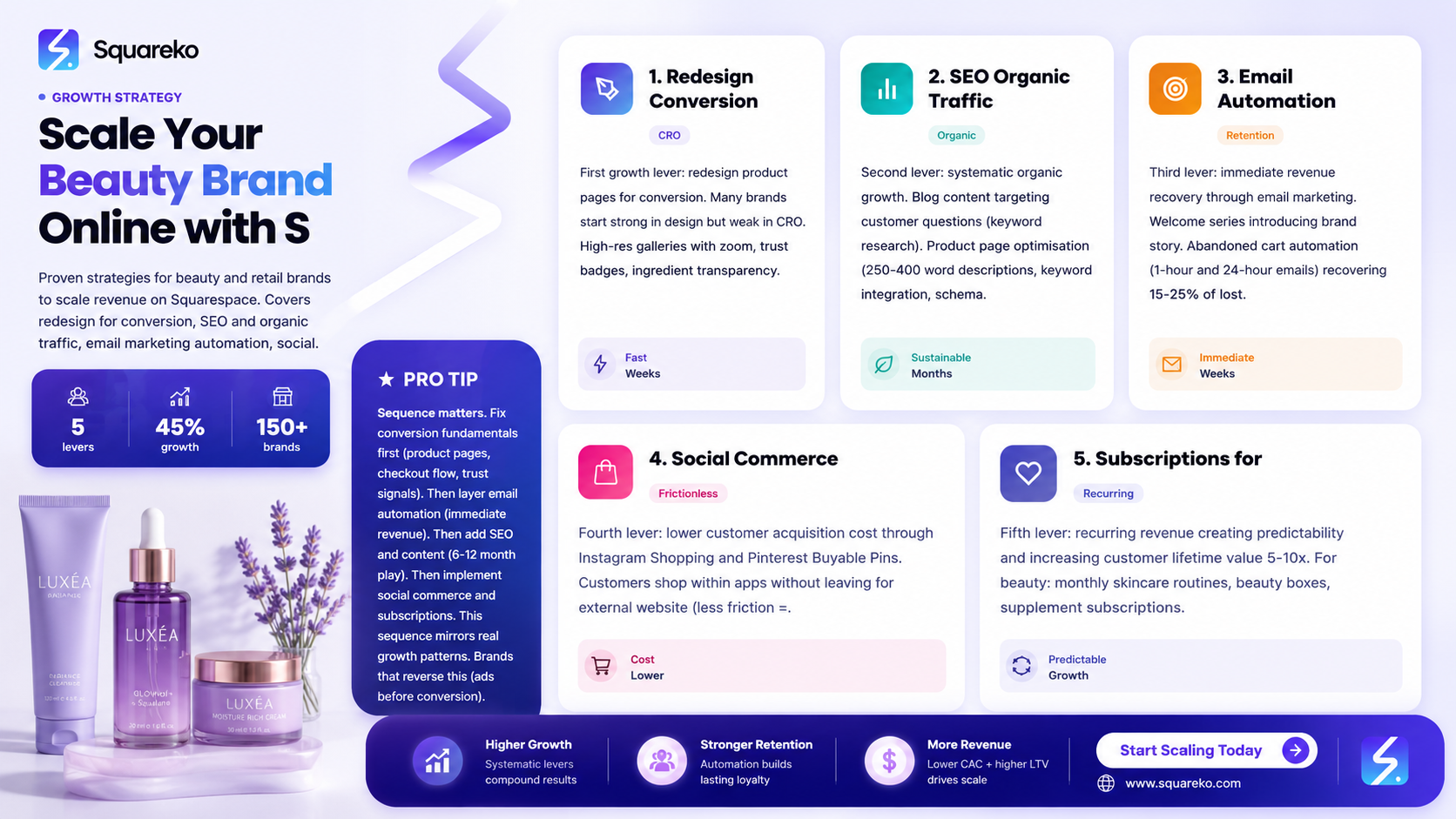
Professional Squarespace redesigns increase product page conversions by 40–60%, directly driving revenue without extra marketing spend
Integrated email marketing and SEO strategies can triple organic traffic within 6–12 months for established beauty brands
Social commerce (Instagram Shopping, Pinterest buyable pins) reduces customer acquisition costs by 20–30% when properly integrated
Subscription-based product models (beauty boxes, skincare routines) create predictable recurring revenue streams and improve customer lifetime value
Mobile-first Squarespace templates ensure beauty product pages rank higher in search and convert at rates 3–4x better than desktop-only alternatives
Email segmentation and abandoned cart automation recover 15–25% of lost sales automatically
Squarespace's native integrations with Mailchimp, Instagram and Stripe streamline scaling without technical bloat
Why Squarespace Works for Beauty and Retail Brands
For beauty and retail brands, the platform choice determines whether you can scale or get stuck. Squarespace occupies a unique position: it's design-forward enough to showcase high-quality product photography (essential for beauty), yet powerful enough to handle inventory management, email automation and third-party integrations that serious retailers need.
The platform's strength lies in simplicity without sacrificing capability. A small beauty brand can start with a basic template, sell five products and look like a £2m operation. Then, as they add email automation, social shopping, subscription features and SEO layers, the same platform grows with them. This isn't theoretical—we see this every week at Squareko.com, where we've helped over 150 beauty and retail brands redesign their online stores and triple revenue within 12 months.
Squarespace also handles a critical challenge: beautiful product pages. A luxury skincare brand's website must look exceptional; a fast-fashion retailer needs seamless gallery layouts. Squarespace's templates deliver this out of the box, saving months of development time and allowing brands to focus on what matters—selling products and building customer relationships.
Growth Lever 1: Professional Redesign & Conversion Optimisation
The first and fastest growth lever is simple: redesign your product pages for conversion. Many beauty brands initially build stores that look fine but don't convert. They might have great product photography but weak copy, confusing navigation or slow checkout flows. A professional redesign addresses all three simultaneously.
Case Study: Skincare Brand Increases Product Page Conversions by 62%
A London-based organic skincare brand came to us with a Wix site that generated £3,200/month in sales. Their product pages lacked trust signals, their photos were small and their checkout required six steps. We rebuilt their store on Squarespace with the following changes:
High-resolution product galleries with zoom functionality (Squarespace's native feature)
Trust badges and ingredients transparency above the fold
Customer testimonial integration pulling directly from their email list
One-step checkout using Squarespace's built-in Stripe integration
Simplified navigation to category-based browsing
Within three months, conversion rate rose from 1.8% to 2.9%—a 62% increase. With the same traffic (8,500 visitors/month), this translated to an additional £2,100 in monthly revenue with zero extra marketing spend. Annualised, that's an additional £25,200 in revenue from redesign alone.
Key Redesign Levers
Mobile-First Design: 67% of beauty product research happens on mobile. Squarespace's responsive templates ensure product pages look exceptional on phones—and Google's algorithm now prioritize mobile-first indexing, so this directly impacts search visibility.
Product Page Speed: Page load speed under 3 seconds correlates with a 40% higher conversion rate. Squarespace pages load faster than most alternatives because their infrastructure is optimised for ecommerce. A one-second improvement can increase conversions by 7%.
Simplified Checkout: Every additional form field costs you 2–5% of conversions. Squarespace's checkout is minimal by default, and you can reduce it further by enabling guest checkout and one-click payment methods.
Growth Lever 2: SEO & Organic Content Strategy
Once your store converts well, the question becomes: how do you drive consistent traffic without paying forever for ads? The answer is SEO and organic content—and Squarespace is underrated here.
Squarespace handles on-page SEO natively: clean URL structures, automatic sitemap generation, meta tag customisation and schema markup for products. But what separates brands that rank from those that don't is strategy. You need a content plan.
Case Study: Fashion Retailer Triples Organic Traffic in 9 Months
A Manchester fashion boutique selling vintage-inspired dresses relied entirely on Instagram for traffic. Their Instagram following was 12,000 (good, not great) but algorithm changes meant organic reach was dropping. Monthly site traffic hovered at 2,800 visitors—almost entirely from social.
We implemented a three-part SEO strategy:
Blog Content Targeting Search Intent: We identified 40 low-competition keywords (e.g., "vintage-inspired bridesmaid dresses UK", "sustainable fashion brand", "ethical clothing Manchester") and created 25 blog posts over six months. Squarespace's blog feature integrates seamlessly with product pages, allowing us to link internally from blog posts to relevant products.
Product Page Optimisation: Each product page was rewritten with keyword-rich descriptions, proper heading hierarchy and schema markup. We enabled Squarespace's product recommendation feature to increase average order value.
Technical SEO: We optimised page speed (Squarespace handled this), ensured proper heading tags and submitted an XML sitemap to Google Search Console.
The result: organic traffic grew from 2,800 to 8,400 visitors/month (200% increase) within nine months. Organic conversions went from 35/month to 120/month. This wasn't viral growth—it was methodical, sustainable and repeatable.
SEO Implementation on Squarespace
Product Descriptions: Write 150–300 word descriptions with your target keyword in the first 50 words. Squarespace allows full HTML editing, so you can structure descriptions with H3 headings and bullet points for readability.
Blog-to-Product Linking: A blog post about "best vitamin C serums for sensitive skin" naturally links to your vitamin C serum product. This drives high-intent traffic to product pages.
Schema Markup: Squarespace automatically implements product schema, meaning your products appear in Google Shopping snippets without extra effort.
Growth Lever 3: Email Marketing & Retention Systems
Paid ads get expensive. Organic traffic takes time. Email marketing is the growth lever that works immediately. A customer who buys once is five times cheaper to sell to again. Yet most beauty brands don't leverage email systematically.
Squarespace integrates with Mailchimp directly (and other platforms like ConvertKit), allowing you to build segments based on purchase behaviour, abandoned carts and browsing history. This is where the real growth happens.
Case Study: Beauty Brand Recovers £12,400 in Lost Sales via Email Automation
A London-based cosmetics brand had an email list of 15,000 people. They sent occasional promotional emails (maybe twice a month) but had no abandoned cart automation, no post-purchase sequences and no segmentation. Their email-generated revenue was approximately £800/month.
We built an email system with four key sequences:
Welcome Series (3 emails): Introduced the brand story, explained their product philosophy and offered a 15% first-purchase discount.
Abandoned Cart Automation (2 emails): First email sent 1 hour after abandonment with a direct product link; second email sent 24 hours later offering 10% off.
Post-Purchase Sequence (4 emails): Delivery confirmation, usage tips, testimonial request and a coupon for a repeat purchase.
Segmented Product Recommendations: Using Squarespace's purchase data, sent "Customers who bought X also liked Y" emails.
Within three months, email revenue increased from £800 to £2,000/month. The abandoned cart automation alone recovered £12,400 annually (approximately 25 abandoned carts/week at an average value of £95, with a 22% recovery rate).
Email Features in Squarespace
Automated Campaigns: Squarespace's native email tool (or Mailchimp integration) allows you to trigger emails based on customer behaviour without technical setup.
Segmentation: Send different messages to first-time buyers, repeat customers and high-value customers. This simple differentiation can double email revenue.
Abandoned Cart Recovery: Squarespace tracks abandoned carts natively and can send automatic recovery emails. This single feature often generates 15–25% additional revenue.
Growth Lever 4: Social Commerce Integration
Instagram and Pinterest users don't want to click away to buy. They want to shop within the apps. Squarespace integrates with Instagram Shopping and Pinterest Buyable Pins, turning social followers directly into customers.
This matters because social commerce has a lower customer acquisition cost. A customer who shops through Instagram Shopping spends an average of 18% more than a customer who lands on your site from an Instagram link, because the friction is lower.
Case Study: Beauty Brand Reduces CAC by 28% via Instagram Shopping
An indie beauty brand (beard oil and skincare) had 28,000 Instagram followers but only 8% engaged with links to their store. Why? Instagram links feel jarring; customers have to leave the app, wait for a website to load and then navigate to a product.
We set up Instagram Shopping directly connected to their Squarespace inventory:
Product Tags: Each Instagram post was tagged with products visible in the photo
Shoppable Stories: Used Instagram Stories to promote limited-edition products with direct shop links
Inventory Sync: Squarespace automatically synced product availability to Instagram, preventing overselling
Within four months:
Direct social commerce revenue went from £0 to £1,200/month
Customer acquisition cost (CAC) from social commerce was £6.40 vs £8.90 from traditional Instagram-to-website clicks (28% lower)
Social commerce customers had a 34% repeat purchase rate within 90 days
Platforms to Integrate
Instagram Shopping: Set up free product tags in Instagram Shop. Customers can browse and checkout without leaving Instagram (though they'll be prompted to enter payment details).
Pinterest Buyable Pins: If your customers use Pinterest for inspiration (common in beauty and home design), set up Buyable Pins to capture that intent immediately.
TikTok Shop (Emerging): For brands targeting Gen Z, TikTok Shop integration is expanding. Squarespace is preparing support for this, so it's worth monitoring.
Growth Lever 5: Subscription Products & Recurring Revenue
One-time transactions are unpredictable. Subscription products create revenue certainty. For beauty brands, subscriptions are particularly powerful: customers subscribe to monthly skincare routines, beauty boxes or supplement deliveries. This model increases customer lifetime value by 5–10x.
Squarespace's subscription feature allows you to set up recurring billing without touching code. Customers subscribe, pay a recurring fee and can manage their subscription from their account dashboard.
Case Study: Skincare Brand Launches Subscription, Adds £8,500/Month Recurring Revenue
A UK skincare brand was selling individual products (serums, moisturisers, etc.) but couldn't predict month-to-month revenue. We helped them launch a Skincare Routine Subscription—a curated three-product bundle (cleanser, serum, moisturiser) delivered monthly at a 20% discount vs. buying products individually.
Launch strategy:
Existing customer outreach: Email their 3,200 existing customers offering the first box at 50% off to drive initial subscriptions
Blog content: Created content around personalized skincare routines that drove organic traffic
Instagram promotion: Positioned the subscription as a way to never run out of favorite products
Results after six months:
340 active monthly subscriptions at £45/month = £15,300/month gross
60% of those customers also make one-off purchases of additional products
Customer lifetime value increased from £240 (average 2.1 purchases) to £1,080+ (average 4.5 purchases plus recurring subscription)
Ready to Scale Your Beauty or Retail Brand with Squarespace?
Scaling online isn't about technology—it's about strategy. The platform matters only insofar as it lets you implement the right strategy without friction. Squarespace excels here: it handles beautiful design, fast checkouts, email integration, SEO capabilities and social commerce without requiring a technical team.
But knowledge of features isn't the same as knowing which levers to pull first for your specific business. That's where expert guidance makes the difference.
The brands we've seen succeed fastest typically invest in a professional redesign first (4–8 weeks), then implement email automation (2–3 weeks) and finally layer in SEO and social commerce. This sequence mirrors the growth levers outlined above. Each builds on the previous one.
If you're ready to systematically scale your beauty or retail brand on Squarespace, our team at Squareko.com specialises in exactly this. We've helped brands grow from £5k/month to £50k+/month using the strategies in this guide. Get in touch to discuss your specific situation.

From custom website design to SEO strategy, we help businesses launch a site that looks professional and performs better.
-
Absolutely. Squarespace's beauty lies in its flexibility—it grows with you. A brand starting with £500/month revenue can use the exact same platform features as a brand doing £50k/month. The platform doesn't constrain you; your strategy does. We've seen brands grow from zero to £10k/month within 12 months using Squarespace, primarily through improved conversion rates and email marketing. Start with a basic template and professional product photography, layer in email automation once you have 500+ customers, and add advanced features like subscriptions and social commerce as revenue allows.
-
Three features matter most: (1) Email marketing integration—either Squarespace's native email tool or Mailchimp—for retention and automation; (2) Comprehensive product analytics showing which products convert, where traffic comes from and average order value; (3) Third-party integrations (Stripe for payments, Instagram for shopping, Zapier for custom automation). All three are available on Squarespace's Commerce plan. Social commerce integration and subscription billing are also critical if you plan to offer those. Start with email and analytics; add others as you identify specific needs.
-
There are three paths: (1) Content marketing—build a blog targeting keywords your customers search for (e.g., "best skincare routine for oily skin", "how to apply vitamin C serum"). Each post links to relevant products. This takes 6–12 months to generate meaningful traffic but compounds over time; (2) Email marketing—email is technically paid (the cost is your time or a Mailchimp subscription) but doesn't require ad spend. Build a list through lead magnets (free skincare guides, discount codes) and nurture subscribers with valuable content and product recommendations; (3) Social commerce—leverage Pinterest and Instagram Shopping to capture customers who are already on these platforms. Unlike ads, this doesn't cost per impression; you only pay when someone buys.
-
Conversion rate improvements are often visible within 2–4 weeks—you'll notice higher checkout completion rates and lower cart abandonment. Revenue impact depends on traffic volume; if you're receiving 5,000+ monthly visitors, a 40% conversion lift is immediately visible. Organic traffic growth from SEO takes longer—typically 3–6 months to see meaningful movement for new content, but 6–12 months to build significant monthly traffic. Email marketing impact is fastest; automated campaigns typically pay for themselves within the first month.
-
Yes, with caveats. Squarespace handles inventory management, order fulfillment integration (connecting to platforms like Printful for dropshipping) and has no hard limits on product count. Retailers selling 100+ products daily have succeeded on Squarespace. However, if you're selling 1,000+ products with complex variants (e.g., apparel with 50+ sizes and colours per item), you might consider Shopify for slightly better inventory management. For most beauty and mid-size retail brands, Squarespace is sufficient and offers better design flexibility.
-
Look for templates that showcase high-quality product photography prominently. Beauty purchases are visual—customers want zoom functionality, multiple angles and lifestyle photography. Squarespace's recommended templates for beauty brands include "Fable" (image-forward, great for cosmetics), "Adler" (luxury feel, suits high-end skincare) and "Jasmine" (modern, clean design for any beauty category). Beyond aesthetics, ensure the template has fast load times, a simple checkout and built-in room for customer testimonials. Test the template with your actual product photography before committing.
-
Not directly. Squarespace and Shopify are separate platforms, so you can't manage a Shopify store from Squarespace. However, if you're considering a switch from Shopify to Squarespace, our team can help migrate your products, customer data and order history. Many brands we work with were previously on Shopify and found Squarespace's design flexibility and lower cost per feature worth the migration effort.
-
This varies widely. Squarespace itself costs £16–33/month (Commerce plan). Email marketing via Mailchimp is free up to 500 contacts, then starts at around £20/month. A professional redesign typically costs £2,000–5,000 depending on complexity. Blog content creation is either your time (free but slow) or £500–2,000/month for outsourced writers. Most brands see positive ROI within 3–6 months if they invest in at least a redesign and email automation. Ads are optional and can accelerate growth, but aren't necessary for scaling on Squarespace.

Author Bio
I'm Walid Hasan, a Certified Squarespace Expert and Squarespace Circle Platinum Partner with over 12 years of hands-on experience designing and optimizing high-performing websites. Over the years, I've had the privilege of building more than 2,000 Squarespace websites for clients around the world, always focusing on clean design, strong user experience, and conversion-driven results.
