How Architects Use Squarespace to Showcase Their Process and Philosophy to Win Ideal Clients
The most successful architecture practices have learned something crucial: clients don't hire architects based solely on portfolio quality. They hire based on values alignment, creative philosophy, and the confidence that comes from understanding how a firm thinks and works.
Your Squarespace website has the opportunity to communicate this alignment at every level. When potential clients visit, they should see not just beautiful projects, but the thinking behind them. They should understand your design principles, your approach to sustainability, your studio culture, and what makes your practice distinct. This is what transforms your website from a portfolio display into a client acquisition engine.
Key Takeaways
Architecture clients select their architect as much for philosophy and values alignment as for portfolio quality
A dedicated Design Manifesto page establishes authority and clarifies your creative thinking for ideal clients
Sustainability and environmental credentials must be prominently featured to meet contemporary client expectations and values
About and Studio Culture pages that reveal process, research methods, and team philosophy build trust and differentiation
Awards and recognition communicate values-driven achievement, not just accolades
Squarespace's design tools enable sophisticated storytelling that positions your practice as thoughtfully strategic, not just technically skilled
Introduction
Architects spend years developing a distinctive approach to design. Your practice has a philosophy—whether you've formally articulated it or not. Perhaps you prioritise adaptive reuse and conservation. Perhaps you're committed to community-centred design. Perhaps your work focuses on creating spaces that enhance wellbeing through biophilic principles. Whatever your foundation is, your ideal clients are actively searching for firms that share their values.
The challenge is that architects squarespace showcase process philosophy win ideal clients requires more than a portfolio of completed projects. It demands a coherent narrative about why you work the way you do, how you solve problems, and what you believe about architecture's role in the world. When you communicate this clearly on Squarespace, you attract clients who already resonate with your approach before they even contact you.
This guide covers how to structure your Squarespace website to showcase your design process and philosophy in ways that win the exact clients you want to work with.
Why Philosophy and Process Matter More Than You Think
Most architecture websites display portfolios effectively. Fewer communicate the thinking behind the work.
Contemporary clients—especially those with budgets and ambitious visions—are making their architect selection based on philosophical alignment. They're asking: Does this firm understand what I value? Will they push my thinking in productive directions? Do they approach problems the way I do?
Research on client decision-making in creative services consistently shows that when technical capability is assumed (your portfolio demonstrates this), clients make their final choice based on trust, rapport, and values match. Your website is where this match is established.
A client concerned with environmental impact needs to see your commitment to sustainable design documented on your site, not explained during an initial meeting. A client who values community engagement needs evidence of participatory processes in your work. A client seeking cutting-edge materials innovation needs to see your research interests and technical explorations featured prominently.
Squarespace enables this communication through customisable page layouts, video integration, and sophisticated typography that makes complex ideas visually coherent. When used strategically, your website becomes a pre-qualification tool: clients who see your philosophy and resonate with it arrive at meetings already convinced of your fit.
Building a Design Manifesto Page That Attracts Ideal Clients
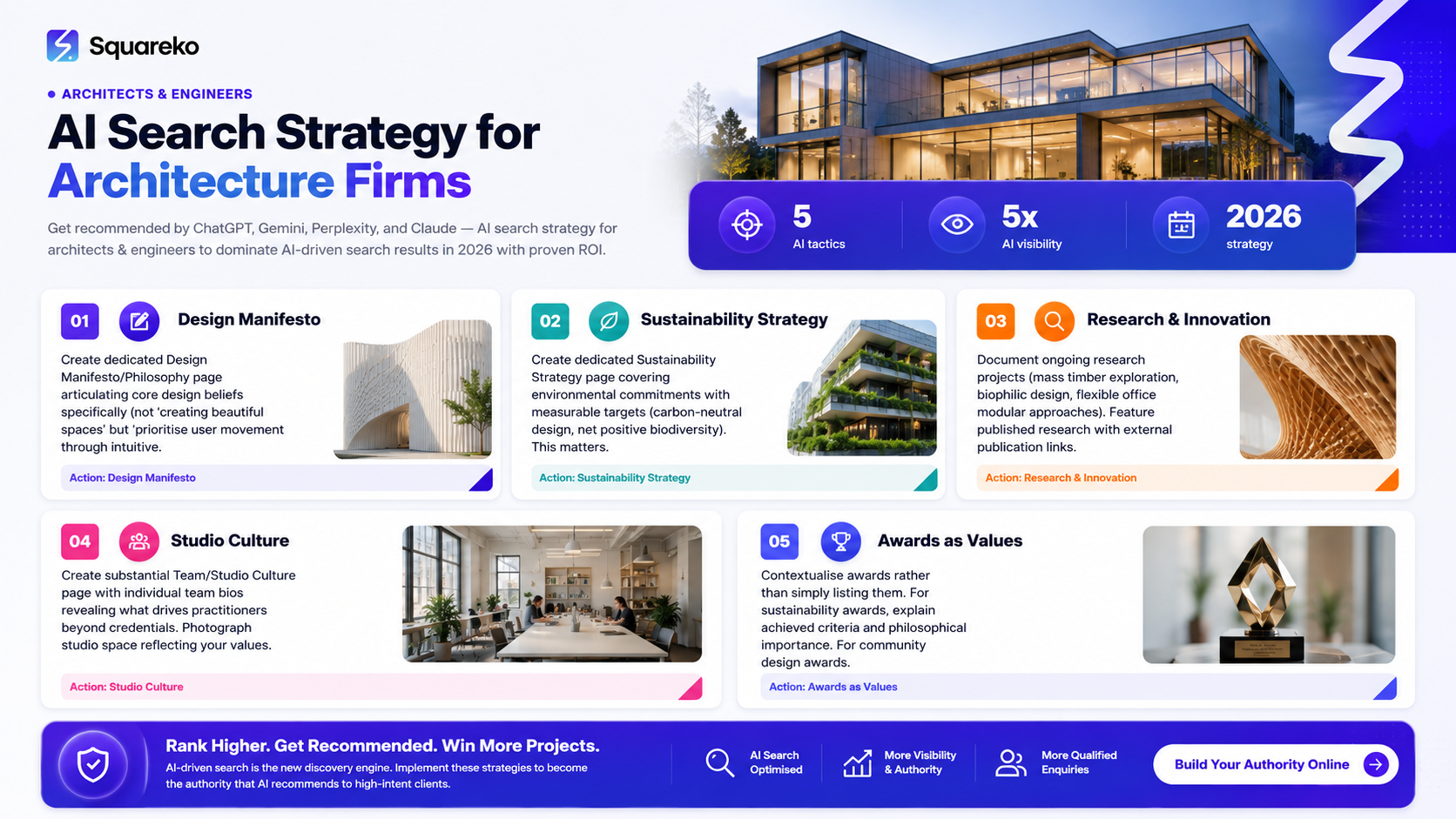
Your Design Manifesto page is the foundation of philosophy communication. This isn't a vague mission statement. It's a clear, substantive articulation of how you approach design problems.
Structure your Design Manifesto as follows:
Core Principles (3–5 core ideas) State your fundamental design beliefs. Rather than generic language like "creating beautiful spaces," be specific: "We design buildings that prioritise user movement and wayfinding through intuitive spatial hierarchies" or "We believe materials should honestly express their properties and contribute to occupant wellbeing."
The Problem You Solve Describe the specific design challenge or gap in the market you address. Perhaps you've recognised that commercial office buildings typically overlook acoustic and thermal comfort, so you've developed a proprietary approach to designing these elements. Perhaps you specialise in converting Victorian industrial buildings for contemporary adaptive use.
Your Process Philosophy How do you approach projects? Do you lead with extensive site analysis and research? Do you involve end-users in co-design workshops? Do you use computational design and parametric modelling to test multiple design iterations? This reveals your intellectual rigour and thoughtfulness.
Values and Commitments What commitments guide your practice? Sustainability? Community benefit? Craft and materiality? Local employment and supply chains? This is where values alignment happens.
Why This Matters on Squarespace Use Squarespace's full-width text blocks, feature images, and video embeds to make your manifesto visually compelling. Consider a design that pairs your manifesto statement with a carefully curated image from a project that exemplifies each principle. The goal is making your philosophy feel tangible and connected to actual work.
Communicating Sustainability and Environmental Philosophy
Environmental credentials are no longer optional. Clients increasingly select their architect based on proven commitment to sustainable design and carbon reduction.
Create a dedicated Sustainability Strategy page that covers:
Your Environmental Commitments State your measurable commitments clearly. Are you pursuing carbon-neutral design across all projects? Do you have a materials specification standard that prioritises recycled, reclaimed, and locally sourced materials? Are you targeting net positive biodiversity outcomes?
Carbon and Embodied Energy Approach Explain your methodology for reducing both operational and embodied carbon. Document specific case studies where you've calculated embodied carbon and material choices that resulted in measurable reductions. Link to published research or third-party certifications where relevant.
Sustainable Material Selection Process Walk through your criteria for material selection. What makes a material "sustainable" in your practice?
Do you prioritise durability and longevity?
Thermal mass?
Biodegradable and non-toxic formulations?
This transparency reassures clients that your sustainability commitment is rigorous, not performative.
Green Building Certification Strategy If you pursue BREEAM, Living Building Challenge, Passivhaus, or other certifications, explain why. What do these certifications mean to your practice philosophy? How do you use them as tools rather than badges?
Supply Chain and Craft Considerations Do you work with local manufacturers and makers? Do you prioritise fair-trade and ethical sourcing? Contemporary clients increasingly value this dimension of practice sustainability.
Squarespace Content Strategy for Sustainability Create a dedicated section with case studies highlighting sustainable projects. Use comparison images showing before/after material choices, carbon calculations visualised, and lifecycle assessment methodology. Consider a downloadable resources section featuring your material specifications or sustainability checklist that clients can use as a project guideline.
The Research and Innovation Content Strategy
Ideal clients want to work with architects who are intellectually active and evolving their practice. A dedicated Research and Innovation section positions your firm as forward-thinking and rigorous.
Include:
Ongoing Research Projects Document your studio's active investigations. Are you exploring mass timber construction? Researching biophilic design principles and their measurable impact on occupant wellbeing? Developing new approaches to modular, flexible office design? Share this work in progress, with images, diagrams, and clear explanations of your research questions.
Published Work and Thought Leadership If you've published research, written articles, or presented at conferences, feature this prominently. Link to external publications and explain the ideas that drove your research. This signals intellectual credibility.
Material and Technical Experimentation Have you collaborated with material scientists or developed proprietary construction techniques? Document these explorations. Show prototypes, testing processes, and the thinking behind your technical innovations.
Collaboration and Knowledge Sharing Do you partner with universities, research institutions, or other specialists? Feature these collaborations as evidence that your practice is embedded in broader design discourse.
Why This Matters Research and innovation content differentiates your practice from firms that focus purely on portfolio display. It says: we're not simply executing projects competently; we're advancing the field.
Showcasing Studio Culture and Team Values
Your team is part of your philosophy. When clients hire your firm, they're hiring the people who'll shape their project.
Create a substantial Team and Studio Culture page that includes:
Individual Team Bios Beyond Credentials Rather than listing job titles and credentials, reveal what drives each team member. What projects are they most proud of? What design problems fascinate them? What are their outside interests? This humanises your practice and reveals culture.
Your Design Process Walk through your typical project methodology in detailed narrative and visual form. How do you begin? What's your research and analysis phase? How do you iterate on design concepts? Where do clients participate? This transparency builds confidence in your approach.
Your Studio Space If your office reflects your values—whether through sustainable design, flexible collaboration spaces, or strong connections to nature—photograph it extensively. Your studio environment tells clients about how you work.
Your Approach to Collaboration How do you work with clients, consultants, and contractors? Do you hold regular design workshops? Do you use digital collaboration tools in specific ways? Do you facilitate ongoing feedback and iteration? Document your collaborative philosophy.
Professional Development What opportunities do your team members have for growth? Do you support travel, research, continued education, and professional conference attendance? This reveals whether you're building a practice that attracts and retains talented architects.
Using Awards and Recognition as Evidence of Values
Awards aren't just accolades. When positioned correctly, they communicate what your practice values and the outcomes you're committed to achieving.
Rather than simply listing awards, contextualise them:
Why This Award Matters to Your Practice If you've won a sustainability award, explain what criteria you satisfied and why achieving those outcomes was important to your philosophy. If you've received a community design award, discuss the participatory processes you employed and what you learned about community-centred design.
The Work Behind the Recognition For your most meaningful awards, create case study pages that walk through the design process, the challenges overcome, and the values your approach exemplified. This transforms an award from a credential into a story about your practice philosophy.
Diversity and Representation Awards If your practice has been recognised for diversity, equity, and inclusion initiatives, this is powerful values evidence. Document your commitments and outcomes clearly.
Innovation and Research Recognition Research-focused awards signal intellectual engagement. Feature these prominently as evidence that your practice is advancing the field.
Frequently Asked Questions
-
Your About page should go far beyond founding history. Include: your design philosophy and core principles; your distinctive approach to projects and clients; your team's collective expertise and individual passions; your studio culture and working methods; your commitments to sustainability, community, or other values; and enough narrative detail that ideal clients can assess philosophical alignment before contacting you. Consider it your manifesto in narrative form.
-
Create a dedicated Design Manifesto or Philosophy page that articulates your core design beliefs, the problems you solve, your process philosophy, and your values commitments. Support these written statements with curated imagery from projects that exemplify each principle. Use Squarespace's full-width text and image combinations, video embeds, and custom layouts to make your philosophy visually coherent and compelling.
-
Absolutely. Environmental commitment is now a core selection criterion for many clients. Feature your sustainability approach prominently, with specific commitments (e.g., carbon-neutral design targets), documented methodologies (e.g., how you calculate embodied carbon), and case studies demonstrating outcomes. This transparency differentiates your practice and attracts values-aligned clients.
-
Position your About page as a values and philosophy statement first, credentials second. Include: your design philosophy; your studio culture and team approach; your research and innovation interests; your environmental and social commitments; your distinctive process and methodology; and specific examples of projects that exemplify these values. This allows ideal clients to pre-qualify themselves before reaching out.
-
A portfolio demonstrates what you've built. A philosophy showcase explains why you built it that way and what you believe about architecture's role. Ideal clients need both, but they select architects primarily on the philosophy dimension. Squarespace enables you to integrate these—each project can be contextualised within your broader philosophical framework.
-
Specificity and consistency prove authenticity. Rather than generic statements, articulate precise commitments with measurable outcomes. Document your process transparently. Show the difficult decisions and trade-offs you've navigated. Feature work in progress and research alongside finished projects. Invite clients into your thinking, not just your results. This transparency signals confidence in your values and approach.
-
Yes, but frame them strategically. Feature testimonials that highlight clients' experience of your process, their appreciation for how you approached their values and goals, and their sense of partnership. This validates that your philosophy translates into successful client relationships.
-
Your core philosophy should remain stable, but update your Research and Innovation sections quarterly or semi-annually with new work and explorations. Update your Awards and Recognition sections as you earn new accolades. Your Case Studies page should evolve as you complete projects. This demonstrates that your practice is actively engaged and evolving.
Conclusion
The architecture practices winning ideal clients are those who've mastered the art of communicating not just what they build, but how they think. Your Squarespace website is the vehicle for this communication. When you create a sophisticated design philosophy page, articulate your environmental commitments clearly, showcase your research and innovation, and reveal your studio culture transparently, you're doing something more valuable than displaying your portfolio.
You're establishing trust. You're allowing ideal clients to assess philosophical alignment before they pick up the phone. You're positioning your practice not as technically skilled project executors, but as thoughtfully strategic partners who understand what they value and how to achieve it.
The clients worth working with—those with ambitious visions, meaningful budgets, and genuine commitment to their projects—are actively searching for architects who share their values. When your philosophy shines through on your website, those clients find you.
Ready to Showcase Your Architecture Practice?
Your practice's distinctive philosophy and process deserve a website that communicates them with sophistication and clarity. Squaresco specialises in designing Squarespace websites for architecture firms who want to attract ideal clients through values-aligned storytelling.
Get a free Squarespace consultation to discuss your practice's philosophy, your ideal client profile, and how to structure your website to showcase your design thinking, sustainability commitment, and studio culture. Visit Squareko to schedule your consultation today.

From custom website design to SEO strategy, we help businesses launch a site that looks professional and performs better.

About Author
I'm Walid Hasan, a Certified Squarespace Expert and Squarespace Circle Platinum Partner with over 12 years of hands-on experience designing and optimizing high-performing websites. Over the years, I've had the privilege of building more than 2,000 Squarespace websites for clients around the world, always focusing on clean design, strong user experience, and conversion-driven results.