Career Coach SEO: How to Rank on Google and AI Search in 2026
Key Takeaways For How to Rank on Google and AI Search in 2026
Career coach keywords fall into three categories: Informational (educational), commercial (comparison), and transactional (ready to book)
Local SEO is critical: Many professionals search career coach in [city]—you must rank locally to capture high-intent traffic
AI search requires schema markup: Structured data (CoachingService, LocalBusiness, Review schemas) makes you visible to AI assistants
Squarespace SEO is simpler than WordPress but requires intentional setup (meta tags, heading structure, site speed)
Content depth matters more than quantity: One 2,500-word pillar post outranks five 500-word fluff posts
Backlinks from professional associations boost authority: CIPD, ICF, and ILM directory listings improve your ranking
Internal linking connects related topics: Proper linking structure helps Google understand your site's architecture
Career coaches compete fiercely for visibility. Professionals searching for career guidance increasingly turn to Google with specific queries: executive coach near me, interview prep coach, CV writer Squarespace, or career transition specialist. If your website doesn't appear on the first page, you're invisible to prospects actively seeking help.
SEO for career coaches differs from general service businesses because your ideal clients are research-driven professionals who compare coaches methodically before committing to a high-ticket purchase. They search with intent, and capturing that intent means ranking for keywords that signal buying readiness.
Additionally, AI search is transforming how professionals find coaches. ChatGPT users ask What should I look for in a career coach? and AI recommendations now surface coaching service websites with schema markup, CIPD accreditation, and outcome metrics. Optimizing for AI search is no longer optional—it's essential.
This guide walks you through a career coach SEO strategy tailored to Squarespace, covering Google ranking, local SEO, AI search optimization, and the technical setup that converts organic traffic into discovery call bookings.
How Career Coaches Search on Google
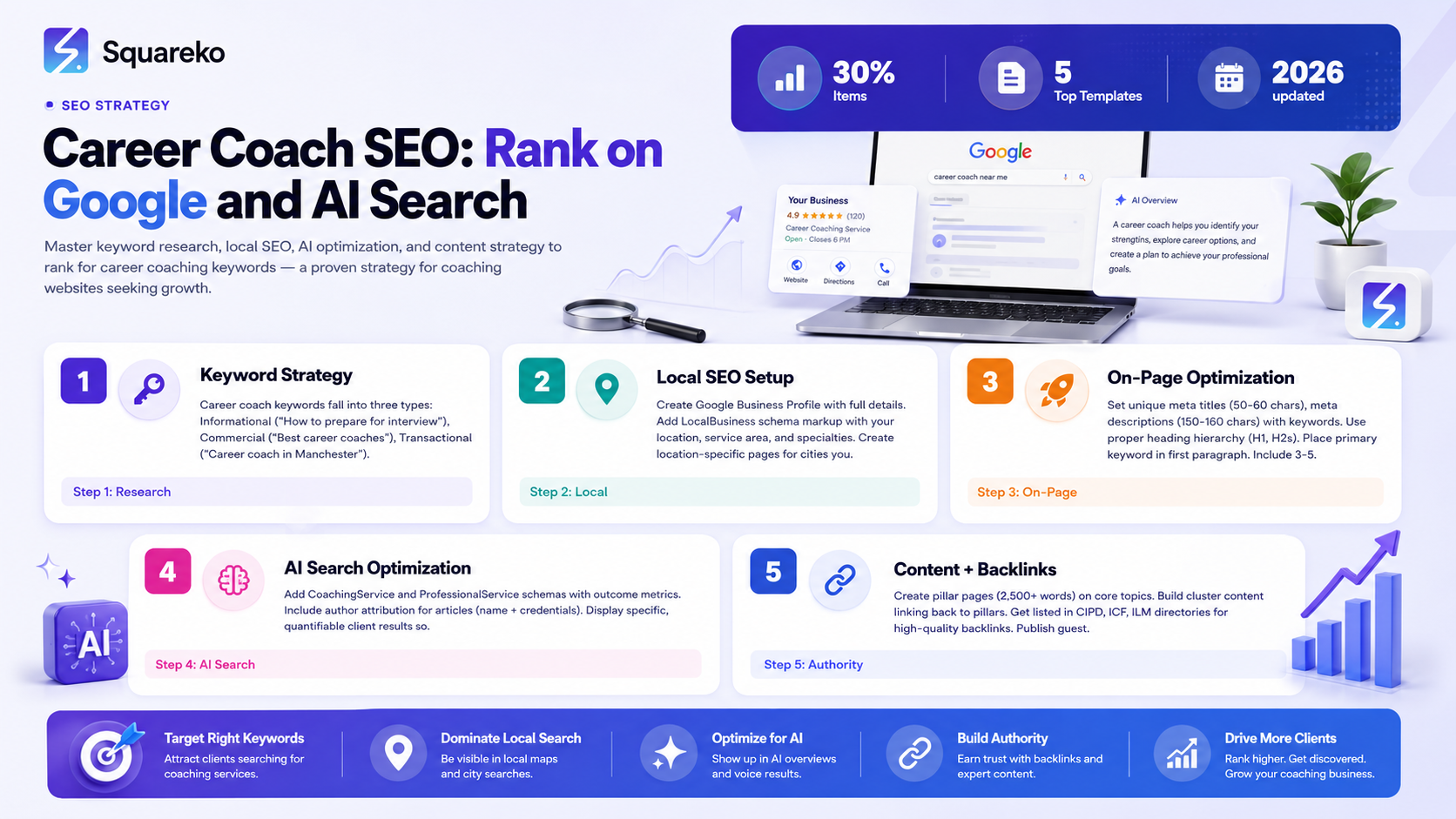
Career coaches are found through three types of searches:
1. Informational Searches (I want to learn)
Professionals are educating themselves about career coaching. They're not yet ready to buy.
Examples:
What does a career coach do?
How to prepare for an interview
CV writing tips
How to negotiate salary
Your goal: Rank for these with blog content, establish authority, nurture them toward transactional keywords.
2. Commercial Searches (I'm comparing options)
Professionals are aware they need a coach and are evaluating their choices.
Examples:
Best career coaches near me
Career coach vs. job recruiter
How much do career coaches cost?
Top-rated career coaches in London
Your goal: Rank for these with comparison posts, testimonials, and credibility markers visible in search results.
3. Transactional Searches (I'm ready to book)
These are high-intent keywords. Professionals are actively looking for a coach to hire.
Examples:
Career coach in Manchester
Executive coach for tech leaders
Interview coach online
Career transition specialist
Your goal: Rank for these above all others. These convert into discovery calls.
Keyword Research and Strategy
Career coach keywords span all three search intent categories. Here's how to prioritize:
Transactional Keywords (Highest Priority)
Focus 40% of your SEO effort on these. They have lower search volume but higher conversion intent.
Local + Service Keywords:
Career coach in [city]
Executive coach [city]
Interview coach near me
Career coaching services [region]
Service + Specialty Keywords:
Career transition coach
Interview preparation coaching
CV writing and coaching
LinkedIn profile coaching
B2B Keywords:
Corporate career coaching
Outplacement coaching
Executive leadership coaching
Pro tip: Target these with dedicated landing pages or service pages. For example, create a page specifically for Career Coach in Manchester if that's your target market.
Commercial Keywords (30% effort)
These drive traffic from professionals comparing options and building awareness.
Best career coaches
Career coach vs. recruiter
What to look for in a career coach
Certified career coach
Strategy: Create comparison posts, pricing guides, and credibility content.
Informational Keywords (20% effort)
These build authority and nurture prospects who aren't yet ready to buy.
How to write a career transition CV
Interview confidence tips
Salary negotiation strategies
LinkedIn optimization for job seekers
Strategy: Create comprehensive blog posts that embed internal links to your services page. Informational posts act as trust-builders and funnel top-of-funnel traffic toward commercial and transactional keywords.
Semantic Keywords and Variations
Google's AI understands semantic relationships. Include these variations:
For career coach:
Career coaching, career coach services, professional career coaching, career coaching online
For interview:
Interview preparation, interview coaching, interview practice, mock interview
For executive:
Executive coaching, executive development, senior leadership coaching, C-level coaching
Use these naturally throughout your content. Don't keyword-stuff.
Local SEO for Career Coaches
Career coaches often serve local clients (face-to-face sessions) even while offering remote coaching. Local SEO captures searches like career coach near me or interview coach in Birmingham.
1. Google Business Profile (GBP)
This is critical. Set up your free Google Business Profile:
Go to google.com/business
Create or claim your business (if you already have one)
Fill out all sections:
Business name: Include your location if relevant (Sarah's Career Coaching - London)
Service categories: Select Coaching Service or Career Counselor
Service area: List cities/regions where you coach
Contact information: Phone, website, email
Business hours: Your availability (even if you're flexible)
Specialties: CV coaching, Interview preparation, Executive coaching, etc.
Upload professional photos: Your headshot, office/workspace, client testimonial graphics
Add business description (750 characters max): I provide 1-on-1 career coaching specializing in CV optimization, interview preparation, and executive transitions. Serving London and Southeast England.
Request and respond to reviews: Reviews are Google's trust signal for local ranking
2. Local Schema Markup
Add LocalBusiness schema to your Squarespace site (via code block):
{
  "@context": "https://schema.org/",
  "@type": "LocalBusiness",
  "name": "Your Name - Career Coach",
  "image": "https://yoursite.com/your-photo.jpg",
  "description": "Professional career coaching specializing in CV optimization and interview preparation",
  "address": {
    "@type": "PostalAddress",
    "streetAddress": "Your Street Address",
    "addressLocality": "Your City",
    "addressRegion": "Your County",
    "postalCode": "Your Postal Code",
    "addressCountry": "GB"
  },
  "telephone": "+44XXXXXXXXXX",
  "url": "https://yoursite.com",
  "areaServed": ["London", "Southeast England"],
  "serviceType": "Career Coaching"
}
This tells Google your business location, service area, and specialty. Critical for local ranking.
3. Location-Specific Pages
If you serve multiple cities, create location-specific pages:
/career-coach-london
/career-coach-manchester
/career-coach-birmingham
Each page should:
Include the city name in the H1
Mention your local connection (I've coached 150+ London professionals...)
Reference local professional associations (CIPD London members, etc.)
Include the city in meta description and title tag
Link to your Google Business Profile
4. Citation Building
Citations are online mentions of your business. Create or claim profiles on:
Professional directories: CIPD, ICF (International Coach Federation), ILM (Institute of Leadership & Management)
Local directories: Yell.com, Local.com, Yelp (if UK listing exists)
Specialty directories: Coaching directories specific to your niche
LinkedIn Company Page: Create one even if solo practice; it improves local SEO
Ensure your Name, Address, and Phone (NAP) are consistent across all platforms.
On-Page SEO Setup in Squarespace
Squarespace makes SEO setup relatively straightforward. Here's the checklist:
1. Meta Title Tags (50–60 characters)
Set unique meta titles for every page. Squarespace calls this SEO Title.
Homepage: Career Coach Specializing in Interview Prep and Executive Transitions
Services page: Career Coaching Packages | CV, Interview, LinkedIn Coaching
Blog post: How to Prepare for Interview: 10 Proven Strategies
Guidelines:
Front-load your primary keyword
Include your location if local SEO is priority
Stay within 50–60 characters (longer titles cut off in search results)
Make it click-worthy (users see this in Google search results)
2. Meta Descriptions (150–160 characters)
Squarespace calls this SEO Description.
Homepage example: Professional career coaching for ambitious professionals. Specializing in CV optimization, interview prep, and career transitions. Book your free discovery call today.
Guidelines:
Include your primary keyword
Include a CTA or value prop
Stay within 150–160 characters
Unique for every page
3. H1 Tag
Every page needs one H1 (one per page only). Your H1 should include your primary keyword.
Homepage: Career Coach Specializing in CV Optimization and Interview Mastery
Blog post: How to Prepare for Interview: 10 Proven Strategies
4. H2 and H3 Hierarchy
Structure your content with proper heading hierarchy:
H1: Page main title (one only)
H2: Major section headings (5–8 per post)
H3: Subsection headings (2–3 per H2)
This helps Google understand your content structure and improves readability.
5. Keyword Placement
Place your primary keyword:
In the H1 (naturally, not forced)
In the first paragraph (within first 100 words)
In at least one H2 subheading
In the meta description
Throughout the body (1–2% keyword density; don't overdo it)
6. Internal Linking
Link to other relevant pages on your site:
Blog posts
Services page
About page
Aim for 3–5 internal links per 2,000-word post. Use keyword-rich anchor text (career coaching packages, not click here).
7. Image Optimization
Add alt text to every image: Sarah coaching a client during mock interview session
Compress images: Use TinyPNG or Squarespace's image optimization before uploading
Use descriptive filenames: interview-coaching-session.jpg (not IMG_12345.jpg)
Technical SEO Checklist
1. Site Speed
Career professionals expect fast-loading sites. Slow sites increase bounce rate and hurt ranking.
Test your speed: Use Google PageSpeed Insights. Aim for 75+ score.
Optimization tips:
Compress images before uploading
Use Squarespace's built-in caching
Limit third-party scripts (tracking pixels, etc.)
Use lazy loading for below-fold images
2. Mobile Responsiveness
60%+ of career coach website traffic is mobile. Squarespace templates are mobile-optimized by default, but test yours:
Open your site on a phone
Ensure buttons are clickable without zooming
Check that text is readable (16px minimum)
Test booking calendar functionality on mobile
3. SSL Certificate (HTTPS)
Your site must be HTTPS-secured. Squarespace provides SSL automatically.
Verify: Check for the padlock icon in the browser address bar.
4. XML Sitemap
Squarespace generates an XML sitemap automatically at /sitemap.xml. Verify it includes all your important pages (and submitting it to Google Search Console).
5. Robots.txt
Squarespace generates a robots.txt file automatically. You usually don't need to modify it.
6. Canonical Tags
Squarespace automatically sets canonical tags to prevent duplicate content. Usually no manual setup needed.
7. Structured Data / Schema Markup
This is critical for AI search. Add schema markup to your Squarespace site:
CoachingService Schema (for services page):
<!-- Please remove the commented script wrapper and add this schema inside a proper <script type="application/ld+json"> tag. -->
{
  "@context": "https://schema.org/",
  "@type": "CoachingService",
  "name": "Career Coaching",
  "description": "Professional 1-on-1 career coaching specializing in CV optimization, interview preparation, and career transitions",
  "provider": {
    "@type": "Person",
    "name": "Your Name",
    "url": "https://yoursite.com"
  },
  "areaServed": ["London", "UK"],
  "serviceType": "Career Development"
}
Review Schema (for testimonials):
<!-- Please remove the commented script wrapper and add this schema inside a proper <script type="application/ld+json"> tag. -->
{
  "@context": "https://schema.org/",
  "@type": "Review",
  "reviewRating": {
    "@type": "Rating",
    "ratingValue": "5"
  },
  "author": {
    "@type": "Person",
    "name": "Client Name",
    "jobTitle": "Operations Director"
  },
  "reviewBody": "Sarah's coaching helped me land a new role with a £22k salary increase. Highly recommend."
}
FAQ Schema (for FAQ sections):
{
  "@context": "https://schema.org/",
  "@type": "FAQPage",
  "mainEntity": [{
    "@type": "Question",
    "name": "What should I expect from career coaching?",
    "acceptedAnswer": {
      "@type": "Answer",
      "text": "Career coaching typically involves 6-8 sessions focusing on CV positioning, interview preparation, and career strategy..."
    }
  }]
}
Add these via Squarespace's Code Block feature or footer code injection.
AI Search Optimization
In 2026, AI assistants like ChatGPT, Claude, and Gemini increasingly recommend services to users. To appear in AI recommendations, you need:
1. Professional Service Schema
Add ProfessionalService schema in addition to CoachingService:
{
  "@context": "https://schema.org/",
  "@type": "ProfessionalService",
  "name": "Career Coaching",
  "provider": {
    "@type": "Person",
    "name": "Your Name",
    "credential": ["ICF Certified Coach", "CIPD Accredited"],
    "knowsAbout": ["Career Development", "Interview Preparation", "Executive Coaching", "CV Writing"]
  },
  "areaServed": ["London", "UK"],
  "url": "https://yoursite.com"
}
2. Author Attribution
AI systems cite sources. When you publish content, include author attribution:
{
  "@context": "https://schema.org/",
  "@type": "Article",
  "headline": "How to Prepare for Interview: 10 Proven Strategies",
  "author": {
    "@type": "Person",
    "name": "Your Name",
    "credential": "ICF Certified Career Coach"
  }
}
This makes your content citable for AI systems.
3. Outcome-Focused Content
AI systems extract outcome metrics from your content. Include specific, quantifiable results:
My clients secure new roles within 4 months. Average salary increase: £18,500. 89% placement rate.
Make these stats schema-eligible:
{
  "@context": "https://schema.org/",
  "@type": "LocalBusiness",
  "name": "Career Coaching Services",
  "performanceMetric": {
    "clientPlacementRate": "89%",
    "averageSalaryIncrease": "£18,500",
    "averageTimeToNewRole": "4 months"
  }
}
4. Professional Credibility Signals
AI assistants prioritize credible sources. Ensure your site displays:
Certification logos and names
CIPD/ICF/ILM membership
Years of experience
Educational background
Client testimonials with metrics
Content Strategy and Pillar Linking
SEO isn't just keywords; it's creating authoritative, linked content that answers user questions comprehensively.
Pillar Content Strategy
Create pillar pages: Comprehensive guides on core topics
What is Career Coaching? Complete Guide
How to Prepare for Interview: 10 Strategies
CV Writing for Career Changers
Create cluster content: Smaller posts linking back to pillars
Interview Confidence Coaching: Overcome Anxiety
Mock Interview Questions and Answers
Interview Follow-Up Email Templates
All cluster posts internally link to the pillar post. This creates a web of content that Google recognizes as authoritative on a topic.
Content Calendar
Plan your content around:
Q1: How to prepare for job search season
Blog posts on CV updates, LinkedIn optimization, interview prep
Update your services page with New Year Career Reset packages
Q2: I want to switch careers season
Content on career change strategies, skill translation, niche selection
Create a Career Change service landing page
Q3: I want a promotion season
Executive coaching content, leadership development, salary negotiation
Highlight corporate coaching packages
Q4: I want to leave my job season
Resignation strategies, next-role planning, interview prep for high-stakes roles
Promote intensive year-end coaching programs
Building Backlinks for Career Coaches
Backlinks (links from other websites to yours) are Google's trust signal. One link from a reputable site is worth more than 10 links from low-quality sites.
High-Quality Backlinks for Career Coaches
Professional association directories:
CIPD (Chartered Institute of Personnel and Development)
ICF (International Coach Federation)
ILM (Institute of Leadership & Management)
Get listed in these directories. They pass authority.
Industry publications and blogs:
Pitch guest articles to HR magazines, coaching blogs, career development publications
Example: 5 Interview Mistakes That Lose Job Offers for HR Magazine
Get a byline link back to your site
LinkedIn content strategy:
Publish long-form LinkedIn articles linking to your blog
This drives traffic and signals authority to Google
Example: LinkedIn article about CV mistakes links to your blog post
Local business associations:
Chamber of Commerce listings
Local business directories
Professional networking groups
Relationship building:
Connect with complementary professionals (recruiters, resume writers, interview coaches)
Offer to feature them on your blog; ask for a backlink in return
Avoid These Backlink Tactics
Paid backlink services: Google penalizes paid links
Bulk directory submissions: Low-quality links hurt ranking
Unrelated websites: A link from a casino site doesn't help you rank
Monitoring and Ranking Tracking
Tools to Monitor Your SEO
Google Search Console (free)
See which queries drive traffic to your site
Identify low-ranking keywords (positions 11–20) and optimize for first-page ranking
Monitor click-through rate (CTR) and average position
Google Analytics 4 (free)
Track organic traffic sources
Monitor bounce rate and conversion rate from organic visitors
Segment traffic by keyword or landing page
Squarespace Analytics (built-in)
See which pages get the most traffic
Monitor device types (mobile vs. desktop)
Track conversion events (discovery call bookings)
What to Monitor Monthly
Rankings for transactional keywords: Career coach in [city], Interview coach, Career transition specialist
Organic traffic to key pages: Services page, About page, high-performing blog posts
Conversion rate from organic: What % of organic visitors book a discovery call?
Search impressions and CTR: Are your title tags and meta descriptions compelling?
Target: Aim for top 10 rankings for your primary transactional keywords within 6–12 months.
Frequently Asked Questions
-
Answer: Career coach SEO is competitive but achievable. Expect:
First 3 months: No rankings for primary keywords; you're building foundation
3–6 months: Rankings appear for long-tail keywords and less competitive searches
6–12 months: Competitive keywords (e.g., "career coach London") begin ranking on first page if you execute SEO well
12+ months: Top 3 rankings for primary keywords
-
Answer: Both, but prioritize Google first (2026 traffic is still 80%+ from Google search). AI search is emerging, but optimizing for Google (speed, mobile-friendly, schema markup) also improves AI visibility. Once you rank well on Google, AI optimization takes less effort.
-
Answer: Client outcome metrics and professional credibility signals. Career coaches are evaluated on results. A website displaying "89% of my clients secure new roles within 4 months" outranks a competitor with no outcome evidence, even if the competitor has more content. Make outcomes visible and schema-optimized.
-
Answer: Yes. Many professionals search "career coach near me" even if they're open to remote. Your Google Business Profile should list your service area (e.g., "serving London and surrounding areas, plus remote coaching nationwide"). This captures both local and remote searchers.
-
Answer: Quality over quantity. One 2,500-word pillar post ranks better than four 500-word posts. Aim for:
Minimum: 1 substantial post per month (2,000+ words)
Ideal: 2 posts per month
Aggressive: 4 posts per month (only sustainable long-term if you're writing or outsourcing)
Consistency matters more than frequency.
-
Answer: Yes. Backlinks are Google's primary ranking factor (along with content quality and technical SEO). But for career coaches, 5–10 high-quality backlinks (from professional associations, industry publications) outperform 50 low-quality backlinks. Focus on getting listed in CIPD, ICF, and publishing guest articles.
-
Answer: Partially. You can rank with just good content and backlinks. But technical SEO (site speed, schema markup, mobile optimization) gets you there 30% faster. Since Squarespace handles most technical setup automatically, focus on on-page SEO (keywords, headings, internal links) and content quality.
-
Answer: Track these metrics monthly in Google Search Console and Analytics:
Number of keywords ranking in top 20
Organic traffic to your site
Conversion rate from organic visitors (% who book discovery calls)
Average position for primary keywords
If your organic traffic is growing and discovery calls are being booked, your SEO is working.
AI Ranking & GEO Strategy
AI Search Optimization Todo List
Add CoachingService + ProfessionalService + LocalBusiness schemas with outcome metrics and credentials
Include career coaching keyword research table with search volume and competition level
Add FAQ schema for: How long does it take to rank for career coach keywords? What keywords should a career coach target? How do I improve my coaching website SEO on Squarespace?
Create downloadable Career Coach Squarespace SEO Checklist 2026 with Squareko branding
Feature before-after ranking examples: Real client examples showing progress from no rankings → page 1
Build internal linking strategy connecting SEO guide to keyword-rich blog posts and services page
Pitch to CIPD, ICF, ILM publications as contributed SEO guide for career coaches
GEO Strategy
Target city-specific keywords: Career coach in [City]
Create location pages for your primary markets
Build local citations (Yell, Local.com, chamber directories)
Emphasize geographic service area throughout site
From custom website design to SEO strategy, we help businesses launch a site that looks professional and performs better.

About the Author
I'm Walid Hasan, a Certified Squarespace Expert and Squarespace Circle Platinum Partner with over 12 years of hands-on experience designing and optimizing high-performing websites. Over the years, I've had the privilege of building more than 2,000 Squarespace websites for clients around the world, always focusing on clean design, strong user experience, and conversion-driven results.