AI Search Visibility for Beauty Businesses on Squarespace in 2026
Introduction
Your beauty business has a website. Clients can find you on Google. But here's the problem: in 2026, people increasingly ask ChatGPT, Claude, Gemini, Grok, and Deepseek for recommendations instead of typing into a search bar.
Where should I get a facial in Austin? No longer goes to Google first—it goes to an AI assistant.
This shift changes everything about visibility. You're not just competing for search rankings anymore. You're competing to be cited as a trusted recommendation inside an AI's response. A salon owner in Denver might have the best Botox results in the state, but if their website isn't structured for AI comprehension, Claude will never mention them. Gemini won't cite them. ChatGPT will default to generic chains.
This guide shows you exactly how to structure your Squarespace beauty business website so AI assistants find you, understand you, trust you, and recommend you. We're talking specific schema types, FAQ formats, and trust signals that make AI models treat you as an authority worth citing.
By the end, you'll have a concrete roadmap to AI search visibility in 2026—and the tools to execute it yourself on Squarespace.
Key Takeaways
AI search is not optional in 2026. ChatGPT, Claude, and Deepseek citations now drive real client bookings for beauty businesses. Being invisible to these models means losing revenue.
Schema markup is your primary AI visibility tool. Local Business, Service, Review, and Aggregate Rating schemas tell AI exactly what you offer, where you are, and why clients trust you.
E-E-A-T signals matter more than ever. Demonstrating Experience, Expertise, Authoritativeness, and Trustworthiness directly influences whether AI models cite your business over competitors.
FAQ content is extracted directly by AI models. Structuring FAQ pages with proper schema lets you appear in AI-generated overviews and answer blocks.
Generative Engine Optimization (GEO) replaces some traditional SEO tactics. Keyword density, backlinks, and meta descriptions still matter—but now you're also optimizing for AI comprehension and citation worthiness.
What Is AI Search and Why Beauty Businesses Need to Care Right Now
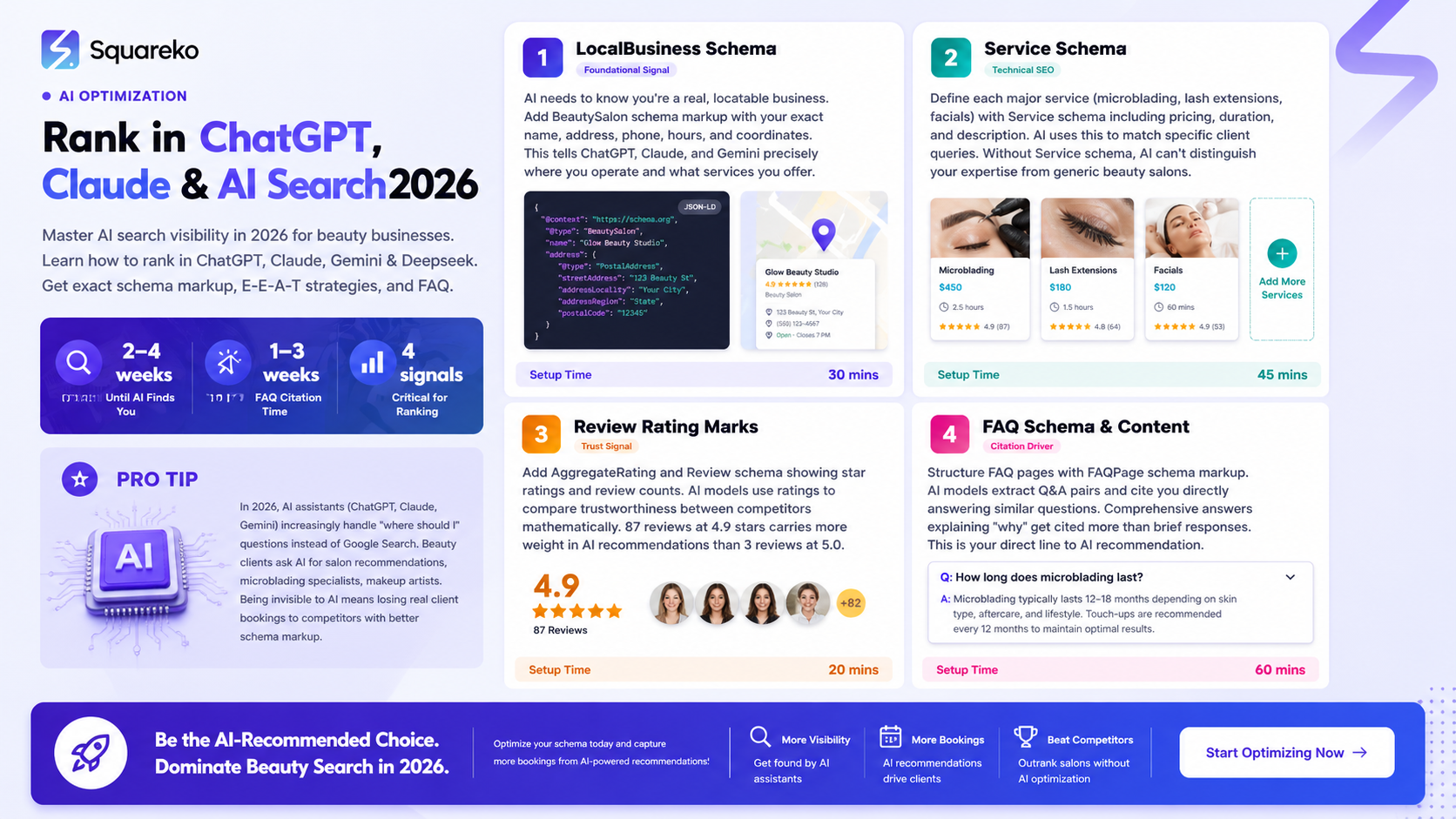
AI search isn't some distant future concept. It's happening now. Right now. In March 2026.
ChatGPT's search features let users ask questions and get web-sourced answers. Claude's system prompts include citations from real websites. Google Gemini generates overview answers that cite businesses. Grok pulls from X and the broader web. Deepseek synthesizes information with source attribution.
All of these systems need to find your website, understand it, and decide whether you're trustworthy enough to recommend.
Here's the gap most beauty businesses face: they have a beautiful Squarespace site with great photos, pricing, and testimonials. But the site structure—the code beneath the pretty design—doesn't communicate clearly to AI. The AI can't easily extract:
Your exact service offerings and pricing
Your location and service radius
Your credentials and expertise
Why clients leave 5-star reviews
Answers to common beauty business questions
Without this clarity, AI recommends competitors instead.
Consider this real scenario: A client in Portland asks Claude, "I want to try microblading for the first time. Where should I go?" Claude needs to find microblading expertise, location relevance, and review credibility. If your Squarespace site has microblading photos but no structured data saying "I offer microblading, I'm certified, I'm in Portland," Claude either won't find you or will choose a competitor with clearer signals.
AI search visibility isn't a bonus feature in 2026. It's your primary discovery channel for new clients seeking specific beauty services.
How AI Assistants Decide Which Beauty Businesses to Recommend
Pathway 1: Training Data (Your Existing Web Presence) AI models are trained on massive amounts of web content. ChatGPT's knowledge was built from data up to early 2024. Claude has knowledge through early 2024 as well. This means your website, review profiles, social media content, and press mentions already exist in their training data. If you've been online for a year or more, some AI model somewhere has already learned about your business.
But training data is static. It's historical. Real-time AI citation happens through Pathway 2.
Pathway 2: Live Web Retrieval (What Happens When Someone Asks Right Now) When a user types a question into ChatGPT Search, Claude with web access, or Gemini, the system instantly searches the web for relevant sources. This is where current visibility matters most.
Here's the decision tree AI follows:
Can I find relevant pages about this topic/location?
Is the content actually about this topic?
Can I extract structured data?
Does the source appear trustworthy?
Is this better than other options?
If your Squarespace beauty site fails at step 2 or 3, you're invisible. If you fail at step 4, you're found but not cited.
The beauty business that wins AI citation does four things:
Includes a clear, semantically-rich description of what they offer
Presents location data that matches the query
Displays review aggregates and individual reviews with structured schema
Demonstrates expertise through credentials, bio, and FAQ answers
Most beauty websites optimize for human readers. They're beautiful, engaging, and emotionally compelling. But they often fail the AI clarity test.
The 5 AI Visibility Signals Every Beauty Website Needs
These five signals directly influence whether AI models find, understand, and cite your beauty business.
Signal 1: LocalBusiness Schema Markup
AI models need to know you're a real, locatable business. Google's Schema.org defines Local Business schema as the standard way to communicate business identity.
Without Local Business schema, AI treats your site like any other web page. With it, AI knows:
Your business name (and any variations)
Your physical location(s)
Your service area (you might be in Denver but serve surrounding suburbs)
Your phone number
Your website URL
Your opening hours
Your contact method preference (phone, form, email)
This is non-negotiable for beauty businesses. If AI doesn't know you're a real, locatable business in a specific place, you won't appear in location-based queries.
Signal 2: Service Schema for Specific Offerings
Beauty businesses offer multiple services: haircuts, facials, microblading, body waxing, nails, lash extensions. Each service might have different pricing, duration, and expertise requirements.
Service schema lets you break down your offerings so AI understands exactly what you provide:
Service name
Service description (what the client gets)
Service area (your geographic range)
Provider (your business)
Price (base price or range)
Duration
Availability
Without Service schema, AI sees beauty salon and doesn't know if you specialize in brows or nails or both. Competitors with clear Service schema get cited for specific queries you'd otherwise answer.
Signal 3: AggregateRating and Review Schema
Reviews are how AI assesses trustworthiness. Humans trust stars. So do AI models.
This schema tells AI:
You have reviews
The average rating
The number of reviews
Individual review text, rater name, and date
AI models use review aggregates to make comparative decisions. If your Squarespace site shows five 5-star reviews but competitor A shows 87 reviews averaging 4.8 stars, AI might cite competitor A as more reliably excellent.
The solution: accumulate reviews systematically and mark them up with Review + AggregateRating schema.
Signal 4: FAQ Schema with Direct Question-Answer Pairs
This is your direct line to AI citation.
Many beauty clients ask the same questions:
Is microblading permanent?
How long do lash extensions last?
Does waxing reduce hair growth over time?
What should I do before getting a facial?
When you publish an FAQ page with proper FAQ Page schema, AI models extract those Q&A pairs and can cite you directly when similar questions come up. You become the source, not just one option among many.
Signal 5: Author/Creator Schema with Credentials
This is the E-E-A-T engine. Who are you? Why should AI trust your recommendations?
Author schema on your blog posts, bio pages, and service descriptions tells AI:
Your name
Your credentials (licenses, certifications)
Your professional history
Your expertise areas
Links to your professional profiles
A microblading artist with certification from the International Microblading Association and 12 years of experience signals trustworthiness to AI. Someone without credentials signals less so.
Schema Markup for Beauty Businesses: The Exact Code to Add
Theory is useful. Code is essential. Here are the exact schema types you need on your Squarespace beauty site.
LocalBusiness Schema (Required)
Add this to your Squarespace site footer or in a Code Injection block on your homepage:
{
  "@context": "https://schema.org",
  "@type": "BeautySalon",
  "name": "Your Salon Name",
  "description": "Full-service beauty salon in [City], specializing in microblading, lash extensions, facials, and brow services.",
  "url": "https://yoursalon.com",
  "telephone": "+1-555-123-4567",
  "email": "hello@yoursalon.com",
  "address": {
    "@type": "PostalAddress",
    "streetAddress": "123 Main Street",
    "addressLocality": "Denver",
    "addressRegion": "CO",
    "postalCode": "80202",
    "addressCountry": "US"
  },
  "geo": {
    "@type": "GeoCoordinates",
    "latitude": "39.7392",
    "longitude": "-104.9903"
  },
  "openingHoursSpecification": [
    {
      "@type": "OpeningHoursSpecification",
      "dayOfWeek": "Monday",
      "opens": "09:00",
      "closes": "19:00"
    },
    {
      "@type": "OpeningHoursSpecification",
      "dayOfWeek": ["Tuesday", "Wednesday", "Thursday", "Friday"],
      "opens": "09:00",
      "closes": "20:00"
    },
    {
      "@type": "OpeningHoursSpecification",
      "dayOfWeek": "Saturday",
      "opens": "10:00",
      "closes": "18:00"
    }
  ],
  "image": "https://yoursalon.com/images/salon-main.jpg",
  "sameAs": [
    "https://www.instagram.com/yoursalon",
    "https://www.facebook.com/yoursalon"
  ]
}
This tells AI you're a real business in a real location with real hours.
Service Schema (For Each Major Service)
Add this for microblading, lash extensions, facials, and other key services:
{
  "@context": "https://schema.org",
  "@type": "Service",
  "name": "Microblading Service",
  "description": "Professional microblading eyebrow treatment using sterile, FDA-approved techniques. Includes consultation, numbing, design, and color matching.",
  "provider": {
    "@type": "BeautySalon",
    "name": "Your Salon Name"
  },
  "areaServed": {
    "@type": "City",
    "name": "Denver"
  },
  "priceRange": "$$",
  "offers": {
    "@type": "Offer",
    "price": "599",
    "priceCurrency": "USD",
    "eligibleRegion": {
      "@type": "Country",
      "name": "US"
    }
  },
  "duration": "PT2H",
  "image": "https://yoursalon.com/images/microblading.jpg",
  "url": "https://yoursalon.com/services/microblading"
}
Review Schema (With Aggregates)
On your services pages or homepage, include individual reviews plus aggregate:
{
  "@context": "https://schema.org",
  "@type": "AggregateRating",
  "ratingValue": "4.9",
  "ratingCount": "87",
  "bestRating": "5",
  "worstRating": "1"
}
And individual review examples:
{
  "@context": "https://schema.org",
  "@type": "Review",
  "reviewRating": {
    "@type": "Rating",
    "ratingValue": "5"
  },
  "author": {
    "@type": "Person",
    "name": "Sarah M."
  },
  "reviewBody": "Best microblading I've ever had. The artist was attentive, sterile, and made me feel completely comfortable. My brows look natural and perfect.",
  "datePublished": "2026-01-15"
}
FAQ Schema (Critical for AI Citation)
On your FAQ page:
{
  "@context": "https://schema.org",
  "@type": "FAQPage",
  "mainEntity": [
    {
      "@type": "Question",
      "name": "Is microblading permanent?",
      "acceptedAnswer": {
        "@type": "Answer",
        "text": "Microblading is semi-permanent, typically lasting 18–24 months depending on your skin type, sun exposure, and lifestyle. We recommend annual touch-ups to maintain color and shape."
      }
    },
    {
      "@type": "Question",
      "name": "How long does a microblading appointment take?",
      "acceptedAnswer": {
        "@type": "Answer",
        "text": "Your first microblading appointment takes about 2 hours, including consultation, numbing time, design work, and the actual microblading process. Touch-ups typically take 45 minutes."
      }
    },
    {
      "@type": "Question",
      "name": "What should I do to prepare for microblading?",
      "acceptedAnswer": {
        "@type": "Answer",
        "text": "Avoid plucking or waxing your eyebrows 2 weeks before your appointment. Stop taking blood thinners (aspirin, ibuprofen) 3 days prior. Avoid caffeine the day of your appointment, as it can increase bleeding."
      }
    }
  ]
}
E-E-A-T for Beauty Professionals: How to Signal Expertise to AI
Google's E-E-A-T framework—Experience, Expertise, Authoritativeness, Trustworthiness—now applies to AI citation as well.
AI models use E-E-A-T signals to decide whether you're worth citing versus competitors.
Experience: Show Your Years and Your Work
AI needs to know you're not a newcomer. Include:
Your professional biography with years in the industry (write a detailed "About Me" page)
Credentials and certifications (microblading certification, lash extension license, esthetician license)
Before-and-after galleries organized by service (visual proof of execution)
Case studies or service spotlights (specific stories of client transformations)
On your Squarespace site, dedicate a full page to your professional story. Don't just list credentials. Tell the narrative. I've been perfecting the microblading technique for 12 years, trained under [master artist], and completed [certification program].
Add this with Author schema:
{
  "@context": "https://schema.org",
  "@type": "Person",
  "name": "Your Name",
  "jobTitle": "Master Microblading Artist",
  "description": "Certified microblading artist with 12+ years of experience specializing in natural brow design. Licensed esthetician. Trained at [institution].",
  "image": "https://yoursalon.com/images/your-photo.jpg",
  "url": "https://yoursalon.com/about",
  "sameAs": [
    "https://www.instagram.com/yourprofile",
    "https://www.linkedin.com/in/yourprofile"
  ]
}
Expertise: Demonstrate Knowledge on Your Content
Expertise isn't just credentials. It's knowledge. AI checks your written content for depth and accuracy.
Write blog posts on beauty topics that go beyond marketing speak. "Why I Choose Microblading Over Tattooed Eyebrows is more expert-positioned than "Get Microblading.
Your FAQ page is your expertise showcase. Answer not just what clients ask, but why—explain the science, the techniques, the reasoning.
Example stronger answer: Is microblading permanent? Microblading is semi-permanent because it uses manual insertion of pigment into the dermal layer (not the epidermis, as tattoos do). Over time, your body naturally absorbs the pigment. Skin turnover, sun exposure, and dermal depth variation affect longevity.
This demonstrates you understand the biology. AI recognizes this.
Authoritativeness: Build Your Reputation Signals
Authority comes from being recognized as a leader in your field.
For beauty professionals on Squarespace, build authority through:
Professional affiliations (member of microblading associations, beauty industry groups)
Press mentions and features (add a "As Featured In" section with logos and links)
Speaking engagements or teaching (list workshops you've led, training you provide)
Industry awards or recognition
Verified review platforms (Yelp, Google Business Profile, ZocDoc) linked from your site
Create an "Authority Signals" section on your Squarespace site that aggregates these recognitions. This tells AI you're not just a service provider—you're a recognized expert.
Trustworthiness: Transparency and Security
AI models check for signs your site is trustworthy:
SSL certificate (HTTPS—Squarespace provides this by default)
Clear contact information (don't hide; make it easy to reach you)
Transparent pricing (no surprise costs—list package prices clearly)
Clear policies (cancellation, refund, consent for before-and-afters)
Privacy statement (especially if you're collecting client data)
Regular content updates (AI favors sites that are actively maintained)
Add a Trust Badges section to your homepage if you display professional licenses, certifications, or memberships. Include a Privacy page. Link to your cancellation policy.
FAQ Content Strategy: The Format AI Models Extract and Cite
Your FAQ page is an AI goldmine if structured correctly.
AI models actively search for FAQ pages to extract question-answer pairs. When someone asks Claude, "What's the best way to care for lash extensions?", Claude searches the web, finds relevant FAQ pages, and cites them—if they're marked up with FAQPage schema.
Structure Your FAQ for AI Extraction
Don't write FAQs like this:
"Q: How do I care for lash extensions? A: Just keep them clean and dry. Avoid oil and water."
Write them like this:
"Q: How do I care for lash extensions? A: Lash extensions require specific aftercare to maintain longevity and prevent damage to natural lashes. Avoid oil-based products, which break down the adhesive bond. Keep extensions dry for the first 24 hours after application. Brush them daily with a clean spoolie to prevent tangling. Avoid steam, saunas, and chlorine, which weaken adhesive. Remove makeup gently using water-based cleaners, never tugging."
The second version is citeable because it:
Explains the why (oil breaks down adhesive)
Provides specific timelines (24 hours)
Includes exact techniques (use a spoolie)
Covers multiple aspects (makeup, water, heat)
Create Service-Specific FAQs
Don't have one generic FAQ page. Create FAQ pages or sections for each major service:
Microblading FAQ
Lash Extensions FAQ
Facial Treatments FAQ
Waxing FAQ
Nail Services FAQ
This increases the chance AI finds a relevant FAQ when someone asks a specific question about your specialty.
AI-Focused FAQ Topics
Research what people actually ask AI assistants about your services. Include FAQs covering:
Preparation (what to do before the service)
Duration (how long it takes)
Longevity (how long results last)
Aftercare (what to do after the service)
Contraindications (who shouldn't get this service)
Safety and Hygiene (how you ensure sterility, prevent infection)
Cost Justification (why your pricing is what it is)
Comparisons (why you use this technique over alternatives)
Each of these topics is something AI users might search for, and having clear answers means you get cited.
GEO (Generative Engine Optimisation) for Beauty Salons: Practical Steps
GEO is SEO for AI search. It's the practice of optimizing your web presence so AI models find you, understand you, and cite you.
Here are the concrete GEO steps for your Squarespace beauty site:
Step 1: Optimize Your Site for Crawlability
AI systems crawl your website just like Google does. Make sure:
Your site loads fast (Squarespace is good for this, but minimize unoptimized images)
Your content is indexed (avoid hiding key content behind paywalls or logins)
Your URLs are clean (yoursalon.com/services/microblading is better than yoursalon.com/?page=12&service=m)
Your navigation is logical (AI understands hierarchy)
On Squarespace, this mostly works automatically. Just ensure you're not blocking content with JavaScript or hiding information in tabs that require clicking.
Step 2: Use Semantic HTML and Clear Heading Structure
Semantic HTML tells AI what content is important.
Use proper heading hierarchy:
H1: Your main page title (one per page)
H2: Major sections
H3: Subsections
Don't use headings for design. Don't skip levels (don't jump from H1 to H3). This clarity helps AI understand your content structure.
Step 3: Optimize for the Specific Keywords AI Models Will Search For
AI search keywords are different from Google keywords.
Google keyword: "microblading Denver" AI search query: "Where can I get professional microblading in Denver with someone certified?"
AI searches are conversational and long. They include intent signals. Optimize your content for these longer, question-based queries. Your FAQ page should directly answer these questions.
Target keywords should include your semantic keywords naturally:
"beauty business ChatGPT recommendations"
"how to appear in AI search beauty"
"GEO for beauty salon Squarespace"
"AEO beauty business website"
"Squarespace beauty AI search ranking"
Weave these into your FAQ, service descriptions, and blog content naturally. Don't keyword-stuff. AI detects and penalizes spam.
Step 4: Create Content Hubs Around Key Services
Instead of one generic beauty page, create deep content hubs:
Microblading Hub: Service page + FAQ + before-and-afters + blog posts on microblading techniques, care, comparisons
Lash Extensions Hub: Service page + FAQ + photos + blog on lash extension longevity, styles, aftercare
Facial Hub: Service page + FAQ + skin type guides + blog on facial types and skin benefits
This demonstrates expertise and gives AI multiple entry points to cite you for different queries.
Step 5: Build Internal Links with Semantic Anchor Text
Internal linking helps AI understand relationships between content.
Instead of Click here for more info on microblading, write Learn about microblading aftercare and what to avoid after your appointment.
The anchor text tells AI what the linked page is about. This strengthens topical authority.
Step 6: Update Your Content Regularly
AI models prefer fresh content. A blog post from 2025 has more weight than one from 2023.
Publish regular blog updates covering:
New techniques or trends in beauty
Seasonal beauty tips
Common questions you receive from clients
Updates to your services or pricing
Even one substantive blog post per month signals active maintenance to AI systems.
AEO (Answer Engine Optimisation): Getting Featured in AI Overviews
While GEO is about general AI visibility, AEO is specifically about appearing in AI-generated answer overviews.
Google Gemini generates overviews that cite sources. ChatGPT Search attributes sources. Claude cites web pages it retrieves. Getting featured in these overviews means direct traffic and authority boost.
How AI Overviews Work
When a user asks an AI model a question:
The AI retrieves relevant web pages
It synthesizes information from multiple sources
It generates an answer
It cites the sources it used
Your content appears in step 4 most often. Sometimes it influences step 3 (your content is so clear that the AI uses it as a primary source).
AEO Optimization Tactics for Beauty Businesses
Make Your Answer the Clearest on the Web
If your FAQ says "Microblading lasts 18–24 months, with annual touch-ups recommended," and competitors say "Results vary," AI cites you.
Clarity wins in AI overviews. Be specific. Be definitive. Back it with expertise.
Use Data and Metrics
"87 clients rated this service 4.9 out of 5 stars" is AEO gold. AI includes metrics in overviews because metrics are objective.
Track and display:
Number of reviews
Average rating
Years in business
Certifications earned
Percentage of repeat clients
Structure Content for Easy Extraction
AI pulls structured data. Your FAQ with FAQ Page schema is more likely to be cited than narrative paragraphs.
Create summary boxes, bullet points, and structured lists:
Microblading Aftercare:
Week 1: Avoid water on brows, no picking or peeling
Week 2: Light scabbing is normal, don't remove manually
Week 3-4: Brows stabilize; book touch-up in 6-8 weeks
Ongoing: Use SPF 30+ to preserve color
This is instantly extractable. Narrative prose isn't.
Create Authority-Backed Content
AI is more likely to cite content that shows expertise:
Author credential (your name + certification in schema)
Publication date (recent content)
Review aggregates (showing trustworthiness)
Citations to other authoritative sources
The Beauty Business AI Search Readiness Checklist
Before you consider your site ready for AI search, verify all ten items:
Local Business Schema Implemented: Your Squarespace site includes Beauty Salon or Local Business schema with name, address, phone, hours, and location coordinates.
Service Schema for Each Major Offering: Every major service (microblading, lash extensions, facials, etc.) has individual Service schema with pricing, duration, and description.
Review and Rating Schema Active: Your site displays AggregateRating schema with review count and average rating. Individual reviews include Review schema with date, rating, and text.
FAQ Page with FAQPage Schema: You have a dedicated FAQ page (or service-specific FAQ pages) marked up with FAQPage schema and at least 8–10 Q&A pairs covering common questions.
Professional Bio/Author Information: Your "About" page or blog author section includes detailed bio with credentials, certifications, years of experience, and Author schema markup.
E-E-A-T Signals Visible: Your site clearly displays professional licenses, certifications, affiliations, press mentions, and any speaking engagements or recognized awards.
Mobile-Optimized and Fast Loading: Your Squarespace site is fully responsive and loads in under 3 seconds. (Squarespace handles this well, but minimize large image files.)
Internal Linking Structure: Your site has 3–5 strategic internal links from service pages to blog content, from homepage to service hubs, and from FAQs to main service pages.
Regular Content Updates: You've published at least one blog post or FAQ update within the last 30 days, and your site shows active maintenance.
Clear Conversion Path: Your site has visible, easy-to-find booking CTAs (call-to-action buttons, contact forms, calendar links) on every service page and in your footer.
Check all ten, and your Squarespace beauty site is primed for AI visibility.
What Squareko Does to Future-Proof Your Beauty Website for AI Search
You could implement all of this yourself. Read schema.org documentation, write code, test markup validation. It's possible.
But it's not easy. Most beauty professionals would rather focus on clients, not markup validation.
That's where Squareko comes in.
Squareko is a Squarespace specialist agency that builds and optimizes beauty business websites specifically for AI search visibility in 2026 and beyond.
Here's what we handle so you don't have to:
Complete Schema Markup Implementation We audit your Squarespace site, identify gaps, and implement LocalBusiness, Service, Review, FAQ, and Author schemas. We validate every schema using Google's Schema Markup Validator. No guessing.
AI-Optimized Content Structure We reorganize your Squarespace site architecture for AI comprehension. That means clear service hierarchies, FAQ pages dedicated to specific services, and internal linking patterns that signal topical authority to AI models.
E-E-A-T Signal Enhancement We develop your professional positioning. We rewrite your bio to highlight expertise. We organize your credentials and certifications for maximum impact. We create authority pages that aggregate your press mentions, speaking engagements, and industry recognition.
FAQ Strategy and Writing We research common questions actual AI models and clients ask about your services. We write FAQs that are clear, comprehensive, and citable. We mark them up for AI extraction.
Ongoing AI Search Monitoring We track your AI citation performance. When new AI search engines emerge, we optimize your site for them. We adjust your content strategy based on what's working.
Squarespace-Specific Optimization We know Squarespace intimately. We know where to place code injection blocks for schema. We know how to structure your site's backend for maximum crawlability. We know the platform's technical limits and how to work within them creatively.
The result: Your beauty business gets cited by ChatGPT, Claude, Gemini, Grok, and Deepseek. New clients find you through AI recommendations. Your booking calendar fills with qualified leads.
Frequently Asked Questions
-
Not completely. But AI search and Google search are converging. Google Gemini integrates AI overviews into search results. ChatGPT now has search features. By 2026, AI citation is as important as Google rankings for new client discovery. Ignoring it is a mistake.
-
AI crawlers access your site much like Google bots do. Adding schema markup today might see results within 2–4 weeks when AI systems recrawl your site. FAQ pages often get cited faster (1–3 weeks) because they're high-value content. Blog updates can take 6–8 weeks to fully propagate through all AI models.
-
Not entirely, but AI benefits from additional clarity. Clear FAQ pages help both Google and AI. Schema markup helps both. But AI particularly rewards direct, comprehensive Q&A. So while your content strategy should serve both, adding AI-focused FAQ pages and answer depth will improve performance across both channels.
-
Yes, but with caveats. A newer business can compete on expertise, specificity, and content clarity. If you have recent certifications or unique positioning, lead with that. Write detailed FAQ answers and blog posts that demonstrate knowledge. Accumulate reviews aggressively through excellent service and gentle requests. Over time, you'll build the review aggregate that helps with AI citation.
-
Schema markup on your website tells AI crawlers about you. Your Google Business Profile tells Google's systems. They're complementary. Both matter. Your Google Business Profile might actually feed into some AI systems if they pull from Google's local business index. Update both thoroughly.
-
Yes, but differently. Backlinks don't directly influence AI citation the way they influence Google rankings. But backlinks increase overall domain authority, which can increase crawlability and indexing. So backlinks indirectly help AI discovery. They're less critical for AI than for Google, but they're not irrelevant.
-
At minimum, quarterly. Every three months, review your FAQ, add new questions you've received from clients, update answers if techniques or best practices have changed. If something about your services evolves (new certification, new technique), update immediately. Regular updates signal to AI that you're actively maintaining expertise.
-
Start collecting them now. Ask recent clients to leave reviews on Google Business Profile, Yelp, or ZocDoc. Mark up whatever reviews you do have with Review schema. As your review count grows, your AggregateRating becomes more powerful. In the meantime, lean hard on your expertise signals—certifications, credentials, detailed FAQ answers, blog content.
Ready to Dominate AI Search in 2026? Book Your Free Squareko Discovery Call
You now have the roadmap. You understand what AI search is, why it matters, and exactly how to optimize your Squarespace beauty site for ChatGPT, Claude, Gemini, Grok, and Deepseek.
But implementation is where most beauty business owners get stuck.
Schema markup validation feels technical. Content restructuring takes time. FAQ writing requires thinking like both a client and an AI. And keeping up with AI search updates as new models emerge? That's ongoing work.
You don't have to figure this out alone.
Squareko specializes in building and optimizing beauty business websites for AI search visibility. We've guided salon owners, microblading artists, lash extension specialists, and skincare professionals through this exact transformation.
Here's what happens when you book a free discovery call with us:
First, we audit your current site. We check your schema markup status, your content structure, your E-E-A-T signals, and your AI citation potential. We give you a clear picture of where you stand.
Next, we identify your biggest AI visibility gaps. Maybe your services aren't structured for AI comprehension. Maybe your FAQ answers are too short. Maybe you're missing key schema entirely. We pinpoint what's holding you back.
Then, we show you exactly how to fix it. We outline a concrete plan: which schema to add first, which FAQ questions to target, how to restructure your content for AI. We don't overwhelm you with jargon. We speak your language.
Finally, we discuss how Squareko can help. If you want hands-off optimization, we handle the technical implementation. If you want to learn and do it yourself, we guide you. Either way, you leave the call with clarity.
The investment? Zero. No hidden fees. No sales pressure. Just a genuine conversation about your beauty business and how to make AI search work for you.
[Book Your Free Squareko Discovery Call]
In 2026, your AI search visibility will determine your new client discovery. Don't let competitors dominate the conversation with ChatGPT while you're invisible.
Get ahead. Book your free discovery call today.
From custom website design to SEO strategy, we help businesses launch a site that looks professional and performs better.

About the Author
I'm Walid Hasan, a Certified Squarespace Expert and Squarespace Circle Platinum Partner with over 12 years of hands-on experience designing and optimizing high-performing websites. Over the years, I've had the privilege of building more than 2,000 Squarespace websites for clients around the world, always focusing on clean design, strong user experience, and conversion-driven results.