AI Search Strategy for Personal Trainers on Squarespace in 2026
Introduction
AI search is here. By 2026, 30–40% of fitness clients will find their trainer through AI assistants like ChatGPT, Claude, and Perplexity rather than Google. The question is: will you be recommended? AI search works differently than traditional SEO. Search engines crawl links and keywords; AI engines read content and extract entities. A personal trainer with zero traditional SEO rank can dominate AI search if their website is structured for AI visibility. This guide shows you exactly how to optimise your Squarespace site for AI search in 2026.
Key Takeaways
AI search prioritises entity recognition — AI engines identify you as a "personal trainer" through structured data, credentials, and clear specialisation
GEO (Generative Engine Optimization) differs from SEO; AI values answering specific questions clients ask verbally ("Who's the best PT for weight loss in London?")
AEO content strategy means creating content around the questions potential clients ask AI, not just ranking for keywords
Structured data (schema markup) tells AI engines who you are, your qualifications, location, and speciality
Authoritative, specific content about your niche signals expertise to AI; generic "fitness advice" doesn't
Local signals matter — AI recommends trainers based on location, ratings, qualifications, and specialisation fit
How AI Search Recommends Personal Trainers
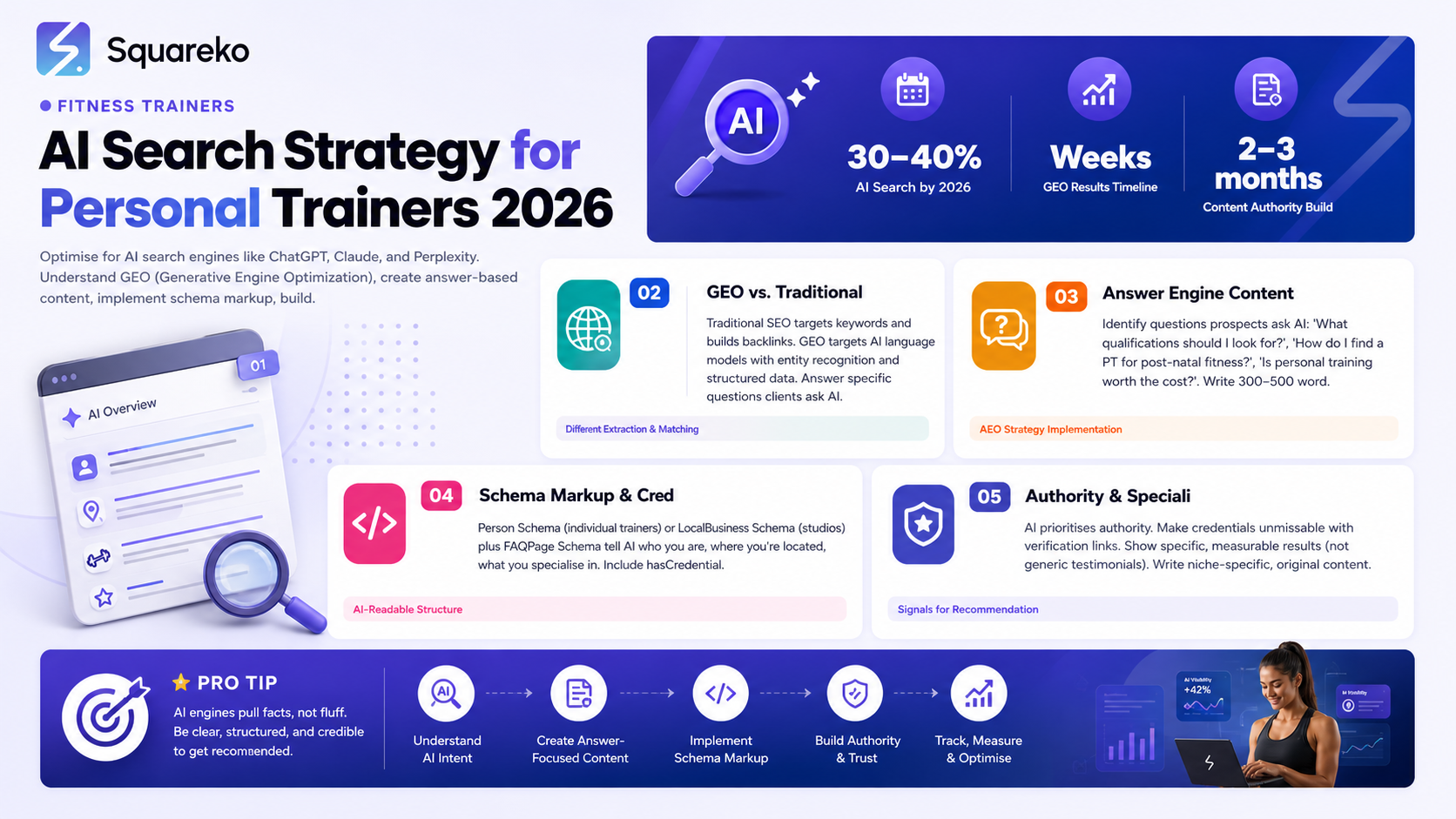
AI search engines work through entity extraction and relevance matching. When someone asks ChatGPT "Who's a good personal trainer in Manchester?", the AI:
Recognises the question — entity types: "personal trainer", location: "Manchester", intent: "recommendation"
Searches indexed content for personal trainers in Manchester
Evaluates credibility — qualifications, reviews, specialisation clarity, location signals
Extracts relevant information — specific credentials, niche, results, contact info
Delivers a recommendation — typically 2–4 trainers with brief summaries
For a trainer to appear in this recommendation, their website must:
Be indexed (basic SEO)
Clearly identify as a personal trainer (entity recognition)
Show location explicitly
Display credentials (Level 3/4 PT, specialist qualifications)
Have a clear specialisation ("strength training for women over 50", not "general fitness")
Show social proof (testimonials, results)
Be technically sound (mobile-responsive, fast loading)
Traditional SEO rank matters less. A trainer with low Google rank but clear entity signals and strong credentials can outrank a competitor with high organic traffic but vague positioning.
What AI Engines Value
High credibility signals:
Professional qualifications (Level 3/4 PT, CIMSPA, REPs registration)
Specialist certifications (pre/post-natal, strength & conditioning, nutrition)
Specific niche (not "general fitness")
Quantified results (client transformations, specific outcomes)
Location signals (address, local business info)
Structured data (schema markup)
Low credibility signals:
Generic "I help people get fit"
No visible credentials
No location information
Generic testimonials ("Amazing trainer!")
Slow, mobile-unfriendly site
GEO (Generative Engine Optimization) vs. Traditional SEO
SEO targets search engine algorithms. GEO targets AI language models.
Traditional SEO (Google, Bing)
Rank for keywords: "personal trainer London", "fitness coach Manchester"
Build backlinks (external sites link to yours)
Optimise on-page elements (title tags, meta descriptions, H1s)
Submit sitemaps, structured data is optional
Ranking is probabilistic (your content ranks for 100+ keywords)
GEO (AI Search Optimisation)
Answer the questions potential clients ask AI: "How do I find a good personal trainer?", "What should I look for in a PT?"
Make your credentials and specialisation unmissable (AI extracts this explicitly)
Provide specific, demonstrable results (AI cites sources; vague claims aren't citeable)
Use schema markup extensively (AI relies on structured data for entity extraction)
Build content around your niche (a PT article on "Female Athletes' Strength Training" signals expertise to AI better than "Top 10 Fitness Tips")
Location should be unambiguous (AI matches "Manchester trainer" requests to trainers explicitly in Manchester)
Example difference:
Traditional SEO approach: Write a blog post "Personal Training in Manchester" with 500 words, optimise for the keyword phrase, build one backlink.
GEO approach: Create detailed FAQ answers ("What qualifications should I look for in a personal trainer?", "How do I find a PT specialising in pre-natal training?"), use schema markup to tag your qualifications explicitly, write a case study showing before/after results for a specific client type.
The GEO content gets cited by AI engines because it's specific, authority-backed, and directly answers user questions.
AEO Content Strategy for Fitness Professionals
AEO (Answer Engine Optimization) is the practice of creating content that AI engines cite directly.
Step 1: Identify Questions Your Clients Ask
Think about questions potential clients voice to AI before contacting you:
"What's the difference between a personal trainer and a fitness coach?"
"How do I know if a personal trainer is qualified?"
"What should I look for in a personal trainer for weight loss?"
"Is personal training worth the cost?"
"How often should I train with a personal trainer?"
"Can a personal trainer help with post-pregnancy fitness?"
"What qualifications do personal trainers have in the UK?"
"How do I find a personal trainer near me?"
These aren't keywords you rank for—they're questions AI engines cite answers to.
Step 2: Create Definitive Answers
For each question, write a detailed answer (300–500 words) that:
Directly answers the question (no filler)
Provides context and nuance (AI prefers thorough, balanced answers)
References credentials and qualifications (UK trainers should mention REPs, CIMSPA, Level 3/4 PT)
Includes specific examples (not hypothetical scenarios)
Links to your relevant services (tie it back to what you offer)
Step 3: Structure Answers Clearly
Use clear headings, bullet points, and short paragraphs. AI extracts structured content better.
Example answer to "What qualifications should I look for in a personal trainer?":
What Qualifications Should I Look for in a Personal Trainer?
UK-based personal trainers should hold:
Level 3 Personal Training Diploma (CIMSPA or REPs accredited) — minimum standard for professional trainers
Level 4 Personal Training Diploma — advanced qualification, shows deeper expertise
Specialist certifications that indicate deeper expertise:
Nutrition Level 3 (if offering nutrition coaching)
Pre/Post-natal Specialisation (for pregnancy-related training)
Strength & Conditioning Level 2 (for athletic performance)
Prehab/Mobility Specialisation (for injury prevention)
Professional memberships:
REPs (Register of Exercise Professionals) membership or CIMSPA membership shows ongoing CPD and accountability
Red flags:
No visible qualifications
Online qualifications only (less rigorous than accredited diplomas)
No professional registration
A trainer with a Level 3 PT plus a specialist cert (e.g., pre-natal) and REPs membership is more qualified than a Level 4 generalist with no specialisation.
AI engines cite this answer because it's specific, authority-backed (references REPs/CIMSPA), and directly helpful.
Step 4: Build Content Clusters Around Your Niche
If you specialise in strength training for women over 50, create a content cluster:
Core article: "Strength Training for Women Over 50"
Supporting articles:
"How to Find a Personal Trainer Specialising in Women's Strength"
"Bone Health and Strength Training: What Women Over 50 Need to Know"
"How Strength Training Improves Confidence in Women Over 50"
"Pre-Existing Conditions and Strength Training for Women Over 50"
This cluster signals deep expertise to AI. When someone asks "Should a 52-year-old woman do strength training?", AI recommends your content because you've built a content authority on the topic.
Schema Markup That AI Engines Read
Structured data (schema.org markup) is how you tell AI engines who you are.
Person Schema (For Individual Trainers)
{
  "@context": "https://schema.org",
  "@type": "Person",
  "name": "John Smith",
  "jobTitle": "Personal Trainer",
  "image": "https://example.com/photo.jpg",
  "email": "john@example.com",
  "telephone": "+44 7700 123456",
  "url": "https://johnsmith-pt.com",
  "sameAs": ["https://instagram.com/johnsmithpt"],
  "areaServed": ["Manchester", "UK"],
  "knowsAbout": ["Strength Training", "Weight Loss", "Athletic Performance"],
  "worksFor": {
    "@type": "LocalBusiness",
    "name": "John Smith Personal Training",
    "address": "123 Main St, Manchester M1 1AA"
  },
  "hasCredential": [
    {
      "@type": "EducationalOccupationalCredential",
      "name": "Level 4 Personal Training Diploma",
      "credentialCategory": "Professional Qualification",
      "issuedBy": {
        "@type": "Organization",
        "name": "CIMSPA"
      }
    },
    {
      "@type": "EducationalOccupationalCredential",
      "name": "Pre/Post-natal Specialisation",
      "credentialCategory": "Specialist Certification",
      "issuedBy": {
        "@type": "Organization",
        "name": "REPs"
      }
    }
  ]
}
This tells AI: "John Smith is a personal trainer in Manchester with Level 4 PT qualifications and pre/post-natal specialisation."
LocalBusiness Schema (For Fitness Studios)
{
  "@context": "https://schema.org",
  "@type": "LocalBusiness",
  "name": "Manchester Strength Studio",
  "image": "https://example.com/studio.jpg",
  "description": "Strength training studio specialising in women's fitness",
  "address": {
    "@type": "PostalAddress",
    "streetAddress": "123 Main St",
    "addressLocality": "Manchester",
    "postalCode": "M1 1AA",
    "addressCountry": "UK"
  },
  "telephone": "+44 161 123 4567",
  "email": "info@manchesterstrength.com",
  "url": "https://manchesterstrength.com",
  "priceRange": "£40-£60",
  "areaServed": "Manchester",
  "knowsAbout": ["Strength Training", "Women's Fitness", "Athletic Performance"]
}
FAQPage Schema (Critical for GEO)
AI engines heavily cite FAQ schema. Every question on your site should have schema markup.
{
  "@context": "https://schema.org",
  "@type": "FAQPage",
  "mainEntity": [
    {
      "@type": "Question",
      "name": "What qualifications should I look for in a personal trainer?",
      "acceptedAnswer": {
        "@type": "Answer",
        "text": "UK-based trainers should have Level 3 or Level 4 Personal Training Diploma from CIMSPA or REPs. Specialist certifications (pre-natal, nutrition, strength & conditioning) indicate deeper expertise in specific areas. REPs or CIMSPA membership shows ongoing professional development."
      }
    }
  ]
}
Add this to every FAQ section on your site. AI engines cite FAQ schema directly in recommendations.
Building Authority and Specialisation Signals
AI prioritises authority. Three ways to build it:
1. Make Your Credentials Unmissable
Create a dedicated Credentials or Qualifications page on your Squarespace site:
Level 3 Personal Training Diploma, CIMSPA (2018)
Level 4 Personal Training Diploma, CIMSPA (2021)
Pre/Post-natal Specialisation, REPs (2023)
Nutrition Level 3, ISSN (2024)
Include:
Qualification name
Awarding body (CIMSPA, REPs, etc.)
Year achieved
Verification link (e.g., "Verify my REPs registration")
AI extracts this information and weighs it heavily. A trainer with visible, verified credentials ranks higher in AI recommendations than one with hidden qualifications.
2. Show Specific Results
Instead of generic testimonials, document specific client transformations:
Weak testimonial (not citeable by AI): "John transformed my fitness journey. Highly recommend!"
Strong case study (citeable): "Sarah, 52, completed a 12-week strength programme. Results: deadlift strength increased 40kg to 70kg, body composition improved (lost 8kg fat, gained 4kg muscle), resting heart rate decreased from 78 to 62 bpm. Sarah now trains independently 2x per week and reports increased confidence in daily life."
AI can cite specific numbers. Generic praise isn't useful for recommendations.
3. Write Niche-Specific, Original Content
A post titled "How to Strength Train as a Woman Over 50" signals specialisation. A post titled "5 Fitness Tips" doesn't.
AI prioritises original, specific content. If you're the only trainer in your area writing detailed content about your niche, AI will recommend you for that niche.
Local Optimisation for AI Discovery
Location matters for AI recommendations, especially for local services like personal training.
Claim and Complete Your Google Business Profile
Even if you're not ranking well on Google Search, AI engines use Google Business Profile data for local entity information.
Complete:
Business name
Address (exact location)
Phone number
Website
Business category ("Personal Trainer" or "Fitness Trainer")
Opening hours
Service area (if mobile trainer)
Photos
Posts (update regularly)
Add Local Schema to Your Website
Include your address and service area in your Squarespace site's code:
<!-- Please remove the commented script wrapper and add this schema inside a proper <script type="application/ld+json"> tag. -->
{
  "@context": "https://schema.org",
  "@type": "LocalBusiness",
  "name": "Your PT Name",
  "address": "123 Main St, Manchester M1 1AA",
  "telephone": "+44 161 123 4567",
  "areaServed": ["Manchester", "Greater Manchester"]
}
List Yourself on Niche Fitness Directories
AI also indexes fitness directories. Register on:
PT directories: PtDirectory.com, FitnessProfessionals.com
UK fitness registries: REPs official registry, CIMSPA members directory
Local business directories: Yell.com, ThreeBestRated.com
These local signals tell AI: "This trainer operates in [location]."
Mid-Post CTA: Optimise for AI Search
By 2026, AI search will be as important as Google search. Trainers who optimise now have a massive advantage. In a year or two, AI recommendations will be a primary client acquisition channel.
But GEO requires knowledge:
How to structure content for AI (schema markup, answer intent, entity extraction)
Which questions to target
How to build authority signals
Local optimisation for AI
Squareko specialises in GEO and AI optimisation for fitness professionals. We structure your Squarespace site for AI search, create answer-based content clusters, set up all necessary schema markup, and build authority signals that make AI engines recommend you.
Frequently Asked Questions
-
SEO targets traditional search engines (Google, Bing) using keywords and backlinks. GEO targets AI search engines using entity extraction, structured data, and answer-based content. Both matter in 2026, but GEO is growing faster.
-
No. Google is integrating AI search into its platform (Google SGE). Traditional search will coexist with AI search. Smart trainers optimise for both.
-
AI-optimised content: answers specific questions directly, includes structured data (schema), references credentials and qualifications, provides specific examples (not generic advice), and signals clear specialisation.
-
Not necessarily more posts, but different types. Instead of ranking for broad keywords, create answer-based content clusters around your niche. Quality over quantity. 10 deep, niche-specific articles beat 50 generic "fitness tips" posts.
-
PersonSchema (if self-employed) or LocalBusinessSchema (if studio-based), plus FAQPageSchema. These tell AI who you are, where you're located, and what you specialise in.
-
No. AI values transparency. If you have no credentials, AI will note that. If you have credentials, display them. Hiding information is less trustworthy than being honest.
-
AI engines re-index frequently. You can see changes within weeks if you update schema markup. Building authority through content takes 2–3 months to see meaningful AI recommendation increases.
-
Yes. Squarespace supports schema markup, FAQs, structured content, and fast loading. You'll need to add schema code via Code Injection (Squarespace's feature), but it's fully possible.
Get Found by AI Search
Your ideal clients are asking AI questions about fitness right now. The question is: will they find you?By 2026, AI search will be as important as Google Search. Trainers who optimize now—with clear credentials, niche-specific content, schema markup, and authority signals will dominate AI recommendations. If you're ready to position yourself for AI search and build a sustainable client pipeline that grows with AI, Squareko can help.

From custom website design to SEO strategy, we help businesses launch a site that looks professional and performs better.

About the Author
Walid | squareko
I'm Walid Hasan, a Certified Squarespace Expert and Squarespace Circle Platinum Partner with over 12 years of hands-on experience designing and optimizing high-performing websites. Over the years, I've had the privilege of building more than 2,000 Squarespace websites for clients around the world, always focusing on clean design, strong user experience, and conversion-driven results.