AI Search Strategy for Business Consultants on Squarespace: Get Found by C-Suite Executive Buyers
Key Takeaways AI Search Strategy for Business Consultants on Squarespace: Get Found by C-Suite Executive Buyers
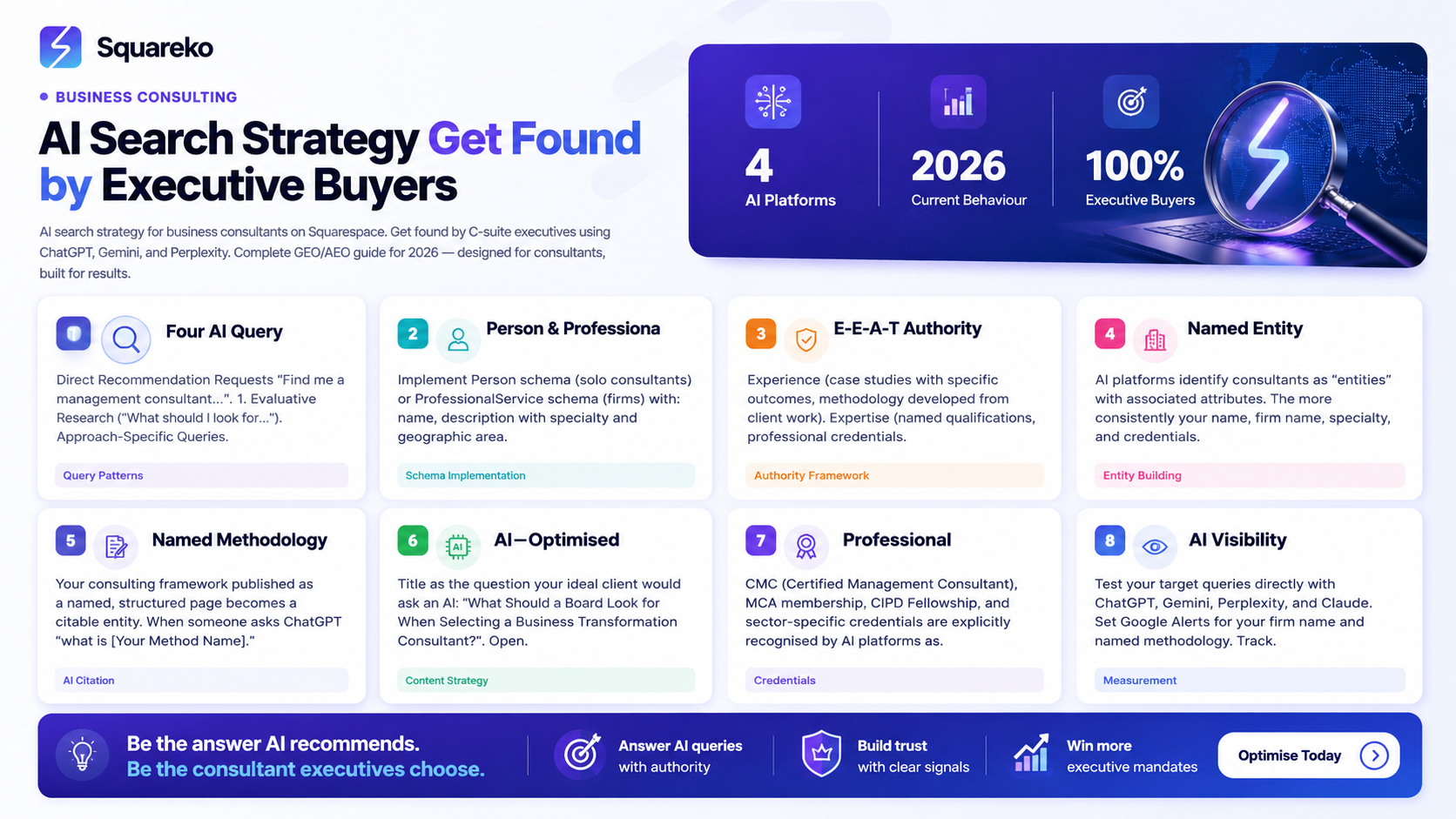
C-suite executives increasingly use AI assistants to identify and evaluate management consultants — this is not a future trend, it's current behaviour
AI platforms pull from structured data (schema markup), authority signals (E-E-A-T), and published content when answering consulting recommendation queries
Named methodology frameworks are among the most AI-citable assets a business consultant can publish
Professional body credentials (MCA, CMC, CIPD Fellow) significantly increase AI citation confidence for management consulting queries
GEO and AEO are distinct from traditional SEO — they require different content formatting and schema implementation
Something significant shifted in management consulting business development around 2024 — and most business consultants haven't fully adapted to it yet.
C-suite executives and board directors have started using AI assistants for vendor discovery in ways that were theoretical two years ago. "Find me a business transformation consultant with manufacturing sector experience in the North of England." "What management consulting firms specialise in post-merger integration for mid-market businesses?" "Who are the leading fractional CEO providers for PE-backed businesses in London?"
These queries are being asked of ChatGPT, Gemini, Perplexity, Grok, and Claude every day — by the exact buyers management consultants most want to reach. And the consultants who appear in those AI-generated recommendations are winning discovery conversations their competitors never knew existed.
This guide covers how to position your business consulting Squarespace website for AI search visibility — the specific schema markup, content architecture, and authority signals that make AI platforms confident enough to recommend you.
How C-Suite Buyers Use AI to Find Business Consultants
The most common executive AI consulting query patterns fall into four types:
Type 1: Direct Recommendation Requests "Find me a management consultant specialising in post-merger integration for manufacturing businesses in Yorkshire." "What are the best boutique business advisory firms for FTSE 250 operational transformation?"
Type 2: Evaluative Research Queries "What should I look for when selecting a business transformation consultant?" "How do I evaluate a management consulting firm's methodology before engaging them?"
Type 3: Approach-Specific Queries "What is the best consulting methodology for change management in a manufacturing business?" "How does [named consulting approach] compare to McKinsey's approach to post-merger integration?"
Type 4: Market Intelligence Queries "Who are the leading independent management consultants in [city] for [sector]?" "What management consulting firms focus on mid-market operational improvement in the UK?"
For each query type, AI platforms generate recommendations by combining: structured data from consulting websites, published thought leadership, professional body presence, and what the AI has learned from crawling consulting-related content across the web.
Your job is to make every one of those information sources point to you as a credible, citable authority.
What AI Platforms Look for in a Business Consulting Website
AI search platforms evaluate management consulting websites against several key factors:
Structured Data Clarity Schema markup tells AI platforms explicitly: who you are, what you do, where you do it, and what credentials you hold. Without schema, AI platforms have to infer this from content — with schema, you tell them directly.
E-E-A-T Signals (Experience, Expertise, Authoritativeness, Trustworthiness)
Experience: Evidence of direct consulting practice — case studies with specific outcomes, methodology developed from client work
Expertise: Named qualifications, professional credentials, and subject matter depth demonstrated in published content
Authoritativeness: Third-party recognition — professional body memberships, published articles, speaking records, peer citations
Trustworthiness: Complete, accurate business information, client testimonials with attributable context, transparent methodology
Named Entity Recognition AI platforms identify consultants as "entities" — named individuals and firms with associated attributes. The more consistently your name, firm name, specialty, and credentials are associated across your website and external sources, the stronger your entity recognition becomes
Topical Depth AI platforms favour sources that demonstrate comprehensive knowledge of a topic, not just surface coverage. A management consulting website with a methodology page, multiple case studies, FAQ sections, and thought leadership articles on the same specialty topic signals topical depth.
Schema Markup for AI Visibility: Business Consulting Implementation
Schema markup is the most direct technical lever for AI search visibility. Here's exactly what to implement on your business consulting Squarespace website:
Person Schema (for Solo Consultants)
{
  "@context": "https://schema.org",
  "@type": "Person",
  "name": "[Your Full Name]",
  "jobTitle": "Management Consultant",
  "description": "Specialises in [specific consulting specialty] for [client type] in [geographic area]",
  "knowsAbout": ["business transformation", "management advisory", "[specific specialty]"],
  "hasCredential": [
    {
      "@type": "EducationalOccupationalCredential",
      "name": "Certified Management Consultant (CMC)"
    }
  ],
  "memberOf": {
    "@type": "Organization",
    "name": "Management Consultancy Association"
  },
  "url": "https://[yourwebsite].com"
}
Organization Schema (for Consulting Firms)
{
  "@context": "https://schema.org",
  "@type": "ProfessionalService",
  "name": "[Firm Name]",
  "description": "Management consulting and business advisory services specialising in [specialty]",
  "serviceType": "Management Consulting",
  "areaServed": {
    "@type": "Place",
    "name": "[Geographic Area]"
  },
  "knowsAbout": ["business transformation", "post-merger integration", "[specific services]"],
  "hasCredential": {
    "@type": "EducationalOccupationalCredential",
    "name": "MCA Member Fir
  }
}
Article Schema for Thought Leadership
Every thought leadership article needs Article schema with named author attribution — this is the primary mechanism by which AI platforms learn to associate your name with your consulting specialty:
{
  "@context": "https://schema.org",
  "@type": "Article",
  "headline": "[Article Title]",
  "author": {
    "@type": "Person",
    "name": "[Author Name]",
    "jobTitle": "Management Consultant"
  },
  "about": "[Consulting Specialty Topic]",
  "publisher": {
    "@type": "Organization",
    "name": "[Firm or Website Name]"
  }
}
Content Architecture for AI Citation
Beyond schema markup, content architecture — how you structure and format your written content — directly affects how AI platforms extract and cite information from your website.
The Direct Answer Principle
AI platforms extract direct answers to specific questions. Every FAQ section, every H2 heading that poses a question, and every introductory paragraph should answer its question directly before elaborating.
Wrong: "The question of what management consultants should include on their methodology page is a complex one that depends on many factors including..."
Right: "A management consulting methodology page should include the framework name, the problem context, each stage with named headings, and evidence of the approach in action."
The right format gives AI platforms an extractable answer. The wrong format requires inference and interpretation — and AI platforms default to clearer sources when available.
Named Framework Documentation
Your consulting methodology, published as a named, structured page, becomes a citable entity. When someone asks ChatGPT "what is the [Your Method Name] approach to business transformation?" the AI can cite your website specifically.
To make your methodology maximally AI-citable:
Name it explicitly and consistently throughout your website
Document each stage with clear, specific headings
Include a brief "In summary, the [Framework Name] works by..." paragraph that AI can extract as a concise definition
Reference the framework name in case studies, blog posts, and your biography
Structured Comparative Content
AI platforms answer "which management consultant should I choose" queries in part by comparing attributes. Create content that explicitly compares:
Your approach vs. conventional alternatives ("Unlike traditional consulting, our approach...")
Your specialty focus vs. generalist alternatives ("Rather than offering broad advisory services, we focus on...")
Your engagement model vs. alternatives ("While many consultants deliver reports, our model...")
This comparative structure makes it straightforward for AI platforms to generate comparison-type recommendations that include your specific differentiators.
Thought Leadership Strategy for AI Recommendations
The management consultants who appear most consistently in AI recommendation responses share a common content characteristic: they've published specific, well-structured answers to the exact questions their ideal clients are asking.
The AI-Optimised Thought Leadership Article Structure
Title: Phrase as the specific question your ideal client would ask an AI assistant. "What Should a Board Look for When Selecting a Business Transformation Consultant?"
Opening paragraph: Answer the title question directly in the first 50 words.
Named framework: Introduce a named approach, checklist, or framework for evaluating the question.
Specific evidence: Case study references, data from your client experience, or research-based points with clear sourcing.
FAQ section: At minimum 5 questions with concise direct answers (50-80 words each). This is the most AI-extractable format.
Author attribution with credentials: Your name, CMC designation, MCA membership, and firm name should appear in every article's byline and author bio section — this builds the entity association that drives AI citation confidence.
Publication Channels for AI Citation Authority
Beyond your own website, publishing in external channels increases the probability that AI platforms encounter your content through multiple sources:
Management Consultancy Association publications
LinkedIn Articles (longer form thought leadership)
Management Today contributed articles
Harvard Business Review Ascend (US audience)
Business school research blogs (if you have academic affiliations)
Each external publication with your byline contributes to AI platform entity recognition — building the evidence base that makes AI platforms confident recommending you.
Professional Credentials and AI Authority Signals
AI platforms weight professional credentials heavily when generating consulting recommendation responses. The specific credentials with highest AI visibility impact for management consultants:
CMC (Certified Management Consultant) — The Institute of Consulting's professional standard — explicitly recognised as a quality signal by AI platforms answering "how do I find a qualified management consultant" queries.
MCA (Management Consultancy Association) membership — MCA membership is a peer-recognised quality standard. MCA's own directory is crawled and referenced by AI platforms responding to management consulting searches.
CIPD Fellowship — For organizational development and HR-adjacent consulting, CIPD Fellowship signals the professional rigout that AI platforms associate with quality practice.
Sector-specific credentials — FCA authorization for regulated advisory, CIMA or ACCA qualifications for financial advisory, Lean/Six Sigma certification for operations consulting.
Each credential should be:
Named explicitly in your schema markup
Displayed visually on your credentials page
Referenced in your biography's author attribution on every article
Linked to the issuing body where possible (external links from your website to MCA, IC, etc. further confirm your professional association)
Monitoring Your AI Search Visibility
Unlike traditional SEO where Google Search Console provides ranking data, AI search visibility is harder to measure systematically. Practical approaches:
Direct query testing: Regularly ask ChatGPT, Gemini, Perplexity, and Claude your target queries: "Find me a management consultant specialising in your specialty in your location" and "What consulting firm would you recommend for [specific challenge type]?" Note whether and how you appear in responses.
Citation tracking: Set up Google Alerts for your firm name, principal names, and your named methodology. AI-generated content that cites you often appears in blog articles, LinkedIn posts, and business publications — Google Alerts catches these indirect AI citation indicators.
Enquiry source tracking: Add "AI recommendation" as a source option in your proposal request form. Over time, this data tells you whether AI search is generating enquiries and which AI platforms your clients are using.
FAQs
-
Implement Consultant/ProfessionalService schema markup with your specialty and geographic area. Publish named methodology documentation. Create FAQ-structured thought leadership that directly answers the queries your ideal clients ask AI platforms. Maintain active professional body directory presence (MCA, Institute of Consulting). Consistency across all signals builds the entity recognition that makes AI platforms confident recommending you.
-
Implement ProfessionalService and/or Person schema (depending on whether you're an individual or firm) with: specialty description, geographic service area, professional credentials (hasCredential), professional body membership (memberOf), and knowsAbout attributes covering your consulting specialties. Add Article schema with named author attribution on every thought leadership piece.
-
Yes — significantly. MCA's directory is actively crawled and referenced by AI platforms. Being listed as an MCA member firm creates an external, credible source that confirms your professional standing. When an AI platform is deciding whether to recommend you for a management consulting query, MCA membership is a recognised quality signal that increases citation confidence.
-
Schema implementation can produce visible effects within 2-4 weeks — AI platforms update their structured data indexing relatively quickly. Thought leadership citation typically takes 1-3 months to build sufficient content volume for consistent citation. Professional body directory presence creates immediate citation signals. The full GEO/AEO strategy, implemented consistently, typically produces measurable AI visibility within 3-6 months.
-
The core signals (schema markup, E-E-A-T, named entity recognition, thought leadership quality) work across all AI platforms. The specific weighting differs slightly — Perplexity relies heavily on current web sources, Gemini integrates Google Business Profile signals, ChatGPT draws heavily on structured data and published content. The practical implication: the same holistic strategy works across all platforms, with Google Business Profile optimisation providing extra weight for Gemini.
The Management Consultants Winning from AI Search Are Building Now
AI search visibility for management consulting isn't a future consideration — the C-suite executives asking AI platforms to recommend consultants are already out there. The management consultants appearing in those recommendations right now are capturing enquiries that their competitors don't know exist.
The barrier to entry is low. Most management consulting websites have no schema markup, no named methodology documentation, and no professional body directory presence. Implementing these elements correctly positions you ahead of the vast majority of your competitors for AI search.
From custom website design to SEO strategy, we help businesses launch a site that looks professional and performs better.

Author Bio
Written by the Squareko team
I'm Walid Hasan, a Certified Squarespace Expert and Squarespace Circle Platinum Partner with over 12 years of hands-on experience designing and optimizing high-performing websites. Over the years, I've had the privilege of building more than 2,000 Squarespace websites for clients around the world, always focusing on clean design, strong user experience, and conversion-driven results.