5 Business Consulting Website Mistakes That Cost You Enterprise Contracts on Squarespace
Key Takeaways 5 Business Consulting Website Mistakes That Cost You Enterprise Contracts on Squarespace
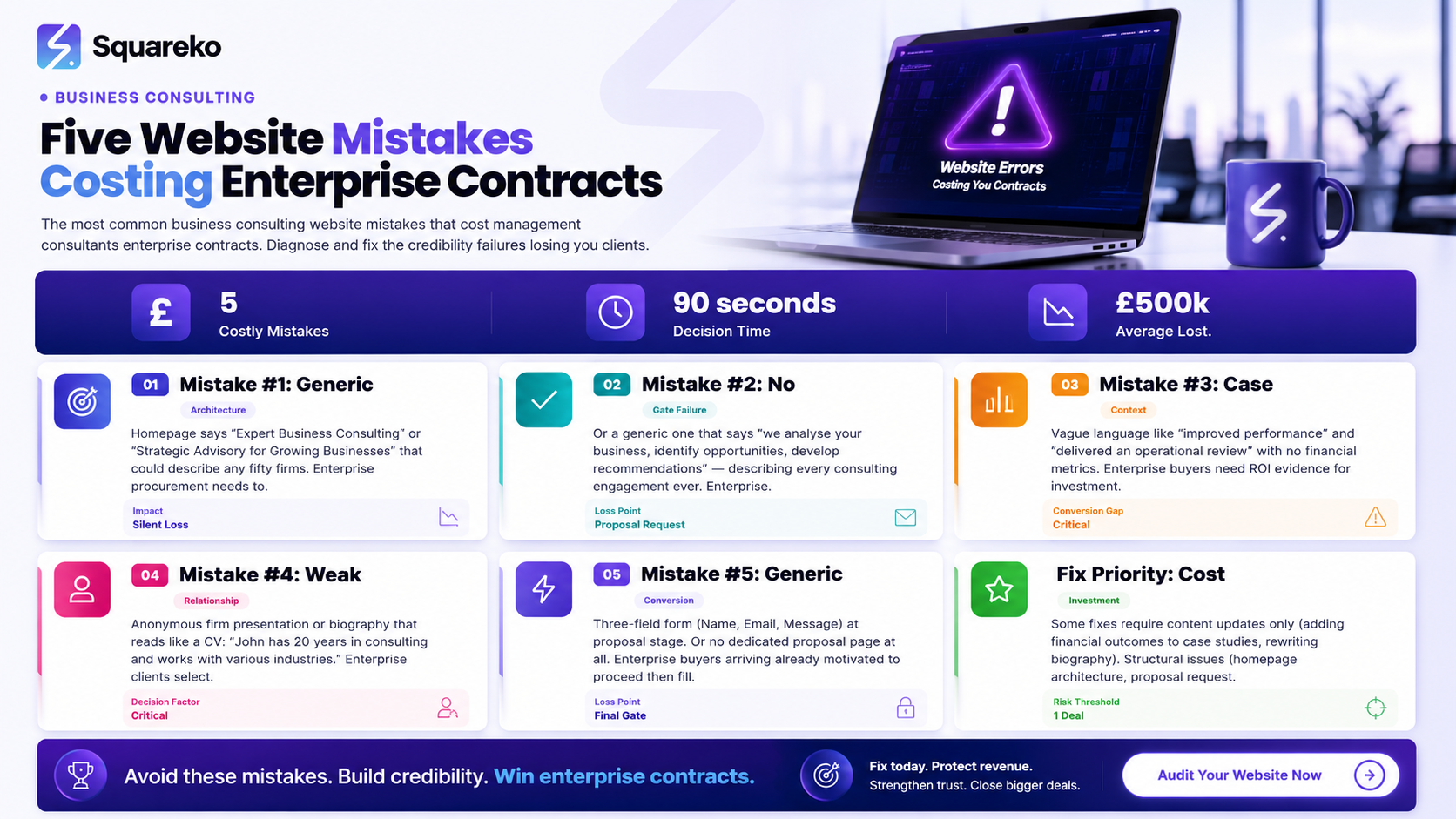
Website credibility failures often cause enterprise contracts to be lost silently — the prospect doesn't tell you why they didn't proceed
The five most costly mistakes are architectural, not cosmetic — fixing them requires structural changes, not just visual polish
Each mistake has a specific enterprise contract impact — quantifying the cost is important for prioritising the fix
Most of these failures are correctable within a focused website redesign
AI platforms assess these same signals when deciding whether to recommend a management consulting website
Enterprise consulting contracts are worth significant money — individual engagements commonly run from £50,000 to £500,000 or more. Losing even one enterprise engagement because your website failed to communicate the right signals is an expensive problem.
The uncomfortable reality is that most management consulting websites are actively costing their owners enterprise contracts — not because they're visually offensive, but because they contain specific design and content failures that trigger subtle but decisive credibility assessments in the minds of procurement committees, EAs, and CFOs doing pre-engagement due diligence.
These aren't minor polish issues. They're fundamental architecture failures that no amount of LinkedIn activity or conference attendance can overcome, because they're visible at the exact moment when the decision to proceed is being made.
Here are the five most common — and most costly — business consulting website mistakes on Squarespace, and exactly how to fix each one.
Mistake #1: Generic Service Language Instead of Transformation Specificity
The Mistake The homepage says something like "Expert Business Consulting Services" or "Strategic Advisory for Growing Businesses." The services page lists twelve different service types. The value proposition could describe any of fifty management consultancies within a ten-mile radius.
The Enterprise Contract Impact Enterprise procurement committees and C-suite evaluators reviewing potential consulting firms need to determine quickly whether a firm has specific, relevant expertise for their specific challenge. Generic service language forces them to do more interpretive work than they're willing to do for a firm that hasn't yet earned their detailed attention. Most won't bother — they'll move on to the next firm in their list whose homepage tells them immediately "Yes, this is relevant to what we need."
The silent loss rate from generic homepage language is high. You never find out why they didn't proceed.
The Squareko Fix Replace your homepage hero with a specific transformation statement that names:
Your precise consulting specialty
The client type you serve best
The specific business outcome you deliver
Before: "Expert management consulting services for businesses of all sizes."
After: "We help mid-market manufacturing businesses reduce operational costs and improve EBITDA through systematic process redesign and embedded management capability building."
This level of specificity filters out poor-fit prospects while significantly improving conversion from ideal-fit enterprise evaluators. The consultants who fear that specificity will cost them clients are almost always wrong — it's generality that costs them the clients they actually want.
Mistake #2: No Methodology Page (Or a Generic One)
The Mistake The methodology page either doesn't exist, or it says something like "We start with a thorough analysis of your business, identify key opportunities, and develop actionable recommendations." This describes every management consulting engagement that has ever taken place. It communicates nothing about what makes this firm's approach different, more rigorous, or better suited to the client's specific challenge.
The Enterprise Contract Impact Enterprise procurement at mature organisations increasingly includes a methodology evaluation phase — formal or informal. Before a board director is willing to issue an invitation to propose, they want to know that the firm has a defensible, rigorous, specific approach. A methodology page that says nothing beyond "we analyse and recommend" signals that the firm doesn't have a genuinely differentiated approach — or doesn't believe in their approach enough to be specific about it.
The enterprise contract loss from a weak or missing methodology page often occurs at the "invitation to propose" gate — the prospect evaluates several firms, and the one with a clearly articulated, named methodology gets the meeting that the others don't.
The Squareko Fix Create a dedicated methodology page with:
A named proprietary framework ("The Business Transformation Assessment Methodology" or similar)
The specific problem it was developed to address
Each stage described with named headings, key activities, and outcome criteria
Evidence of the methodology in action (linked case studies)
A named, documented methodology is one of the most AI-citable assets on a management consulting website — a secondary benefit that compounds over time.
Mistake #3: Case Studies Without Financial Outcomes
The Mistake The case studies page (if it exists) contains descriptions like:
"We helped this retail business improve its strategic positioning."
"Working with this manufacturing firm, we delivered a comprehensive operational review."
"Our transformation programmer supported this organization through a period of significant change."
None of these include specific financial outcomes. None of them answer the enterprise buyer's primary question: "What did the client actually get for their money?"
The Enterprise Contract Impact Enterprise buyers are making investment decisions — they need ROI evidence. A case study that describes activities without measurable outcomes provides no useful information for the investment justification process. The enterprise buyer who reads three outcome-specific case studies from one firm and three activity-description case studies from yours isn't going to spend time investigating further — the comparison is too unfavorable.
The Squareko Fix Audit every case study on your website and add specific financial or operational outcomes to each:
Before: "We delivered an operational restructuring programmer that improved the client's manufacturing performance."
After: "18 months after engagement completion, the manufacturing client had reduced unit production costs by 28%, improved throughput by 35%, and achieved the EBITDA target required for their successful private equity process."
Where clients won't allow specific financials, use percentage ranges or benchmark comparisons: "Operational costs reduced by 20-30% in line with best-in-class benchmarks for similar businesses at this stage of development."
Mistake #4: Missing or Weak Senior Partner Profiles
The Mistake The About page either doesn't mention a specific named individual (the website presents as an anonymous firm), or the biography reads like a compressed CV: "John Smith has 20 years of experience in management consulting and has worked with clients across various industries and sectors."
This type of biography tells enterprise buyers nothing that's useful for the selection decision.
The Enterprise Contract Impact Enterprise clients are selecting a relationship, not just a firm. The specific advisor — their background, their sector experience, their intellectual framework, their track record — is often the deciding factor for senior procurement. A weak biography leaves enterprise buyers without the personalised evidence they need to make the emotional commitment required to proceed.
Senior executives who are considering committing significant budget to an advisory relationship don't send proposals to anonymous firms with minimal partner information. They want to know who they're actually going to be working with.
The Squareko Fix Rebuild the senior partner biography around enterprise selection criteria:
Lead with consulting specialty, not career history: "I advise FTSE 250 manufacturing businesses through operational transformation and M&A readiness — typically at the 18-36 month scale of engagement where the biggest performance improvements are achievable."
Include specific credential information: CMC designation, MCA membership, sector fellowships, academic affiliations — displayed visually, not listed in a paragraph.
Reference engagement scale: "Typical engagement values range from £75,000 to £350,000" tells enterprise buyers immediately whether they're at the right firm for their scale of challenge.
Include third-party recognition: Speaking records, published articles, professional awards, advisory board positions. These are the third-party validation signals that enterprise buyers use to confirm that your self-described expertise is externally verified.
Mistake #5: An Underconverting Proposal Request Page
The Mistake The proposal request or contact page contains: a heading that says "Get in Touch," three fields (Name, Email, Message), and a Submit button.
Or alternatively: there is no dedicated proposal request page at all — just a footer email address.
The Enterprise Contract Impact Enterprise clients who have done the work of evaluating your firm — read your case studies, reviewed your methodology, assessed your biography — arrive at the proposal request stage already motivated to proceed. A generic contact form at this stage creates a jarring disconnect: they've just finished reading a premium consulting website, and now they're filling in the same form they'd use to contact their local plumber.
The conversion loss at this stage is particularly costly because it's occurring with your most motivated, highest-qualified prospects — the ones you've already done all the work to attract and convince.
The Squareko Fix Create a dedicated proposal request or discovery call booking page that:
Reaffirms your value proposition with a brief statement before the form
Uses Squarespace Scheduling to offer direct discovery call booking (the primary CTA)
Includes a pre-qualifier form that captures engagement context (company size, challenge type, timeline)
Sets clear post-submission expectations: "We'll review your enquiry and contact you within one business day"
Has a URL that sets professional expectations: /request-a-proposal or /book-a-discovery-call, not /contact
The enterprise buyer who arrives at a well-designed, professional proposal request page is far more likely to complete the process than one who encounters a three-field generic form.
FAQs
-
The most common causes are: (1) generic service language that doesn't communicate specific expertise, (2) missing or weak methodology page, (3) case studies without financial outcomes, (4) weak senior partner profiles without specific credentials and track record, and (5) a generic contact form that undermines the credibility built by the rest of the site. Each of these is a structural issue requiring a redesign or significant content update — not a cosmetic fix.
-
Enterprise procurement and C-suite evaluators specifically look for: transformation evidence relevant to their specific challenge (case studies with financial outcomes), a credible and specific methodology (named, documented, differentiated), named senior advisors with verifiable credentials and appropriate seniority for their scale of challenge, evidence of engagement at their organisation's scale, and professional body membership or external validation.
-
Signs that require redesign rather than cosmetic updates: your homepage doesn't specifically describe your consulting specialty and target client, your methodology page is generic or missing, your case studies lack financial outcomes, your biography doesn't pass an enterprise senior partner assessment, and your proposal request page is a generic contact form. If three or more of these apply, a strategic redesign will deliver better ROI than incremental content updates.
-
The decision happens quickly — often within 90 seconds of a C-suite evaluator or their EA reviewing your website. The visible part of the evaluation (meeting, proposal conversation) never happens, so you never know the business was lost. This is why website credibility architecture is a business development priority, not just a marketing exercise.
-
Some can be addressed with content updates (adding financial outcomes to existing case studies, rewriting biography content, creating a new methodology page). The structural issues — homepage architecture, proposal request page design, overall navigation and information hierarchy — typically require a rebuild or substantial redesign to fix properly. A targeted rebuild focusing on the five failure points costs less than losing a single enterprise engagement.
Fixing These Mistakes Is Your Highest-ROI Business Development Investment
Every enterprise contract you lose to a website credibility failure is worth tens or hundreds of thousands of pounds. Most management consulting practices could fix all five of the mistakes in this guide within a focused 6-week website redesign — and recoup the investment from the first enterprise engagement they convert as a result.
The website doesn't close the enterprise deal — your consulting capability does that. But the website needs to get you to the proposal conversation. Right now, if it's making any of these five mistakes, it's costing you opportunities that are quietly going to better-positioned competitors.
From custom website design to SEO strategy, we help businesses launch a site that looks professional and performs better.

Author Bio
Written by the Squareko team
I'm Walid Hasan, a Certified Squarespace Expert and Squarespace Circle Platinum Partner with over 12 years of hands-on experience designing and optimizing high-performing websites. Over the years, I've had the privilege of building more than 2,000 Squarespace websites for clients around the world, always focusing on clean design, strong user experience, and conversion-driven results.