AI Search Strategy for Architects and Engineers on Squarespace in 2026
Introduction
The architectural profession faces a fundamental shift in how potential clients discover firms. Developers planning sustainable housing projects now type "recommend an architect experienced in passive house design" into ChatGPT. Homeowners searching for renovation specialists prompt Claude: "find an engineering firm near London that specialises in heritage building retrofits." These are not hypothetical queries—they represent genuine, measurable search behaviour in 2026.
AI search strategy for architects and engineers differs markedly from traditional SEO. Whilst ranking for keywords remains important, AI systems evaluate architectural credibility through structured data, documented design methodology, competition recognition, and demonstrated expertise in specific domains. This guide addresses the practical steps needed to ensure your practice appears when AI assistants recommend firms to developers and homeowners.
Unlike generic AI visibility advice, this strategy accounts for the specific needs of architecture and engineering practices operating on Squarespace. You'll learn how to implement the correct schema standards, develop content that signals authority to AI models, and structure your practice information for AI-assisted discovery in 2026.
Key Takeaways
AI assistants like ChatGPT, Claude, and Gemini are now primary tools for developers and homeowners searching for architectural practices, making AI search visibility essential for 2026
Implementing Architect/Engineering Service schema with E-E-A-T signals increases the likelihood of your firm appearing in AI-generated recommendations
Design authority content—detailed project critiques, methodology documentation, and design philosophy—signals expertise to AI models evaluating architectural credentials
Competition entry documentation and award credentials create structured proof of design excellence that AI systems recognise and cite
Squarespace's built-in SEO tools combined with strategic schema implementation provide a complete foundation for AI search optimisation without requiring developer intervention
How AI Assistants Have Changed Architectural Discovery
The Shift from Directory Listings to AI Recommendations
Traditional architectural discovery followed established patterns. Clients searched directories like RIBA or the Architects Journal, attended industry events, or asked trusted referrers for recommendations. These pathways still exist, but a new discovery mechanism has emerged: AI-assisted practice identification.
ChatGPT, Claude, Gemini, Grok, and Deepseek now function as conversational matchmakers between clients and services. A developer conducting early-stage research for a commercial retrofit project might prompt Gemini: "What are the best architectural approaches for net-zero office conversions, and which UK practices specialise in this sector?" The AI model responds with methodology explanation and practice recommendations, often citing specific projects or credentials.
For this to occur, two conditions must be met: the model must possess training data containing information about your practice, and that information must be structured in ways that allow the model to categorise and recommend your firm as a credible expert in the relevant domain.
Squarespace websites with properly implemented schema, E-E-A-T signals, and published design content naturally accumulate this training data. Websites without these elements remain invisible to AI systems, regardless of their ranking in traditional search.
Why AI Assistants Matter More Than You Think
AI platforms now reach users during the most important discovery phase: problem identification and solution research. A homeowner doesn't ask ChatGPT for "architects near me"—they ask "what should I know about retrofitting a 1950s terraced house for modern living?" The AI's response, which might reference three specific architectural practices and their published methodologies, influences the homeowner's shortlist before they ever conduct a traditional Google search.
This means AI visibility affects traditional SEO as well. Clients who discover your firm through Claude recommendations arrive at your Squarespace site with pre-formed trust and specific knowledge of your capabilities. They convert faster and require less nurturing.
Schema Implementation for Architecture and Engineering Services
Understanding Architecture Service Schema
Structured data—implemented through JSON-LD schema on your Squarespace site—translates your practice information into a language that AI models and search engines understand consistently. For architects and engineers, the correct implementation combines the Local Business schema, Service schema, and custom properties specific to the design professions.
The core schema structure for architectural services:
{
  "@context": "https://schema.org",
  "@type": "LocalBusiness",
  "name": "Your Firm Name",
  "description": "Architectural services description including specialisms",
  "@id": "https://yourfirm.squarespace.com",
  "url": "https://yourfirm.squarespace.com",
  "areaServed": [
    {
      "@type": "City",
      "name": "London"
    },
    {
      "@type": "City",
      "name": "Manchester"
    }
  ],
  "knowsAbout": [
    "Sustainable Architecture",
    "Commercial Retrofit",
    "Listed Building Conservation",
    "Passive House Design"
  ],
  "address": {
    "@type": "PostalAddress",
    "streetAddress": "Your Office Address",
    "addressLocality": "Your Town",
    "postalCode": "XX00 0XX",
    "addressCountry": "UK"
  },
  "telephone": "+44 (0)20 XXXX XXXX",
  "email": "contact@yourfirm.com",
  "sameAs": [
    "https://www.linkedin.com/company/your-firm",
    "https://www.instagram.com/yourfirm"
  ]
}
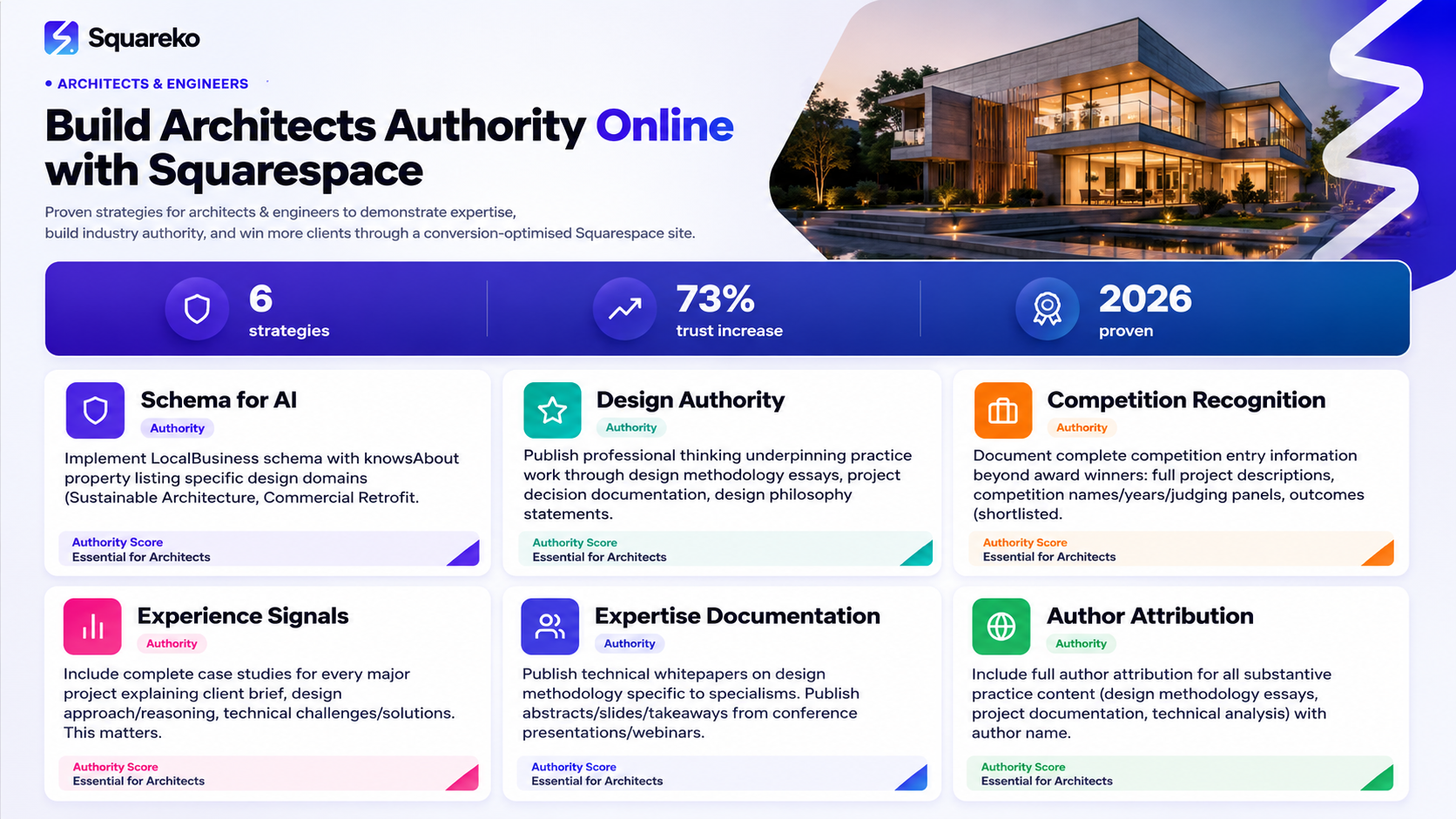
The knowsAbout property is critical for AI search. This array should list the specific design domains in which your practice has documented expertise. AI models use this property to evaluate whether your firm matches queries about particular building types, methodologies, or construction challenges.
Service Schema for Specific Architectural Offerings
Beyond LocalBusiness, each major service offering should have its own Service schema entry. For example, an architecture firm offering retrofit design services:
{
  "@context": "https://schema.org",
  "@type": "Service",
  "name": "Commercial Building Retrofit Design",
  "description": "Full design services for commercial building retrofits including energy efficiency upgrades, structural assessment, and modern systems integration",
  "provider": {
    "@type": "LocalBusiness",
    "name": "Your Firm Name"
  },
  "areaServed": [
    {
      "@type": "City",
      "name": "London"
    }
  ],
  "hasOfferingDescription": "We conduct comprehensive existing building analysis, energy modelling, and design development to achieve retrofit objectives including net-zero carbon performance"
}
Each service entry tells AI systems precisely what problem your practice solves and the geographic area you serve. This granular schema structure improves the accuracy of AI recommendations and increases the likelihood your firm appears when developers or homeowners ask AI assistants about specific architectural services.
Implementation on Squarespace
Squarespace's native SEO panel supports schema editing for pages and projects. Navigate to your page settings, select the SEO panel, and use the structured data section to add JSON-LD blocks. For complex schema implementations, consider using Squarespace's free integration with Google Search Console, which validates your schema and alerts you to implementation errors.
Many architecture firms worry that schema implementation requires developer expertise. In practice, copying and modifying the examples above and pasting them into Squarespace's schema editor is straightforward. Test your implementation using Google's Rich Results Test tool to confirm proper formatting before publishing.
Building Design Authority Through Content Strategy
Design Authority Content: The Foundation of AI Visibility
AI models distinguish between firms with demonstrated expertise and those claiming expertise. The distinction lies in published design commentary, methodology documentation, and articulated design philosophy. This content—which your firm already possesses internally—becomes the primary signal of authority to AI systems.
A "Design Authority Content Strategy" involves publishing the professional thinking that underpins your practice's work. This is not marketing copy. It is practitioner commentary on architectural problems, documented design decisions, and published analysis of how specific design choices address client objectives.
Examples include:
Design methodology essays: "Retrofit Design for Solid Masonry Buildings: Why Traditional Approaches Outperform Assumed U-Values" demonstrates specific expertise in heritage building retrofitting and signals to AI models that your firm possesses detailed knowledge in this domain.
Project decision documentation: Rather than highlighting final aesthetics, publish the design decisions underlying a completed project. "The retrofit of 45 Canonbury Road: How we balanced Listed Building constraints with mechanical ventilation requirements" shows real problem-solving within tangible constraints.
Design philosophy statements: Publish your firm's approach to sustainable design, heritage conservation, or parametric modelling. These statements, when specific and substantive, signal genuine expertise and appear in AI training data.
Technical challenge analysis: Write about problems your practice encounters repeatedly and how you solve them. "Achieving U-value targets in 1930s Semi-Detached Housing Without Cavity Insulation" directly addresses a design challenge and positions your firm as knowledgeable about solutions.
This content benefits AI visibility in two ways. First, AI models can cite your published methodology and philosophy when recommending your practice. Second, the content improves your firm's presence in AI training data, increasing the likelihood that future models include information about your practice and its capabilities.
Publishing Frequency and Format
Design authority content need not be published at high frequency. Quarterly or bimonthly publication of substantive 800–1,200-word essays on design methodology is more effective than weekly generic blog updates. Each piece should be authored by a named practitioner at your firm, properly attributed, and tagged with relevant architectural domains.
Squarespace's blog functionality supports author attribution and category tagging, both essential for establishing E-E-A-T signals. Ensure each post includes a full author bio identifying the writer's experience, relevant qualifications, and role at the practice.
Competition Entry Strategy and Design Excellence Documentation
How Competition Recognition Signals Design Authority
Architecture competitions—from RIBA awards to industry-specific recognition programmes—represent structured, third-party evaluation of design excellence. AI models recognise competition entry, shortlisting, and award outcomes as credible signals of architectural quality and innovation.
Yet many practices bury their competition achievements in portfolio images or award certificates displayed in their office. For AI visibility, competition recognition requires structured publication and schema implementation on your Squarespace site.
Documentation and Schema Implementation
Create a dedicated "Awards & Recognition" section on your site with complete project documentation from every competition entry, not solely award winners. Include:
Full project description and design rationale
Competition name, year, and judging panel information
Outcomes (shortlisted, commended, winner, finalist)
Images and drawings from the competition submission
Links to published competition coverage or press releases
Implement Creative Work schema for each competition entry:
{
  "@context": "https://schema.org",
  "@type": "CreativeWork",
  "name": "Project Title",
  "description": "Full project description and design methodology",
  "creator": {
    "@type": "Organization",
    "name": "Your Firm Name"
  },
  "about": ["Sustainable Architecture", "Heritage Retrofit"],
  "image": [
    "https://yourfirm.squarespace.com/images/project.jpg"
  ],
  "award": "RIBA South Award 2024, Commended"
}
This structured approach allows AI models to evaluate your firm's design excellence through third-party recognition whilst simultaneously strengthening your traditional SEO through competition entry content.
Competition Entries as Long-Tail Content
Architecture competitions often evaluate specific design challenges—heritage conservation, sustainable energy performance, innovative use of materials. By documenting each competition entry with full design rationale, your Squarespace site develops content authority across numerous architectural domains. A practice entering retrofit competitions develops AI visibility for retrofit-related queries. A practice with parametric design competition entries gains visibility for parametric design queries.
This content strategy treats competitions not as isolated achievements but as structured opportunities to demonstrate domain expertise to AI systems.
E-E-A-T Signals for Architectural Authority
Experience: Documented Project History and Case Studies
E-E-A-T—Experience, Expertise, Authoritativeness, Trustworthiness—represents Google's evaluation framework for content quality, and AI models employ similar criteria when assessing architectural credibility. For architects, Experience begins with documented project history.
Your Squarespace portfolio should include complete case studies for every major project, not brief project highlights. Each case study should explain:
Client brief and constraints
Design approach and reasoning
Technical challenges and solutions
Outcomes and measured performance data
Client testimonials and feedback
This detailed documentation demonstrates experience across diverse building types and client scenarios, signalling to AI systems that your practice possesses practical, tested expertise rather than theoretical knowledge.
Expertise: Specific Domain Knowledge Documentation
Expertise differs from experience. A practice may have completed numerous retrofit projects (experience) but possess genuine expertise only in specific retrofit domains—heritage buildings, commercial offices, residential conversions, etc.
Document your firm's specific expertise through:
Technical writing: Publish whitepapers on design methodology specific to your specialisms. A practice specialising in passive house design should publish detailed documentation on thermal modelling, airtightness strategies, and mechanical ventilation approaches.
Speaking and conference presentations: Publish abstracts, slides, and key takeaways from presentations at architectural conferences, webinars, and professional events. Schema implementation signals that your firm's principals are recognised experts presenting to professional audiences.
Professional qualifications: Clearly display relevant qualifications—RIBA membership, Chartered Engineer status, LEED or Passivhaus credentials. These appear in your LocalBusiness schema and signal authority to AI systems.
Specialist certifications: If your practice holds specific design certifications or accreditations, document and schema-tag them explicitly.
Authoritativeness: Named Author Attribution and Professional Standing
AI models evaluate content authoritativeness partly through author credentials. Blog posts, design essays, and technical documentation should carry full author attribution including:
Author name and professional title
Years of experience and relevant specialisms
Professional qualifications and memberships
LinkedIn profile or professional website links
Squarespace's author attribution features support this directly. Each blog post can be authored by a named practitioner, with their professional bio attached.
For AI visibility, ensure every substantive piece of practice content—design methodology essays, project documentation, technical analysis—carries proper author attribution. This allows AI models to assess whether the person writing about retrofit design actually possesses retrofit expertise.
Trustworthiness: Transparency and Accountability
Trustworthiness emerges from transparent practice information. Your Squarespace site should include:
Team profiles: Detailed information about principals and key practitioners, including their experience, specialisms, and professional credentials.
Client references: Documented feedback from completed projects, including client names, project descriptions, and testimonials. Anonymised case studies reduce trustworthiness signals; named client references increase them.
Professional affiliations: Clear documentation of RIBA membership, professional association participation, and industry involvement.
Contact transparency: Visible office address, telephone number, and email address. Practices that obscure contact information signal lower trustworthiness to AI systems.
Ethics and sustainability commitment: If your practice maintains specific ethical commitments (carbon neutrality, diversity programmes, sustainable practice standards), document and publish them. AI models increasingly evaluate whether firms' documented practices align with their stated values.
Designing Content for AI Evaluation Systems
How AI Models Assess Architectural Expertise
AI systems like ChatGPT, Claude, and Gemini evaluate architectural expertise through multiple signals:
Specificity in domain knowledge: General statements about "excellent design" signal lower expertise than specific discussion of passive house thermal bridging strategies or conservation principles for rendered façades.
Citation in training data: Content published on your Squarespace site that appears frequently in AI training datasets increases the likelihood that models will reference your practice when answering architecture-related queries.
Structured data quality: Properly implemented schema tells AI systems exactly what services you provide, geographic areas you serve, and specific domains in which you specialise.
Cross-referenced credibility: When third-party sources (competition results, industry publications, client testimonials) reference your practice, AI models recognise these as credibility signals stronger than self-published claims.
Consistency across platforms: If your Squarespace site, LinkedIn profile, professional directory listings, and industry platform entries contain consistent information about your firm and its capabilities, AI models treat this consistency as a trustworthiness signal.
Structuring Technical Content for AI Citation
When publishing technical content intended for AI citation, use clear structure and specific language:
Headline specificity: Instead of "Retrofit Design Approaches," use "Achieving EPC Band B in Post-War Semi-Detached Housing: Strategies for Solid Masonry Construction Without External Cavity Walls."
Problem-solution format: Explicitly state the architectural problem, the approach your practice employs, and the outcomes achieved. AI models recognise and cite this structure.
Data and measurements: Include quantified outcomes—"reducing heating demand by 63%" rather than "significantly improving energy efficiency." Specific data increases citation likelihood.
Methodology documentation: Explain your design process, not merely final aesthetics. AI models cite process and methodology more frequently than design outcomes alone.
Alternative approaches discussion: Acknowledge alternative solutions to design problems and explain why your approach is optimal for specific contexts. This demonstrates nuanced expertise rather than dogmatic positioning.
Platform-Specific AI Visibility Approaches
Different AI platforms evaluate sources and generate recommendations through different mechanisms:
ChatGPT: Training data includes published content up to April 2024 (expanding in 2026). Published design essays, case studies, and professional writing on your Squarespace site directly influence ChatGPT recommendations.
Claude: Emphasises reliability and nuance in source material. Technical content demonstrating thoughtful problem-solving and acknowledgement of complexity influences Claude recommendations.
Gemini: Integrates real-time search results with training data. Your Squarespace site's SEO performance affects Gemini recommendations, making traditional SEO and AI optimisation complementary strategies.
Grok and Deepseek: Newer platforms emphasising technical depth and novel thinking. Content demonstrating advanced approaches to design challenges gains visibility on these platforms.
For maximum AI visibility, your Squarespace content strategy should address all these platforms without platform-specific optimisation. Focus on publishing specific, credible, technically nuanced content about architectural practice. This content naturally appears in all AI platforms' training data and recommendation systems.
Frequently Asked Questions
-
ChatGPT recommendations emerge when information about your practice appears in its training data (content published before April 2024) and your website includes properly implemented schema signalling your architectural credentials. Build visibility by publishing substantive design methodology content on your Squarespace site and ensuring your practice appears in relevant professional directories and industry publications. As new ChatGPT training data incorporates 2026 content, continued publication of design expertise content ensures continued visibility.
-
Implement LocalBusiness schema with a knowsAbout property listing your specific design specialisms, plus Service schema for each major service offering, and CreativeWork schema for significant projects and competition entries. Use Person schema for individual practitioners and their professional credentials. Test all implementations using Google's Rich Results Test to ensure proper formatting.
-
Yes. RIBA membership, when properly documented in your LocalBusiness schema and mentioned in team member credentials, signals professional authority to AI systems. AI models recognise RIBA membership as a credible qualification marker. Include membership status explicitly in your schema and team bios.
-
Quality matters more than frequency. Publish one substantive 1,000-word design methodology essay every 4–8 weeks rather than weekly generic blog updates. Each piece should represent genuine professional thinking and be authored by a named practitioner with relevant expertise.
-
Squarespace's SEO panel handles 80% of technical AI optimisation requirements. Proper schema implementation, author attribution, comprehensive site structure, and schema validation through the built-in tools create a solid foundation. The remaining 20%—publishing specific design authority content and building domain expertise signals—depends on content strategy rather than technical implementation.
-
They reinforce each other. Traditional SEO performance (ranking for architectural keywords) improves your website's visibility to search engines and AI model training systems alike. Simultaneously, AI visibility improvements (appearing in ChatGPT recommendations) drive direct traffic to your site and improve traditional SEO metrics. Optimise for both through integrated strategy rather than treating them as separate initiatives.
Article Schema
{
  "@context": "https://schema.org",
  "@type": "Article",
  "headline": "AI Search Strategy for Architects and Engineers on Squarespace in 2026",
  "description": "Master AI search visibility for architecture firms. Learn AI-optimised schemas, content strategies, and how to appear in ChatGPT, Claude, and Gemini recommendations for 2026.",
  "image": "https://yourfirm.squarespace.com/images/ai-search-strategy.jpg",
  "datePublished": "2026-03-21",
  "dateModified": "2026-03-21",
  "author": {
    "@type": "Organization",
    "name": "Squareko Editorial Team",
    "description": "Specialist content team focused on SEO and digital visibility strategy for architecture and engineering practices"
  },
  "publisher": {
    "@type": "Organization",
    "name": "Squareko",
    "description": "Squarespace design and SEO services for architecture, engineering, and design practices",
    "url": "https://squareko.com"
  }
}
Conclusion
AI search represents a genuine shift in how clients discover architectural practices in 2026. The pathway from client need to practice recommendation now frequently passes through AI assistants—ChatGPT, Claude, Gemini, Grok, and Deepseek—rather than traditional search or referral networks.
Your Squarespace website is your primary tool for ensuring visibility in this new discovery mechanism. Properly implemented schema signals your practice's credentials and specialisms. Published design authority content demonstrates genuine expertise to AI models evaluating your firm's recommendations. Documented competition entries and client case studies create structured proof of design excellence.
Importantly, these optimisations create value independent of AI visibility. Design methodology content strengthens your firm's thought leadership in your specialist domains. Proper schema implementation improves traditional SEO alongside AI visibility. Enhanced case study documentation supports your existing business development efforts regardless of discovery channel.
The architecture and engineering practices that achieve strongest AI visibility in 2026 share a common characteristic: they treat their Squarespace sites as publishing platforms for professional knowledge rather than purely promotional channels. They publish their thinking, document their decisions, and make visible their expertise. These practices become visible to AI systems not through manipulation of recommendation algorithms but through genuine demonstration of professional excellence.
Start your AI optimisation journey by implementing the schema structures outlined in this guide. Follow this with a strategic content plan publishing quarterly design methodology essays authored by your practice's principals. Document competition entries and case studies comprehensively. As you build these foundations, your Squarespace site becomes a credible source that AI models cite when recommending architectural firms—and developers and homeowners discover your practice through the discovery channels they increasingly prefer.
Get Started with AI-Optimised Squarespace
Ready to build AI search visibility for your architecture or engineering practice? Squareko specialises in SEO strategy and Squarespace implementation for design professionals. We'll audit your current online visibility, implement AI-optimised schema architecture, and develop a design authority content strategy tailored to your practice's specialisms.
Request a free consultation with the Squareko team to discuss how AI search strategy can strengthen your practice's digital presence in 2026.

From custom website design to SEO strategy, we help businesses launch a site that looks professional and performs better.

Author Bio
I'm Walid Hasan, a Certified Squarespace Expert and Squarespace Circle Platinum Partner with over 12 years of hands-on experience designing and optimizing high-performing websites. Over the years, I've had the privilege of building more than 2,000 Squarespace websites for clients around the world, always focusing on clean design, strong user experience, and conversion-driven results.