10 Must-Have Pages Every Consulting Website Needs on Squarespace
Key Takeaways 10 Must-Have Pages Every Consulting Website
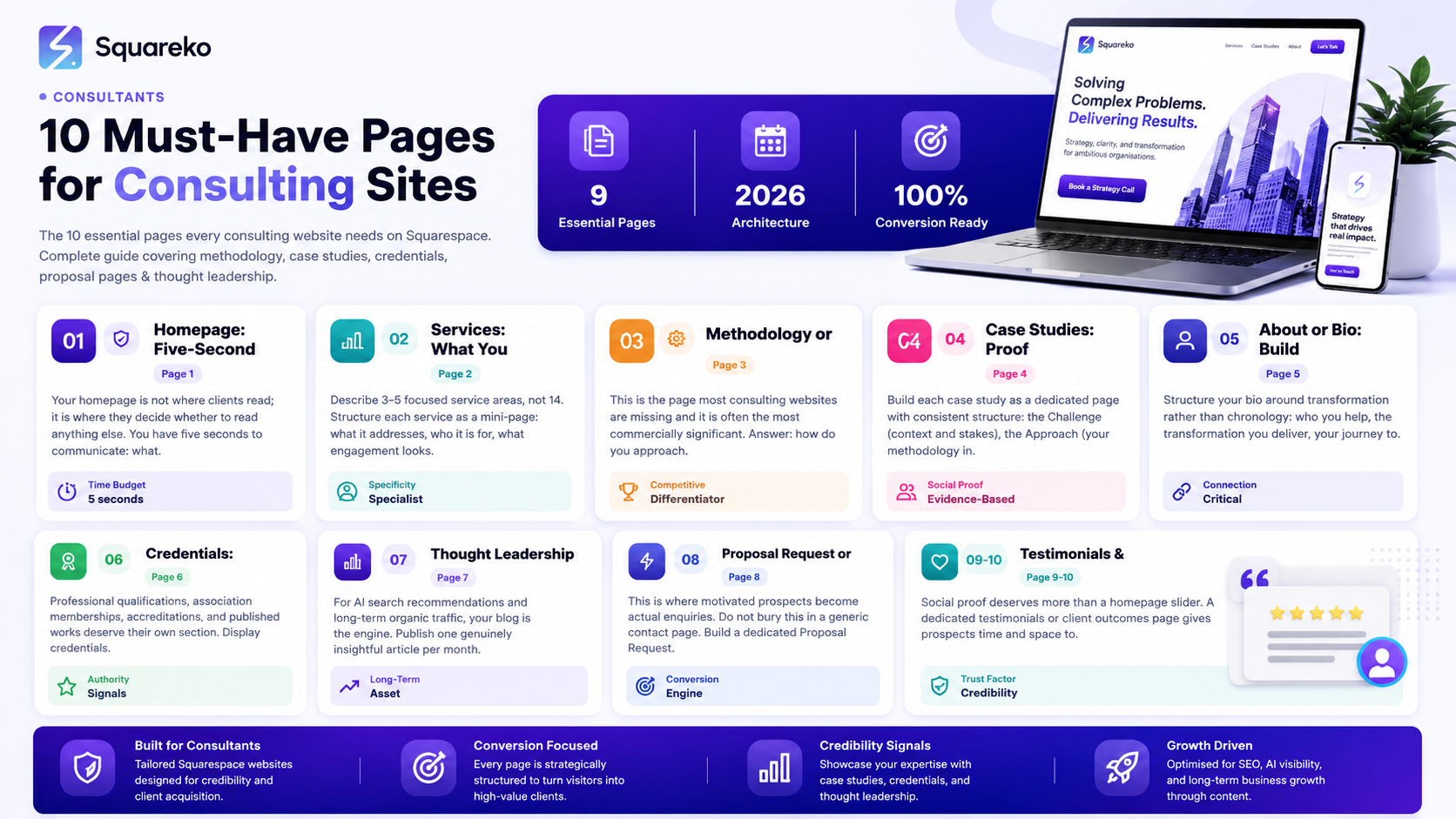
A consulting website needs more than a services page and contact form to convert high-value B2B clients
Methodology, case study, and credentials pages are the most commonly missing — and most commercially valuable — pages on consulting websites
Each page plays a specific role in the consulting client evaluation journey
Well-structured consulting websites with 8-12 pages significantly outperform minimal sites for both organic search and conversion
AI search platforms extract information from specific pages — building them correctly improves your chances of being recommended
Most consulting websites have three pages: Home, Services, and Contact. And most consulting websites underperform — not because the consultant lacks expertise, but because the website isn't built to handle how consulting clients actually evaluate potential advisors.
Consulting clients don't make decisions on a homepage. They explore. They compare. They build a mental case for why you're the right fit before they ever pick up the phone. A consulting website with only a handful of pages leaves them without the evidence they need to make that case.
This guide covers the 10 pages every consulting website needs on Squarespace in 2026 — and explains why each one matters for both client conversion and search visibility.
The 10 Essential Pages for Every Consulting Website
Page 1: Homepage — Your Five-Second Pitch
Your homepage is not where clients read; it's where they decide whether to read anything else. You have about five seconds to communicate: what you do, who you help, what makes you qualified, and what they should do next.
Squarespace Expert Tip: Build your homepage hero around a single, specific statement of what transformation you deliver — not what service you offer. Strategy consulting is a service. Helping mid-market manufacturers double EBITDA margins within 18 months is a transformation. The latter wins the five-second test.
Your homepage should also include:
A brief evidence block (one or two client outcomes or credential references)
A clear primary CTA (book a discovery call or request a proposal)
Navigation to the pages below that do the heavy lifting
Page 2: Services — What You Actually Do
Your services page is where prospects confirm they've found the right type of consultant. It should be specific, not comprehensive. Listing 14 services tells clients you're a generalist. Presenting 3-5 focused service areas tells them you're a specialist.
Squarespace Expert Tip: Structure each service as a mini-page within the services section: what the service addresses, who it's for, what the engagement looks like, and what outcome the client can expect. Consider using Squarespace's accordion blocks to keep the page scannable without truncating important detail.
Page 3: Methodology or Approach — How You Think
This is the page that most consulting websites are missing — and it's often the most commercially significant page on the site.
Your methodology page answers the question every prospective client asks before they ask about price: How do you actually approach problems like mine? When you can articulate your method clearly, explain why it works where alternatives fail, and demonstrate that it's proprietary rather than generic — you justify premium fees and attract better clients.
Squarespace Expert Tip: Give your methodology a name. A named framework (The TRANSFORM Method, The Consulting Bridge Framework) becomes searchable, citable by AI platforms, and more memorable than a generic Our Approach description. Include a visual representation of the methodology steps — Squarespace's gallery and layout blocks support this well.
Page 4: Case Studies — Your Proof of Performance
Case studies are the primary conversion tool for consulting websites. Consulting clients hire based on evidence of solved similar problems. Testimonials help, but structured case studies with context, approach, and measurable outcomes are what genuinely move high-value clients from evaluation to conversation.
Squarespace Expert Tip: Build each case study as a dedicated page, not a blog post. Use a consistent structure: The Challenge (context and stakes), The Approach (your methodology in action), The Outcome (specific, quantified results), and optionally a Client Testimonial. Create a case studies index page that lets prospects filter by industry, service type, or challenge.
If clients prefer anonymity, use A FTSE 250 retail business or A Yorkshire-based manufacturer — the sector and scale context is still highly valuable for prospective clients evaluating your relevant experience.
Page 5: About or Bio — The Person Behind the Practice
For most consulting practices — particularly solo consultants and boutique firms — the About page is where the buying decision often gets made. Clients are not just buying a service; they're deciding whether they trust a person with a significant business challenge.
Your About page should not read like a CV. It should read like the story of how you came to be uniquely qualified to solve the specific type of problem your ideal client faces.
Squarespace Expert Tip: Structure your bio around transformation rather than chronology: who you help, what transformation you deliver, the journey that equipped you to deliver it, and what drives you professionally. End with a personal element that makes you human — even for B2B clients who claim to make purely rational decisions, interpersonal connection matters.
Page 6: Credentials and Qualifications — Third-Party Validation
Professional qualifications, association memberships, accreditations, and published work are the third-party validation that converts sceptical B2B buyers. Many consultants list these in their bio paragraph — which buries them. They deserve their own section.
Squarespace Expert Tip: Create a dedicated Credentials section (either as a standalone page or a prominent section on your About page) that displays professional qualifications visually — not just as a list. For financial and regulated consulting specialties, credentials aren't just trust signals; they're compliance requirements.
Include:
Professional qualifications with issuing body names
Professional association memberships with links
Published works, white papers, or media appearances
Speaking engagements at recognised conferences or institutions
Any awards or recognitions from professional bodies
Page 7: Thought Leadership Blog — Your Ongoing Authority Signal
For AI search recommendations and long-term organic traffic, your blog is the engine. Consulting firms that publish consistent thought leadership content on Squarespace build the content authority that makes AI platforms confident enough to recommend them when relevant queries arrive.
Squarespace Expert Tip: Don't treat your blog as a news feed. Use it strategically — publish one genuinely insightful article per month rather than four generic pieces per week. Title every article around the specific question your ideal client is searching for. Use your methodology and case study insights as the source material; it demonstrates you're writing from genuine experience, not just research.
Page 8: Proposal Request or Discovery Call Booking — Your Conversion Engine
This is the page where potential clients become actual clients. Most consulting websites bury this in a generic Contact page with a basic form. That's a conversion failure.
Squarespace Expert Tip: Build a dedicated Proposal Request or Discovery Call page that reconfirms your value proposition before presenting the form or booking calendar. Use Squarespace Scheduling to embed a live booking calendar so motivated prospects can book without a back-and-forth email exchange. Include a pre-qualification form if you want to improve enquiry quality — ask about company type, challenge, and timeline so you arrive at the call prepared.
The URL should be something like /book-discovery-call or /request-proposal — not just /contact. The specificity signals professionalism and sets clear expectations.
Page 9: Insights or Resources — Your Lead Magnet Hub
Consultants sit on significant intellectual capital — frameworks, assessment tools, templates, and research — that prospective clients would find genuinely valuable. Gating this content in exchange for contact details creates a lead capture mechanism that works even for prospects who aren't ready to book a call.
Squarespace Expert Tip: Use Squarespace's Member Areas or simple form-based email captures to offer resources like:
Operations Efficiency Self-Assessment (PDF)
Management Consulting Website Checklist
The 5-Stage Business Transformation Framework
Each download should carry your branding, your contact details, and a clear CTA that invites prospects to take the next step when they're ready.
Page 10: Testimonials or Client Outcomes — Your Social Proof Centre
Social proof deserves more than a slider on your homepage. A dedicated testimonials or client outcomes page gives prospective clients the time and space to absorb the evidence at their own pace — and it provides an important SEO and AI search anchor for your credibility signals.
Squarespace Expert Tip: Structure this page with specific, attributable testimonials wherever possible. A great consultant to work with is worthless. Within six months of our engagement, we reduced operational costs by 34% and increased throughput by 22% — directly attributable to the process design we implemented together — this is what converts. Supplement with a client outcome metrics summary: total engagements, average outcomes improvement, sectors served.
Bonus Consideration: Location or Sector Specialist Pages
If you serve specific geographic markets or sectors, add dedicated pages for each (Business Consulting Manchester or Financial Consulting for Startups). These pages drive local and sector-specific organic search traffic and support the AI recommendation signals discussed in our [local SEO for consulting firms guide →].
Mid-Post CTA
Does your Squarespace consulting website have all 10 of these pages working as hard as they should? Squareko reviews and redesigns consulting websites for maximum client acquisition performance.
FAQs
-
Yes — and it's more important in 2026 than it's ever been. Thought leadership content on Squarespace is the primary mechanism by which AI platforms like ChatGPT and Gemini discover and recommend consultants for relevant queries. A blog also drives organic search traffic for the specific questions your ideal clients search for. Even publishing one substantive article per month compounds significantly over time.
-
Absolutely. Case studies are the single most commercially valuable content type on a consulting website. They provide the evidence-based validation that B2B consulting clients require before they're willing to initiate a conversation. A consulting website without case studies is asking clients to take a leap of faith that most sophisticated buyers won't take.
-
For conversion: your Homepage (the first filter), your Methodology page (the credibility deepener), and your Proposal Request or Discovery Call page (the actual conversion mechanism). For organic traffic: your Blog (long-term), your Case Studies (trust-building), and your Location/Sector pages (local and niche search capture).
-
Most consulting websites perform best with 8-15 pages: Homepage, Services (1 per service or a single page with service sections), Methodology, Case Studies (index + individual pages), About, Credentials, Blog, Discovery Call Booking, Resources, and Testimonials. Beyond 15 pages, you should focus on deepening existing content rather than adding new pages.
-
Your primary navigation should include: Home, Services (with dropdown if needed), About, Case Studies, Insights/Blog, and Contact or Book a Call. Secondary navigation or footer should include: Credentials, Resources, and any location or sector-specific pages. Keep the primary navigation to 5-6 items — cognitive overload in navigation increases bounce rate.
-
Yes. All 10 pages described in this guide can be built on Squarespace using the built-in editor and content blocks without any custom code. Schema markup (the one technical element that significantly improves search performance) can be added via Settings → Advanced → Code Injection — a simple copy-paste process that doesn't require coding knowledge.
-
Service pages: 500-800 words. Methodology page: 600-1,000 words. Each case study: 400-700 words. About/bio page: 400-600 words. Blog articles: 1,500-3,500 words depending on topic. Discovery call page: 300-500 words (keep it focused and friction-free).
Your Consulting Website Should Work as Hard as You Do
If your current site is missing even three or four of these pages, it's likely losing qualified clients at some point in the evaluation process. Not because those clients don't need what you offer — but because they couldn't find enough evidence to take the next step.
The consultants with full-architecture websites — methodology pages, case study libraries, credentials sections, properly structured booking flows — consistently outperform those with minimal sites on every metric that matters: organic traffic, enquiry volume, and enquiry quality.

From custom website design to SEO strategy, we help businesses launch a site that looks professional and performs better.

Author Bio
I'm Walid Hasan, a Certified Squarespace Expert and Squarespace Circle Platinum Partner with over 12 years of hands-on experience designing and optimizing high-performing websites. Over the years, I've had the privilege of building more than 2,000 Squarespace websites for clients around the world, always focusing on clean design, strong user experience, and conversion-driven results.