Squarespace Templates for Life Coaches
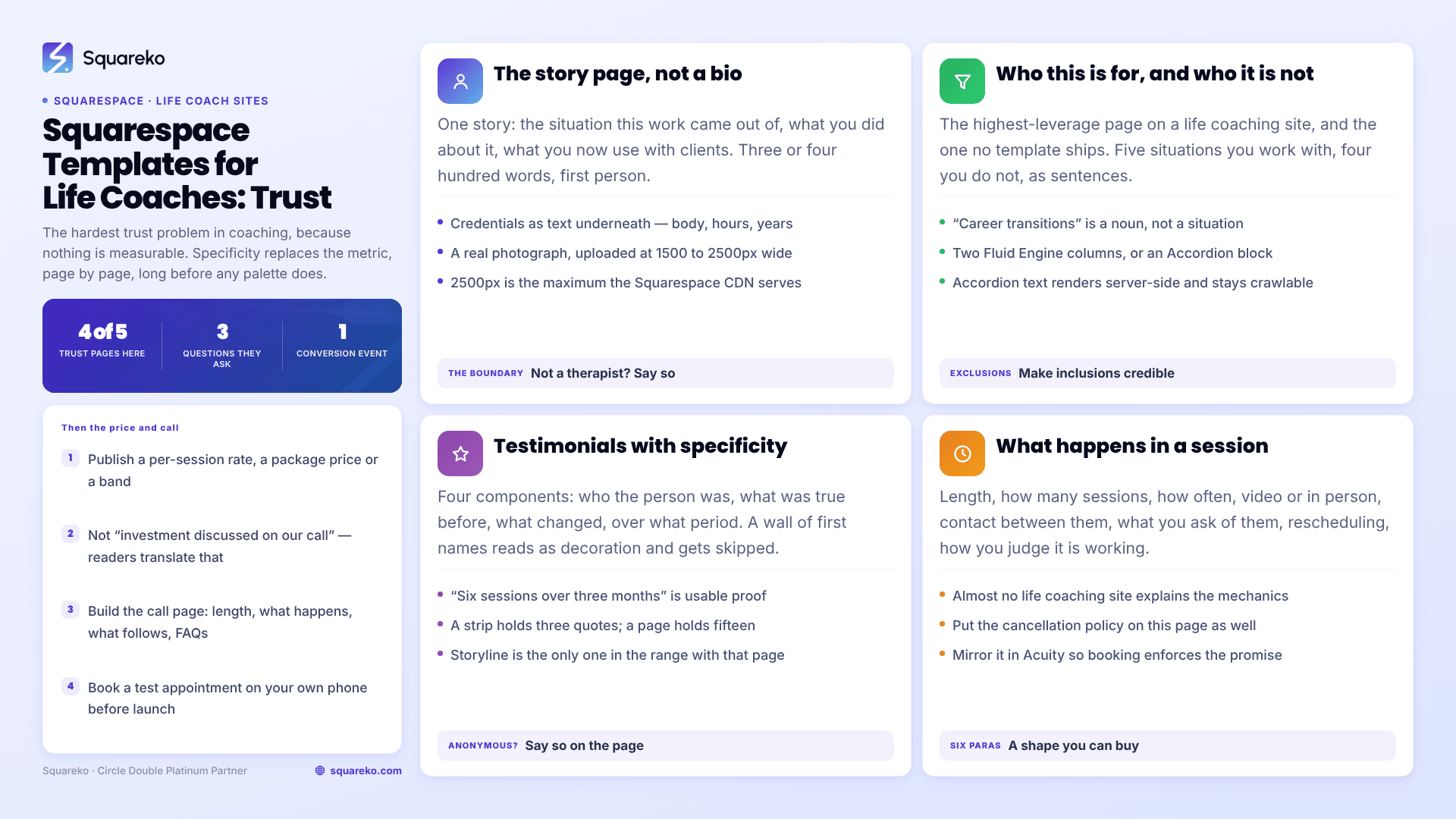
The short answer: A life coaching website has the hardest trust problem in coaching, because what you sell cannot be measured. There is no revenue figure, no before-and-after photograph, no certification a stranger recognises. Trust has to be built out of five specific pages instead: a story page, a who-this-is-for page that also says who it is not for, testimonials with real specificity, a plain description of what a session actually involves, and a visible price. Choose a Squarespace template that already has somewhere for those to live.
Design is not the lever here. A beautiful life coaching site that says nothing concrete converts worse than a plain one that does.
The trust problem, stated properly
Put yourself on the other side of the screen. Someone is unhappy in a way they find difficult to describe. They have typed something into Google at eleven at night. They land on your site, and they are asking three questions in this order:
Does this person understand the specific thing that is wrong with my life?
Is this a real profession or is it a stranger with a website?
What actually happens, what does it cost, and what am I agreeing to?
Business coaching answers question one with a number. Fitness coaching answers it with a photograph. Life coaching has neither, so it answers all three with specificity — the willingness to describe a situation precisely enough that the reader thinks that is me, and to describe the process precisely enough that it stops sounding like a leap of faith.
Vagueness is the failure mode, and it is nearly universal. "I help people live their most authentic lives" is not a promise; it is a category. Every page below exists to replace a category with a specific.
The first screen, and the niche question underneath it
Before any of the five pages, the homepage has one line to do the recognition work, and it is where most life coaching sites lose the reader.
The test is simple: could a competitor put the same sentence on their homepage without changing anything? "Coaching for women ready to step into their power" passes that test, which means it fails. "I work with people in their thirties and forties who are good at a job they no longer want to be doing" does not pass it, because it excludes most readers — and excluding most readers is the point.
This is the niche question in practical form, and it does not require you to niche your practice, only your page. You can coach anyone who books; the homepage still has to speak to one person. A life coach who takes clients from four different situations is better served by four situation-led sections down the homepage — each with its own heading, its own two sentences and its own link — than by one sentence that averages them into nothing. Squarespace 7.1 pages are stacks of sections, and every Squareko template ships 150+ pre-designed ones, so building four is duplication rather than design work.
Underneath the headline: one photograph of you, one sentence of proof, and one button that goes to the booking page. Not a carousel, not a mission statement.
Page 1 — The story page, which is not a bio
A life coach's About page is the second-most-visited page on the site and usually the weakest. The default version lists a certification body, a career change, and a sentence about a hike.
The version that works tells one story: the situation you were in that this work came out of, what you did about it, and what you learned that you now use with clients. Three or four hundred words. First person. A real photograph of your face, taken by a person, at a size Squarespace will serve properly — upload at 1500 to 2500px wide, since 2500px is the maximum Squarespace's CDN serves and it converts to WebP automatically.
Then the credentials, as text underneath: training body, hours of supervised practice, years, any accreditation, and — importantly — the boundary. If you are not a therapist, say so on this page. Naming what you do not do is one of the strongest trust signals available to a life coach, and almost nobody uses it.
Page 2 — Who this is for, and who it is not
This is the highest-leverage page on a life coaching site and the one no template ships.
Two columns, or two stacked sections. On one side, five specific situations you work with — written as sentences a person would recognise, not as nouns. "You are three years into a job you took for good reasons and you have stopped being able to explain why you are still there" beats "career transitions". On the other side, four things you do not work with: active crisis, clinical depression, couples work, anyone looking for someone to tell them what to do.
The exclusions do three jobs at once. They stop the wrong enquiries before they cost you a call. They demonstrate professional boundaries, which is the thing a nervous reader is scanning for. And they make the inclusions credible, because a person who says no to things is more believable when they say yes.
Build it as a standard Squarespace 7.1 section — two columns in Fluid Engine, or an Accordion block if you want each situation expandable. Accordion content renders server-side, so it stays crawlable.
Page 3 — Testimonials, with specificity or not at all
A wall of first names and one-line praise is decoration. It reads as decoration, and readers skip it.
A testimonial that works has four components: who the person was in a way the reader can map onto themselves (role, life stage, situation — not necessarily a name), what was true before, what changed, and over what period. "Six sessions over three months. I came in unable to decide whether to leave my job. I left it, and I understand now why the decision had been stuck." That is usable proof. "Life-changing, five stars, would recommend" is not.
Where clients will not be named — common in life coaching and entirely legitimate — say so explicitly: "Clients are quoted with permission; names and identifying details are withheld." That line makes anonymity read as discretion rather than as invention.
Practical note: give testimonials a page, not just a homepage strip. A strip holds three; a page holds fifteen, grouped by situation, so a reader can find the one that matches theirs. Storyline is the only template in the Squareko range that ships a dedicated Testimonial page.
Page 4 — What actually happens in a session
Almost no life coaching site explains the mechanics, and the mechanics are what an anxious person needs before they book.
Write it plainly: how long a session runs, how many sessions a typical engagement is, how often they happen, whether they are video or in person, whether there is contact between sessions and through what channel, what you ask them to do in between, what happens if they need to reschedule, and how you both decide whether it is working. Six short paragraphs.
This page also does something structural: it converts a vague ongoing commitment into a defined thing with a shape, which is what makes it purchasable. A reader who cannot picture the process cannot picture themselves buying it.
Put the cancellation and rescheduling policy here too, and mirror it in your Acuity Scheduling settings so the booking flow enforces what the page promises.
Page 5 — The price, visible
The most contested decision in life coaching, and the evidence from enquiry quality is one-directional: publishing a price or a band raises the proportion of discovery calls that turn into clients, because the people who were never going to pay it filter themselves out before they take an hour of your week.
You do not have to publish a single number. Any of these work: a per-session rate, a package price with the number of sessions stated, a band ("engagements run from £900 to £2,400 depending on length"), or a starting point ("from £150 a session, with most clients booking six"). What does not work is "investment discussed on our call", which every reader correctly translates as "expensive, and I am going to have to have an awkward conversation".
Relief and Advisory are the two templates in the Squareko range with a dedicated Pricing page. If your template has none, build one and put it in the main navigation, not in the footer.
The discovery call is the only conversion event
Everything above exists to produce one action: booking a call. Build that page properly.
It needs four short sections and a calendar. How long the call is. What happens on it — and be specific: "you describe what is going on, I ask questions, and at the end I tell you whether I think coaching would help and whether I am the right person". What happens afterwards, including that there is no obligation. Two or three FAQ lines in an Accordion block. Then the calendar.
The calendar is Acuity Scheduling — Squarespace Scheduling and Acuity are the same product. Add it with Add Block → Scheduling, which embeds the booking flow in your page and requires a paid Acuity subscription; the legacy free Acuity plan cannot embed a scheduler. A Button block linking to your Acuity scheduling page is the simpler alternative and survives a template change. Squarespace charges no transaction fee on bookings taken through a Scheduling block.
Before launch, book a test appointment on your own phone. The most common Acuity complaint in the Squarespace Forum is not the embed at all — it is availability configuration, with Business Settings → Availability → Global Availability Limits → Start Time Intervals producing minute-by-minute slots instead of clean hourly blocks.
Squarespace templates for life coaches
Four worth considering, scored on the 25-point rubric published in the coaching templates pillar.
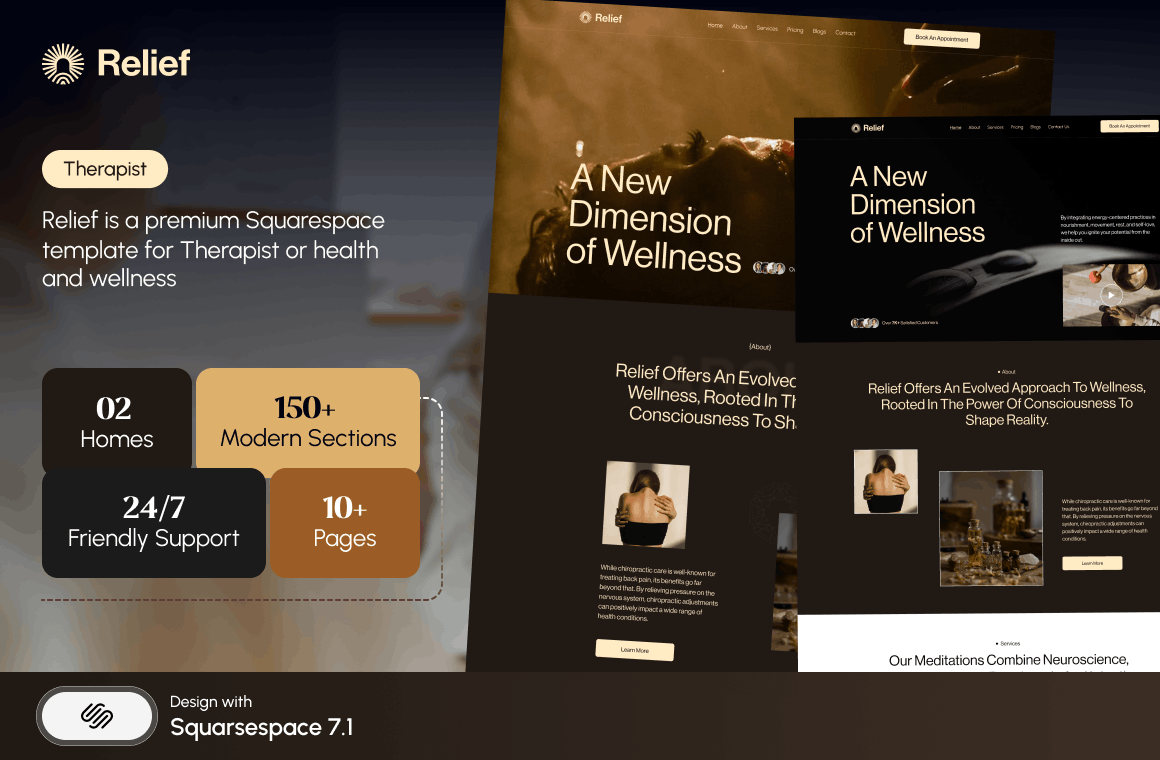
Relief — 21/25. Relief is 11 pages, tagged Therapist and Wellness Coach, with a Pricing page, an FAQs page and a Blog. It is the closest match in the range to the page list above: pricing visible, objections handled, quiet visual register that suits one-to-one work. Its gap is proof — no dedicated testimonial page, so that structure is yours to build.
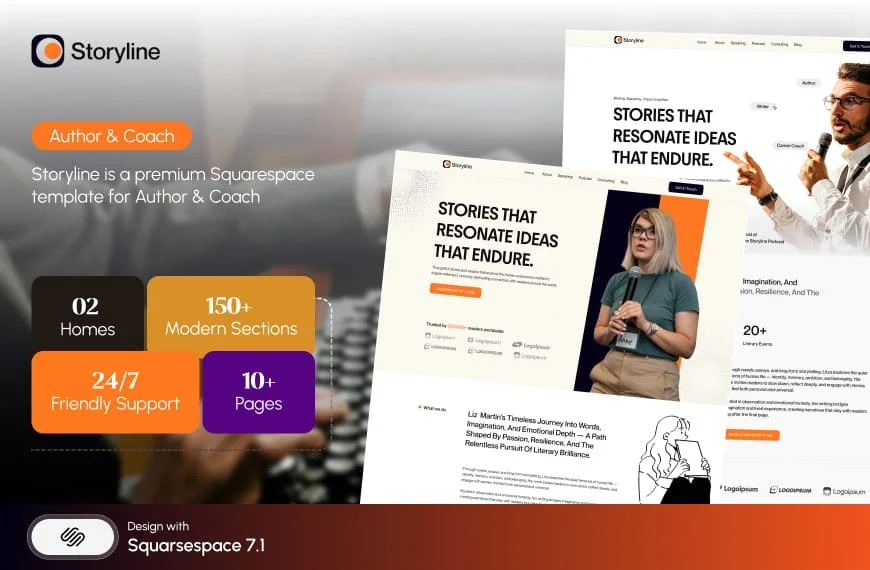
Storyline — 22/25. Thirteen pages tagged Author & Coach and Speaker, with dedicated Booking and Testimonial pages plus Podcast, Speaking and a Blog. The highest-scoring coaching template in the range, and the only one shipping both structures a coaching site converts on. No Pricing page, and no publicly viewable demo — its published live-demo link returns HTTP 401, so none is given here. Ask for a walkthrough.
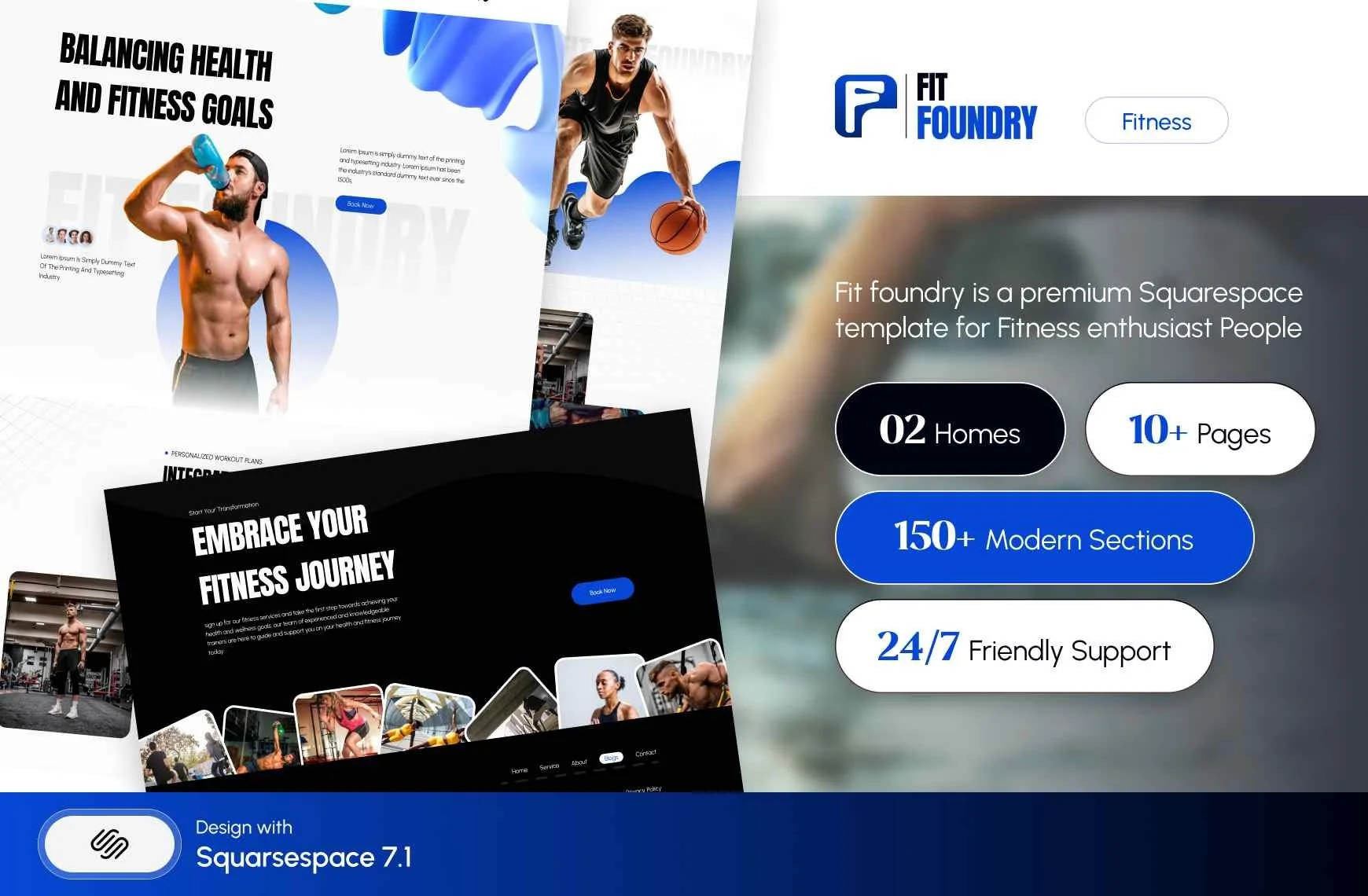
Fit Foundry — 20/25. Fit Foundry is 11 pages tagged Fitness & Wellness and Coach, with a Shop, a Blog, an FAQs page and a Freebie page. Relevant to a life coach who sells a self-paced product alongside one-to-one work — a journal, a workbook, a short course. The Shop gives it a product page rather than an invoice.
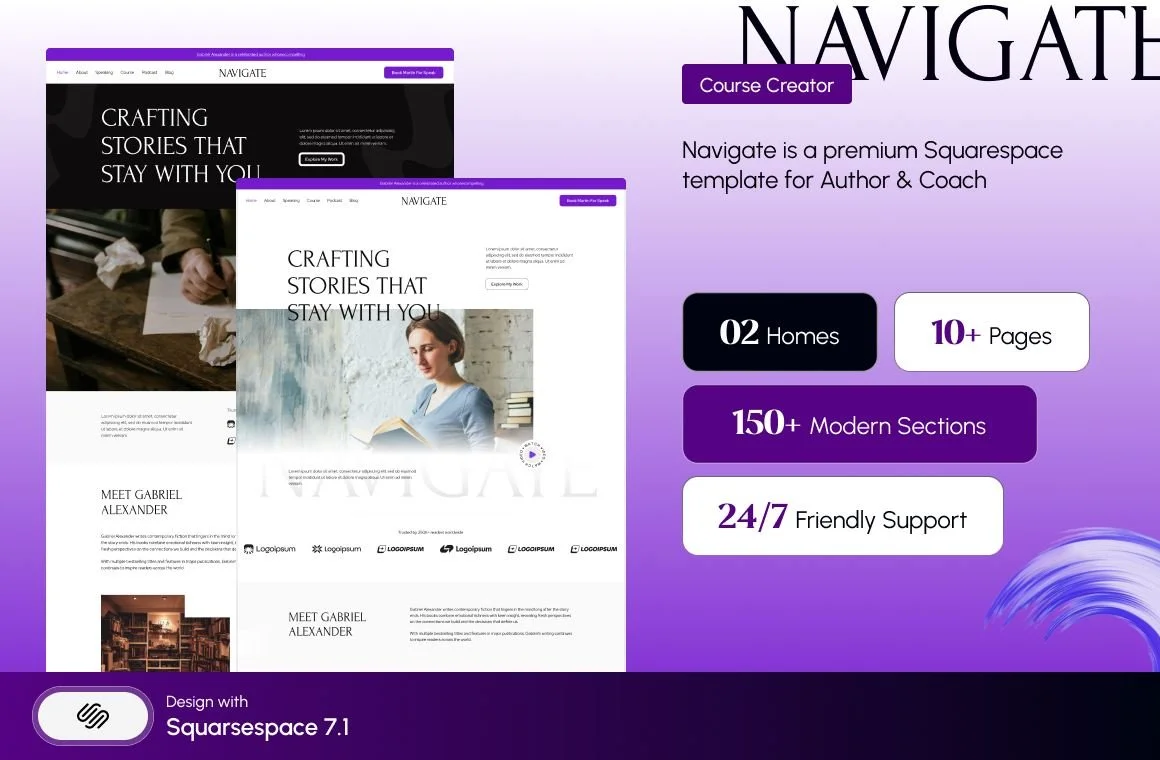
Navigate — 18/25. Ten pages tagged Author & Coach and Speaker, with Course, Podcast and Speaking pages and a Blog. Built for the coach whose practice runs on published work rather than paid traffic. Thin enquiry path — no Booking or Pricing page — and no publicly viewable demo; the published live-demo link returns 401.
Outside the range, Hold Space Creative and JPK Design Co both build specifically for therapists and coaches and their copy structures show it. Big Cat Creative sells coaching templates at $297 and Applet Studio at roughly $225. Squarespace's own free life coach templates are included with every subscription and are a completely reasonable starting point for a four-page site.
Choosing one
The pages matter more than the template. Write the who-this-is-for page first — it will tell you whether your practice has a shape yet — then the session-structure page, then the price. If you can write those three honestly, almost any template will convert. If you cannot, no template will.
When you do pick one, choose on whether it already holds the pages above rather than on the palette, because in Squarespace 7.1 colour and type are half an hour's work and page architecture is a weekend's.
If you would rather not run the install yourself, the premium Squarespace templates in our range arrive as a Squarespace contributor invitation rather than a file download, and can be installed onto an existing live site without taking it offline. Most life coaches reading this will do it themselves, and the four templates above are the shortlist worth starting from.
FAQ
-
Five pages that carry the trust: a story page explaining where this work came from, a who-this-is-for page that also names who it is not for, testimonials with situation and timescale rather than first names, a plain description of what a session involves, and a visible price or price band. Then a booking page.
-
Through specificity. Describe the client's situation precisely enough that they recognise themselves, describe the process precisely enough that it stops being a leap of faith, name what you do not work with, and publish a price. Vagueness is the failure mode, not bad design.
-
Usually yes — a per-session rate, a package price, or a band. Published pricing filters out people who were never going to buy before they take an hour of your week, and raises the proportion of discovery calls that convert. "Investment discussed on the call" reads as expensive and evasive.
-
Four components: who the person was in a way a reader can map onto themselves, what was true before, what changed, and over what period. Where clients cannot be named, say explicitly that names and identifying details are withheld with permission — that makes anonymity read as discretion.
-
Relief, at 21/25, is the closest structural match — 11 pages with a Pricing page and an FAQs page. Storyline scores higher at 22/25 on its Booking and Testimonial pages but has no publicly viewable demo. Squarespace's free life coach templates are a reasonable four-page starting point.
-
Proof. A business coach's site leads with results, case studies and numbers, so the offer pages come first. A life coach's site has no metric, so it leads with recognition, boundaries and process, and the story and who-this-is-for pages come before the offer.

Author Bio
I'm Walid Hasan, a Certified Squarespace Expert and Squarespace Circle Platinum Partner with over 12 years of hands-on experience designing and optimizing high-performing websites. Over the years, I've had the privilege of building more than 2,000 Squarespace websites for clients around the world, always focusing on clean design, strong user experience, and conversion-driven results.