Squarespace SEO for Accountants and CPAs: Rank on Google and AI Search in 2026
Introduction
In 2026, ranking for accounting keywords requires more than SEO tactics—it requires authority, transparency, and alignment with how both Google and AI systems evaluate financial professionals. The landscape has shifted. Google increasingly prioritises expertise, experience, authoritativeness, and trustworthiness (E-E-A-T) for financial content. AI systems, meanwhile, now mediate client discovery for accounting services, referencing structured data, citations, and verified credentials. For CPAs and accounting firms on Squarespace, understanding this dual-platform environment is essential.
This pillar guide covers comprehensive Squarespace SEOfor accountants and CPAs, including keyword strategy, YMYL (Your Money, Your Life) compliance, schema implementation, and the emerging role of AI in accounting search. We explore how to rank for high-intent searches like small business accountant in [city], tax return accountant near me, and how accounting firms now appear in AI financial advice queries. By the end, you'll have a complete roadmap to dominate search visibility for accounting services in 2026 and beyond.
Key Takeaways Squarespace SEO for Accountants and CPAs: Rank on Google and AI Search in 2026
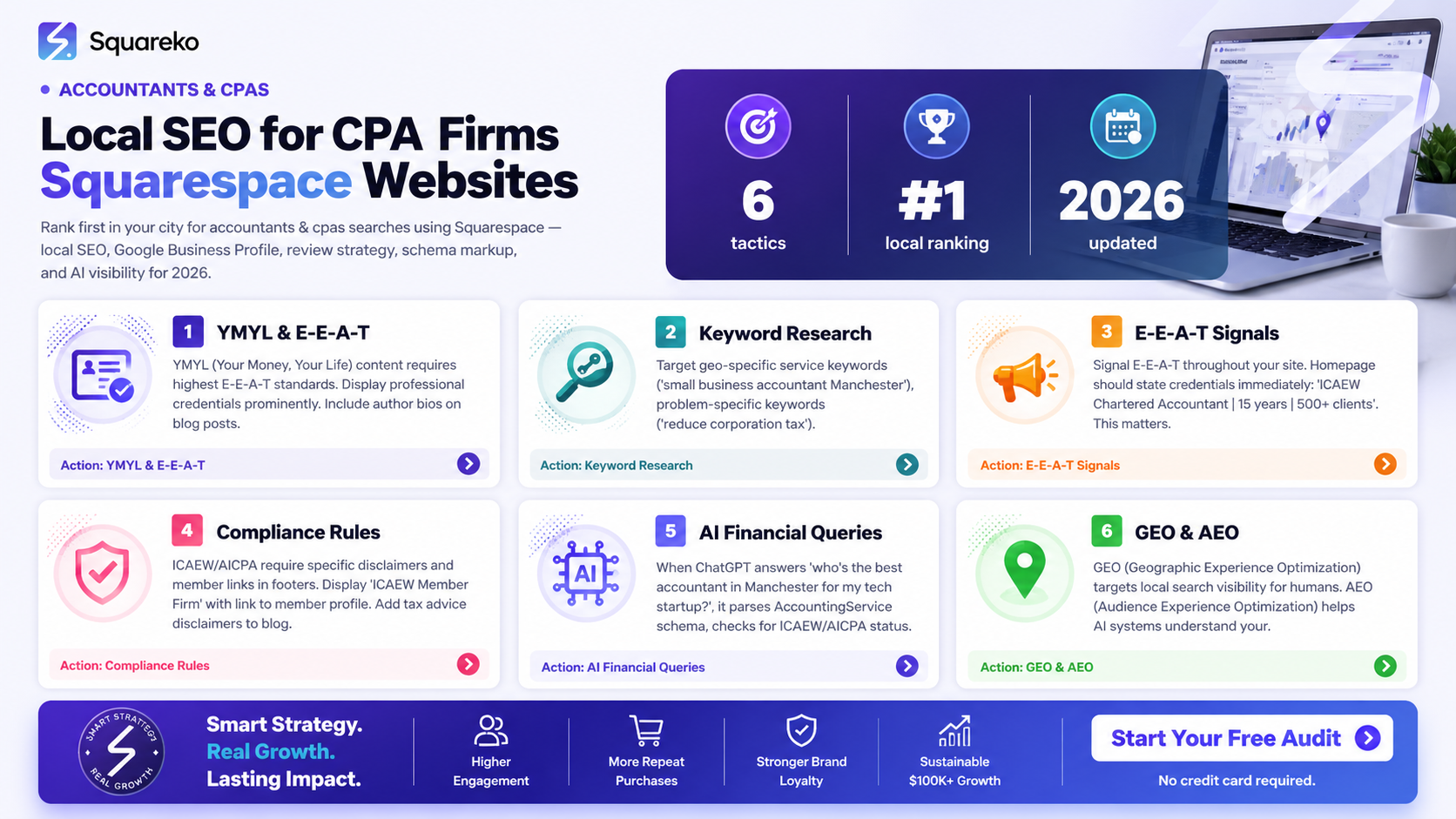
YMYL and E-E-A-T requirements for accounting content are stricter than ever; every page must demonstrate professional credentials, experience, and trustworthiness
Structured data (Accounting Service schema) combined with verified professional credentials signals legitimacy to both Google and AI systems
Tax service keyword research must target hyper-local, intent-rich phrases: small business accountant [city], tax return accountant near me, bookkeeping services [postcode]
ICAEW and AICPA member status, prominently displayed on your Squarespace site, is now a ranking factor and a prerequisite for appearing in AI financial recommendations
AI systems in 2026 actively recommend qualified accountants based on citations, schema markup, and structured credentials—making your local SEO foundation as important as organic ranking
GEO and AEO (Audience Experience Optimisation) strategies ensure your Squarespace site serves both human visitors and AI systems simultaneously
YMYL and E-E-A-T: Why Accounting SEO Is Different
YMYL (Your Money, Your Life) is Google's term for content that can significantly impact someone's financial, legal, or medical wellbeing. Accounting and tax advice are quintessential YMYL categories. This means Google applies stricter quality standards to accounting websites than to other industries.
What Is E-E-A-T?
E-E-A-T stands for:
Experience: The author/business has direct experience with the subject matter
Expertise: Formal training, qualifications, and demonstrated knowledge
Authoritativeness: Recognition within the industry, citations, backlinks, professional credentials
Trustworthiness: Transparent about qualifications, clear contact information, professional representation
For accounting firms, E-E-A-T is not a nice-to-have marketing angle—it is a ranking requirement.
How YMYL Affects Accounting SEO
When someone searches how do I prepare a tax return? or what is corporation tax?, Google prioritises results from:
Verified accounting professionals
Professional bodies (ICAEW, AICPA)
Established accounting firms with a long track record
Websites with clear author credentials and professional qualifications
A startup accounting blog written by a non-qualified author, no matter how well-written, will struggle to rank. Conversely, a blog post written by a chartered accountant with 15 years' experience and published on a website displaying ICAEW membership will rank far higher.
E-E-A-T Implementation on Squarespace
To signal E-E-A-T on your Squarespace site:
Display Professional Credentials Prominently
Add ICAEW Chartered Accountant or CPA badge to your homepage header
Include team member qualifications on the About or Our Team page
Link to official ICAEW or AICPA member profiles
Include Author Bio on Every Blog Post
Author name + qualifications ( Written by James Smith, ICAEW Chartered Accountant)
Brief biography linking to full team member profile
Year of qualification and relevant experience
Create an Extensive About Us Page
Firm history and founding date (signals experience)
Individual team member profiles with photos and qualifications
Press mentions, case studies, client testimonials
Professional memberships and certifications
Show Client Relationships
Client logos (with permission)
Anonymised case studies: We helped a manufacturing company reduce its tax liability by £50,000
Number of clients served, average tenure
Industry specialisation (We specialise in accounting for tech startups)
Link to External Authority
Link to your ICAEW or AICPA member profile
Link to professional body guidelines (e.g., ICAEW guidance on tax filing)
Reference peer-reviewed accounting journals or official government tax guidance
The Authority Multiplier
When YMYL requirements are met, your Squarespace site gains what Google calls an authority multiplier. This means that pages from your site will rank higher for the same keywords compared to less authoritative sources. A single blog post on a site with strong E-E-A-T can outrank longer, more detailed content from lower-authority websites.
Tax Service Keyword Research and High-Intent Targeting
Accounting keyword research differs from general business keyword research. You're not targeting broad keywords; you're targeting high-intent phrases that indicate someone actively needs accounting services.
High-Intent Keyword Categories for Accountants
1. Geo-Specific Service Keywords
These are the foundation of accounting SEO:
Small business accountant [city] (small business accountant Manchester)
Tax return accountant near me
Bookkeeping services [postcode] (bookkeeping services M1)
CPA [region] (CPA Greater Manchester)
Accountant for [business type] (accountant for tech startups)
Search volume: 10–100 monthly per location (modest, but highly qualified) Intent: Very high (person is actively seeking services) Competition: Moderate (dominated by local firms and directories) Value: Extremely high (each click likely to convert)
2. Problem-Specific Keywords
These reveal where prospects have pain points:
How to reduce corporation tax
Self-employed tax deadline 2026
What can I claim on expenses as a freelancer
How do I file my tax return late
Bookkeeping for small business
Do I need an accountant for my business
Search volume: 50–1,000 monthly (higher volume) Intent: Medium to high (person is researching, not yet decided) Competition: High (major accounting bodies rank here) Value: Medium (converts after education and trust-building)
3. Vertical-Specific Keywords
If you specialise, target your vertical:
Accountant for contractors
Tax services for limited companies
Accounting for e-commerce sellers
Bookkeeper for nonprofits
Search volume: 20–500 monthly Intent: High (person knows they need specialised service) Competition: Low to moderate Value: Very high (attracts ideal clients)
Keyword Research Workflow on Squarespace
Identify Your Core Service Keywords
List all services you offer (tax returns, bookkeeping, payroll, audit, etc.)
Add your top 3–5 geographic service areas
Use Keyword Research Tools (Ahrefs, SEMrush, Moz)
Search small business accountant [city] for each of your service areas
Search tax return accountant near me and similar problem-based phrases
Record search volume, difficulty score, and current top-ranking sites
Assess Ranking Opportunity
Keywords with difficulty score below 40: Rank within 3–6 months with good SEO
Keywords with 40–60 difficulty: Rank within 6–12 months with consistent effort
Keywords above 60: Requires significant content and authority; skip if you're new
Create a Content Map
Assign keywords to specific pages:
Homepage: accountant [city], CPA [region]
Service pages: bookkeeping services, tax return preparation, payroll services
Service area pages: accountant in [specific town]
Blog: Problem-based keywords (how to reduce tax, self-employed tax tips)
Prioritise Keywords with Local Intent
A single accountant in Manchester ranking is worth more than 100 generic accounting tips rankings
Focus on geo-specific, service-specific keywords first
Build problem-based content later to support trust-building and SEO authority
Accounting Service Schema: The Foundation of Accounting SEO
Schema markup is the bridge between Google's search algorithms and AI systems. For accounting firms, Accounting Service schema is non-negotiable.
Accounting Service Schema Structure
Implement this schema on your Squarespace homepage or in the footer via Code Injection. Example:
{
  "@context": "https://schema.org",
  "@type": "AccountingService",
  "name": "Smith & Associates Chartered Accountants",
  "url": "https://example.com",
description: Chartered accounting and tax services for small businesses and individuals across Greater Manchester. We specialise in corporation tax, self-employed tax returns, bookkeeping, and business formation.,
"image": "https://example.com/logo.png",
  "areaServed": [
    {
      "@type": "AdministrativeArea",
      "name": "Manchester"
    },
    {
      "@type": "AdministrativeArea",
      "name": "Stockport"
    },
    {
      "@type": "AdministrativeArea",
      "name": "Salford"
    }
  ],
  "serviceType": [
    "Corporation Tax Return Preparation",
    "Self-Employed Tax Returns",
    "Bookkeeping",
    "Payroll Services",
    "Business Audit",
    "VAT Registration and Returns"
  ],
  "priceRange": "$$$",
  "telephone": "+44 161 XXX XXXX",
  "email": "hello@example.com",
  "address": {
    "@type": "PostalAddress",
    "streetAddress": "123 King Street",
    "addressLocality": "Manchester",
    "addressRegion": "Greater Manchester",
    "postalCode": "M1 1AA",
    "addressCountry": "GB"
  },
  "knowsAbout": [
    "Income Tax",
    "Corporation Tax",
    "VAT Compliance",
    "Business Formation",
    "Payroll Management"
  ],
  "staff": [
    {
      "@type": "Person",
      "name": "Jane Smith",
      "jobTitle": "Chartered Accountant",
      "credential": "ICAEW"
    }
  ],
  "sameAs": [
    "https://www.linkedin.com/company/smith-associates",
    "https://www.icaew.com/find-a-member/[member-id]"
  ]
}
Key Fields Explained
areaServed: List all geographic areas you serve; crucial for local ranking
serviceType: Specific services you offer; helps Google match searches to your site
knowsAbout: Expertise areas; used by AI systems to validate your authority
staff: Team members with credentials; supports E-E-A-T signals
sameAs: Links to ICAEW/AICPA profiles; validates professional status
Adding Schema to Squarespace
Go to Settings > Advanced > Code Injection
Paste the AccountingService JSON-LD into the Header section
Click Save
Test using Google's Schema Markup Validator (schema.org/validate)
When implemented correctly, Google will begin showing your business in Knowledge Panel results and special rich snippets for accounting searches.
Professional Credentials and E-E-A-T Signals on Squarespace
E-E-A-T signals must be visible throughout your Squarespace site, not buried in fine print. This includes professional credentials, which now directly influence both Google rankings and AI recommendations.
Homepage Credential Display
Your homepage should immediately communicate professional status:
[Logo]
Smith & Associates
ICAEW Chartered Accountants | Founded 2010
Award-Winning Accounting for Ambitious Businesses
[Three feature boxes:]
- ICAEW Member Since 2010
- £500M+ Total Client Assets Under Management
- 500+ Happy Clients Across Greater Manchester
This approach immediately establishes experience, authoritativeness, and trust.
About Page Structure
Create a dedicated About page with:
Firm History (100–150 words)
Year founded, growth trajectory, mission statement
Example: "Founded in 2010, Smith & Associates grew from a two-person practice to a 12-person team serving over 500 businesses across Greater Manchester. We specialise in helping ambitious SMEs navigate complex tax and accounting challenges."
Team Member Profiles (one per team member)
Photo, name, job title
Qualifications (ICAEW, CPA, ACA, etc.)
Specialisation and years of experience
Example: Jane Smith, Senior Chartered Accountant | ICAEW ACA | 15 years' experience in corporation tax and business strategy | Specialises in tech startup accounting"
Professional Memberships
ICAEW membership number with link to member profile
Any specialist accreditations (Xero Gold Partner, QuickBooks Authorised User, etc.)
Links to professional body verification pages
Press and Recognition
Press mentions, industry awards, speaking engagements
Featured in [publication], Shortlisted for [award], Speaker at [conference]
Client Portfolio (anonymised)
Number of clients: "Proud to serve 500+ businesses"
Average tenure: "Our clients stay with us for an average of 8 years"
Industry breakdown: "25% tech, 20% professional services, 15% e-commerce, 40% general SMEs"
Team Page with Credential Links
Go beyond names and titles. For each team member, include:
[Photo]
Jane Smith
Senior Chartered Accountant
ICAEW Member | Certified Tax Advisor
Jane has 15 years of experience in corporate tax and financial planning.
She specialises in working with tech startups and scaling businesses.
ICAEW Member Profile: [link to ICAEW profile]
LinkedIn: [link to professional LinkedIn]
Each clickable link to external credentials (ICAEW profile, LinkedIn) reinforces E-E-A-T signals.
ICAEW and AICPA Member Disclaimers and Compliance
When you display professional credentials or offer tax advice, compliance with professional body guidelines is mandatory. Failure to comply can result in disciplinary action and loss of accreditation.
ICAEW Disclaimer Requirements
If you're an ICAEW member, your website must include:
Clear statement that you are an ICAEW member
Link to your member profile on icaew.com
Disclaimer that advice is subject to ICAEW regulations
Confidentiality statement if you handle sensitive client data
Standard footer disclaimer:
Smith & Associates is an ICAEW member firm. All advice is subject to
ICAEW regulations and professional standards. ICAEW Member Firm Registration: [Number]
View our member profile: icaew.com/find-a-member/[your-member-id]
AICPA Disclaimer Requirements (for US-based CPAs)
If you serve US clients or hold CPA status:
Smith & Associates CPAs is a member firm of the American Institute of
Certified Public Accountants (AICPA). All tax and financial advice complies
with AICPA professional standards and ethical guidelines.
Tax Advice Disclaimers
On blog posts offering tax guidance:
This article is for informational purposes only and does not constitute
tax or legal advice. Every situation is unique. Please consult with a
qualified tax professional or accountant before making financial decisions
based on this information.
Compliance Checklist
Display professional credentials on homepage and About page
Include ICAEW/AICPA member link in footer
Add tax advice disclaimer to all blog posts offering guidance
Ensure team member profiles link to official credential verifications
Review credentials annually to ensure compliance with professional body requirements
Include confidentiality statement if handling sensitive client financial data
Non-compliance can result in removal from professional directories and disciplinary action. Ensure your Squarespace site meets these standards before publishing.
How Accounting Firms Appear in AI Financial Advice Queries in 2026
The 2026 search landscape includes AI-mediated queries that don't appear in traditional Google results. When someone asks ChatGPT, Perplexity, or Claude "who is the best accountant in Manchester for my tech startup?", the AI system searches for and ranks accounting firms based on structured signals, not keyword matching.
How AI Systems Evaluate Accounting Firms
Schema Markup Parsing
AI systems parse AccountingService schema to understand your services, locations, and credentials
If schema is missing or incomplete, AI systems cannot accurately represent your firm
Professional Credential Verification
AI systems check for ICAEW, AICPA, or other verified professional credentials
Non-credentialed providers are deprioritised or excluded from recommendations
Citation Aggregation
AI systems aggregate citations from multiple sources (Google Business Profile, ICAEW directory, Yelp, professional directories)
More citations = higher confidence in your legitimacy
Review Signals
AI systems consider review volume and sentiment across Google, Yelp, and professional platforms
Negative reviews directly reduce your likelihood of being recommended
Content Authority
AI systems scan your website for authoritative content addressing common questions
A well-researched blog post about "tax deductions for tech startups" increases your visibility in relevant queries
Example AI Query and Response
User: "I'm a freelancer in Manchester earning £60k. Do I need an accountant?"
AI System processes:
User location: Manchester
User situation: Freelancer, medium income
Search: Accounting Service schema with area Served: Manchester + service Type: Self-Employed Tax Returns
Filter: Only verified (ICAEW/AICPA) providers with positive reviews
Response: Based on your situation, you'd benefit from an accountant specialising in self-employed tax. I found Smith & Associates, an ICAEW Chartered Firm in Manchester with strong client reviews. They offer [specific services]. Visit [your website] to learn more.
Your firm appeared because:
You have AccountingService schema covering Manchester
You display ICAEW membership
You have positive reviews across multiple platforms
Your website contains content about self-employed tax
Action Steps for AI Visibility
Complete Your Schema
Ensure AccountingService schema is fully populated on your Squarespace site
Include all services you offer, all locations you serve, and your professional credentials
Build Citations in Professional Directories
ICAEW member profile with full details
AICPA directory (if applicable)
Yelp Business profile
Local Chamber of Commerce listing
Create Authority Content
Blog posts addressing common questions: Should I hire an accountant?, How much do accounting services cost?, What taxes do freelancers need to pay?
Target the questions your ideal clients actually ask
Generate Reviews Systematically
Ask satisfied clients for Google reviews
Respond to all reviews—positive and negative—within 48 hours
Encourage clients to mention specific services in reviews
Link to External Credentials
Link to your ICAEW member profile from your homepage and About page
Link to professional body guidance on your blog
When AI systems encounter multiple converging signals (schema, citations, credentials, reviews, content), your firm becomes a top recommendation candidate.
GEO and AEO: Optimising for Google and AI Systems
GEO (Geographic Experience Optimisation) and AEO (Audience Experience Optimisation) are two complementary strategies for 2026.
GEO: Optimising for Geographic Search
GEO focuses on local search visibility and geographic relevance:
Service Area Pages
Create dedicated pages for each location you serve
Each page targets accountant in [city] searches
Include local content, testimonials from that area, local business context
Postcode-Level Optimisation
Go beyond city pages; create pages for postcodes or districts
Example: Accounting services in Stockport M19 targets hyper-local searchers
Fewer pages (5–10) than full postcode coverage, but better ranking potential
Local Content
Reference local business organisations, Chamber of Commerce, local media
Mention local economic trends
Cite local tax advisories or compliance requirements specific to your region
Local Link Building
Contact local business organisations for directory listings
Sponsor or participate in local events; secure mentions on event websites
Build relationships with local business journalists and bloggers
AEO: Optimising for AI Systems
AEO focuses on how AI systems interpret and recommend your business:
Structured Data Completeness
Ensure all fields in Accounting Service schema are populated
Include staff, knowsAbout, sameAs fields (often overlooked)
Validate schema using Google's Schema Validator
Author Credentials
Every blog post should list the author and their credentials
Example: Written by Jane Smith, ICAEW Chartered Accountant, 15 years' experience
Link author names to team member profiles with full credentials
Clear Service Descriptions
Don't use marketing jargon; use clear, factual descriptions
We prepare tax returns for self-employed professionals (good)
We unlock your tax potential through strategic fiscal optimisation (bad—jargon and unclear)
Citation Consistency
Ensure your business name, address, and phone are identical across all platforms
Inconsistencies confuse AI systems and lower credibility scores
Use tools like Semrush Local or Moz Local to audit your citations
Content FAQs and Q&A
AI systems scan FAQ sections to understand your expertise areas
Address common questions with factual, detailed answers
Use plain language; avoid jargon
Example of AEO-optimised FAQ:
Q: What is corporation tax, and who has to pay it?
A: Corporation tax is a tax on company profits in the UK.
Any limited company must file a corporation tax return,
even if it made no profit. The current rate is 19% on profits
up to £50,000 and 25% above that threshold (as of 2026).
We help our clients understand their corporation tax obligations
and identify legitimate deductions to reduce their tax bill.
[Author: Jane Smith, ICAEW Chartered Accountant]
Building a Topical Authority Structure on Squarespace
Topical authority means your website is recognised as a comprehensive resource on a specific subject. For accounting firms, building topical authority around tax services for [your specialism] dramatically improves rankings and AI visibility.
Topical Authority Hub Model
Structure your content around core topics:
Hub Page: Tax Services for Tech Startups
├── Blog Post: Corporation tax for tech companies
├── Blog Post: R&D tax relief for software developers
├── Blog Post: Investor tax considerations for startup founders
├── Blog Post: VAT obligations for digital services
└── Service Page: Tech Startup Accounting Services
Each piece links to the hub page and to other related pieces. This creates a web of topically relevant content that Google (and AI systems) recognise as comprehensive.
Topical Authority Implementation
Identify Your Core Topics (typically 3–5)
Example topics: Tax for tech startups, Self-employed accounting, Limited company accounting
Create Hub Pages (one per topic)
Long-form overview (2,000–3,000 words)
Links to 5–8 related blog posts
Links to relevant service pages
Internal linking strategy: every piece of content in the cluster links back to the hub
Create Supporting Content
8–15 blog posts per topic cluster
1,200–2,000 words each
Each post answers a specific question within the broader topic
Interlink Strategically
Every blog post in a cluster links to the hub page (in introduction and conclusion)
Blog posts link to related posts in the same cluster
Service pages link to relevant hub pages
Example internal linking:
Blog post: R&D Tax Relief for Tech Companies
[Intro paragraph]
...Part of our comprehensive guide to tax services for tech startups.
Learn more: [link to hub page]
[Body content]
[Within body, mention related content]
For more on startup accounting, see our guide:
[link to 'Corporation Tax for Tech Companies' post]
[Conclusion]
Ready to navigate tech startup tax? Explore our full range of
Tech Startup Accounting Services
When executed correctly, topical authority clusters outrank individual articles and establish your firm as THE resource for your specialism.
Frequently Asked Questions
-
Accounting firms should prioritise three keyword categories: (1) geo-specific service keywords like "small business accountant in [city]" and "tax return accountant near me"—these have modest search volume but extremely high intent and conversion value; (2) problem-based keywords like "how to reduce corporation tax" or "self-employed tax deadline"—these attract prospects researching solutions; (3) vertical-specific keywords like "accountant for tech startups" or "bookkeeper for nonprofits"—these attract ideal-fit clients. Start by researching your top 3–5 service areas using tools like Ahrefs or SEMrush, targeting keywords with difficulty scores below 50. Create a content map assigning keywords to your homepage, service pages, service area pages, and blog. Most accounting firms find their fastest ROI by focusing on geo-specific, high-intent keywords first, then building topical authority around problem-based content.
-
Yes, Squarespace is perfectly adequate for CPA and accounting firm SEO. Squarespace supports custom URLs, H1/H2 tags, meta descriptions, image alt text, and structured data implementation via code injection. The platform's performance is solid for ranking purposes. The limiting factor is not Squarespace itself, but rather how thoroughly you implement SEO best practices. Many Squarespace accounting sites rank poorly not because of platform limitations, but because they lack schema implementation, service area pages, professional credential visibility, or consistent content creation. When configured correctly—with full schema markup, clear E-E-A-T signals, and strategic content—Squarespace sites rank as well as any other platform. The platform is particularly well-suited to accounting firms because its Design System allows you to create professional, credential-focused layouts without coding knowledge.
-
To rank for tax keywords, you need to meet four requirements: (1) E-E-A-T signals—display your professional credentials (ICAEW, CPA, ACA) prominently and link to your member profiles; (2) schema implementation—add AccountingService schema to your Squarespace footer specifying your services and expertise areas; (3) topical authority—create a hub page and 8–10 supporting blog posts covering different tax topics, interlinked to build authority; (4) geographic specificity—if "tax return accountant near me" is your target, create service area pages for each location and mention those locations in your content. Blog posts should be written or reviewed by qualified professionals (list credentials in the author bio) and include clear disclaimers. Target long-tail keywords (e.g., "corporation tax for limited companies") rather than ultra-competitive broad terms. Most accounting firms see measurable ranking improvements within 6–12 months of implementing this approach consistently.
-
Google Business Profile is arguably the single most important local ranking factor for accounting firms. A complete, verified profile can improve local visibility by 80%. However, its importance varies by business model. If you serve clients locally (in-person meetings, same-city focus), Google Business Profile is critical—you must claim it, verify it, complete all fields, and maintain it actively. If you serve clients regionally or nationally (mostly remote, video consultations), Google Business Profile is still important but less critical than organic SEO. Either way, claim and optimise your profile; the effort is minimal and the visibility gains are substantial.
-
AI systems in 2026 recommend accountants based on: (1) structured data (AccountingService schema parsed from your website), (2) professional credentials (verified ICAEW, AICPA, or similar status), (3) citation aggregation (same business name, address, phone across multiple directories), (4) review signals (volume and sentiment of reviews across Google, Yelp, professional platforms), (5) content authority (authoritative articles on your website addressing common financial questions). If you're missing any of these signals, AI systems have less confidence in recommending you. The most common mistake is ignoring schema markup—if your website lacks proper schema, AI systems cannot accurately understand what you do or where you serve. Prioritise schema, credentials visibility, and citation building, then focus on content authority and review generation.
-
Even if you work remotely, service area pages are valuable for three reasons: (1) they help you rank for geo-specific searches (someone in Manchester searching "accountant for tech startups" will find you), (2) they help AI systems understand your service areas, (3) they cost little to create and maintain. However, if you serve a truly national or international market, prioritise fewer, higher-quality service area pages (5–8 major cities or regions) over dozens of thin pages. Focus on areas where you have the most client concentration. Remote-serving firms typically see better ROI from topical authority and problem-based content than from exhaustive geographic coverage.
-
GEO (Geographic Experience Optimisation) focuses on local search visibility for human users—service area pages, local keywords, local content, local link building. AEO (Audience Experience Optimisation) focuses on how AI systems interpret and recommend your business—schema completeness, credential clarity, citation consistency, structured content FAQs. Both matter in 2026. A human searching "accountant in Manchester" expects a local business profile and geographic relevance (GEO). An AI system answering "who should I hire for accounting in Manchester?" needs clear schema, credentials, and citations to accurately recommend you (AEO). Implement both strategies simultaneously for maximum visibility.
Ready to Build Your Accounting Firm Website on Squarespace?
Ranking for accounting keywords in 2026 requires more than basic SEO. You need professional credential visibility, schema implementation, topical authority, and strategic positioning for both human searchers and AI systems. You need to demonstrate E-E-A-T at every level—credentials, content, citations, reviews.
For many accounting firms, these elements require technical expertise, content strategy, and ongoing optimisation. This is where Squareko excels. Our Squarespace web design specialists have built hundreds of accounting firm websites that rank consistently for competitive keywords, appear in AI recommendations, and convert prospects into clients.
We handle:
Accounting Service and Local Business schema implementation
E-E-A-T signal optimisation (credential visibility, author bylines, professional links)
Service area page strategy and creation
Topical authority structure and content mapping
Google Business Profile optimisation
Citation auditing and management
Ongoing SEO monitoring and improvement
Whether you're launching a new accounting firm website or rebuilding an existing one, we ensure every technical and strategic element is in place for maximum visibility in Google search, local results, and AI-mediated recommendations.
From custom website design to SEO strategy, we help businesses launch a site that looks professional and performs better.

Author Bio
I'm Walid Hasan, a Certified Squarespace Expert and Squarespace Circle Platinum Partner with over 12 years of hands-on experience designing and optimizing high-performing websites. Over the years, I've had the privilege of building more than 2,000 Squarespace websites for clients around the world, always focusing on clean design, strong user experience, and conversion-driven results.