SEO for Boutique Websites on Squarespace: Get Found by Local and Online Shoppers in 2026
Introduction
If you're running a boutique, you know that beautiful design alone isn't enough—customers need to find you. Whether you're selling handcrafted jewellery, curated fashion pieces, or artisan beauty products, SEO for boutique websites on Squarespace is your pathway to reaching both local shoppers and customers searching online. In 2026, boutiques that invest in strategic SEO see significantly higher conversion rates and customer loyalty than those relying solely on paid advertising. This guide covers everything you need to optimise your Squarespace boutique store for search engines, from technical settings to local visibility strategies that drive real, sustainable traffic.
Key Takeaways
Squarespace SEO fundamentals are built-in but require deliberate configuration—meta titles, descriptions, URL slugs, and image alt text must be optimised for your products and collections
Local SEO is non-negotiable for boutiques; linking your Squarespace store to Google Business Profile and using local schema markup helps customers find you nearby
Keyword research for boutique products focuses on niche, intent-rich terms that attract high-value shoppers
On-page optimisation for product and collection pages significantly improves rankings; Squarespace's flexible editing tools make this straightforward when you know what to prioritise
Technical SEO, blogging, and backlink building are often overlooked by small boutiques but separate top performers from the rest
Tracking performance via Google Search Console and Squarespace analytics reveals which strategies work; data-driven decisions beat guesswork every time
AI search and geo-optimisation are reshaping how boutiques compete in 2026; understanding these trends keeps you ahead
Squarespace SEO Settings: Your Foundation
Before you write a single piece of content, you need to get Squarespace's built-in SEO features working for you. Many boutique owners overlook these basics, but they're the difference between a website Google can't rank and one that climbs steadily.
Meta Titles and Descriptions
Your meta title appears in search results and browser tabs; your meta description is the 150–160 character snippet below it. Both significantly influence click-through rates.
For your homepage:
Keep meta titles to 50–60 characters
Include your primary keyword naturally
Mention a unique value prop
For product pages:
Use product name + key attribute + brand
Meta descriptions should highlight benefits and details
In Squarespace, access these in the Page Settings > Advanced tab. Don't skip them—Google rewards sites with intentional, unique meta data.
URL Structure and Slugs
URLs influence both SEO and user experience. Squarespace auto-generates URLs, but you should customise them.
Best practices:
Keep URLs short and descriptive: /navy-cashmere-wrap not /p/product123
Use hyphens, not underscores
Avoid keywords stuffing; one primary keyword per URL is ideal
For collections: /bestsellers or /new-arrivals rather than /collection-1
Consistency matters. If you're selling sustainable leather bags, use that phrase in related URLs rather than mixing eco-friendly bags and green leather.
Image Alt Text and Image Optimisation
Images drive boutique websites, but Google can't see them without alt text. Alt text serves two purposes: it helps search engines understand your images, and it ensures accessibility for customers using screen readers.
Alt text formula for product images:
Describe the product, colour, and material: Emerald green linen blazer with mother-of-pearl buttons
Include your keyword where natural: Sustainable wool overcoat in charcoal grey
Avoid keyword stuffing; Google penalises this
Keep it under 125 characters
In Squarespace, edit alt text by clicking the image, then selecting Design > Alt Text. Do this for every product and hero image.
Image file names matter too. Rename images before uploading: emerald-linen-blazer.jpg instead of IMG_2024.jpg.
Structured Data and Schema Markup
Squarespace automatically adds basic schema markup, but you can enhance it. Schema helps Google understand your products, prices, reviews, and availability.
For an ecommerce boutique, ensure you have:
Product schema (name, description, price, availability, reviews)
LocalBusiness schema (if you have a physical shop)
FAQ schema (for common product questions)
You can test your schema with Google's Rich Results Test.
Keyword Research for Boutique Products and Categories
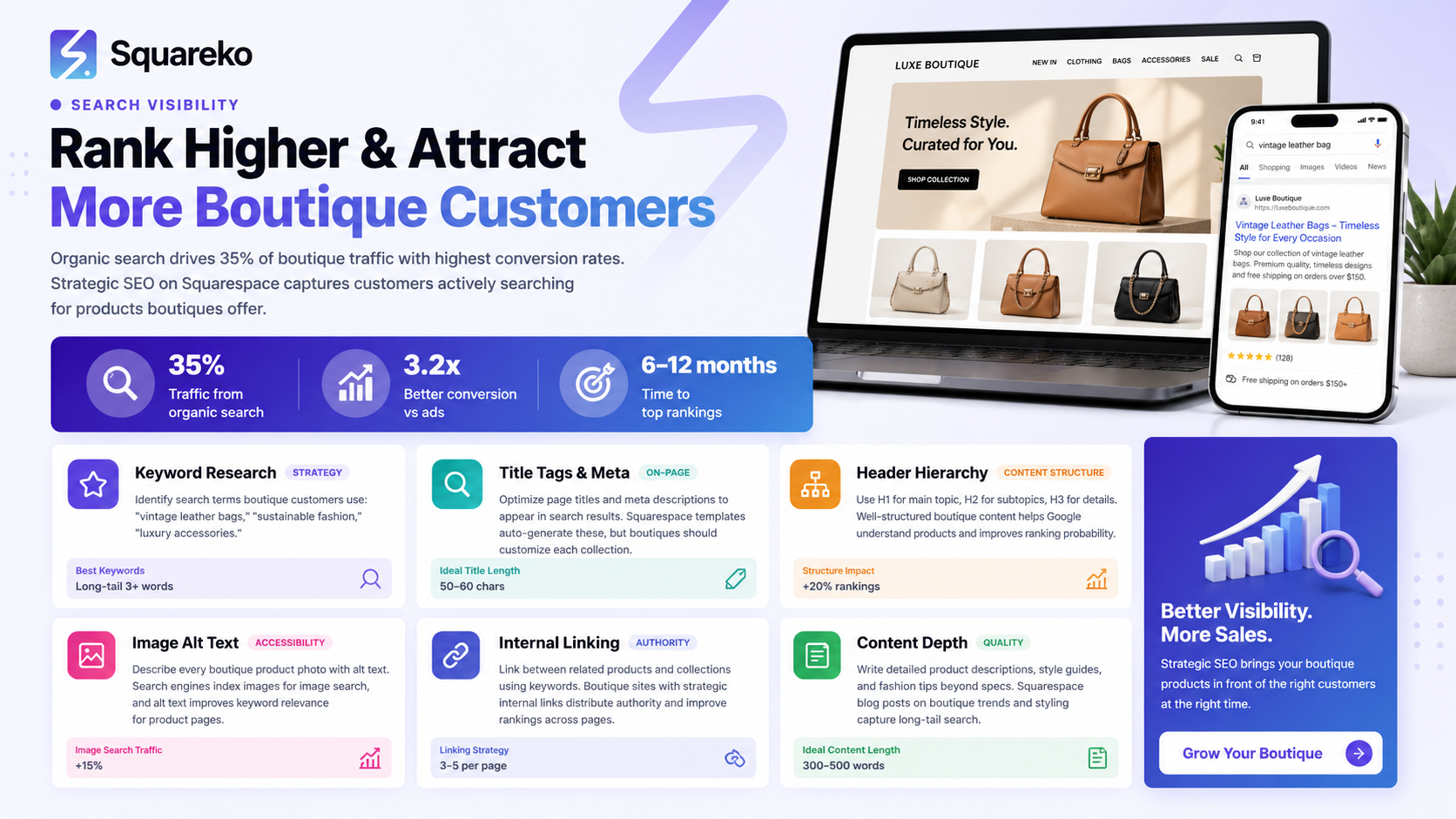
Boutique customers don't just search for "dresses" or "jewellery"—they search for specific, intent-rich phrases. This is where boutique SEO differs from mass-market retail.
Niche Keywords Over Broad Terms
A customer looking for sustainable linen dresses is more likely to buy than one searching dresses. They've already decided what they want.
Research process:
Start with your products. List everything you sell: product types, materials, styles, colours, price points.
Think about modifiers. Add: sustainable, handmade, bespoke, vintage-inspired, ethical, eco-friendly, luxury, artisan, local, etc.
Consider your location. Boutique fashion Melbourne or luxury skincare shop Manchester attracts local intent.
Use tools. Google Keyword Planner (free), Ahrefs' free keyword tool, or SEMrush reveal search volumes and competition.
Long-Tail Keywords and Customer Intent
Long-tail keywords (3+ words) typically have lower search volume but higher conversion intent.
Examples:
"handcrafted silver jewellery UK" (13 searches/month, high intent)
"silver jewellery" (2,400 searches/month, low intent, mixed intent)
Boutiques win by targeting the long-tail. You won't rank for "jewellery" against Amazon and ASOS, but "sustainable lab-grown diamond earrings" is absolutely achievable.
Seasonal and Occasion-Based Keywords
Boutiques thrive on seasonality. Research keywords around:
Seasons (summer linen, winter coats, spring dresses)
Occasions (wedding guest outfits, date night jewellery, gift ideas)
Trends (dopamine dressing, quiet luxury, Y2K revival)
Add these to your keyword list and plan content around them.
Competitor Analysis
Search your primary keywords and note the top five results. Ask:
Are they boutiques like mine, or large retailers?
What's the tone? Luxury? Eco-conscious? Playful?
What keywords do they target in their meta descriptions?
How long are their product descriptions?
This reveals gaps. If competitors focus on luxury positioning, you might own "affordable sustainable fashion" instead.
On-Page SEO for Product Pages and Collections
Once you've identified your keywords, it's time to optimise your pages.
Product Page Optimisation
Each product page is an opportunity to capture relevant searches.
H1 tag: Use one per page, and make it the product name or primary keyword phrase.
Handcrafted Linen Blazer in Charcoal Grey | Ethical Fashion
Product description:
Lead with benefits, not features: "Breathable and wrinkle-resistant linen, perfect for summer workwear" vs. "100% linen"
Include your keyword 1–2 times naturally, never stuffed
Address pain points: "Ethically made in Portugal" or "Free shipping over £50"
Mention materials, dimensions, care instructions (these support rankings and reduce returns)
Call-to-action placement: Include a clear CTA near the top and bottom: "Add to Basket", "Explore Matching Pieces", "Join the Waitlist".
Collection and Category Pages
Collection pages are ranking opportunities.
Optimisation steps:
Write a collection description. Don't leave it blank. Write 150–200 words explaining the collection, its purpose, and what customers will find.
Target collection-specific keywords: Shop sustainable fashion, New arrival dresses, Luxury handbags.
Use H2 and H3 tags. Break descriptions into sections: Overview, Why Shop This Collection, Care Tips.
Filter and facet pages: If your store allows filtering (size, colour, price), ensure these pages don't create duplicate content issues. In Squarespace, filter pages are generally fine, but check Google Search Console.
Internal Linking Strategy
Internal links pass authority and guide customers to important pages.
Best practices:
Link from blog posts to relevant product pages
Use anchor text that includes keywords: shop our sustainable linen collection not click here
Link to category pages from the homepage and navigation
Create a Shop Related or You Might Also Like section on product pages
Local SEO for Boutiques: Google Business Profile and Beyond
If you have a physical store, local SEO is essential. Even online-only boutiques benefit from local optimisation.
Google Business Profile Optimisation
Your Google Business Profile is your local storefront.
Complete setup:
Claim or create your listing at Google Business
Fill every field: Name, address, phone, hours, website, categories
Add high-quality photos: Store exterior, interior, products, team. Update quarterly.
Write a detailed description: Independent fashion boutique specialising in sustainable and ethically made clothing. Family-run since 2015. We offer personal styling consultations.
Respond to reviews. Thank positive reviewers; professionally address concerns. This boosts local ranking.
Add posts. Google Business allows posts about new arrivals, sales, events. Use these regularly.
Local Keywords in Your Website
Incorporate location into your website strategically:
Homepage: Add a "Shop in [City]" section or mention your location in your H1 or first paragraph
Footer: Include your address, phone, and hours
Schema: Use LocalBusiness schema with your address and phone number
Blog: Write content around local themes ("10 Fashion Trends Spotted in Melbourne This Spring")
Local Link Building
Local directories and partnerships boost local authority:
Claim listings on Yell, Trustpilot, and local business directories
Partner with local events, markets, or charities
Get mentioned in local blogs and lifestyle websites
Sponsor or host local events and request a link in return
Technical SEO on Squarespace: Speed, Crawlability, and Structure
Technical SEO isn't glamorous, but it directly impacts rankings.
Page Speed and Performance
Google uses page speed as a ranking factor. Squarespace is generally fast, but you can optimise further:
Compress images: Use tools like Tinypng before uploading
Limit third-party scripts: Each app or widget adds load time
Enable caching: Squarespace handles this, but ensure it's active
Test performance: Use Google PageSpeed Insights to identify issues
Target a Core Web Vitals score of "Good" across all metrics.
XML Sitemap and Robots.txt
Squarespace auto-generates a sitemap and robots.txt, but verify they're correct:
Visit yourdomain.com/sitemap.xml to check your sitemap is complete
Check yourdomain.com/robots.txt to ensure crawlers aren't blocked
Submit your sitemap to Google Search Console
Mobile Optimisation
Over 60% of ecommerce searches happen on mobile. Squarespace websites are mobile-responsive by default, but test:
Tap targets: Buttons and links should be at least 48px
Form fields: Easy to fill on mobile
Images: Scale properly on all screen sizes
Navigation: Clear and accessible
Test your site on various devices and use Google's Mobile-Friendly Test.
Duplicate Content and Canonicalisation
Ecommerce sites often have duplicate content issues (e.g., same product in multiple collections). Squarespace handles canonical tags, but:
Avoid creating the same content across multiple pages
If you must have similar pages, use canonical tags
Set up preferred domain (www vs. non-www) in Squarespace settings
Content Marketing and Blogging for Long-Tail Keywords
Blogging is underutilised by boutiques, but it's one of your best SEO tools.
Blog Strategy for Boutiques
Blog topics should address:
Product education: How to Care for Linen, Guide to Jewellery Metals, Layering Tips for Summer Dresses
Seasonal content: Spring Fashion Trends 2026, Winter Capsule Wardrobe Essentials
Lifestyle and inspiration: Sustainable Fashion on a Budget, Building Your Personal Style, Ethical Brands We Love
Trend commentary: Position your boutique as a thought leader
Keyword targeting: Each blog post targets 1–3 long-tail keywords your store pages don't cover. For example:
Store page targets: Sustainable linen dresses
Blog post targets: How to style sustainable linen dresses or Best fabrics for summer dresses
Blog Post Structure and On-Page SEO
Headline: Keyword-focused and compelling
Meta description: Include keyword, describe benefit
Introduction: Hook the reader and include your keyword in the first 100 words
H2 and H3 subheadings: Break content into scannable sections
Internal links: Link to relevant product pages and previous blog posts
Word count: 1,500–2,500 words for best results; deeper content ranks better
Visuals: 2–3 high-quality images per 1,000 words
Publishing Frequency and Consistency
Post consistency matters more than volume.
Realistic goal: 2–4 posts per month
Avoid burnout: Batch-write content or repurpose existing material
Promote strategically: Share on Instagram, email subscribers, Pinterest
Building Backlinks and Authority for Boutique Brands
Backlinks signal authority to Google. For boutiques, focus on quality over quantity.
Earning Editorial Backlinks
High-quality backlinks come from relevant, authoritative sites mentioning your boutique.
Strategies:
PR outreach: Contact fashion bloggers, lifestyle journalists, and Instagram influencers in your niche. Share your story, new collection, or unique angle.
Press releases: Announce new collections, milestones, or partnerships. Distribute via local news outlets or press release sites.
Interviews and expert commentary: Pitch yourself as an expert. Offer quotes to journalists covering your industry.
Guest blogging: Write articles for fashion, lifestyle, or local business blogs. Include a link to your site in the author bio.
Local Link Building
Sponsor or participate in local events; request a link
Partner with complementary businesses (coffee shops, salons) for cross-promotion
Get featured in local business directories and awards listings
Backlink Monitoring
Monitor your backlinks quarterly or tools like Ahrefs. Remove low-quality links if they appear.
Tracking, Measuring, and Optimising Your SEO Performance
Data-driven decisions beat assumptions.
Google Search Console Setup
Search Console shows how Google sees your site and reveals opportunities.
Key metrics to monitor:
Impressions: How often your site appears in results
Clicks: Actual traffic from search results
Average position: Your ranking position
Click-through rate (CTR): If CTR is low, revisit your meta descriptions and titles
Actions:
Monitor new keywords you're ranking for; create content around them
Identify pages with 2nd–3rd page rankings; optimise to push them to page 1
Check for crawl errors and fix broken links
Squarespace Analytics
Squarespace's built-in analytics show traffic, referral sources, and conversions:
Track which product pages get the most visits
Identify high-bounce pages and optimise them
Moitor conversion rate; flag underperforming products
Quarterly Reviews
Every three months, audit your progress:
Ranking improvements: Which keywords have moved up in rankings?
Traffic trends: Are sessions increasing month-on-month?
Revenue impact: Are higher-ranking pages driving sales?
Content performance: Which blog posts get the most engagement?
Backlink growth: How many quality backlinks have you earned?
Adjust your strategy based on this data.
SEO Trends for Boutiques in 2026: AI Search and Geo-Optimisation
SEO is evolving rapidly. Stay ahead with these 2026 trends.
AI Search and Generative AI Integration
Google's Search Generative Experience (SGE) and ChatGPT are reshaping how people search.
Implications for boutiques:
AI Overview results: Google now shows AI-generated summaries at the top of results. To appear here, create comprehensive, authoritative content (blog posts, guides, FAQs)
FAQ optimisation: AI tools pull from FAQs; detailed, well-structured FAQs boost visibility
Entity recognition: Ensure your brand name, product names, and attributes are consistent across your site. AI uses this to understand your boutique
Voice and visual search: Optimise for voice queries ("show me sustainable leather bags") and image search (detailed alt text, structured image markup)
Geo-Optimisation and Near Me Searches
Near me searches are growing. Even online-only boutiques should localise:
Mention your location: Include city names and neighbourhoods naturally in content
Local schema: Implement LocalBusiness and offer local schema markup
Location pages: If you ship to multiple regions, create location-specific pages
Local content: Write blog posts about local fashion trends, community involvement, and local partnerships
Core Web Vitals and User Experience
Google's Core Web Vitals (loading speed, interactivity, visual stability) remain ranking factors:
Keep page load times under 2.5 seconds
Ensure buttons and interactive elements respond instantly
Prevent layout shifts (images and ads shouldn't shift content unexpectedly)
Entity-First SEO
Google is moving towards understanding entities (things, concepts) rather than just keywords.
For boutiques:
Your brand is an entity; build consistent brand mentions across your site and the web
Your products are entities; ensure names, descriptions, and attributes are consistent
Locations are entities; consistent local information boosts local ranking
Frequently Asked Questions
-
SEO is a marathon, not a sprint. Most boutiques see measurable improvement in 3–6 months with consistent effort. Higher-competition keywords may take 6–12 months to rank. However, you'll see immediate benefits from on-page optimisation (better click-through rates, improved conversions) even before ranking improves. Consistency and patience are essential.
-
Both approaches work, depending on your time and expertise. DIY SEO requires learning, experimentation, and ongoing effort—realistically, 5–10 hours per week. Many boutique owners find this challenging alongside running the business. Agencies like Squareko handle strategy, optimisation, and monitoring, freeing you to focus on products and customer service. A hybrid approach—hiring an agency for quarterly audits and strategy while managing day-to-day optimisation—also works well.
-
Both. Even if you ship nationally or internationally, local optimisation helps if you have a physical store or serve a region. Online optimisation targets broader searches from customers anywhere. The best strategy is: (1) dominate local search in your area with Google Business Profile and local keywords, (2) capture online searches with broader, niche keywords and content marketing, (3) use blogging and backlinks to build national/international authority.
-
Product pages target specific product searches (e.g., "emerald green linen blazer") and individual keywords. Collection pages target broader keywords (e.g., "sustainable blazers", "summer clothing collection") and serve as hubs linking to multiple products. Both need optimisation, but collection pages should be more strategic, emphasising the breadth of the collection and long-form description.
-
Update them quarterly, or when your offerings or strategy shift. If a page is ranked but getting low click-through rates, a more compelling meta description can improve CTR without any ranking change. Monitor Search Console to identify underperforming titles and descriptions, then test variations.
-
Yes, significantly. Google's generative results and AI summaries mean comprehensive, authoritative content performs better. FAQs are increasingly important. Boutiques should also optimise for AI search tools like ChatGPT and Google's SGE, which means ensuring your products and brand are well-documented across your site and in structured data.
-
Squarespace has solid built-in SEO tools (meta tags, sitemaps, mobile optimisation, security). For boutiques, it's a strong choice. Shopify offers more granular control over some SEO elements; WordPress offers maximum flexibility but requires more technical knowledge. For most boutiques, Squarespace's balance of ease and capability is ideal, especially when paired with strategy from a specialist agency like Squareko.
Ready to Build Your Boutique Website with Squarespace?
SEO is one piece of the puzzle—your website design, user experience, and brand voice matter just as much. A beautifully designed, fast-loading Squarespace store that's also optimised for search engines creates the perfect foundation for a thriving boutique business.
At Squareko, we specialise in building stunning Squarespace websites for boutiques, fashion brands, and beauty retailers. We combine design excellence with SEO strategy from day one, ensuring your boutique isn't just beautiful—it's found. Whether you're launching your first boutique site or refreshing an existing store, our team can guide you through design, development, and optimisation. Visit squareko to explore how we can help your boutique reach local and online shoppers.

Author Bio
I'm Walid Hasan, a Certified Squarespace Expert and Squarespace Circle Platinum Partner with over 12 years of hands-on experience designing and optimizing high-performing websites. Over the years, I've had the privilege of building more than 2,000 Squarespace websites for clients around the world, always focusing on clean design, strong user experience, and conversion-driven results.