Local SEO for Nutritionists on Squarespace: Rank for Your City in 2026
Introduction
Most registered nutritionists rely on referrals from GPs, corporate wellness schemes, and fitness partners. But in 2026, local search is where qualified clients find you first. When someone searches registered nutritionist in Manchester or IBS dietitian near me, you want to appear at the top. Local SEO on Squarespace gives nutrition professionals the tools to rank for location-specific queries and convert local searches into bookings. This guide walks you through Google Business Profile optimisation, local keyword strategy, and Squarespace setup that puts your nutrition practice on the map—literally.
Key Takeaways
Google Business Profile is non-negotiable: Optimising your GBP with correct categories (Dietitian, Nutritionist, Health Consultant), comprehensive services, professional photos, and regular posts dramatically improves local visibility for nutrition queries.
Local keyword strategy targets registered status: Searches like registered nutritionist London or ANutr dietitian Birmingham show high purchase intent; these clients actively seek credentialed professionals.
Squarespace location pages rank for "nutritionist in city": A dedicated location page (if you serve multiple areas) or homepage optimisation captures the local search intent that drives consultations.
Reviews and local citations build trust for health services: YMYL categories like nutrition require strong local trust signals; ethical review generation and directory listings (ANutr directory, find-a-nutritionist.co.uk) establish authority in your region.
Schema markup (LocalBusiness + Dietitian) tells Google what you are: Squarespace's native schema support, combined with custom Dietitian schema, ensures Google understands you're a credentialed nutrition professional in a specific location.
Why Local SEO Matters for Registered Nutritionists and Dietitians
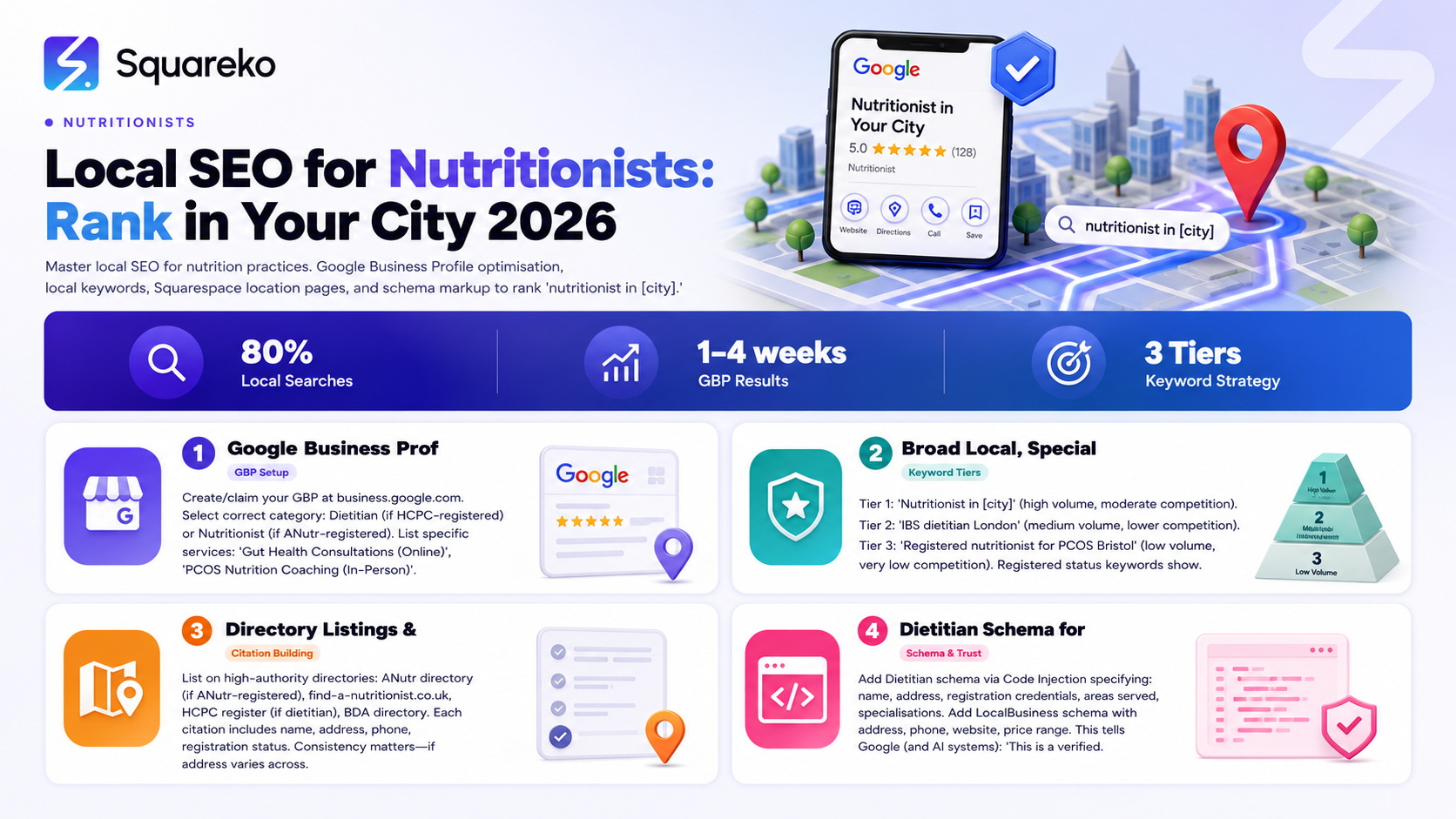
Local SEO is the difference between a nutrition practice that grows through word-of-mouth and one that systematically appears when qualified clients search. The shift is clear: most health searches now include location intent. "Nutritionist" alone generates millions of results. "Registered nutritionist in Bristol" narrows the field and shows genuine client readiness to book.
For HCPC-registered dietitians, ANutr-registered nutritionists, and independent nutrition coaches, local search represents a direct acquisition channel. Unlike organic SEO, which can take months to compound, local SEO improvements (especially GBP optimisation) can drive visible results in weeks.
The YMYL category that nutrition sits in demands extra scrutiny from Google. A strong local footprint—verifiable address, professional photos, legitimate reviews, local citations—signals to Google that you're an established, trustworthy health professional. This matters more for nutrition than for less regulated services.
Google Business Profile Setup for Nutrition Practices
Creating and Claiming Your GBP
If you don't have a Google Business Profile yet, create one at business.google.com. Claim your existing profile immediately to prevent incorrect information or duplicate listings.
For your nutrition practice, accuracy is essential. Include:
Business name: Use your registered professional status. Sarah Mitchell – Registered Dietitian or London IBS Nutrition (ANutr-registered Dietitian) signals credibility immediately.
Address: If you see clients in person, use your real address. If you offer online-only nutrition consultations, leave the address field blank and tick "service area only". Do not use a virtual office address; Google will penalise this.
Phone number: A direct line (not just email) builds trust for health services.
Website: Link to your Squarespace site.
Selecting the Right Categories
Google Business Profile categories determine when and how you appear in local searches. For nutrition professionals:
Primary category: Choose "Dietitian" if you're HCPC-registered. Choose "Nutritionist" if you hold ANutr or other professional registration. If you're an unregistered nutrition coach, select "Health Consultant" (but be transparent about your qualifications).
Secondary categories: Add Health Consultant, Wellness Program, or Nutritional Consulting to capture related searches.
Do not select irrelevant categories like "Gym" or "Health Food Store" to game the algorithm. Google penalises this, and it undermines the trust you build with genuine registration.
Optimising Services on GBP
This is where most nutritionists miss opportunity. Your GBP services section should list the specific services you offer:
"Gut Health Consultations (Online)"
"PCOS Nutrition Coaching (In-Person)"
"Sports Nutrition for Athletes (One-to-One)"
"Weight Management Programme (6-Week Online)"
"Registered Dietitian for IBS Referrals"
Each service should include: description (50–80 words), service area (online, in-person, or both), and price range if applicable. Clients searching "IBS dietitian in Manchester" will see these specific services and know you're a fit.
GBP Photos and Visual Trust
Nutrition is a high-trust category. Your GBP photos shape first impressions:
Professional headshot: High-quality, recent photo (not stock). This is the single most important photo. Clients are trusting you with their health; they want to see who they'll be working with.
Practice photos: Your consultation space (if in-person), office setup, or branded background for online sessions.
Before/after case studies: Only if you have explicit, documented client consent. Never use unauthorised photos. Include brief context ("Client managed IBS symptoms through 3-month nutrition programme").
Educational content photos: Infographics about gut health, nutrition myths, seasonal eating guides—these photos perform well and reinforce expertise.
Update photos monthly. Fresh, recent visuals signal an active practice.
GBP Posts for Nutrition Authority
Google allows you to post updates directly on your GBP profile (similar to social media). These posts appear to clients searching for your practice.
Post twice monthly with nutrition-focused content:
"5 foods that calm IBS symptoms" (linked to your blog post)
"Myth: All fats are bad for you. Here's what the evidence says..." (educational)
"Open bookings now for Q2 consultations" (promotional)
"New blog: How sports nutritionists use periodised nutrition for endurance athletes" (authority building)
Posts stay visible for 7 days and generate engagement signals that boost your profile.
Local Keyword Strategy: Beyond Nutritionist Near Me
The Three Tiers of Local Nutrition Keywords
Tier 1: Broad Local ("nutritionist in [city]", "registered dietitian Manchester")
High search volume, moderate competition
Target with your homepage and primary Squarespace location page
These searches show location intent but low specialisation intent
Tier 2: Specialisation + Location ("IBS dietitian in London", "sports nutritionist Manchester", "PCOS nutrition coach Birmingham")
Medium search volume, lower competition (especially in smaller cities)
Rank for these with targeted blog posts and service pages
These searches show both location and health problem intent—high-quality leads
Tier 3: Credentials + Location + Problem ("registered nutritionist for gut health Bristol", "ANutr-registered dietitian weight management Leeds")
Lower search volume, very low competition
Rank for these with detailed blog posts and FAQ pages
Clients searching this way have made a commitment to finding a credentialed professional
Research Tools and Local Keyword Discovery
Use Google Search Console (connect your Squarespace site) to see which local keywords you already rank for. Google Maps also shows search patterns for your category and location.
For nutrition-specific local research:
Search condition nutritionist in your city to see who ranks and what content they use.
Check the find-a-nutritionist.co.uk directory and ANutr directory to see how other nutritionists describe their services—this informs your local keyword strategy.
Use Semrush or Ahrefs local keyword research to identify location-specific monthly search volume.
In smaller cities (population < 500k), you often find that "nutritionist in [city]" has only 50–100 monthly searches. Your strategy should focus on Tier 2 and Tier 3 keywords—specialisation and registered status matter more than raw volume.
The Registered Status Local Keyword Advantage
This is unique to regulated health professions: clients actively search for "registered", "HCPC", "ANutr", and "dietitian" specifically because they're trying to avoid unqualified practitioners.
Optimise your content for:
"Registered dietitian city"
"ANutr-registered nutritionist city"
"HCPC dietitian region"
"Condition dietitian vs nutritionist city" (educational intent—opportunity to explain the difference and position yourself as credentialed)
These keywords have less volume than generic "nutritionist" searches, but the conversion rate is much higher because clients self-select for credibility.
Squarespace Location Pages and Homepage Optimisation
When to Build a Location Page
If you serve multiple cities or regions (e.g., "nutrition consultant for PCOS in London, Manchester, and Bristol"), create separate location pages for each major city.
If you operate from a single location or offer primarily online services, optimise your homepage instead.
Squarespace Location Page Structure
On your Squarespace site, create a page for each major location. Structure:
/manchester-nutritionist-ibs (or similar URL)
# IBS Nutritionist in Manchester | Registered Dietitian Your Name
Hero section with local trust signals: photo, registration badge, testimonial from Manchester-based client if available
## Why Choose a Registered Nutritionist in Manchester?
2–3 paragraphs explaining local difference, your years in Manchester, any local partnerships
## Our Services in Manchester
Services available locally, whether in-person or online, appointment scheduling CTA
## The IBS Nutrition Approach We Use
Detailed explanation of your approach, results clients can expect
## FAQs About Nutrition Consultations in Manchester
Location-specific Q&As: "How quickly can I book a consultation in Manchester?", "Do you offer in-person appointments in Manchester?", "Why choose an HCPC-registered dietitian?"
## Client Testimonials (Manchester)
Include testimonials from Manchester-based clients
## Local Partnerships
GPs, fitness centres, corporate wellness schemes in Manchester that refer to you
## Contact Us in Manchester
Full contact form, phone, email, booking button
Homepage Optimisation for Single-Location Practices
If you're based in one city, your homepage should prominently feature:
H1: "Registered Nutritionist in City – Specialising in [Your Main Specialism"
First 100 words: Mention city, registration status, and specialisation.
Service area clearly stated: "Currently accepting clients in [City] and online across the UK" (or your actual scope).
Local trust signals: Years in practice locally, any local partnerships or affiliations, client testimonials from local clients (with permission).
Building Local Trust Through Reviews and Citations
Ethical Review Generation for Health Professionals
Health professionals need reviews more than most businesses. Clients want to know: Is this dietitian good? Can she help my PCOS? Do others trust her?
Ethical review generation means:
Ask at the end of successful consultations: "Would you be happy to leave a quick review? It helps other people with [your specialism] find me."
Make it easy: Provide a direct link to your Google Business Profile review page. Add it to your thank-you email after their first session.
Never incentivise reviews: Offering discounts or free services for reviews violates Google's policies and destroys trust.
Respond to all reviews: Reply to positive reviews with gratitude. Reply to negative reviews professionally—never defensively—and offer to resolve offline.
For nutrition practices, expect reviews to focus on: professionalism, knowledge, ability to explain complex topics, results (e.g., "My symptoms improved after 8 weeks").
Local Citation Building
Citations are mentions of your business name, address, and phone number on other websites. They strengthen local authority.
High-value citations for nutritionists:
ANutr directory (Association for Nutrition): Get listed at associationfornutrition.org if you're ANutr-registered. This is the highest-authority citation for UK nutritionists.
find-a-nutritionist.co.uk: Independent nutritionist directory. Verify your listing is accurate.
HCPC register (if you're a registered dietitian): Your HCPC registration page is automatically a local citation.
BANT directory (British Association for Applied Nutrition & Nutritional Therapy): If you're BANT-registered, ensure your listing is optimised.
Local directories: City council directories, local health networks, corporate wellness platforms.
Gym and fitness centres: If you partner with local fitness studios or gyms, ask them to list you on their website or partner directory.
GP practices and private medical referral networks: Get listed on platforms where GPs refer to allied health professionals.
Each citation should include: your name, business name (if different), full address, phone number, website URL, registration/credentials (ANutr, HCPC, etc.), and specialisations.
Consistency matters: if your address varies across citations, Google becomes uncertain about your location.
Local Link Building for Nutrition Professionals
Local links (from nearby websites) are powerful local ranking signals.
Partnership-Based Local Links
GP practices: Partner with local GPs for referrals. Ask if they'll add a link from their "Allied Health Professionals" page.
Fitness centres and personal trainers: Sports nutritionists and fitness professionals overlap. Establish partnerships, exchange links.
Corporate wellness: If you deliver workplace nutrition workshops, ask the company to link to you from their wellness resources page.
Health events: Speak at local health talks, health expos, or community wellness events. Organisers often link to speakers.
University or college: If you teach nutrition or guest lecture, ask for a link from the institution's website.
Content-Based Local Links
Contribute to local publications: Write for local lifestyle magazines (online or print). Include an author bio with a link to your site.
Local health journalism: Pitch nutrition stories to local journalists ("Why gut health is crucial for athletes in Manchester").
Community resources: Create free local resources (e.g., "The Runner's Nutrition Guide for Manchester Athletes") and get linked from local running clubs or fitness communities.
Schema Markup for Local Authority
Squarespace includes basic LocalBusiness and Organization schema by default. For nutrition practices, you should add Dietitian schema.
Adding Dietitian Schema to Squarespace
Squarespace doesn't have a native Dietitian schema option, so you'll add it via Code Injection (Settings > Advanced > Code Injection > Header).
<!-- Please remove the commented script wrapper and add this schema inside a proper <script type="application/ld+json"> tag. -->
{
  "@context": "https://schema.org/",
  "@type": "Dietitian",
  "name": "[Your Full Name]",
  "url": "https://yoursite.com",
  "image": "https://yoursite.com/your-photo.jpg",
  "description": "[Your practice description: 'Registered Dietitian specialising in IBS and gut health']",
  "address": {
    "@type": "PostalAddress",
    "streetAddress": "[Your address]",
    "addressLocality": "[City]",
    "addressRegion": "[Region]",
    "postalCode": "[Postcode]",
    "addressCountry": "GB"
  },
  "telephone": "[Your phone number]",
  "email": "[Your email]",
  "areaServed": [
    {
      "@type": "City",
      "name": "[Your primary city]"
    }
  ],
  "knowsAbout": [
    "Gut Health",
    "IBS",
    "PCOS",
    "[Your specialisations]"
  ],
  "credential": "ANutr, BSc (Hons) Nutrition",
  "sameAs": [
    "https://associationfornutrition.org/...",
    "[Your LinkedIn profile]"
  ]
}
Mid-Post CTA
Ready to dominate local search for nutrition in your city?
Squareko specialises in building Squarespace websites for registered nutritionists and dietitians. We handle local SEO setup Google Business Profile optimisation, schema markup, location page structure, and YMYL-compliant content strategy—so you can focus on seeing clients.From initial strategy to launch, Squareko ensures your nutrition practice appears exactly where qualified clients search for you.
Frequently Asked Questions
-
GBP changes (photos, services, posts) can show results in 1–4 weeks. Ranking for local keywords via your website takes 6–12 weeks, depending on competition and content quality. The more specific your local keyword (e.g., "PCOS dietitian in Manchester" vs. "nutritionist"), the faster you'll rank.
-
No. Google explicitly penalises virtual office addresses. If you work from home, leave the address field blank and select "service area only". Clients will see you serve their location but won't see a specific address.
-
If you serve clients across the UK or beyond, you don't need location pages. Instead, optimise your homepage and service pages for location-agnostic keywords ("registered nutritionist for PCOS", "online dietitian for IBS"). Create location pages only if you have a physical practice location or want to target specific cities for in-person work.
-
Post 2–4 times per month. Consistency matters more than frequency. If you can only post once monthly, do that consistently. Each post should be educational, promotional, or event-based—not random.
-
Citations are mentions of your name, address, phone number on other sites (like directories). Backlinks are hyperlinks from other websites to yours. Both help local SEO, but citations are especially important for local ranking. A citation without a link is still valuable.
-
Use Google Search Console (free) to track which local keywords you rank for and your click-through rate. Use Google Business Profile Insights to see how many people search for you, view your profile, and call or visit. Track bookings and attribute them to local search if possible.
-
Google Local Services Ads appear above organic results for local searches. They're high-intent placements. For nutrition, LSAs can be cost-effective if your local market has competition. Start with organic SEO first (it's free), then test LSAs if organic alone isn't generating enough bookings.
-
Technically, yes—but you shouldn't try. "Dietitian" is a protected HCPC title. Only HCPC-registered professionals can call themselves dietitians. If you're ANutr-registered (nutritionist), rank for "nutritionist" and be clear about your credentials. Trying to rank for "dietitian" as a nutritionist is both legally problematic and ethically wrong.
Closing CTA
Your nutrition practice deserves a website that ranks locally and converts.
If local search strategy feels overwhelming, or you're not sure whether your Squarespace site is optimised for "nutritionist in, Squareko is here to help. Walid and the Squareko team specialise in building websites for nutrition professionals—complete with local SEO setup, YMYL-compliant content, professional registration display, and booking system integration.

From custom website design to SEO strategy, we help businesses launch a site that looks professional and performs better.

About the Author
Walid Hassan is the founder of Squareko,
I'm Walid Hasan, a Certified Squarespace Expert and Squarespace Circle Platinum Partner with over 12 years of hands-on experience designing and optimizing high-performing websites. Over the years, I've had the privilege of building more than 2,000 Squarespace websites for clients around the world, always focusing on clean design, strong user experience, and conversion-driven results.