Local SEO for Coaches on Squarespace: Rank for '[Specialty] Coach in [City]' Keywords
Key Takeaways Local SEO for Coaches on Squarespace
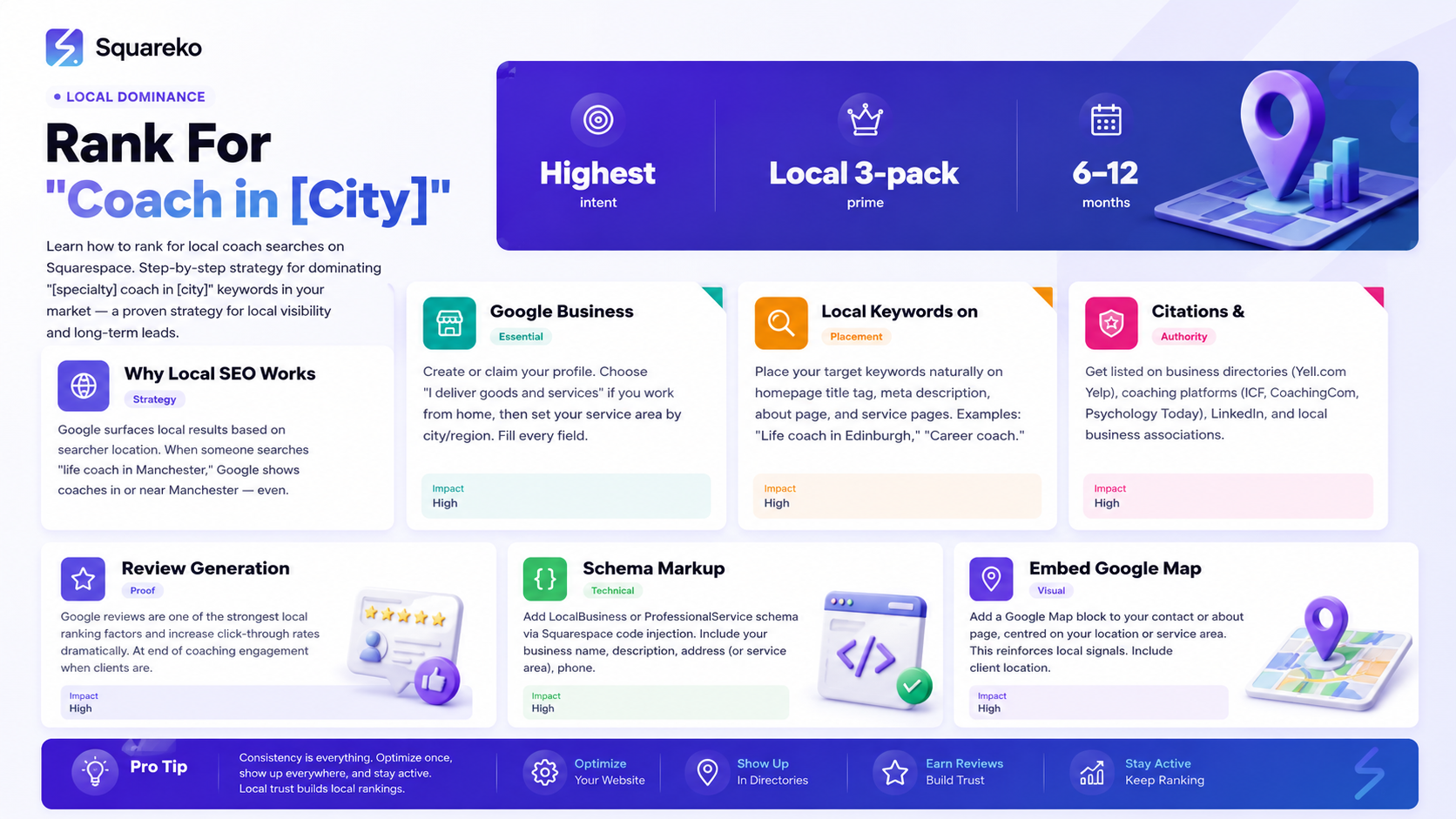
Local SEO targets people actively searching for coaches in a specific location — the highest-intent traffic available to coaches
Google Business Profile is your single most powerful local ranking tool and it's completely free
Even coaches who work primarily online benefit from local SEO — Google allows service area settings without a physical address
Local keyword placement on your Squarespace homepage, about page, and service pages sends direct signals to Google
Client reviews are one of the strongest local ranking factors — a systematic review request strategy is non-negotiable
Life coach in [your city] is one of the highest-intent searches a coaching prospect makes. When someone types that into Google, they're not browsing. They're looking for someone to hire — soon. If your Squarespace coaching website doesn't show up for that search, you're handing those leads to a competitor.
Local SEO for coaches is different from general SEO, and it's often more achievable. You're not competing against every coaching website in the world — you're competing against the coaches in your city or region. That's a much smaller field, and with the right strategy, you can dominate it.
This guide covers everything you need to rank for [specialty] coach in [city] searches in 2026 — from your Google Business Profile to local keyword placement on your Squarespace site, to the content and citation strategy that builds local authority over time.
Why Local SEO Matters Even for Online-Only Coaches
Many coaches assume local SEO only matters if they see clients in person. That's a misconception that's costing them leads.
How Google Treats Online Coaches
Google serves local results based on searcher location, not just the coach's physical location. If someone in Manchester searches career coach, Google will show coaches based in or near Manchester — even if those coaches work entirely via video call. Why? Because Google knows people generally prefer to work with someone they perceive as local — a shared context, time zone, and cultural reference point.
This means that a career coach based in Manchester who does all her work online still benefits enormously from appearing in Manchester-specific search results. Her competitors aren't every career coach in the UK — they're the handful of career coaches who've done the local SEO work in Manchester.
The Local 3-Pack
Google's local results often appear as a 3-pack — three business listings with ratings, contact information, and a map. Appearing in the local 3-pack is prime real estate. These listings appear above organic results and get a disproportionate share of clicks. For coaches, appearing in the local 3-pack for [specialty] coach [city] searches can be transformative for inbound enquiries.
Getting into the 3-pack requires a well-optimised Google Business Profile, consistent local citations, and a steady stream of client reviews.
Setting Up Your Google Business Profile as a Coach
Creating Your Profile
Go to Google Business Profile (business.google.com) and create or claim your listing. If you work from home or don't want to display a physical address, select I deliver goods and services to my customers and set your service area instead. You can define your service area by city, region, or radius.
Completing Your Profile Fully
An incomplete Google Business Profile ranks poorly. Fill in every field:
Business name — Use your actual coaching business name. Don't add keywords to your business name (Sarah Life Coach London) — Google prohibits this and it can get your listing suspended.
Category — Choose the most specific category available. Life Coach, Career Counselor, Business Management Consultant — use the primary category that best describes your coaching specialty.
Description — Write a keyword-informed description that explains who you help, what transformation you deliver, and how to work with you. Include your city and specialty naturally. 750 characters maximum.
Services — Add individual services with names and descriptions. This is an often-neglected field that adds significant keyword density to your profile.
Photos — Add a professional headshot, your logo, and ideally some photos of your workspace or client interactions. Profiles with photos get significantly more views and direction requests than those without.
Website link — Link to your Squarespace website homepage or a specific landing page.
Posting to Google Business Profile
Google allows you to publish posts (updates, offers, events) directly to your Business Profile. Posting once or twice a week — even short updates about blog posts, new programmes, or client wins — signals to Google that your profile is active. Active profiles rank higher than dormant ones.
Local Keywords: How to Find and Use Them on Squarespace
Identifying Your Local Keywords
Your primary local keyword structure is: [specialty] coach in [city] or [specialty] coach [city]. Examples:
Life coach in Edinburgh
Career coach London
Business coach Glasgow
Executive coach Manchester
Mindset coach in Birmingham
Start with your city, then expand to surrounding areas and regions. If you serve clients across multiple cities, you may eventually create location-specific landing pages.
Beyond the primary structure, think about more specific local terms:
Best life coach in Edinburgh
Life coach for women Edinburgh
Online career coach UK
Career change coach London
Use Google Autocomplete — type [specialty] coach in [city] and see what Google suggests. These are real searches people are making.
Local Keyword Placement on Squarespace
Once you have your keywords, place them in the right spots:
Homepage title tag — [Specialty] Coach in [City] | [Your Name] or [Your Business Name] — [Specialty] Coach, [City]
Homepage meta description — Include city and specialty naturally in a sentence that reads well as a search result snippet.
Homepage H1 or hero section — Your opening headline doesn't have to be a keyword phrase, but it should mention your location and specialty either in the headline or in the first paragraph.
About page — Based in [city], I work with clients across [region] — natural placement that adds geographic context.
Individual service pages — Whether you're in [city] or [region], this programme is designed for… — integrate location without forcing it.
Footer — Many coaches add their city/region to their footer. This is a legitimate local SEO signal and helps confirm your location to Google's crawlers.
Optimising Your Squarespace Pages for Local Search
Create Location-Specific Service Pages
If you serve multiple cities or regions, consider creating separate landing pages for each location. For example:
/life-coaching-london
/life-coaching-manchester
/life-coaching-birmingham
Each page targets that specific city's searchers. You'll need to write genuinely different content for each page — not just swap the city name — or Google will see it as duplicate content. Local insights, area-specific client examples, and local event mentions all help differentiate location pages.
Embed a Google Map
Adding a Google Map embed to your contact page or about page sends a strong local signal. In Squarespace, add a Google Maps block and embed a map centred on your location (even if it's a service area, not a street address). This small addition reinforces your local relevance.
Include Local Testimonials
When displaying client testimonials, include the client's city or region where possible (with their permission). Sarah, Career Coach Client, Edinburgh or Client based in Manchester adds geographic specificity that helps reinforce your local relevance.
Building Local Citations and Backlinks
What Citations Are and Why They Matter
A citation is any online mention of your coaching business that includes your name, address (or service area), and phone number (NAP). Citation consistency — the same information across all platforms — is a local ranking signal. Inconsistent citations (different phone numbers, name variations) can hurt your local rankings.
Where to Get Listed
Build citations on these platforms:
Yell.com and other UK business directories (if you're UK-based)
Yelp (particularly relevant for US and international coaches)
Facebook Business Page — create one even if you don't use Facebook for marketing
LinkedIn Company Page — highly credible domain for coaches
Coaching directories — ICF Find a Coach, CoachingCom, Psychology Today (for certain coaching niches), Bark.com
Local business directories — your local chamber of commerce website, local business associations
Consistency matters more than volume. Fifty consistent citations beat two hundred inconsistent ones.
Getting Backlinks from Local Sites
A backlink from a local website (a local news outlet, business association, or community organisation) is a strong local authority signal. Write a guest post for a local business publication. Get mentioned in a local top coaches in [city] article. Sponsor a local event and get a link from the event website. These local backlinks compound your authority for local searches over time.
Getting Client Reviews: A Practical Strategy
Reviews on your Google Business Profile are one of the strongest local ranking factors — and also one of the most neglected by coaches.
Why Reviews Matter So Much
Google uses review quantity and quality as a significant local ranking signal. A coaching profile with 20+ reviews will almost always outrank a comparable profile with 3 reviews, all else being equal. Reviews also increase click-through rates — a 4.8-star rating makes potential clients far more likely to click your listing.
How to Get Reviews Systematically
Most coaches don't get reviews because they don't ask. Here's a simple system:
At the end of a coaching engagement, when clients express satisfaction or share a win, say: I'm so glad this has been valuable. I'd really appreciate it if you'd leave a quick review on Google — it takes two minutes and helps other people find me. I'll send you a direct link.
Send a follow-up message with your Google Business Profile review link (you can find this in your profile dashboard). Make it one click — the easier you make it, the more reviews you get.
Respond to every review — positive and negative. Responding shows Google you're an active, engaged business owner, and it shows potential clients that you care about feedback.
Don't Incentivise Reviews
Google prohibits incentivising reviews (offering discounts or gifts in exchange for leaving a review). Don't do it — it violates Google's terms and can get your listing suspended. Ask for honest reviews from genuine clients, and let the quality of your coaching do the work.
LocalBusiness Schema Markup for Squarespace
Schema markup tells search engines what type of business you are, where you're located, what you offer, and how to contact you — in a structured format they can read easily. For coaches, the LocalBusiness or ProfessionalService schema is most relevant.
Adding Schema to Your Squarespace Site
Add JSON-LD schema via Squarespace's code injection (Settings > Advanced > Code Injection > Header). Here's a template for a coaching business:
<!-- Please remove the commented script wrapper and add this schema inside a proper <script type="application/ld+json"> tag. -->
{
  "@context": "https://schema.org",
  "@type": "ProfessionalService",
  "name": "Your Coaching Business Name",
  "description": "Brief description of your coaching services",
  "url": "https://yourwebsite.com",
  "telephone": "+44-XXXX-XXXXXX",
  "email": "your@email.com",
  "address": {
    "@type": "PostalAddress",
    "addressLocality": "Your City",
    "addressCountry": "GB"
  },
  "areaServed": {
    "@type": "City",
    "name": "Your City"
  },
  "serviceType": "Life Coaching",
  "priceRange": "£££",
  "openingHours": "Mo-Fr 09:00-17:00"
}
Customise this with your actual details. This schema helps Google understand your local relevance and display your information accurately in search results.
Ready to Dominate Local Coaching Searches in Your City?
Local SEO is one of the highest-ROI investments a coach can make. You're not competing globally — you're competing in your city, against a much smaller field. With the right strategy, you can become the most visible coach in your niche and location within 6–12 months.
Squareko builds Squarespace coaching websites with local SEO foundations built in. Schema markup, local keyword architecture, Google Business Profile optimisation guidance, and a content strategy designed to build local authority — all included.
FAQs
-
Yes, significantly. Google surfaces local results based on where the searcher is located, and people frequently search for coaches in their area even when they're open to online sessions. Ranking for "[specialty] coach in [city]" searches means appearing in front of highly motivated prospects in your target market, regardless of whether sessions happen in person.
-
During setup, choose "I deliver goods and services to my customers" rather than entering a physical address. Then set your service area by city, region, or radius. Google will use this to determine when to show your listing in local search results. Your address won't be displayed publicly — only your service area.
-
There's no fixed number — it depends on your competition. In less competitive markets, 10–15 reviews may be sufficient. In competitive cities, you might need 30+. What matters is having more recent, high-quality reviews than your competitors. Aim to consistently collect reviews throughout your coaching practice — not just during a one-time push.
-
Yes. Squarespace allows you to create pages targeting specific locations. Each page should have unique content for that location — not just a template with the city name swapped. Genuine local content (local references, area-specific client examples) makes location pages more effective and avoids duplicate content issues.
-
A citation is any online mention of your business name, location (or service area), and contact information. They appear on business directories, social media profiles, coaching platforms, and review sites. Consistent citations across all platforms reinforce your local relevance to Google. Use the same business name, phone number, and location details everywhere.
-
Google Business Profile results can appear within 2–4 weeks for less competitive terms once your profile is fully set up and receiving reviews. Organic local search results from your Squarespace site take longer — typically 3–6 months to see initial movement. The local 3-pack is achievable within 3–6 months of consistent effort in most markets.
-
Yes, especially on directories with high domain authority — ICF's coach finder, Psychology Today (if applicable), Bark.com, and others. These listings create valuable citations and some generate direct referrals. Ensure your information is consistent across all directories. Some coaches find that coaching directories generate direct client enquiries alongside their SEO value.
-
Yes. Squarespace's code injection feature (in Settings > Advanced) allows you to add JSON-LD schema markup to your site headers. You can add LocalBusiness, ProfessionalService, and other relevant schema types. This is more manual than WordPress + Yoast, but it's straightforward with the JSON-LD template provided in this guide.
From custom website design to SEO strategy, we help businesses launch a site that looks professional and performs better.

Author Bio
I'm Walid Hasan, a Certified Squarespace Expert and Squarespace Circle Platinum Partner with over 12 years of hands-on experience designing and optimizing high-performing websites. Over the years, I've had the privilege of building more than 2,000 Squarespace websites for clients around the world, always focusing on clean design, strong user experience, and conversion-driven results.