How Wellness Coaches Build Authority and Attract Ideal Clients with Squarespace Content
Introduction
When a prospective client searches for a wellness coach, they encounter dozens of profiles claiming to transform health. The ones who stand out aren't just certified—they've built visible authority through strategic content. This is how wellness coaches build authority and attract ideal clients with Squarespace content.
The wellness coaching market grows more crowded each year. Without a content strategy that establishes expertise, your website becomes one of many. Content-focused wellness coaches attract higher-quality leads, charge premium rates, and fill their programmers faster than those relying on word-of-mouth alone.
Key Takeaways
Content authority differentiates you from unqualified coaches in a crowded market; blog posts demonstrating your methodology and transformation outcomes build trust faster than credentials alone
Topic selection drives results—focus on high-intent searches like "signs you need a wellness coach," "how to set health goals you'll actually achieve," and "difference between wellness coach and therapist"
Consistency beats volume: publishing one excellent 2,000-word post monthly outperforms four mediocre 500-word posts in search visibility and client conversion
Repurposing one post into social posts, email sequences, and video creates a month's worth of content from a single research investment
Email capture through lead magnets (free health audits, 7-day guides, mini-courses) converts blog readers into actionable prospects
Thought leadership extends beyond blogging: podcast appearances, guest contributions, and backlinks amplify your authority across channels
Why Content Authority Matters for Wellness Coaches
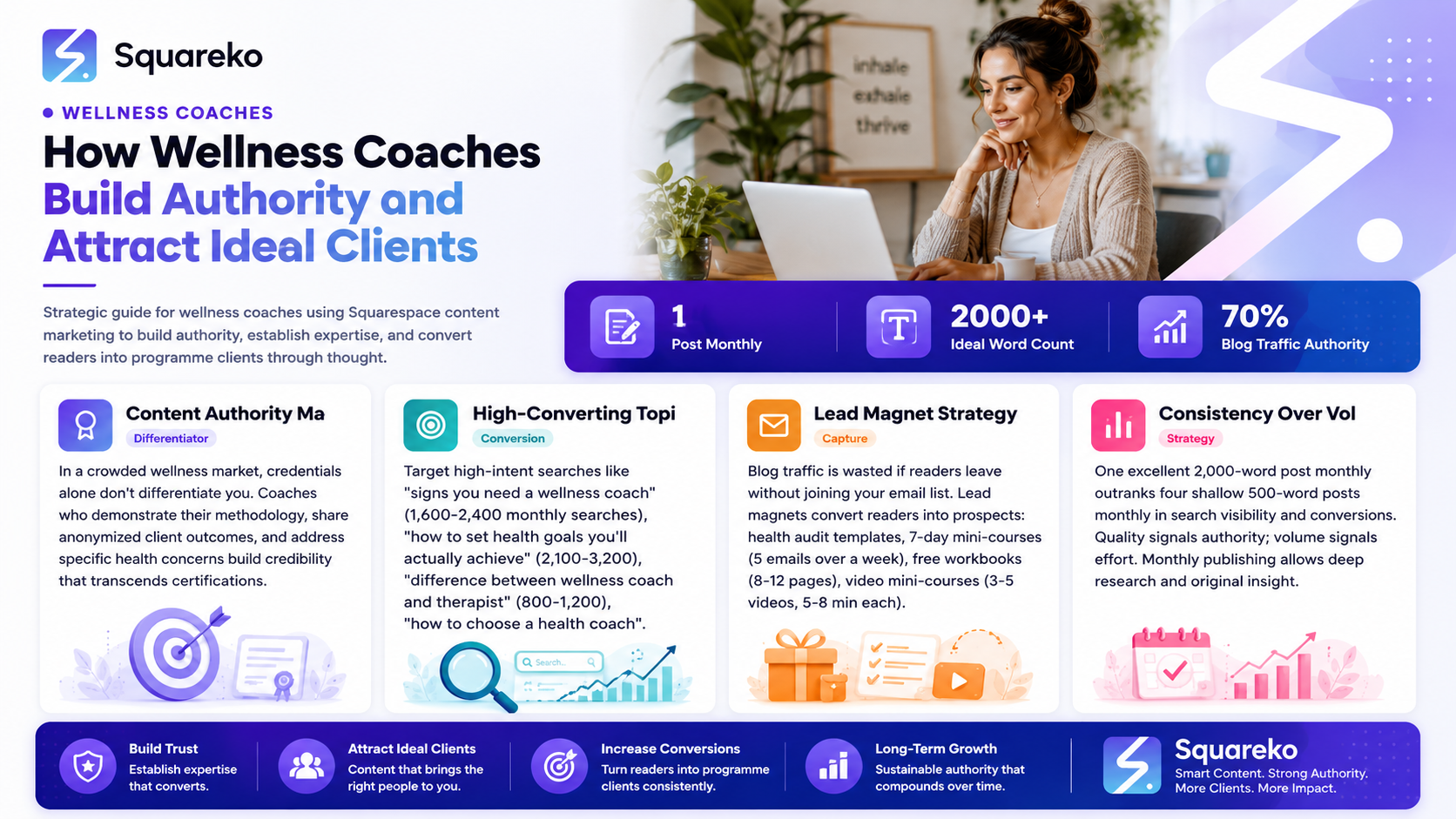
The wellness coaching space attracts newcomers without formal training. Clients searching for a coach can't easily distinguish ICF-credentialed practitioners from self-taught enthusiasts. This creates an opportunity: coaches who demonstrate their methodology, share client outcomes (anonymously), and address specific health concerns build credibility that transcends credentials alone.
Authority content does three things simultaneously. It ranks in search engines, bringing consistent qualified traffic. It converts readers into programme prospects by showcasing your transformation process. It attracts speaking opportunities, guest posts, and media mentions that amplify your reach far beyond your website.
Without content, your website is a static business card. With strategic content, it becomes a 24/7 sales, education, and credibility-building system.
The Trust Equation for Wellness Coaches
Prospective clients evaluate coaches on expertise, experience, trustworthiness, and relatability. A well-structured blog addresses all four. A post titled "How Burnout Blocks Weight Loss: A Wellness Coach's Guide" signals expertise, shares your methodology (relatability), includes case studies (experience), and is transparent about scope and limitations (trustworthiness).
Blog content also provides search engines with evidence of your specialization. A wellness coach writing only about "general health" appears generic. One publishing "5 Signs Your Cortisol Stress Response Is Blocking Your Weight Loss Goals" or "Why Sleep Architecture Matters More Than Sleep Duration for Energy Recovery" signals deep knowledge in specific niches.
What Topics Actually Rank and Convert
Not all blog topics convert equally. The best topics answer questions your ideal clients actually ask while ranking well in search engines. Target high-intent searches—questions asked by people ready to hire a coach, not those casually reading about wellness.
High-Converting Topic Examples
"Signs You Need a Wellness Coach" (1,600-2,400 monthly searches) People asking this question are considering hiring a coach. Your post positions you as the obvious solution. Cover the gap between wanting health change and getting results alone, the role of accountability and expertise, and the coaching process.
"How to Set Health Goals You'll Actually Achieve" (2,100-3,200 searches) This ranks consistently and attracts readers at the decision stage. Your methodology for goal-setting becomes your unique angle. Readers who see your process remember you when ready to commit.
"Difference Between Wellness Coach and Therapist" (800-1,200 searches) Regulatory confusion drives this search. Your clarity here builds trust and prevents misaligned hiring. This post also clarifies your scope of practice, critical for YMYL (Your Money, Your Life) content.
"How to Choose a Health Coach" (1,200-1,800 searches) Ironically, this benefits all coaches. Your post guides readers to evaluate coaching critically—then positions your methodology as the gold standard.
Niche-Specific Posts
"How to Recover from Burnout Without Medication" (wellness + mental health crossover)
"Metabolic Adaptation: Why Your Diet Isn't Working Anymore" (scientific credibility angle)
"How to Build a Sustainable Fitness Routine as a Busy Parent" (niche-specific transformation)
Finding Your High-Intent Keywords
Use Google Search Console to identify questions current blog readers ask. Check your website's "Queries" report for unranked questions—these are people looking for exactly what you cover.
Run searches like "how to [solve problem your ideal client faces]" in Google. If the results show mostly coaches, authority blogs, and guides (not product pages), you've found a high-intent topic worth 2,000+ words.
Building Your Content Pillar Strategy
Scattered posts don't build authority. Organized pillar content does. Create pillar pages (2,500+ words on broad topics) and supporting posts (1,500-2,000 words) that cluster around your core offerings.
Example Pillar Structure for a Burnout Recovery Coach
Pillar Page: "The Complete Guide to Burnout Recovery" (2,500+ words covering phases, timelines, coaching role)
Supporting Posts:
"Cortisol and Burnout: Why Rest Alone Isn't Enough"
"How to Build Boundaries Without Guilt (for Recovery)"
"Sleep, Nutrition, and Energy: The Recovery Framework"
"When to Switch Career: Burnout Coach Perspective"
This structure signals expertise to search engines. Google recognizes the pillar page as authoritative on burnout recovery and ranks it higher. Supporting posts drive traffic to the pillar, boosting its authority further.
Mapping Your Niche and Transformation
Before writing content, define your core transformation statement. "I help burned-out corporate women recover their energy and clarity in 90 days" is more content-generative than "I help people improve their wellness." The specific transformation unlocks dozens of searchable questions:
How long does burnout recovery take?
Can you recover from burnout while staying in your job?
What foods help energy recovery?
How to rebuild confidence after burnout?
Each question becomes a blog post.
The Lead Magnet Strategy for Email Capture
Blog traffic is wasted if readers leave without joining your email list. Lead magnets convert readers into prospects. The best wellness lead magnets solve a specific problem quickly.
High-Converting Lead Magnet Ideas
Health Audit Template (1-2 page PDF) Readers answer 15-20 questions about sleep, stress, nutrition, movement, relationships. You provide a simple self-scoring system and one key insight. This qualifies prospects (showing you their struggles) while delivering value. Include a CTA to schedule a discovery call.
7-Day Mini-Course Five emails over a week, each addressing one aspect of your methodology. Day 1: "The Three Energy Blockers (And Why Most Coaches Miss One)." Day 2: "How to Audit Your Daily Habits for Energy." Each email ends with a CTA to book a discovery call. Format as a Squarespace Email Campaign for simple deployment.
Free Workbook "The 90-Day Health Goal Blueprint" (8-12 pages). Readers work through goal definition, barrier identification, milestone mapping. This shows your coaching framework in action—prospects experience your methodology before hiring you.
Video Mini-Course Record 3-5 videos (5-8 minutes each) addressing a specific problem. Host them on YouTube, embed them in a Squarespace gated page. Require an email to access. Video completion signals serious interest (videos hold attention better than PDFs).
Deploying Lead Magnets on Squarespace
Create a dedicated Squarespace page for each lead magnet. Place signup forms at the end of related blog posts. Use Squarespace's Email Campaigns tool to automate delivery and nurture sequences.
Example placement: Article on "How Stress Blocks Weight Loss" ends with "Download the Free Stress-to-Energy Audit (used by my clients in their first month)." This contextual offer converts 3-5x better than a generic popup.
Podcast and Video Integration in Squarespace
Text content builds authority. Audio and video multiply it. Clients increasingly prefer consuming expertise through podcasts and YouTube. Hosting your own podcast or appearing as a guest exponentially increases authority.
Starting a Wellness Coaching Podcast
A bi-weekly podcast about your niche (e.g., "The Burnout Recovery Show") positions you as the category expert. You don't need thousands of listeners to build authority—50 regular listeners who book discovery calls is a powerful conversion engine.
Record interviews with other practitioners, discuss case studies (anonymously), answer listener questions. Integrate Spotify and Apple Podcasts feeds into your Squarespace site using a podcast embed plugin. Each episode becomes repurposable content (blog post transcript, social clips, email newsletter material).
Guest Podcast Appearances
Appearing on established wellness and health podcasts reaches new audiences. Target shows aligned with your niche. A burnout recovery coach should appear on shows about mental health, entrepreneurship, corporate wellness, and women's health.
Each appearance includes a backlink to your Squarespace site in show notes. Multiple guest appearances signal authority to search engines and introduce your methodology to qualified listeners.
Video Content Strategy
YouTube serves as both a search engine and authority platform. A weekly 8-minute video addressing common client questions builds familiarity and trust. Embed videos in Squarespace using YouTube embeds or Squarespace's native video module.
Video topics mirror your blog pillars: "How to Recognize Burnout Early," "Nutrition Myths That Block Energy Recovery," "Why Accountability Accelerates Results."
Newsletter and Email List Building
Your email list is the only audience you fully own. Social followers and blog readers can disappear if algorithms change. Email subscribers remain your direct prospect pipeline.
Building an Email Strategy
Segment your email list by interest. Subscribers from a "burnout recovery" lead magnet receive different content than those capturing "fitness goal-setting" guides. Squarespace Email Campaigns allows basic segmentation; integrate with Mailchimp or ConvertKit for advanced automation.
Send a weekly or bi-weekly email featuring:
One new blog post summary
One actionable tip or reflection question (this builds engagement)
One programme-related CTA (limited to 20% of emails—avoid over-selling)
Example email structure:
Subject line: "The Energy Paradox: Why Rest Doesn't Always Fix Fatigue"
Opening: Personal story or client question
Main content: Summary of this week's blog post with key takeaway
Actionable reflection: "This week, notice one moment when you confuse genuine tiredness with stress fatigue. What's the difference for you?"
CTA: "Ready to solve your energy puzzle? Book a free discovery call."
Nurture Sequences for Discovery Call Conversions
After someone books a discovery call, send a 3-email sequence:
Confirmation + what to expect + pre-call reflection questions
One resource relevant to their stated interest (e.g., "Before we meet, here's why I focus on X in my methodology")
24-hour reminder with logistics + something to mentally prepare
This nurture sequence deepens rapport and converts more discovery calls into programme enrollments.
The Consistency Principle: One Great Post Monthly
The biggest mistake wellness coaches make is publishing inconsistently. Four posts one month, then silence for three months confuses search algorithms and lulls audiences.
Consistency beats volume. One excellent 2,000-word post monthly (12 posts yearly) outranks four shallow 500-word posts monthly (48 posts yearly) in search visibility and conversions. Quality signals authority; volume signals effort.
Why Monthly Publishing Works
Monthly publishing allows deep research and original insight. A wellness coach with time to interview clients, gather outcome data, and synthesize methodology creates posts readers can't find elsewhere. A rushed post chasing publication frequency copies generic advice everyone else covers.
Monthly publishing also sustains your content repurposing engine (discussed below). One post generates:
4 social posts (one per week)
1 email feature
1 video script
3-5 social clips (quotes, tips, visuals)
1 podcast topic or guest talking point
Monthly consistency also keeps your audience engaged. A reader who sees a new post the same week every month—"Walid's Wellness Coaching Blog posts every Tuesday"—develops a habit of checking your site.
Repurposing Content Across Channels
A 2,000-word blog post is the foundation for a month's entire content calendar. Strategic repurposing multiplies its reach without doubling your effort.
The Repurposing Pathway
Blog Post: "How Sleep Architecture Affects Weight Loss" (2,000 words)
Week 1 - Social Posts (4 posts across Tuesday-Friday):
Post 1: Quote: "Most people focus on sleep duration. The real game is sleep architecture—when and how deeply you sleep. Here's why that matters for your weight..."
Post 2: Tip: "Your sleep architecture affects cortisol recovery. Here's one small change that improved sleep quality for 89% of my clients..."
Post 3: Question: "Is your weight loss blocked by sleep quality rather than calories? Take this 60-second self-assessment..."
Post 4: Announcement: "New blog post on sleep architecture + weight loss. Full breakdown of how sleep phases connect to metabolism..."
Week 2 - Email Feature: Summary of the post + one actionable tip. Include CTA to read the full post.
Week 3 - Video Script: Extract the core framework (3-5 key points) into a 7-minute video. Host on YouTube, embed on Squarespace.
Week 4 - Podcast Topic: Record a 15-minute audio exploring the post's core idea. Release as a YouTube short, podcast episode, and audio embed on your blog.
This approach turns one research investment into six content assets reaching audiences through their preferred channels.
Measuring What Actually Works
Content authority requires iteration. Track metrics that matter: search rankings, traffic, conversions (email signups, discovery call bookings), and ultimately, programmer enrollments.
Key Metrics to Track
Search Visibility: Squarespace's built-in SEO insights (or Google Search Console) show which posts rank, for what keywords, and traffic from search. Focus on high-intent keywords driving discovery calls, not vanity metrics like "10,000 impressions for a broad search."
Email Conversion: What percentage of blog readers sign up for your email list? Use Squarespace's Email Campaigns analytics. Target 2-5% signup rate. If lower, improve your lead magnet or CTA placement.
Discovery Call Bookings: Which blog posts or lead magnets drive the most discovery call bookings? A post on "Choosing a Wellness Coach" might drive 3 bookings monthly while a post on "General Wellness Tips" drives zero. Double down on high-converting topics.
Programme Enrollment Rate: Ultimate metric. Track what percentage of discovery calls convert to programme enrollments. If 40% of calls convert, but a certain blog topic drives prospects who convert at 60%, that topic is your priority for expansion.
Quarterly Content Review
Every three months, review your blog analytics. Identify:
Top 3 posts by traffic (create follow-ups or deeper content on these topics)
Top 3 posts by discovery call referrals (your best-converting content)
Lowest-performing posts (update, repurpose, or retire)
This data-driven iteration ensures your content effort compounds over time.
Thought Leadership Beyond Your Blog
Blog authority expands when featured in larger publications. Guest posts, podcast appearances, media mentions, and backlinks signal to search engines and prospects that you're a recognized authority.
Guest Posting Strategy
Target wellness publications, health blogs, and coaching-focused sites in your niche. A post on "Burnout Recovery During Career Transitions" for a career change blog reaches 5,000+ readers who wouldn't find your site otherwise. Each guest post includes a bio with a link back to your Squarespace site.
Guest posts also build backlinks—critical for SEO. A single high-authority guest post is worth dozens of weak internal links. Aim for 1-2 quality guest posts quarterly.
Podcast Guest Appearances
As mentioned earlier, podcast appearances reach qualified audiences directly. Record 5-10 episodes with different shows over six months. Each appearance includes show notes linking to your site, introducing listeners to your methodology.
Track which podcast appearances drive the most discovery calls. Return to high-performing shows for repeat appearances.
Press and Media Mentions
Local wellness media, online health publications, and entrepreneurship blogs often feature wellness coaches. Reach out to journalists covering your niche. Offer yourself as an expert for quotes on health trend stories.
Press mentions build backlinks, establish media authority, and often lead to interview features on your Squarespace site.
Getting Featured and Building Backlinks
Search engines weight backlinks heavily. A backlink from a respected wellness publication signals authority more powerfully than 100 internal links.
Backlink Generation Strategy
Guest posts (discussed above)
Resource pages: Create a comprehensive resource page (e.g., "50 Best Wellness Coaching Resources"). Reach out to sites mentioned. Many will link back to your resource page as reciprocal recognition.
Original research or surveys: Publish original data (e.g., "Survey: 2,000 Wellness Coaches Reveal Their Top Client Roadblocks"). Other blogs citing your data link to your site.
Expert features and interviews: Interview prominent wellness figures for blog content. They often share the post with their audiences, generating backlinks.
Speaking engagements: Speaking at wellness conferences results in conference websites linking to your Squarespace site in speaker bios.
Backlinks compound authority over time. A wellness coach with 20 quality backlinks from publications and speaking engagements ranks significantly higher than one with zero backlinks but more frequent posting.
Ready to Build Your Content Authority?
Your Squarespace website is your most powerful sales and credibility tool—but only if you're actively building authority through content. Monthly blog posts, email list building, podcast integration, and strategic guest features create a virtuous cycle: more content attracts more traffic, which generates more leads, which funds more content investment.
The wellness coaches winning today aren't the ones with the fanciest websites or the most social media followers. They're the ones who publish thoughtful content consistently, position themselves as methodological experts, and turn readers into programme clients through strategic lead capture.
If you're ready to architect your content strategy but feel uncertain about implementation—technical setup, content calendar planning, email integration, Squarespace page layout—that's where specialized expertise helps. At Squareko, we design Squarespace websites for wellness coaches specifically, with content authority, email list building, and programme sales built into the architecture from day one. We handle the technical complexity so you can focus on writing the expert content that converts.
Ready to build your authority? Book a free consultation with Walid at Squareko, and let's map your content strategy to your specific niche and ideal client.
Frequently Asked Questions
-
Publishing one excellent, well-researched 2,000-word post monthly outperforms publishing four shallow posts weekly. Monthly publishing allows time for deep research, client interviews, and original insight—the foundation of authority content. Consistency matters more than frequency; readers and search algorithms reward predictable publishing schedules.
-
Blog content attracts and educates prospective clients before they decide to hire you. It answers questions, builds trust, and ranks in search engines. Online course content educates clients who've already enrolled in your programme. Blog content is about "coming to know you"; course content is about "working with you." Both are valuable, but blog content is your awareness and lead-generation engine.
-
Specificity is your differentiator. Instead of "General Wellness Tips," write "How Cortisol Dysregulation Blocks Weight Loss: A Burnout Recovery Coach's Methodology." Include your specific framework, share anonymized client examples, discuss your assessment process, and differentiate your approach from competitors. Readers remember specific frameworks, not generic advice.
-
Blog content should always be free—its purpose is to attract prospects, build authority, and capture email addresses. However, lead magnets (the "gated" resources behind email signup forms) can be premium. You might offer a free blog post but charge $27 for a comprehensive workbook or mini-course accessed via email capture. This tiering model works well for wellness coaches.
-
Personal relatability is crucial in wellness coaching. Sharing a professional personal story—"How I Burned Out in My Corporate Career and Recovered Using This Framework"—builds connection and positions you as someone who's walked the client journey. However, distinguish between relatable storytelling and oversharing. Your blog is professional authority-building, not a personal diary.
-
Wellness coaching spans health, which is YMYL-sensitive. Always include a clear scope-of-practice disclaimer (e.g., "I'm a wellness coach, not a medical doctor. Always consult your physician before major health changes"). Include credentials and evidence when discussing health topics. Distinguish between coaching and therapy. Link to medical resources when appropriate. High-quality, credible content with clear disclaimers builds trust and search ranking.
-
Expect 3-6 months to see meaningful search traffic and lead generation from blog content. Initial posts may rank lower. As your site accumulates authority (backlinks, consistent publishing, topical depth), older posts climb search rankings. Email lead magnets can convert immediately, but organic search is a long-term play. The coaches seeing results fastest are those who've committed to 12+ months of consistent monthly posting.
-
If you have writing skill and time, writing yourself conveys authentic expertise and saves cost. However, many coaches prefer outsourcing to focus on client work. A ghostwriter can help structure and polish your insights, reducing your time investment. Hybrid approach: you outline your framework and key points; a writer structures and expands them. Quality matters more than authorship—your blog must represent your actual methodology, whether you write it yourself or direct a writer.
Ready to Build Your Authority Site on Squarespace?
Content authority starts with a website built to support it. A properly architected Squarespace site includes blog infrastructure, email capture integration, SEO optimization, and programme sales pages all working together. Too many wellness coaches work against their websites—beautiful designs without lead capture, blog pages without SEO setup, unclear programme messaging.
Squareko specializes in designing Squarespace websites for wellness coaches ready to scale through authority and content. We handle site architecture, programme page setup, email list integration, and ongoing SEO optimization so you can focus on the expertise that sets you apart.
Ready to move from a DIY website to a professional authority platform? Squareko and let's discuss your content strategy, programme positioning, and site architecture. Your next ideal client is searching for you—let's make sure they find you.

From custom website design to SEO strategy, we help businesses launch a site that looks professional and performs better.

About the Author
Walid is the founder of Squareko,
I'm Walid Hasan, a Certified Squarespace Expert and Squarespace Circle Platinum Partner with over 12 years of hands-on experience designing and optimizing high-performing websites. Over the years, I've had the privilege of building more than 2,000 Squarespace websites for clients around the world, always focusing on clean design, strong user experience, and conversion-driven results.