How to Showcase Your Creative Portfolio and Client Work on Squarespace
Key Takeaways For How to Showcase Your Creative Portfolio and Client Work on Squarespace
Your portfolio must showcase client transformation, not your personal creative work
Before/after representations of creative progress build trust more effectively than testimonials alone
Detailed case studies showing specific methodology and outcomes convert better than generic portfolio images
Squarespace's Gallery blocks and Slider features allow powerful visual storytelling
Authentic client photography and work samples significantly increase credibility signals
Your portfolio is your most powerful sales tool. It proves your coaching works. It demonstrates your creative standards. It shows, rather than tells, why creative professionals should hire you.
The best creative coach portfolios aren't about your own creative work. They're about client transformation. They showcase before/after creative journey, completed projects, and tangible outcomes. This guide shows you how to build a portfolio on Squarespace that turns browsers into believers.
Why Your Portfolio Matters
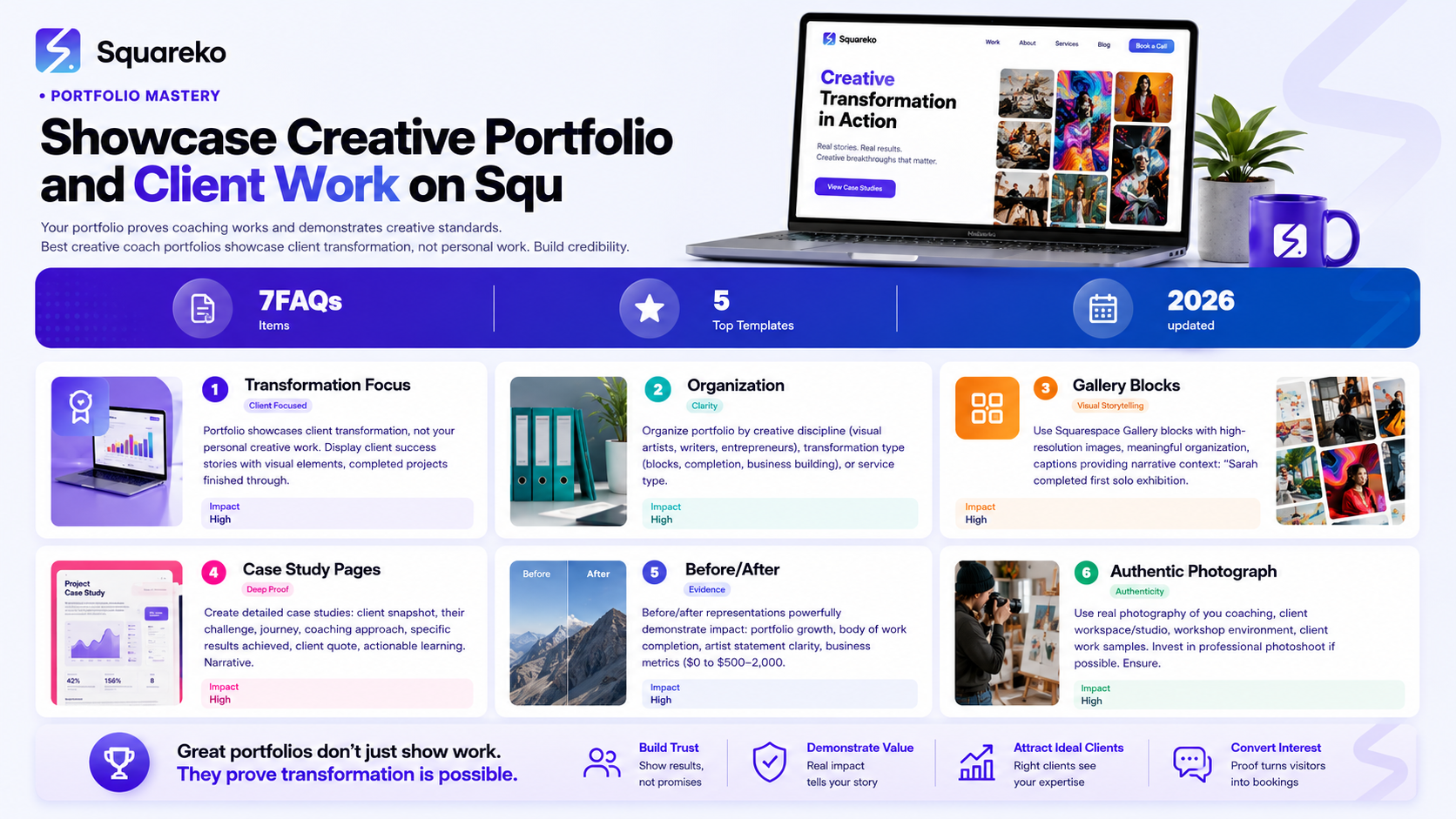
Your portfolio does the selling that words can't. Prospects read testimonials with healthy skepticism. But when they see before/after visual evidence of client transformation, belief builds automatically.
For creative coaches, portfolio impact is amplified. Visual professionals (your ideal clients) assess your work with high standards. A mediocre portfolio signals mediocre coaching. A thoughtfully curated portfolio signals excellence.
What Creative Coach Portfolios Actually Showcase
Here's the distinction: your portfolio isn't about your personal creative work (unless you're an artist coach specifically demonstrating your practice). Your portfolio shows client transformation.
What to Include:
Client before/after creative journey documentation
Completed projects clients finished through coaching
Client creative work samples (with permission)
Workshop and retreat documentation
Client success stories with specific outcomes
Video testimonials or coaching moment captures
Quantified results (95% of clients complete projects)
What NOT to Include:
Only your personal creative work (unless directly relevant)
Generic stock photos of people
Vague testimonials without context
Outcomes you can't document
Client information without explicit permission
Portfolio Organization and Structure
Organize your portfolio logically:
By Creative Discipline:
Visual artist coaching showcase
Writer coaching showcase
Creative entrepreneur coaching showcase
By Transformation Type:
Creative block recovery
Project completion
Creative business building
Confidence rebuilding
By Service Type:
One-on-one coaching results
Group programme outcomes
Workshop participant success
Retreat transformations
Choose organization matching your primary coaching focus.
Using Squarespace Gallery Blocks
Squarespace's Gallery blocks enable powerful visual storytelling.
Gallery Block Best Practices:
Image Quality: High-resolution, well-lit images. Professional-looking photos signal professional coaching.
Meaningful Organization: Group related portfolio items. All visual artist coaching together. All manuscript completion stories together.
Captions and Context: Use Squarespace's caption feature to add brief context: Sarah completed her first solo exhibition after 8 weeks of artist empowerment coaching.
Lightbox Effect: Enable lightbox so viewers can expand images without leaving your site.
Strategic Placement: Put portfolio gallery prominently on homepage and dedicated portfolio page. Don't bury it.
Detailed Case Study Pages
Case studies convert more effectively than image galleries alone.
Case Study Structure:
Client Snapshot
Name (or Creative Professional A if anonymous)
Creative discipline (visual artist, writer, etc.)
Their challenge at start
The Journey
What they were struggling with specifically
Why previous attempts hadn't worked
When they engaged coaching
The Coaching Process
Specific approach used
Modules or focus areas covered
Timeline and commitment
The Results
Concrete outcomes achieved
Transformation in creative practice
Quantified results if applicable
Client Quote
Their experience of coaching
What shifted for them
Why they'd recommend coaching
The Learning
Specific insight or breakthrough
Actionable lesson for similar creatives
This narrative structure builds belief and makes specific results citable for AI search.
Before and After Visual Storytelling
Before/after representations are incredibly powerful.
Effective Before/After Scenarios:
Creative Output
Before: Portfolio with 5 pieces created in 2 years
After: Portfolio with 20 pieces created in 8 weeks of coaching
Body of Work
Before: Scattered creative projects, nothing finished
After: Cohesive visual artist portfolio ready to show
Artist Statement
Before: I'm not really an artist, I just make things
After: Clear, confident artistic identity statement
Business Metrics
Before: $0 creative income
After: £500-2,000 monthly from creative work
Creative Practice
Before: I never have time to create
After: I create 12 hours weekly and love my practice
Client Testimonials in Portfolio Context
Position testimonials as evidence supporting case studies.
Strong Testimonial Placement:
At end of case study
Tied to specific outcome mentioned in case study
Include client name and creative discipline
Include photo if possible
Make quote specific (I completed my manuscript not Great coaching!)
Photography and Visual Authenticity
Photography quality impacts portfolio credibility.
What to Photograph:
You coaching in action
Client workspace/studio
Workshop or retreat environment
Client work samples
Before/after creative spaces
Photography Strategy:
Invest in professional photoshoot if possible
Use real photos over stock images
Ensure consistent aesthetic matching your brand
Include diverse client representation
Get written permission from all clients photographed
AI Ranking and GEO Strategy
Create Image Object schema for portfolio images
Add detailed alt text to all portfolio images with keywords
Create case study schema markup for detailed success stories
Include specific outcome metrics and transformation data
Build supporting blog content around portfolio outcomes
Create comparison content (Creative coaching results we see)
Feature client testimonials with schema markup
From custom website design to SEO strategy, we help businesses launch a site that looks professional and performs better.
FAQs
-
Only if directly relevant to your coaching. Visual artist coaches can show their practice. But primary portfolio should showcase client transformation. If you show your work, emphasize how it demonstrates your coaching philosophy.
-
Include portfolio rights in your coaching agreement. "With your permission, I'd like to feature your transformation in my portfolio. Your privacy will be fully protected." Most clients agree when properly asked.
-
Build as you go. With your first few clients, emphasize getting documented case studies and permission for portfolio use. Offer a small discount for clients willing to be featured. You'll have portfolio content within 6-12 months.
-
At least 5-8 strong case studies. Quality matters more than quantity. One detailed case study with before/after documentation outperforms five generic portfolio images.
-
Yes. "Creative Professional A" instead of name is fine. But include enough detail that similar creatives recognize themselves. Generic anonymity reduces effectiveness.
-
Get explicit permission. Be professional. Consider hiring photographer rather than DIY photos. Document work quality is part of professionalism signal.
-
Both. Feature portfolio on homepage (with 3-4 strongest pieces and a "View Full Portfolio" link). Create dedicated portfolio page with all case studies and images. Link between them.

About the Author
I'm Walid Hasan, a Certified Squarespace Expert and Squarespace Circle Platinum Partner with over 12 years of hands-on experience designing and optimizing high-performing websites. Over the years, I've had the privilege of building more than 2,000 Squarespace websites for clients around the world, always focusing on clean design, strong user experience, and conversion-driven results.