How to Sell Finance Coaching Packages and Online Courses on Squarespace
Key Takeaways For How to Sell Finance Coaching Packages and Online Courses on Squarespace
Group coaching programs generate 3-5x revenue of 1:1 coaching with similar time investment
Digital courses let you educate people who can't afford coaching, building your audience
YMYL-compliant selling requires clear disclaimers on all financial products
Squarespace Commerce integrates scheduling, payments, and delivery seamlessly
Hybrid models (coaching + course) create customer loyalty and reduce churn
Most finance coaches leave revenue on the table. They offer 1:1 coaching and stop there.
But your expertise can be packaged into:
Group coaching programs (10-20 people, $300-500/month each)
Self-paced courses (educate at scale, $97-497 per course)
Digital products (budgets, calculators, worksheets, $17-97)
Hybrid models (1:1 foundation + group coaching + self-paced modules)
This post is about revenue models and e-commerce setup for finance coaches, not financial advice. The product selling strategies discussed here focus on how to scale your income beyond 1:1 coaching.
Understanding Coaching Business Models
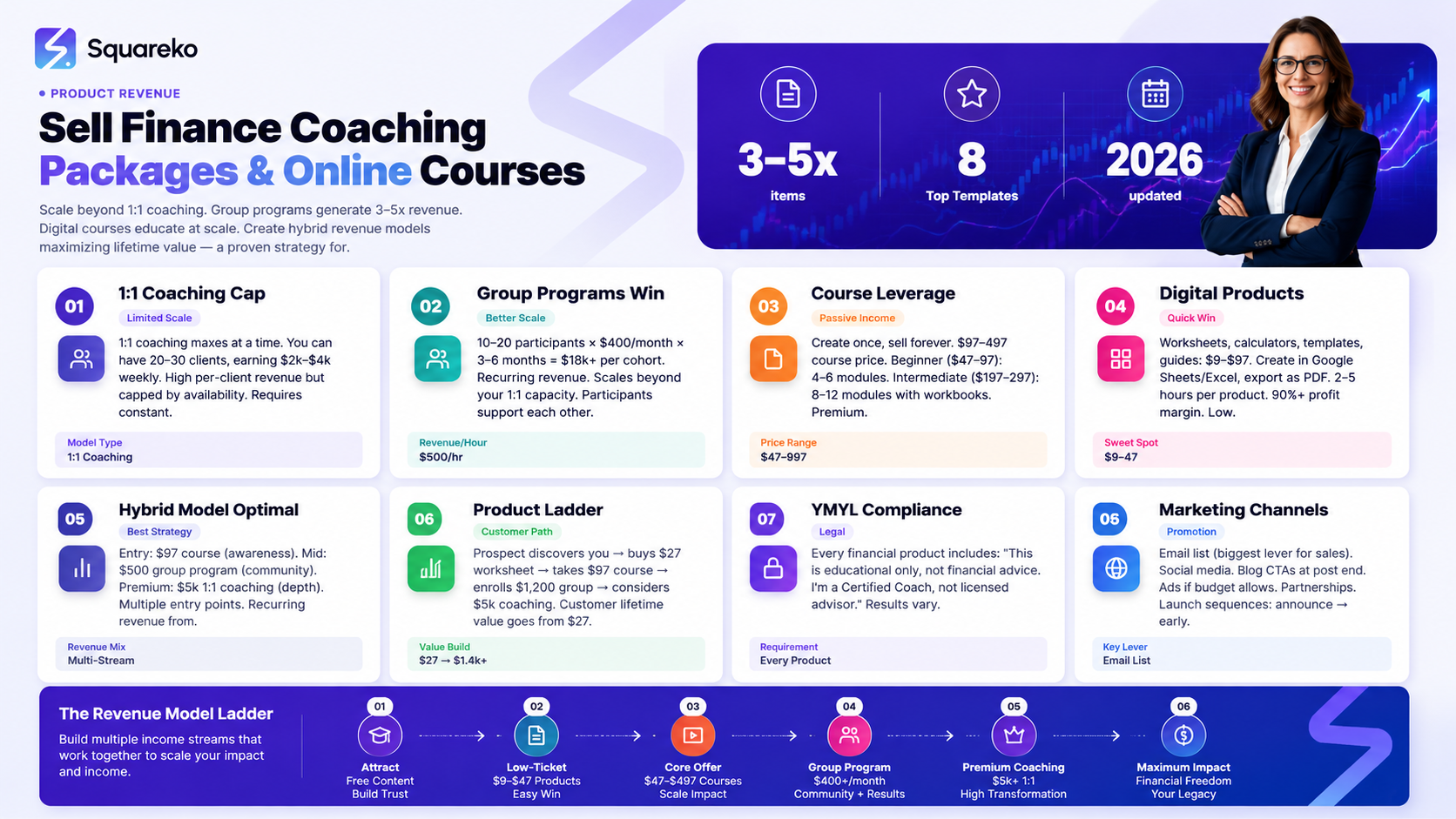
You have multiple revenue levers. Don't just use one.
The 1:1 Coaching Model (Limited Scale)
Revenue: $250-500 per session × 8 sessions/week = $2,000-$4,000/week
Pros:
Highest per-client revenue
Deep client relationships
Easiest to sell (people understand 1:1)
Cons:
Capped by your time (max 20-30 clients at a time)
Requires constant client acquisition
High client dependency
The Group Coaching Model (Better Scale)
Revenue: $400/month per participant × 15 people = $6,000/month recurring
Pros:
Recurring revenue (more stable)
Scales beyond your 1:1 capacity
Participants support each other
Premium pricing (group size creates urgency)
Cons:
Requires group facilitation skills
Less personalized attention
Harder to fill first group
The Course Model (Leverage)
Revenue: $197 per course × 50 students = $9,850 (one-time work, repeated sales)
Pros:
Infinite scale (sell to 100 or 10,000)
One-time content creation, repeated sales
Builds audience for coaching upsells
Passive income
Cons:
Requires course creation discipline
Lower per-person revenue than coaching
Course completion is low (typically 10-20% finish)
The Hybrid Model (Optimal)
Revenue:
Entry: $97 course (awareness, audience building)
Mid: $500 group program (community, results)
Premium: $5,000 1:1 coaching (depth, transformation)
Pros:
Multiple entry points (someone buys course before they're ready for coaching)
Recurring revenue from group programs
Passive revenue from courses
Customer lifetime value maximized
Natural progression path
Cons:
Requires managing multiple products
More complex to sell
This is the optimal model for scaling.
Group Coaching Programs
Group programs generate the best ROI for time invested.
What is Group Coaching?
10-20 participants in a cohort, meeting together (weekly or bi-weekly) for 8-12 weeks.
Structure Example: 12-Week Women's Wealth Building Group
Format:
Weekly 90-minute group calls
Private Slack channel for support
Worksheets and homework between sessions
Monthly 1:1 coaching check-ins (15 min each)
Participant mix: 12-15 women at different wealth-building stages Investment: $400/month for 3 months = $1,200 total Revenue: 15 people × $1,200 = $18,000 per cohort Your work: ~3 hours/week × 12 weeks = 36 hours
Revenue per hour: $500/hour (compared to $250/hour for 1:1)
Group Program Structure
Phase 1: Launch (Weeks 1-3)
Cohort meets and bonds
Establish group norms
Identify individual goals
Phase 2: Core Work (Weeks 4-9)
Deep education
Implementation support
Peer accountability
Phase 3: Integration (Weeks 10-12)
Results celebration
Long-term planning
Graduation
Group Program Topics for Finance Coaches
Debt Freedom Groups:
90-Day Debt Elimination Challenge
12-Week Debt Freedom Bootcamp
Consumer Debt Payoff Cohort
Women's Wealth Groups:
Women's Wealth Accelerator
Build $100k in 12 Weeks (Group Cohort)
Women and Money: Building Confidence Together
FIRE Groups:
FIRE Optimization Cohort
Fast-Track to Financial Independence
12-Week FIRE Planning Group
Pricing Group Programs
Entry-level group: $300-400/month × 3 months = $900-1,200 total (For large groups, 15+ people)
Premium group: $500-700/month × 3-6 months = $1,500-4,200 total (Smaller groups, 8-10 people, more intimate)
VIP groups: $1,000+/month (5-6 people, high-touch, premium positioning)
People often prefer group programs to 1:1 because:
Lower cost
Built-in community
Peer support and accountability
Feels less intimidating
Self-Paced Online Courses
Courses let you serve people who can't afford coaching.
Course Structure for Finance Coaches
Typical course layout:
8-12 modules (1 module = 10-15 min video + worksheet + worksheet)
Module 1: Foundation or mindset work
Modules 2-7: Core content (one topic per module)
Module 8: Integration and next steps
Time investment:
30-40 hours to create a quality course
1 hour per 10-minute video (recording + editing)
Example: Debt Freedom Masterclass
Module 1: The Debt Psychology
Video: Why You Got Into Debt (And It's Not Your Fault)
Worksheet: Identify your debt triggers
Resource: Debt shame recovery guide
Module 2: Debt Mapping
Video: How to See Your Complete Debt Picture
Worksheet: List all debts with interest rates
Resource: Debt consolidation vs. payoff calculator
Module 3: Payoff Strategy
Video: Which Debt Payoff Strategy Works Best?
Worksheet: Model your payoff timeline
Resource: Payoff timeline calculator
(Continue through Modules 4-8...)
Course Pricing Strategy
Beginner course: $47-97
Solves one specific problem
4-6 modules
Low barrier to entry
Goal: audience building, not revenue
Intermediate course: $197-297
Comprehensive on one topic
8-12 modules
Workbooks and tools included
Goal: mix of revenue and audience
Premium course: $497-997
Masterclass level content
15+ modules
Includes 1-2 group calls or 1:1 add-ons
Goal: revenue generation
Course Sales Tips
Offer free mini-course: Give away 2-3 modules free to email list (builds audience)
Launch cohort: Run course live first time with group calls (builds testimonials)
Repurpose course: Take 1:1 coaching content, record it, sell as course
Update regularly: Course should evolve as you learn from coaching clients
Upsell coaching: Finished the course? Ready for personal coaching?
Digital Products and Tools
Small products build revenue without heavy lifting.
Digital Products Finance Coaches Can Sell
Worksheets and Workbooks:
Debt elimination tracker ($27)
Monthly budget planner ($17)
Wealth building roadmap ($37)
Money values assessment ($9)
Calculators and Tools:
Debt payoff calculator ($47)
Financial independence calculator ($47)
Budget-to-wealth converter ($29)
Templates:
Debt payoff spreadsheet ($17)
Investment tracking template ($19)
Financial goal-setting template ($17)
Guides and Reports:
5 Steps to Debt Freedom guide ($19)
Women's Financial Independence Roadmap ($37)
Complete Money Mindset Reset ($49)
Digital Product Pricing Sweet Spots
$9-17: Impulse buy range (templates, simple worksheets)
$27-47: Good value (comprehensive worksheet, basic course)
$97-197: Courses or bundles
$297+: High-end courses or coaching packages
Creating Digital Products
Fastest path:
Create in Google Sheets or Excel (your tools)
Export as PDF or keep as Google Doc
Upload to Squarespace
Link from product page
Time investment: 2-5 hours per product Maintenance: Low (update annually) Profit margin: 90%+ (mostly passive once created)
Setting Up Squarespace Commerce
Squarespace makes selling products simple.
Enable Squarespace Shop
Go to Settings > Products (or create a Shop page)
Add product: Products > Add Product
Adding Products to Squarespace
For digital products:
Product title: Debt Freedom Masterclass
Price: $97
Description: Full course outline and what students get
File upload: Upload course materials, worksheets, videos
Digital delivery: Squarespace sends files via email after purchase
For courses:
Create page: [Squarespace doesn't host video natively]
Solution: Use Kajabi, Teachable, or Thinkific for courses, link from Squarespace
Or: Create Members area in Squarespace for course content
Integrations
For video courses:
Kajabi: Full course platform, $100-500/month
Teachable: Course platform, $50-300/month
Thinkific: Course platform, $50-249/month
YouTube (free): Host videos, link from Squarespace page
For group coaching:
Mighty Networks: Private community + course hosting
Circle: Community platform
Slack (free): Private community for participants
Payment Processing
Squarespace uses Stripe for payments:
Squarespace takes 3% + $0.30 per transaction
Stripe handles payment collection
Automatic digital delivery of products
Pricing Digital Products
Your digital products should follow a pricing ladder.
The Product Ladder Strategy
Customer journey:
Free: Email signup, free mini-course (audience building)
$17-47: Digital products (impulse buys, quick sales)
$97-297: Self-paced course (education, authority building)
$1,200-5,000: Group coaching or 1:1 coaching (transformation)
Someone discovers you → buys $27 worksheet → takes $97 course → enrolls in $1,200 group program.
Customer lifetime value: $1,400+ (from initial $27 product).
Pricing Formula for Digital Products
Cost-based: Cost + markup
Cost: 10 hours × $50/hour = $500
Markup: 10x = $5,000
But this doesn't reflect value...
Value-based: What's it worth to the customer?
Debt elimination worksheet helps someone avoid $5,000 in interest
Worth: $47-97 (fraction of value delivered)
Market-based: What similar products cost?
Look at competitors
Price at same level unless positioned differently
Recommendation: Use value-based pricing.
YMYL Compliance for Product Selling
YMYL rules apply to courses and products too.
YMYL Disclaimers on Products
Every financial product should include:
In product description: This course provides educational information about financial strategies and money management. It is not financial advice. Consult a licensed financial advisor for specific investment recommendations. Results vary by individual and depend on implementation.
In course materials: Include disclaimer in first module: This course is educational only. The instructor is a Certified Financial Coach, not a licensed financial advisor. Do not use this course to make investment decisions without consulting a qualified financial professional.
In product delivery email: Important: This course is for educational purposes only and is not financial advice. See full disclaimer here [link].
What You Can't Claim
Don't say: Eliminate debt in 60 days or Guaranteed wealth building Do say: Many clients eliminate $5k-$15k in the first 3 months, but results vary
Don't say: This investment strategy will beat the market Do say: This course teaches portfolio diversification principles used by professional investors
Don't say: You'll earn $100k from this course material Do say: You'll learn the strategies used by successful business owners to build wealth
Marketing Your Products
How do you actually sell them?
Email Marketing Strategy
Build list: Offer free guide or mini-course to email signup
Nurture: Send 1-2 emails per week with value
Promote: Include product links in email footer
Launch: When launching new product, email sequence (5-7 emails over 10 days)
Website Strategy
Home page: Mention your top product/course
Product page: Dedicated page for each major product
Blog CTAs: Include relevant product CTA at end of posts
Sales page: Long-form page (2,000 words) selling your premium course
Social Media Strategy
Instagram: Free content + product link in bio
LinkedIn: Educational content + course/product mentions
Pinterest: Create pins linking to product pages
TikTok: Short financial education + link in bio for full course
Launch Strategy for New Products
Week 1: Announce (email + social, link not live yet) Week 2: Early bird pricing ($50 off for subscribers) Week 3: Regular launch (full price) Week 4: Ongoing sales + testimonial building
Frequently Asked Questions
-
Do both. Courses attract people not yet ready for coaching. Coaching builds deep relationships. Together, they maximize revenue.
-
Kajabi is easiest (all-in-one), but pricey. Teachable is mid-range. Squarespace works for basic courses + digital products.
-
Record your knowledge (or hire to record/edit), organize into modules, create workbooks, upload to platform.
-
Yes, for digital products (PDFs, downloads). For video courses, use Kajabi/Teachable and link from Squarespace.
-
$97-297 for comprehensive finance course. More if including group calls or 1:1 add-ons.
-
No. Many customers buy course first, then invest in coaching later. It builds your audience.
-
Email list (biggest lever), social media, blog CTAs, ads (if budget allows), partnerships.
Ready to scale beyond 1:1 coaching?
Squareko helps finance coaches design and sell group programs, courses, and digital products. Let's diversify your revenue.

From custom website design to SEO strategy, we help businesses launch a site that looks professional and performs better.

About the Author
I'm Walid Hasan, a Certified Squarespace Expert and Squarespace Circle Platinum Partner with over 12 years of hands-on experience designing and optimizing high-performing websites. Over the years, I've had the privilege of building more than 2,000 Squarespace websites for clients around the world, always focusing on clean design, strong user experience, and conversion-driven results.