How to Build an Architecture Firm Website on Squarespace That Wins More Commissions
Introduction:
Architecture firms operate in a world of high-stakes, long-duration projects. A potential client evaluating your practice isn't making a quick purchase decision—they're assessing whether your firm understands their vision, possesses the technical credentials to execute it, and has delivered comparable work at comparable scales.
Your website is the primary vehicle through which clients form this assessment. An architecture firm website on Squarespace that's properly structured doesn't just showcase buildings. It communicates your design philosophy, demonstrates your expertise across project types, proves your track record through awards and publications, and ultimately converts qualified leads into commission inquiries.
This guide walks you through building that website—from portfolio strategy to award presentation to conversion mechanics. We'll examine how the best architecture practices use Squarespace to stand out in a competitive field and secure more commissions.
Key Takeaways
Your architecture website must mirror how clients evaluate firms: portfolio quality first, followed by philosophy alignment, team credentials, and award recognition
Squarespace's project type filtering and custom categorisation allow you to organise work by typology (residential, commercial, cultural), scale, and geographic region
Awards and publications carry immense weight in the architectural decision journey—display RIBA, Dezeen, and Architectural Review recognition prominently, with evidence and context
A streamlined consultation request workflow converts portfolio browsers into qualified leads
Visual presentation standards for Squarespace must prioritise high-quality photography, clear project descriptions, and consistent storytelling across all work
Multi-page case studies demonstrating design process, client challenge, and outcomes build credibility faster than image galleries alone
Understanding the Architecture Commission Decision Journey
Architecture commissions begin with a question: Does this firm understand what we want to build?
The client's evaluation process is systematic and deeply structured. They move through distinct phases before approaching your firm with a brief.
Portfolio Review is the first and most critical stage. A prospective client will spend time reviewing your previous work—not to admire aesthetics alone, but to answer specific questions: Have you built at this scale? In this geography? For this sector? Do your design values align with ours?
When a client sees a 20,000 m² healthcare facility you've completed, they're extracting data. They're asking whether you understand clinical workflows, whether you've managed complex stakeholder requirements, and whether you can navigate the regulatory landscape their own project will face.
Practice Philosophy Alignment follows. Architectural practice isn't neutral. Every firm has a point of view—about materiality, about cost control, about community impact. The most successful commission wins occur when the client's values match yours. A practice known for minimalist residential work will struggle to win a baroque heritage restoration, no matter how competent they are.
Team Credentials matter enormously. If the client sees that the project will be led by your founding partner and they respect that person's body of work, the likelihood of engagement increases significantly. If your team includes specialists in their sector, even better.
Awards and Publications serve as third-party validation. When a project has been recognised by RIBA, featured in Dezeen, or reviewed in Architectural Review, it signals that independent experts consider your work meritorious. This matters more than you might think in a field where subjective taste can be disguised as objective quality.
Brief Consultation is where the relationship becomes transactional. At this stage, the client has already formed a view of your firm. The consultation confirms whether you listen, ask intelligent questions, and show genuine interest in their specific problem.
Your Squarespace architecture website must support each of these stages explicitly.
Designing Your Portfolio Strategy on Squarespace
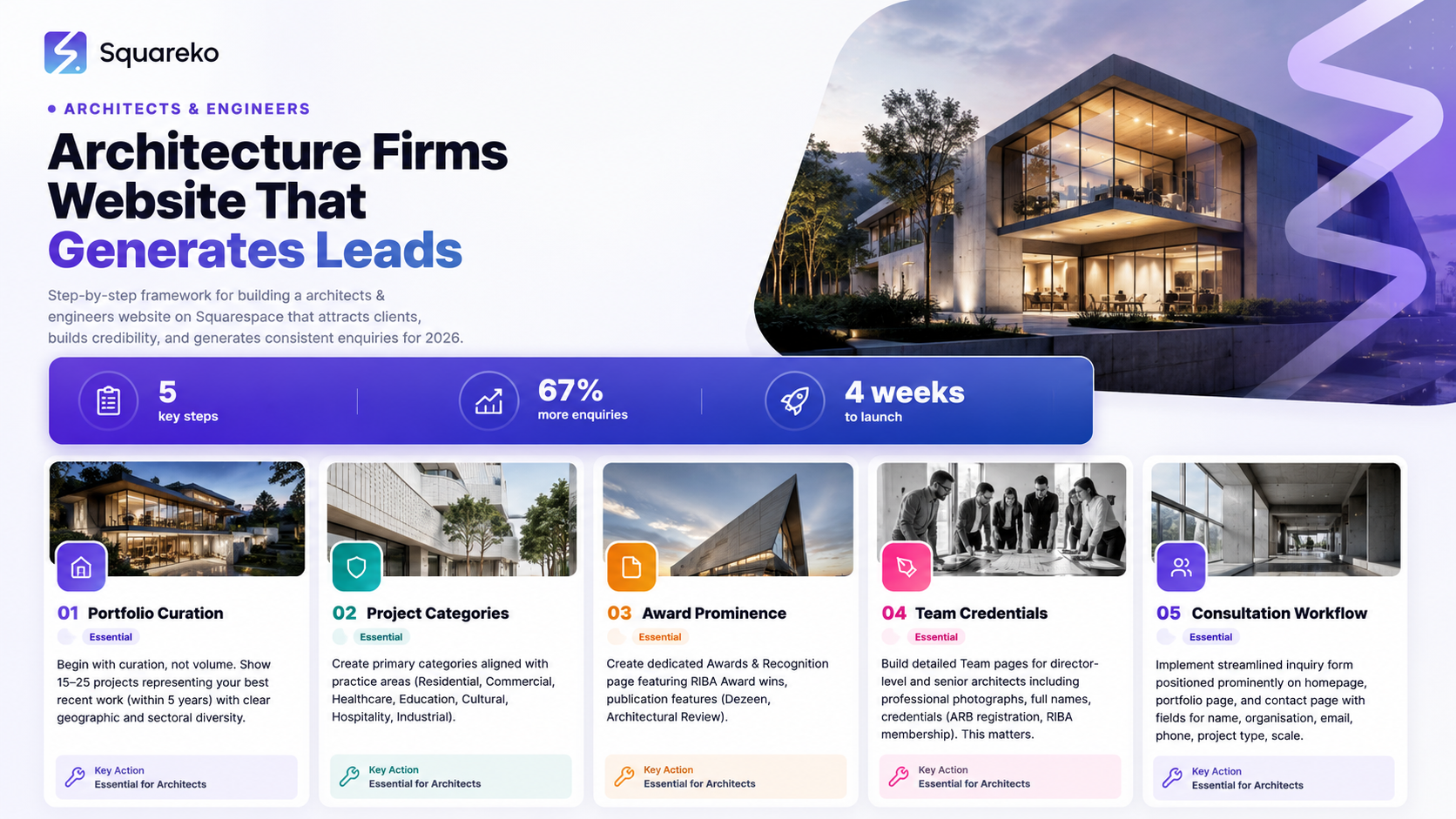
Too many architecture firm websites treat portfolios as image galleries. They're not. A portfolio is a strategic argument about who you are and what you're capable of.
Begin with curation, not volume. An architecture practice with 200 completed projects doesn't need to show all 200. You need to show 15–25 projects that represent:
Your best recent work (within the last 5 years)
Clear geographic and sectoral diversity
Ranging project scales (to demonstrate your versatility)
Multiple project types (if you practice across sectors)
On Squarespace, create a Portfolio page using the Image Grid or Gallery layout. Title it clearly: Our Work or Projects rather than generic alternatives. Write a brief introduction explaining your approach to selection: We show work that represents both our design thinking and the collaborative relationships that define our practice.
For each project, create a dedicated project page (Squarespace supports individual project posts within portfolio collections). Include:
Project Title and Year Use the format: Whitworth Library Renovation, Manchester, 2022. Geographic location matters for local search and client comprehension.
Project Brief Write 50–100 words explaining what the client needed to achieve. Use plain language. Example: The heritage library required a complete mechanical and electrical systems upgrade whilst preserving all original Victorian features and maintaining the building's Listed status.
Design Response Explain what your firm chose to do and why. This is where you demonstrate design thinking. Example: We designed a concealed services strategy, routing all new systems through a false floor below the original pine joinery, preserving sight lines and spatial character.
Design Team and Consultants Name your lead architect or design director. Name external consultants (engineers, specialist subcontractors). This builds credibility.
Client and Use Specify the client type (local authority, private developer, heritage trust) and primary building use.
Images Use 8–12 high-quality photographs. Include: exterior elevation, key interior spaces, detail photography, and process/construction photography. Minimum 2000px width. Avoid overly saturated or stylised imagery that misrepresents the actual outcome.
Project Metrics Include budget (if releasable), area, completion date, and key stakeholders.
Outcome What happened after completion? Did the building win awards? Has it been featured? How has the client responded? This matters.
This approach transforms your portfolio from a visual display into a credibility document.
Setting Up Project Type Categories and Filters
Squarespace Collections allow you to tag projects with multiple categories. Use this strategically.
Create primary categories aligned with your practice areas:
Residential
Commercial
Healthcare
Education
Cultural
Hospitality
Industrial
Mixed-Use
Create secondary filter categories:
Geographic regions (London, South East, National, International)
Scale (Under 5000 m², 5000–15000 m², 15000+ m²)
Heritage/Conservation vs New Build
Award-Winning
In your Portfolio page introduction, add text: Filter our work by project type to see how we approach different building uses. Each sector demands distinct thinking.
Configure Squarespace's filter controls to display only filters with content. This prevents confusion and improves user experience. A client seeking healthcare work can instantly isolate those projects.
This categorisation serves two purposes: it helps prospective clients find relevant work, and it improves your internal SEO by creating natural landing pages for searches like "architecture firm healthcare projects" or "London residential architects".
Presenting Your Awards and Recognition
Awards carry disproportionate weight in architectural decision-making. A RIBA Award or Architectural Review mention can shift a client's perception of your practice materially.
Create a dedicated Awards & Recognition page. Structure it clearly
RIBA Awards List RIBA Award wins chronologically, with project name, year, and award category. Include a link to the relevant project page. Example:
2023 RIBA Regional Award: Whitworth Library Renovation2021 RIBA East Award: Residential Project of the Year
If you've received a Commendation or Highly Commended, include it—these are still recognitions.
Publication and Critical Acclaim Create a separate section for Dezeen features, Architectural Review reviews, and other significant publications. Include the publication name, date, and article title. Provide a link to the external article.
Featured: Dezeen, January 2024, "How This Practice Rethinks Heritage Interiors"Reviewed: Architectural Review, May 2023, "Five New Cultural Buildings Worth Seeing"
International Competitions If your practice has competed in and placed in international design competitions (even if not yet built), this signals design credibility. Include competition name, year, and outcome.
Accreditations and Professional Bodies Include ARB (Architects Registration Board) registration numbers for your director-level practitioners. Include RIBA Chartered Practice status if you hold it. These matters matter to institutional clients.
On each relevant project page, add a small badge or notation indicating award status: RIBA Award Winner, 2023. This creates a visual hierarchy and helps clients identify highly-recognised work.
Building Team Credentials and Practice Philosophy Pages
Your practice philosophy isn't your mission statement. It's your stated design values and approach to architectural problems.
Create a dedicated Practice Philosophy page (Squarespace supports custom pages). Write 300–400 words addressing:
Your core design principles
How you approach context and place
Your relationship to heritage, sustainability, and innovation
How you collaborate with clients
Your approach to cost and value
Example passage: We believe that good architecture emerges from a rigorous understanding of place. Our practice integrates climate, local material culture, and historical context into every design decision. We reject the notion that architectural expression demands indifference to site conditions.
Create a separate Team page. For each director-level or senior-architect, include:
High-quality professional photograph
Full name and credentials (ARB registration, RIBA membership)
Brief biography (100–150 words) highlighting: educational background, notable projects they've led or contributed to, professional recognitions, specialisations
Links to relevant project pages they've led
Example:
*Sarah Chen, Director BA(Hons) Architecture, Bartlett School of Architecture, University College London ARB Registered | RIBA Chartered Member
Sarah directs the practice's healthcare and institutional work. She led the Whitworth Library renovation and has 15 years' experience navigating Listed Building and conservation requirements. Her work has been published in Architectural Review and featured in Dezeen. She lectures part-time in conservation architecture at UCL.*
This level of detail communicates that you're led by credentialed professionals with deep expertise. It's immensely reassuring to institutional clients.
Optimising Your Brief Consultation and Inquiry Workflow
A client who's reviewed your portfolio, read your philosophy, and looked at your team's credentials is ready to make contact. Remove friction from this step.
Squarespace offers native Contact Forms. Create a specific inquiry form for consultation requests. Include fields:
Name (required)
Organisation/Company (required)
Email (required)
Phone (optional)
Project Type (dropdown: Residential, Commercial, Healthcare, Cultural, Other)
Project Scale (dropdown: Under £500k, £500k–£2m, £2m–£5m, £5m+)
Project Location (text field)
Project Brief (text area, 200-word minimum)
How did you find us? (dropdown: Web search, Recommendation, Award, Publication, Other)
Add a clear call-to-action above the form: Tell us about your project. We'll respond within two business days to discuss next steps.
After form submission, configure an automated response email. Example:
Thank you for reaching out. We've received your project brief and will review it carefully. One of our directors will contact you within two business days. In the meantime, you might find it useful to explore our practice philosophy and recent project work.
This automation maintains momentum and shows professionalism.
Place this consultation form on your home page (above the fold, or linked prominently), your Contact page, and your main Portfolio page. Don't bury it.
Technical Implementation: Squarespace Setup for Architecture Firms
Homepage Strategy Your Squarespace homepage should introduce your practice in 150–200 words, then lead immediately to a portfolio section showing 3–5 featured projects. Include a prominent CTA: View Our Work or Discuss Your Project.
Navigation Structure Keep top-level navigation simple:
Home
Projects (or Work)
About (linking to Philosophy and Team pages)
Awards
Contact (or Inquiry)
Don't create overly nested menus. Architects hate navigating confusing websites.
Portfolio Collection Setup Use Squarespace's Native Projects feature:
Create a main Portfolio collection
Set up project post pages with custom fields for: Brief, Design Response, Team, Year, Location, Image Gallery, Project Details
Configure filtering by category
Enable project pagination (Previous/Next navigation)
Image Optimisation Architects appreciate high-quality photography. For web:
Minimum 2000px width for portfolio images
Maximum file size 300KB per image (use Squarespace's native image compression)
Consistent colour grading across projects (creates visual coherence)
Include a mix of exterior, interior, detail, and process photography
Mobile Responsiveness Verify that your portfolio displays excellently on mobile. Many clients browse architecture websites on iPads during client meetings. Test thoroughly.
Page Load Speed Monitor page load speed using Google PageSpeed Insights. Architecture websites heavy with images must load in under 3 seconds. Use Squarespace's built-in CDN and image lazy-loading.
SEO Fundamentals
Set unique meta titles and descriptions for each project page
Use the H1 for project title only
Use H2s for sections (Design Brief, Design Response, Outcome)
Include alt text for all images (describe image content for accessibility and SEO)
Create an internal linking strategy: link related projects from within project descriptions
Schema Markup Implement HowTo schema for your website build process. Example:
{
  "@context": "https://schema.org",
  "@type": "HowTo",
  "name": "How to Build an Architecture Firm Website on Squarespace",
  "step": [
    {
      "@type": "HowToStep",
      "name": "Portfolio Strategy",
      "text": "Curate 15-25 projects representing your best work, diverse sectors, and range of scales"
    },
    {
      "@type": "HowToStep",
      "name": "Project Type Filtering",
      "text": "Set up categories by sector, geographic region, and scale to help clients find relevant work"
    },
    {
      "@type": "HowToStep",
      "name": "Award Display",
      "text": "Create dedicated Awards page featuring RIBA, Dezeen, and publication recognitions"
    },
    {
      "@type": "HowToStep",
      "name": "Team Credentials",
      "text": "Build Team page with credentials, biographies, and links to projects each director has led"
    },
    {
      "@type": "HowToStep",
      "name": "Consultation Workflow",
      "text": "Implement streamlined inquiry form with automated response to convert browsers into leads"
    }
  ]
}
Case Study: How Merrick Architecture Won Five Major Commissions Through Strategic Squarespace Redesign
Merrick Architecture is a 12-person practice based in Manchester specialising in heritage conversions and educational buildings. When they approached Squareko, their website was outdated, lacked clear categorisation, and didn't communicate their practice philosophy effectively.
The Challenge Despite having excellent work (including a RIBA Regional Award), Merrick received only 2–3 qualified inquiries per month. They suspected clients couldn't easily navigate their portfolio or understand their design approach.
The Strategy Squareko helped Merrick implement the approach outlined above:
Portfolio Curation: Reduced their portfolio from 45 projects to 18, removing early work and weak examples. Focused on heritage and education work from the last 5 years.
Award Prominence: Created a dedicated Awards page featuring their RIBA Award, Architectural Review publication, and competition recognitions. Added award badges to relevant project pages.
Team Visibility: Built detailed Team pages for their three directors, including project leadership histories and sector specialisations. This was transformative—clients realised the practice was led by highly credentialed practitioners.
Category Filtering: Set up filters by project type (Heritage, New Build, Education, Residential) and by geographic region. This enabled clients seeking heritage specialists to quickly isolate relevant work.
Consultation Workflow: Implemented a streamlined inquiry form positioned prominently on the homepage and every project page.
The Results Within three months, qualified inquiries increased from 2–3 per month to 7–9. Within six months, Merrick had converted five of these inquiries into commissions worth approximately £2.3m combined fee value. The practice attributed the increase directly to improved portfolio presentation and clearer communication of their credentials.
Frequently Asked Questions
-
Curate your strongest recent work (15–25 projects) and create dedicated project pages for each. Include project brief, design response, team, location, year, high-quality imagery, and outcome. Categorise work by sector, geography, and scale to help clients find relevant projects. Focus on storytelling over image galleries—explain what the client needed, what you did, and why.
-
Essential pages: Home, Portfolio/Projects, About (linking to Philosophy and Team pages), Awards & Recognition, and Contact/Inquiry. Optional but valuable: Blog (for thought leadership), Case Studies, Sustainable Design approach, Client Testimonials. Each page should serve a specific purpose in the client decision journey.
-
Only if the budget is releasable (the client has agreed to public disclosure). Most institutional and commercial projects are sensitive, so budgets remain confidential. Instead, use scale metrics (area, number of storeys) to communicate project size and complexity. If you do show budgets, position this as a sign of transparency and confidence.
-
Create a dedicated Awards page with clear sections: RIBA Awards, Publications (Dezeen, Architectural Review, etc.), International Competitions. Include publication dates and links to external reviews. Add award badges to relevant project pages. Ensure your practice philosophy page references design values that align with the awards you've won.
-
Yes, where possible. Include process photography (sketches, models, construction phases) on 3–5 flagship projects. Write brief descriptions of design decisions and iterations. This demonstrates rigorous thinking and helps clients understand your methodology. It's particularly valuable for institutional clients who appreciate seeing the depth of thinking behind final designs.
-
Add new completed projects within one month of completion. Archive or remove projects older than 5 years (or that no longer represent your current practice direction). Review your awards and publications quarterly to ensure they're current. Update team biographies annually. A portfolio that feels current builds more confidence than one that appears stagnant.
-
Use geography and sector-specific language naturally throughout your site. Create project pages with unique, descriptive titles (not just "Project 1"). Write project descriptions that include your location and sectors. Build an internal linking structure—link related projects and relevant pages from within project descriptions. Include location-specific metadata if you serve a geographic region. Consider a blog covering architecture trends, your design process, or sector-specific insights.
-
Yes. Squarespace's native image CDN and compression tools support high-quality imagery without excessive loading times. Provide images at 2000px+ width and ensure consistent colour grading. Test your site on various devices (desktop, tablet, mobile) to verify quality across all screens.
Conclusion
An architecture firm website on Squarespace is fundamentally a business development tool, not a portfolio gallery. It must support the specific decision journey clients move through when evaluating architectural firms: portfolio assessment, philosophy alignment, credibility validation through awards and team credentials, and ultimately, a clear path to consultation.
The practices winning the most commissions understand this. They curate their portfolios ruthlessly. They present awards and publications prominently. They communicate their practice philosophy clearly. They make their team visible and credible. And they remove all friction from the inquiry process.
Squarespace provides excellent tools for this work. Its native Portfolio features, category filtering, and form capabilities are well-suited to architectural practice needs. Combined with strategic content development and thoughtful information architecture, a Squarespace website can become a significant business development asset—one that consistently converts portfolio browsers into qualified commissions.
The practices that build architecture firm websites this way don't just look better than their competitors. They win more work.
Next Steps: Get Expert Help Building Your Architecture Website
Building an architecture firm website that converts requires both strategic thinking and technical execution. If you'd like personalised guidance on portfolio strategy, awards presentation, or Squarespace setup specific to your practice, Squareko offers a free Squarespace consultation for architecture firms. Our team has worked with dozens of practices to improve portfolio presentation and increase qualified leads.
Schedule your free consultation today.

About the Author
The Squareko editorial team comprises experienced digital strategists and content specialists focused on helping professional service firms—particularly architects, engineers, and design practices—communicate effectively online. We work closely with practices to understand their business development challenges and translate that insight into website strategy and content that converts.