How to Build a Website on Squarespace That Communicates Innovation and Disruption
Key Takeaways Build a Website on Squarespace That Communicates Innovation and Disruption
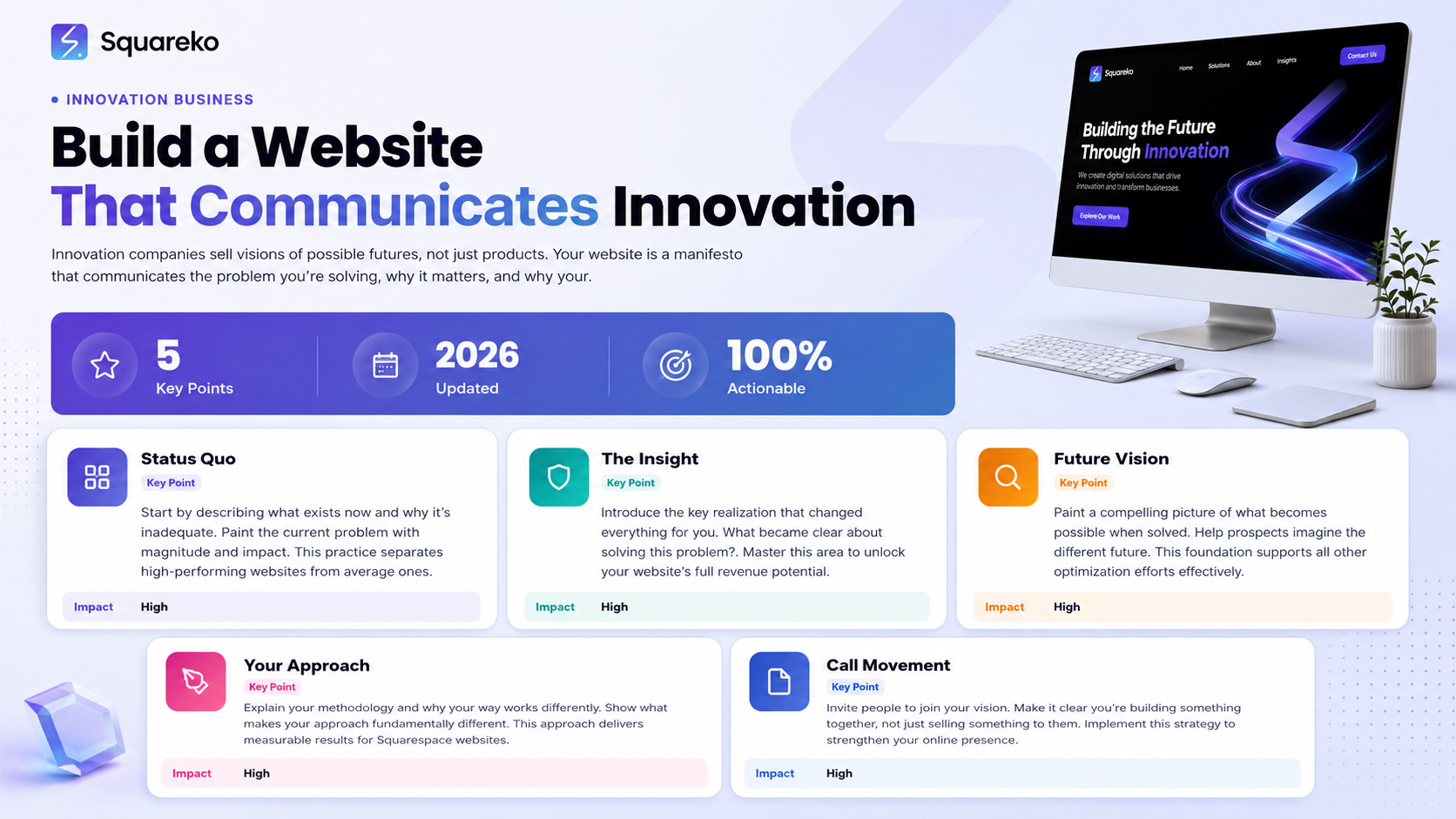
Vision articulation is as important as product demonstration: Explain why you exist, not just what you've built
Problem framing sets up your solution: Help prospects understand the magnitude of the problem you're solving
Disruption narrative positions your approach: Explain why existing solutions are insufficient and why your way is better
Design and language must align with positioning: Every element should reinforce that you're genuinely forward-thinking
Early adopter visibility builds credibility: Show that forward-thinking people are already using you
Innovation companies don't sell products. They sell visions of possible futures. Your website isn't a product showcase—it's a manifesto, a movement invocation, and a signal that you're rethinking how things work.
The best innovation websites communicate four things clearly: what problem you're solving, why it matters, why existing solutions fail, and why your approach is different. They do this through design, narrative, and strategic positioning that attracts early adopters who understand what you're building.
This guide walks through building a Squarespace website that positions your company as genuinely innovative and disruptive, attracting the right audience and building momentum for your vision.
The Innovation Brand Narrative Framework
Innovation companies follow a narrative framework that differs from traditional business messaging.
The Five-Part Innovation Narrative
1. The Status Quo Problem Start by describing what exists now and why it's inadequate:
Current approach to the problem
Why existing solutions fail
Cost or impact of inadequacy
Who suffers from the status quo
Example: Today, enterprise software procurement takes 6-12 months, involves 15+ stakeholders, requires multiple consultants, and still results in 40% of implementations failing to meet requirements.
2. The Insight or Realization Introduce the key insight that changes everything:
What became clear to you
Why this changes possibilities
What you realized about the problem
The shift in perspective
Example: We realized that traditional software procurement starts with the wrong question. Instead of 'What software should we buy?', we ask 'What outcomes do we want to achieve?' When you answer that first, software selection becomes obvious.
3. Your Vision of the Future Paint a picture of what becomes possible:
What the world looks like when solved
How things work differently
What becomes easier or better
What becomes possible that wasn't before
Example: Imagine if software selection was about outcome fit instead of feature comparison. Imagine if implementations succeeded 95% of the time because requirements matched from the start.
4. Your Approach Explain how you're making this vision real:
Your methodology or philosophy
Why your approach works
What's different about your way
How you enable this future
Example: We've developed an outcome-first procurement methodology that eliminates the mismatch between what companies think they need and what actually solves their problem. Our platform guides companies through outcome definition, then matches proven solutions.
5. Call to the Movement Invite people to join your vision:
Who should care about this
What needs to happen next
How they can participate
What you're building together
Example: We're building a community of outcome-focused enterprises that reject the status quo. Join companies already reducing procurement time by 70% while improving implementation success rates.
Homepage Strategy for Innovation Positioning
Your homepage should move someone from I didn't know this was possible to I want to be part of this in 60 seconds.
Hero Section: The Manifesto
Your hero section is your manifesto moment:
Vision statement: We're eliminating enterprise software procurement waste
Problem statement: 6-12 months. 15+ stakeholders. 40% implementation failure. The status quo is broken.
Your vision: Imagine if procurement was outcome-focused, rapid, and 95% successful.
Visual element: Bold, future-forward imagery or video that evokes possibility
CTA: Join the movement or Explore better outcomes (not Learn more about our product)
Insight Section: Why This Matters
Help prospects understand the magnitude of the problem:
The scope: How many organizations face this problem?
The cost: What's the financial or operational impact?
The opportunity: What becomes possible if solved?
The insight: What changed that makes this solvable?
Use data, statistics, or compelling narrative to establish importance.
Solution Section: How You're Different
Explain your approach clearly:
Your philosophy: How you think differently about the problem
Your methodology: Your proven approach
Why it works: What makes your way better
Early results: What teams using you are achieving
Focus on conceptual differentiation (how you think) rather than feature comparison (what you built).
Social Proof: Early Adopter Visibility
Show that forward-thinking people get what you're doing:
Customer logos (if recognizable)
Testimonials from respected early adopters
Press coverage from innovation publications
Community metrics (users, startups, community members)
Awards or recognition for innovation
Emphasize forward-thinking customers, not just customer count.
Community/Movement Building Section
For innovation companies, invite participation:
Early adopter program: Get involved early
Newsletter: Stay updated on your vision
Community: Join companies rethinking this space
Contribute: Help shape where this goes
Make it clear you're building something together, not just selling something.
Clear CTA: What's the Next Step?
Innovation company CTAs should reflect your stage:
Startups/MVPs: Get early access or Join the beta
Established innovations: Schedule a demo or See how we're changing this
Community-driven: Join the community or Get our manifesto
CTAs should invite participation in your vision, not just product demo.
Manifesto and Mission Clarity
Innovation companies benefit from explicit mission and manifesto clarity.
Mission Statement
Create a mission statement that captures your vision:
Not: To provide better software (generic)
Better: To eliminate software procurement waste by making outcome-fit the center of every software decision
Your mission should:
Describe what you're changing
Explain why it matters
Suggest a different future
Be memorable and shareable
Manifesto Section
Consider creating a formal manifesto page:
What is a manifesto? A statement of beliefs and principles about how your domain should work.
Manifesto structure:
We believe.
We believe software procurement should be outcome-focused
We believe implementation success rates should exceed 90%
We believe enterprises are smarter than the status quo
Manifestos work well on dedicated pages and in founding documents.
Core Values and Philosophy
Make your values explicit:
Outcome focus: We prioritize outcomes over features
Transparency: We're honest about what works and what doesn't
Community: We're building this together, not selling to you
Values should feel genuine to your approach, not generic corporate values.
Problem Framing and Disruption Positioning
How you frame the problem determines whether prospects see your solution as necessary.
Problem Articulation Strategy
Identify the real problem:
Is it what people think, or something deeper?
Is the obvious problem actually the symptom?
What are people really struggling with?
Frame it provocatively:
Enterprise software procurement is fundamentally broken
Legacy systems aren't legacy—they're strategic failures
Team communication hasn't evolved since email
Quantify the impact:
Time wasted
Money lost
Opportunities missed
Competitive disadvantage
Identify why status quo persists:
What incentives support broken systems?
Why do smart people tolerate inadequate solutions?
What lock-in prevents change?
Disruption Narrative
Explain why your approach disrupts the status quo:
What changes:
Different question asked (outcome vs. features)
Different process followed (rapid vs. slow)
Different metric optimized (success vs. features)
Why existing solutions can't do this:
Incentive misalignment
Legacy system constraints
Business model limitations
Why your approach is possible now:
Technology changed
Market conditions changed
Thinking evolved
Design and Visual Communication
Your visual design should reinforce your innovation narrative.
Color and Design Language
Bold colors: Avoid corporate neutral (gray, navy)
Modern typography: Contemporary typefaces
Generous whitespace: Not cluttered or cramped
Dynamic imagery: Not static or staged
Motion and animation: Suggest forward movement and possibility
Imagery and Visual Storytelling
Use imagery strategically:
Hero imagery: Evokes future possibility, not current state
Founder/team: Show the humans building this
Community: Show diverse people engaged in your vision
Use cases: Show how your approach works differently
Avoid stock photography. Original imagery and photography feel more authentic.
Language and Tone
Your writing should match your design:
Conversational, not corporate: Talk like humans, not companies
Clear, not jargon-filled: Accessibility matters
Hopeful, not arrogant: Invite participation, don't claim perfection
Specific, not vague: Details make vision credible
Early Adopter and Community Building
Innovation companies thrive on early adopter enthusiasm and community engagement.
Early Adopter Features
Build mechanisms for early participation:
Beta programs: Get involved early
Clear benefits of being early (discounts, influence, recognition)
Engagement mechanisms (feedback, voting on features)
Community visibility for participants
Newsletter: Stay updated on your vision
Regular updates on thinking and direction
Early access to announcements
Exclusive early adopter insights
Community platforms: Connect with like-minded people
Forum or community space
User groups or local meetups
Shared resources and learning
Advocacy programs: Turn users into evangelists
Referral rewards
Co-marketing opportunities
Featured story opportunities
Community Visibility
Make your community visible on your website:
Featured early adopters and community members
Community metrics (members, companies, users)
User stories and testimonials
Community contributions and participation
This signals that forward-thinking people are already engaged.
Squarespace Implementation Strategy
Implement innovation positioning on Squarespace.
Page Structure for Innovation Brand
Homepage
├── Hero (manifesto and vision)
├── Problem section (why this matters)
├── Solution section (your approach)
├── Early adopters/social proof
├── Community call-to-action
└── Primary CTA (next step)
About/Mission
├── Mission statement
├── Founding story
├── Vision of future
└── Values and philosophy
Product/Offering
├── How you're different
├── How it works
├── Early adopter results
└── CTA to get involved
Community/Resources
├── Community space links
├── User stories and testimonials
├── Newsletter signup
└── Early adopter program
Contact/CTA
├── Primary engagement CTA
├── Secondary engagement options
└── Multiple ways to participate
Squarespace Feature Implementation
Using Squarespace blocks effectively:
Image blocks: Hero imagery and visual storytelling
Video blocks: Founder videos, vision videos
Quote blocks: Early adopter testimonials
Gallery: Community members and examples
Newsletter signup: Build your audience
Form strategy:
Beta signup form (not generic contact form)
Early adopter program signup
Newsletter signup
Feedback or input requests
Content Strategy for Innovation Brands
Build content that supports your innovation narrative.
Blog and Thought Leadership
Publish content that:
Explores the problem deeply
Shares your thinking and frameworks
Documents early adopter stories
Analyzes industry trends
Invites community thinking
Publishing frequency: Minimum 1-2 posts monthly. Consistency matters more than volume.
Founder Visibility
Innovation companies benefit from founder visibility:
Founder essays on vision and direction
Founder interviews and profiles
Founder social media presence
Founder speaking and visibility
Build your personal brand alongside company brand.
Community-Generated Content
Leverage your community:
User stories and case studies
Community contributions and ideas
User-created content
Community spotlights
This positions your company as a movement, not a vendor.
Frequently Asked Questions
-
For innovation companies, yes—leading with vision is better. Traditional prospects want product details. Early adopters and forward-thinking customers want to understand your vision. You're attracting the right people by leading with vision.
-
Keep it concise. A strong manifesto is memorable and shareable—typically 50-200 words. If it's longer, break it into multiple statements. Brevity forces clarity.
-
Your early adopters will tell you. Start with your best articulation of your vision. As you talk to customers, refine it. Your website content will evolve as your understanding of what resonates deepens.
-
Keep features secondary to your vision. Lead with vision and problem framing. Put detailed features behind "How it works" or "Product" sections for prospects ready for specifics. Vision comes first.
-
Both matter. Lead with vision (innovation positioning). Then support with credibility (early adopters, early results, team credentials). Prospects need both inspiration and evidence.
-
Frame it as solving a real problem, not as revolutionary. "We're improving X by Y%" is valid if the improvement genuinely matters. Don't oversell incrementality as disruption.
-
Your core vision should be stable. Refine the messaging as you learn. Update your website quarterly at minimum, monthly if you're evolving rapidly. Show that you're thinking and evolving.
-
For innovation companies with founder-led narratives, yes. Founders often embody the vision. But balance founder visibility with team visibility—you're building something together.
Call to Action
Your website is your most important tool for communicating your vision and attracting early adopters who understand what you're building. A well-crafted innovation website becomes part of your movement-building strategy.
At Squareko, we help innovation-led companies build Squarespace websites that tell your vision story and attract early adopters. From narrative development to design implementation, we ensure your website reflects your innovation positioning.
Ready to build a website that communicates your vision and attracts your people? Schedule a consultation with our team.
From custom website design to SEO strategy, we help businesses launch a site that looks professional and performs better.

Author Bio
I'm Walid Hasan, a Certified Squarespace Expert and Squarespace Circle Platinum Partner with over 12 years of hands-on experience designing and optimizing high-performing websites. Over the years, I've had the privilege of building more than 2,000 Squarespace websites for clients around the world, always focusing on clean design, strong user experience, and conversion-driven results.