How to Build a Strategy Consulting Website on Squarespace That Wins C-Suite Clients
Key Takeaways For How to Build a Strategy Consulting Website on Squarespace That Wins C-Suite Clients
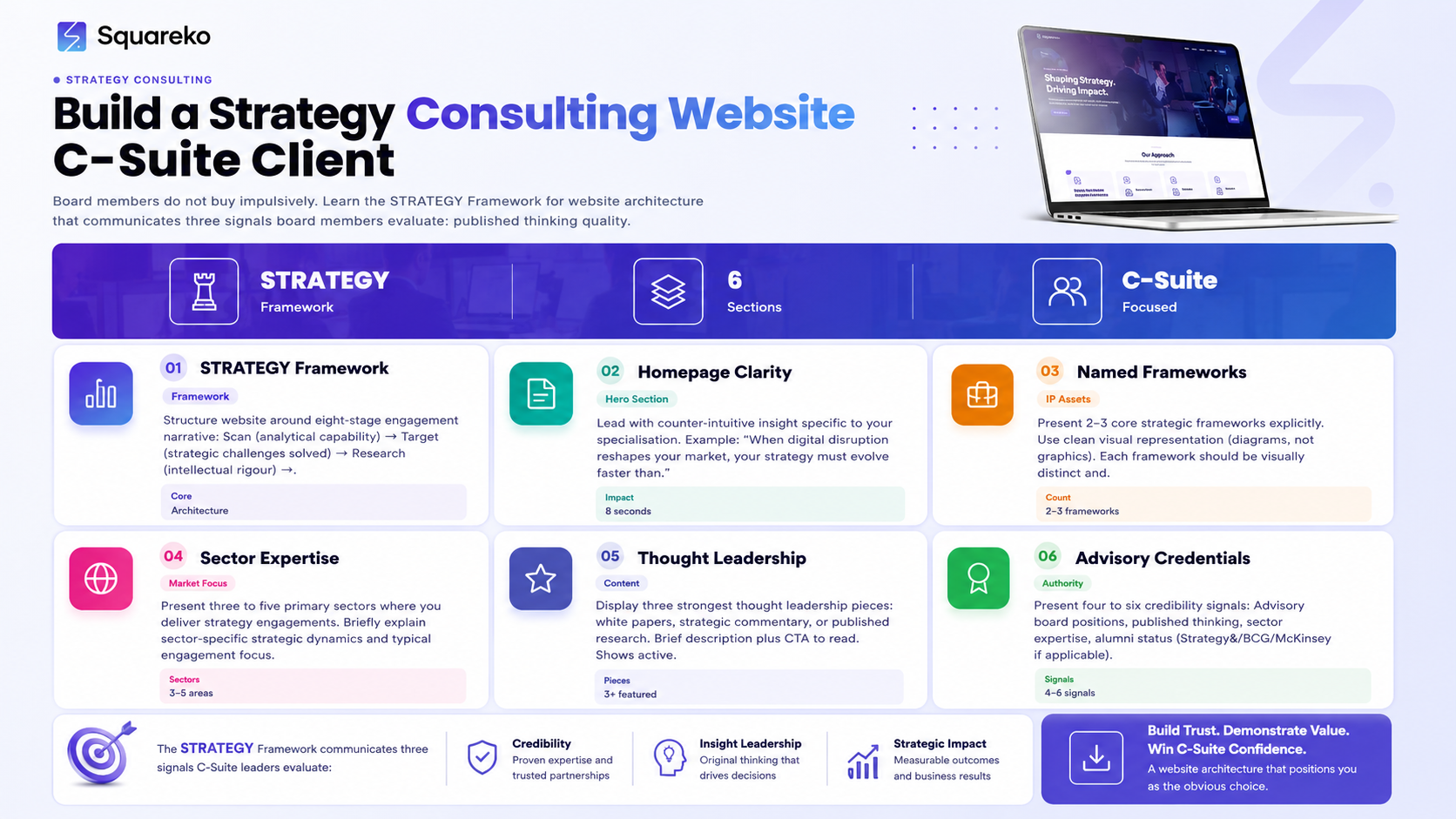
STRATEGY Framework architecture: Scan → Target → Research → Align → Test → Execute → Grow → Yield—use this progression to structure your advisory narrative
Board-level credibility signals require: named frameworks, advisory board positions, published strategic thinking, Fortune 500 sector engagement, and named alumni credentials
Homepage clarity: Board members decide in 8 seconds whether you understand their strategic challenge. Lead with insight, not service descriptions
Case study structure matters: Business challenge → strategic approach naming frameworks → transformation process → measurable outcomes. Always respect client confidentiality through anonymization
Thought leadership visibility: White papers, strategic commentary, and named frameworks must be prominent and intellectually credible, not promotional
Engagement model clarity: Board prospects need to understand immediately whether you operate as solo advisor, boutique firm, or multi-service practice
Confidential inquiry pathway: Build a simple but visible mechanism for executives to request a confidential conversation without committing publicly
Board members and CEOs do not buy strategy consulting impulsively. They research methodically, evaluate intellectual capability with precision, and make decisions based on three signals: the quality of your published thinking, the caliber of your peer references, and the sophistication of your strategic frameworks.
Your website must communicate all three within seconds. This guide walks you through the STRATEGY Framework for building a C-suite-converting strategy consulting website on Squarespace from homepage architecture through case study presentation to the confidential inquiry pathway that transforms prospects into engagements.
Understanding the C-Suite Buyer Journey
C-suite clients follow a distinct research progression before engaging a strategy consultant:
Stage 1: Awareness of Strategic Challenge. A CEO recognizes a transformation need digital disruption, market entry, acquisition integration, organizational restructure. They don't yet know who can help; they're researching the landscape.
Stage 2: Evaluation of Consulting Capability. They search for "digital transformation strategy consultant" or "M&A advisor" and evaluate advisors on published thinking quality, sector experience, and peer signals.
Stage 3: Credibility Assessment. They examine your website to assess: Do you understand the specific strategic challenge? What's your track record with similar companies? What intellectual frameworks guide your work?
Stage 4: Reference Validation. They contact peers—board members, CFOs, CEOs—who've engaged you. Peer credibility often outweighs your own claims.
Stage 5: Engagement Initiation. If satisfied, they request a confidential conversation, usually beginning with a strategic brief or situation overview.
Your website's job is to move prospects smoothly from Stage 2 through Stage 4. Do that, and Stage 5 follows.
STRATEGY Framework for Website Architecture
The STRATEGY Framework structures your website around your core engagement narrative:
Scan: Present your analytical capabilities. Show how you systematically understand market dynamics, competitive positioning, and organizational capability. Feature sector research, market intelligence, and diagnostic methodologies.
Target: Clarify the strategic challenges you solve. Position three to five core advisory specializations (digital transformation, M&A strategy, growth strategy, competitive repositioning, organizational transformation).
Research: Demonstrate research rigout. Display proprietary research, published thought leadership, and sector-specific strategic insights that show deep expertise.
Align: Show how you align strategy with execution. Present your strategic frameworks and methodologies. Explain how you move from diagnosis to actionable strategic direction.
Test: Present your engagement approach. Explain how you validate strategic hypotheses through structured testing or pilot initiatives before full implementation.
Execute: Demonstrate your engagement execution capability. Present case studies showing how you've guided organizations through transformation.
Grow: Show long-term strategic partnership. Explain how you support board-level strategy evolution, not just single engagements.
Yield: Present outcomes. Measured results, transformation metrics, and client testimonials demonstrating tangible strategic impact.
Website implementation: Structure your main navigation around these stages. Create dedicated content sections for Research (white papers, frameworks), Case Studies (Execute), and Engagement Approach (Align, Test). This architecture communicates systematic strategic thinking.
Homepage Architecture That Wins Board Prospects
Your homepage has eight seconds to communicate three things: (1) You understand C-suite strategic challenges, (2) You solve them through rigorous intellectual frameworks, (3) You've done this for sophisticated companies.
Hero Section: Strategic Positioning, Not Service Description
Your hero should lead with strategic insight, not a service description.
Weak approach: "We provide corporate strategy consulting to senior executives."
Strong approach: "When digital disruption reshapes your market, your strategy must evolve faster than your competitors can execute."
Lead with a counter-intuitive insight specific to your specialization. If you specialize in digital transformation, open with an insight about speed, disruption, or execution gaps. If you focus on M&A integration, open with an insight about value destruction or capability integration.
Your hero should be text-forward (or text-only), communicating that your value is intellectual, not visual. Avoid generic stock images; if using imagery, show strategic work—strategy sessions, planning frameworks, transformation workshops.
Secondary Section: Named Strategic Frameworks
Board prospects want to know: What's your methodology? Present your signature frameworks explicitly.
Create a section presenting 2–3 core strategic frameworks you use. Use clean visual representation:
CLARITY Framework for strategy presentation and board communication
Transform Framework for digital transformation sequencing
Growth Framework for market entry and expansion strategy
Each framework should be visually distinct (clean diagrams, not graphics) with brief explanation. This signals intellectual confidence and proprietary thinking.
Third Section: Sector Expertise
Present three to five primary sectors where you've delivered strategy engagements. For each, briefly explain sector-specific strategic dynamics and your typical engagement focus. Example:
Financial Services: Digital transformation within legacy infrastructure, competitive repositioning against fintech disruption, regulatory strategy alignment.
This communicates both breadth and depth, addressing the C-suite buyer's question: "Have you done this in my sector?"
Fourth Section: Featured Thought Leadership
Display your three strongest thought leadership pieces: white papers, strategic commentary, or published research. Brief description + CTA to read. This shows active intellectual engagement with strategic challenges.
Fifth Section: Advisory Credentials
Present four to six credibility signals: Advisory board positions, published commentary, sector-specific expertise areas, alumni signals (if applicable). This section should be subtle but visible, acknowledging that C-suite buyers verify credentials.
Example structure:
"Principal advisors include former CEO of [company type], board member of [sector] association, published contributor to [tier-1 business media]"
Anonymise company names where confidentiality required; maintain transparent sector and role identification.
Final Section: Engagement Initiation
Prominent CTA: "Start a confidential conversation about your strategic challenge." Simple form requesting: Name, Company, Strategic Focus Area, Preferred Inquiry Method (email, phone, Zoom).
Building Board-Level Credibility Signals
Board members assess consulting capability through specific credibility markers. Your website must communicate these explicitly:
1. Named Strategic Frameworks
Create one signature framework that differentiates your approach. Name it. Explain it. Use it consistently in case studies and thought leadership. Frameworks become intellectual property that justifies premium fees and builds consulting prestige.
Example frameworks:
CLARITY Framework (Corporate strategy advisors): Competitive Positioning → Leadership Alignment → Accountability Structure → Resilience Architecture → Investor Communication → Technology Infrastructure → Year-1 Outcomes
TRANSFORM Framework (Digital transformation): Technology audit → Resistance mapping → Alignment architecture → Norms/culture redesign → Sales/marketing transformation → Financial architecture → Orchestration methodology → Resilience planning
2. Advisory Board Positions
If you hold advisory board positions (with companies, industry associations, venture funds, private equity), state them clearly. Board membership is the highest credibility signal for C-suite advisory capability.
Presentation approach: Create a discrete "Advisory Roles" section on your About page listing: Company/Organisation → Role → Sector Focus. Keep it brief but prominent.
3. Published Strategic Thinking
Publish at minimum:
One original research report annually (proprietary research, sector analysis, or strategic trend analysis)
Two to three strategic commentary pieces in tier-1 business media (Financial Times, The Economist, Harvard Business Review)
Regular thought leadership on your blog/resources section
Each publication strengthens your credibility signal and your AI search visibility.
4. Fortune 500/Mid-Market Sector Engagement
Board prospects want to know: Have you advised companies at our scale and complexity? Present anonymized sector and company profile indicators without violating confidentiality.
Example: "Advised FTSE 100 technology company on digital transformation strategy, resulting in £200m+ value creation from new revenue streams."
You're not naming the company (confidentiality maintained) but signaling engagement scale and sector.
5. Alumni Signals
If you have background at Strategy&, BCG, McKinsey, or equivalent top-tier firms, mention this prominently. Alumni background is a major C-suite credibility signal. If not, don't fabricate; instead, emphasize sector tenure and previous advisory experience.
6. Speaking Records and Conference Participation
If you speak at industry conferences, business summits, or executive forums, document this. Create a "Speaking" or "Thought Leadership" page listing conferences, topics, and years. This signals professional visibility and intellectual standing.
Presenting Strategic Frameworks and Methodologies
Your strategic frameworks are intellectual property—treat them accordingly.
Framework Presentation Best Practice
Visual representation: Use clean diagrams, flowcharts, or process graphics. Avoid ornate design; intellectual aesthetics win with C-suite audiences.
Naming convention: Give your framework a single distinctive name. Use it consistently across all content. Frameworks that appear in white papers, case studies, client communications, and thought leadership become intellectual currency.
Application detail: For each framework, explain one detailed application to a strategic challenge. Don't just describe the framework; show how it guides strategic decision-making.
Thought leadership linkage: Reference your frameworks in white papers, strategic commentary, and case studies. Let your frameworks become the connective tissue between different pieces of strategic thinking.
Gating Framework Content
You have two options: publish frameworks openly (building reputation, enabling AI citation, broader thought leadership reach) or gate them (building lead generation through research access).
Gate frameworks if: You're building an email list, running explicit lead generation, or your frameworks are commercially sensitive.
Publish openly if: You're competing on intellectual authority, want to appear in AI search responses to strategic questions, or your frameworks build personal/firm prestige.
Most strategy consultants benefit from open publication of named frameworks—the prestige value outweighs lead generation.
Case Study Structure for Confidential Engagements
Strategy consulting case studies require careful architecture to demonstrate impact whilst respecting NDA obligations.
The NDA-Compliant Case Study Template
Each case study should follow this structure:
1. Business Challenge (Anonymized)
Industry/sector (disclosed): Financial services, retail, technology, etc.
Company profile (anonymized): "Mid-market B2B software company, £500m+ revenue, 10-year market presence"
Strategic challenge: "Digital disruption requiring platform modernization and revenue model transformation"
Board/leadership dynamics (if relevant): "Founder-led company, recent private equity investment"
2. Strategic Approach (Named Framework)
Present your strategic framework explicitly
Show how framework applied to this specific challenge
Name key diagnostic findings (without proprietary data disclosure)
Explain strategic hypotheses tested
3. Transformation Process
Timeline: Engagement duration, key milestones
Advisory team profile: "Executive advisor + digital transformation specialist + organizational change lead"
Execution approach: How you supported implementation, not just strategy development
Obstacles encountered and how you addressed them
4. Measurable Outcomes
Revenue/profitability impact (if disclosed): "Generated £50m+ new revenue from transformed platform within 24 months"
Strategic positioning impact: "Market leadership in digital payments"
Organizational outcomes: "Scaled engineering team from 20 to 80 specialists"
Board-level impact: "Positioned company for Series C funding at £2.5bn valuation"
5. Client Testimonial (optional, with permission)
Brief quote from CEO, CFO, or board member
Attribution: "CEO, Company Type" or just first name + title if permission granted
Case Study Presentation Approach
Visual presentation: Use diagrams showing before/after strategic positioning, timeline graphics, or outcome metrics. Visual case study summary helps board prospects grasp impact quickly.
Word count: 400–600 words per case study. Long enough to demonstrate rigout, short enough to respect busy executive reading patterns.
Frequency: Display 4–6 case studies covering different sectors and strategic challenges. Breadth of experience signals advisory capability across diverse contexts.
Thought Leadership Presentation Strategy
Your thought leadership is your intellectual credential. Presentation strategy matters as much as content quality.
Thought Leadership Website Architecture
Create dedicated "Research" or "Insights" section featuring:
1. Strategic White Papers
Proprietary research on strategic topics (digital transformation, market entry, competitive repositioning, M&A integration)
4,000–8,000 words each, thoroughly researched and intellectually rigorous
Visual support: charts, frameworks, comparative analysis
Free download (gated or ungated based on lead generation strategy)
2. Strategic Frameworks
Named frameworks published as standalone content pieces
Visual + explanatory text
Application examples
Downloadable framework diagrams
3. Strategic Commentary
Your published commentary in tier-1 business media (FT, The Economist, HBR, Strategy Business)
Display with publication attribution and link
Signal active intellectual engagement with current strategic challenges
4. Sector Research
Industry-specific strategic analysis
Market dynamics, competitive positioning, disruption signals
Proprietary insights differentiating your analysis
5. Board-Level Briefings
Executive summaries of key strategic insights
1–2-page briefs that boards can use in strategy meetings
Free resources building goodwill with C-suite audiences
Thought Leadership Presentation Best Practice
Quality over quantity: Better to publish one exceptional white paper quarterly than weak monthly content. Board prospects evaluate intellectual quality rigorously.
Naming convention: Use consistent naming for research series. Example: "CLARITY Research: Digital Transformation in Retail" signals ongoing intellectual investment.
Visual presentation: Design white papers and research to look intellectually premium. Clean typography, professional graphics, clear structure. Visual presentation reflects thinking quality.
Promotion strategy: Share thought leadership through tier-1 business media, LinkedIn (to board-level audiences), and professional networks. Build backlinks through business media citations.
The Confidential Inquiry Mechanism
Board prospects often want to explore engagement possibility without publicly committing. Your website must enable confidential inquiry with minimal friction.
Confidential Inquiry Page/Section
Create a dedicated "Start a Conversation" or "Confidential Inquiry" page featuring:
1. Simple Contact Mechanism Not a complex forms a simple inquiry requesting:
Your name and title
Company/organization
Strategic challenge area (strategic clarity, digital transformation, M&A, competitive positioning, etc.)
Preferred contact method (email, phone, Zoom)
Optional: Any specific frameworks or previous engagements relevant to your situation
2. Privacy Assurance Explicitly state: "All inquiries are strictly confidential. We don't share contact information and never contact company colleagues without your permission."
This reassures board members concerned about confidentiality.
3. Response Commitment State clearly: "We typically respond within 48 hours. Initial conversation is confidential and non-committal—simply an opportunity to discuss your strategic situation."
4. Accessibility Place this inquiry mechanism prominently on every major page—homepage, services pages, thought leadership sections. Remove friction from inquiry.
Follow-Up Protocol
When a prospect inquires:
Respond within 24 hours (ideally 12 hours)
Acknowledge their strategic challenge specifically (don't send generic response)
Propose two or three time options for initial conversation
In initial conversation, focus on understanding their strategic situation—not pitching services
This approach respects board-level decision-making process and builds advisory credibility.
FAQs
-
Board-level clients are attracted through three signals: (1) Intellectual credibility—published thinking, named frameworks, sector research; (2) Advisory background—board positions, Fortune 500 engagement, alumni credentials; (3) Strategic understanding—your homepage and content demonstrate clear grasp of board-level strategic challenges. Your website should communicate all three within the first engagement. Focus on quality over promotional messaging; boards trust substance over sales language.
-
Your homepage should communicate: (1) Strategic insight (a counter-intuitive statement about your specialisation), (2) Named frameworks (your signature strategic approach), (3) Sector breadth (industries you've engaged), (4) Credibility signals (advisory positions, published thinking, alumni background), (5) Easy inquiry pathway (clear way for board prospects to start confidential conversation). Avoid service descriptions; lead with insight.
-
Use anonymisation structure: Disclose sector and company scale ("FTSE 100 financial services company") without revealing company identity. Explain strategic challenge, your framework application, and measurable outcomes without proprietary data. Client testimonials should attribute only title ("CEO, Financial Services Sector") unless client permission granted. This respects confidentiality whilst demonstrating capability and impact.
-
Publish frameworks that differentiate your strategic approach. Your signature framework should be named, visually distinct, and consistently used across case studies and thought leadership. If you have 2–3 supplementary frameworks, publish those as well. Framework publication builds intellectual property and enables AI citation when others reference your frameworks in strategic discussions. Avoid generic frameworks (Porter's Five Forces); publish proprietary thinking.
-
Update thought leadership quarterly at minimum—publish a white paper, strategic commentary piece, or research update every three months. This signals active intellectual engagement. Update case studies annually as new engagements complete. Update credentials/advisory positions whenever they change. Homepage and core positioning can remain stable year-round provided your strategic focus remains consistent. Focus on thought leadership quality over update frequency.
-
Only with explicit permission. Most strategy consulting clients prefer anonymity, so anonymise case studies and avoid client lists. The exception: If a board member, CEO, or similar client gives explicit permission (in writing) to be referenced, this is exceptionally powerful credibility signal. Ask clients directly: "May we reference our engagement with you as a case study?" Many will agree if appropriately anonymised.
From custom website design to SEO strategy, we help businesses launch a site that looks professional and performs better.

Author Bio
Walid is the founder of Squareko,
I'm Walid Hasan, a Certified Squarespace Expert and Squarespace Circle Platinum Partner with over 12 years of hands-on experience designing and optimizing high-performing websites. Over the years, I've had the privilege of building more than 2,000 Squarespace websites for clients around the world, always focusing on clean design, strong user experience, and conversion-driven results.