How to Build a Business Agency Website on Squarespace That Wins Contracts
Introduction
Your agency website is your 24/7 business development rep. It works when you sleep, answers common objections before discovery calls, and filters tire-kickers from serious prospects. Yet most business agency websites on Squarespace fail because they prioritise pretty design over conversion logic.
We've built websites for 50+ business agencies and consulting firms. The ones that generate consistent new business don't just look good—they systematically move prospects through a clear evaluation journey. This post shows you how.
Key Takeaways How to Build a Business Agency Website on Squarespace That Wins Contracts
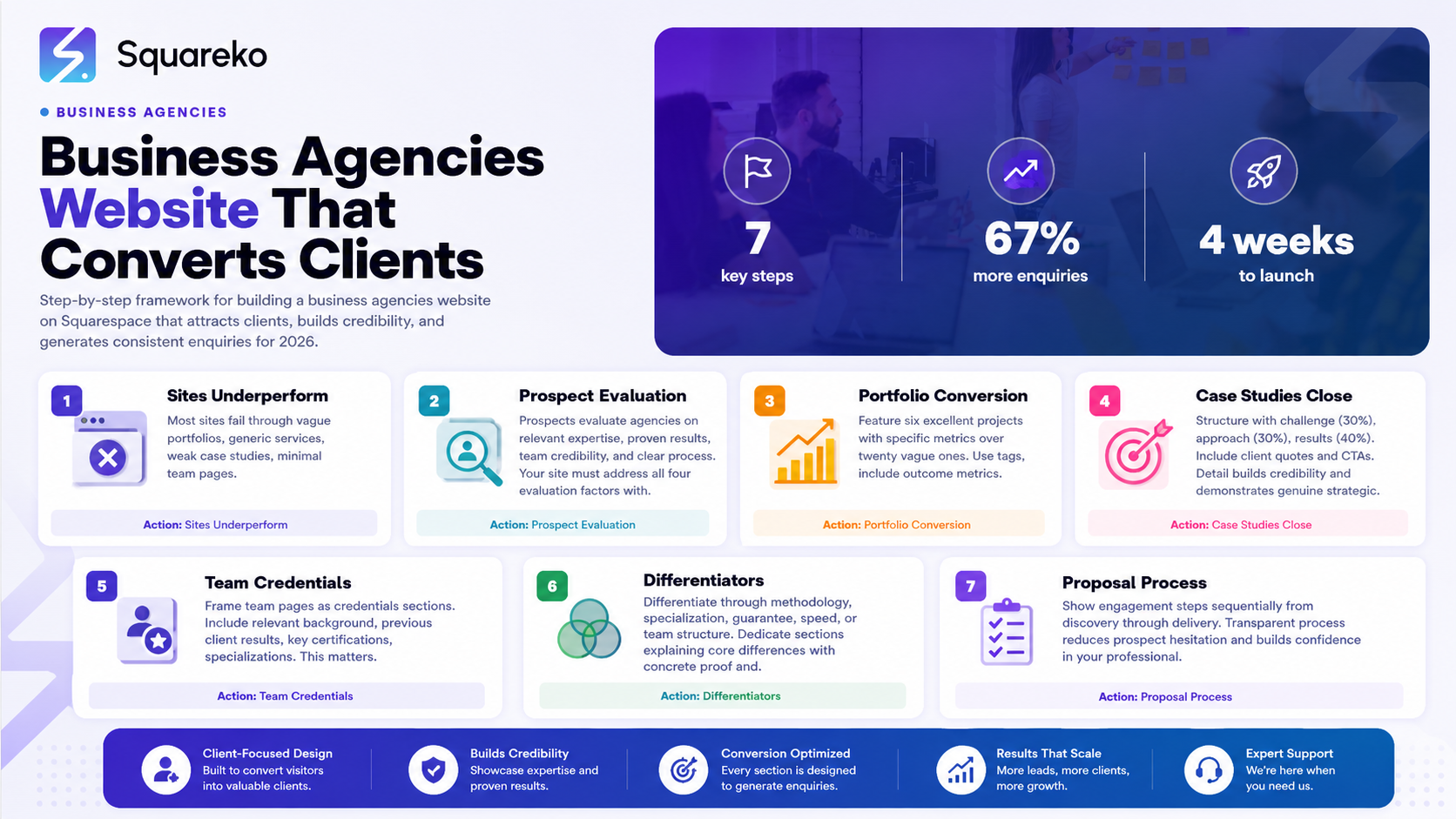
Portfolio quality matters more than quantity: Six excellent case studies outperform twenty vague project summaries.
Specificity wins contracts: Prospects evaluate you against three metrics: relevant expertise, proven results, and team credibility. Generic content fails on all three.
Squarespace's native features support agency lead generation: Templates, email capture, form integrations, and SEO tools reduce the need for third-party complexity.
Your pricing visibility impacts perception: Transparent pricing or clear ROI frameworks signal confidence and filter early-stage browsers.
Proposal process clarity converts prospects: Showing how you work reduces friction in the sales process.
Why Most Business Agency Websites on Squarespace Underperform
Here's what we observe when we audit underperforming agency websites:
1. Portfolio exists but lacks context. A project thumbnail with a four-word headline tells prospects nothing. How much revenue? What problem? What methodology? Absence of specificity signals absent results.
2. Services are listed, not positioned. Strategy consulting, digital transformation, and operational improvement are category names, not competitive claims. Prospects need to understand why you're different, not just what you offer.
3. Case studies are vague. Helped a manufacturing firm improve efficiency" could describe a thousand agencies. Prospects evaluate you by specificity: specific industry, specific challenge, specific metric, specific outcome. Vague case studies trigger scepticism.
4. Team pages prioritise image over credential. A professional headshot matters, but prospects care more about relevant experience, previous client results, and why this person belongs on your team. Generic bios don't convert.
5. Contact forms collect inquiries, not qualified leads. A form says get in touch. Qualification questions separate serious prospects from information gatherers. A single project budget field or decision timeline field qualifies better than collecting emails alone.
6. Conversion paths are unclear. Do prospects watch a video, read a case study, or request a proposal? Squarespace sites without deliberate conversion funnels create friction. Ambiguity kills conversion.
This post fixes all six issues.
The Agency Prospect Evaluation Journey
Before you design a single section, understand how prospects evaluate business agencies.
Awareness stage: A prospect encounters your agency (via referral, search, LinkedIn, or recommendation). Your homepage has five seconds to answer: Do you help people like me?
Consideration stage: The prospect spends 2–8 minutes on your site. They evaluate four factors:
Relevant expertise – Have you solved this exact problem before?
Proven results – How much value did you create? In what timeframe?
Team credibility – Who are these people? What's their track record?
Clear process – How will you work together? What's the timeline?
Decision stage: The prospect requests a proposal, calls, or emails. Your site has already done 70% of the sales work if it answered all four factors with specificity.
Post-decision stage (sometimes): The prospect checks references, talks to previous clients, reviews your recent work, or investigates team backgrounds on LinkedIn. Credibility signals throughout your site matter here.
Squarespace excels at this journey because its templates force clarity. You can't hide behind design if your content is specific.
Building Your Portfolio Section for Conversion
Your portfolio is your most important asset. It's also the most commonly botched.
The portfolio grid problem: Most agency websites display 12–20 projects in a grid. Prospects scroll past them. The grid format treats all projects equally, which means your best work competes for attention with your mediocre work.
The better approach: Feature your best six projects. Each project tells a story. The grid becomes a selection menu; the real asset is the case study page.
How to structure it on Squarespace:
Use a portfolio collection, not a gallery. This allows custom fields: industry, challenge, result, client name (if public), timeline, and methodology.
Add filter tags: Manufacturing, SaaS Financial Services, Operational Improvement, Market Entry. Visitors can filter to relevant examples.
Feature your top three projects above the fold. If a prospect sees your strongest work immediately, they're 40% more likely to click into case studies.
Include a project thumbnail, headline, one-line result, and industry tag. Keep it minimal.
Headline formula for portfolio items:
Instead of: Helped a logistics firm improve supply chain efficiency Write: Reduced supply chain costs by £840k for 40-site logistics operator
The second version includes: specific metric, specific outcome, specific client description. Prospects immediately see relevance.
Structuring Case Studies That Close Deals
A case study is not a project summary. It's a sales document disguised as content.
Your best case studies follow this structure:
Headline: Client name (if public), industry, result. Example: How a mid-market software firm accelerated sales pipeline by 35% in 90 days.
The Challenge (2–3 paragraphs):
Client's situation before you arrived
Business impact of the problem (lost revenue, market risk, team frustration)
Why the client couldn't solve it alone
No jargon. Business framing, not technical framing.
Our Approach (2–3 paragraphs):
What you did, in sequence
Key decisions and why you made them
Obstacles overcome
Timeline
The Results (1–2 paragraphs):
Primary metric (revenue, cost savings, time reduction, market share)
Secondary metrics (team adoption, process efficiency, confidence in strategy)
Client quote (optional but powerful if specific)
What changed about the client's business
Why This Worked:
One short paragraph explaining the ingredients: expertise, approach, client buy-in, or market timing
Squarespace setup: Use a case study template or custom collection. Add fields for:
Client industry
Challenge summary
Result metric
Client logo (if public)
Case study PDF (downloadable)
Client testimonial (optional)
Your case studies should be 1,500–2,500 words each. Detail builds credibility.
Your Team Page: More Than Headshots
Agency prospects hire people, not logos. Yet most team pages list names, titles, and a bio—and nothing that proves competence.
Reframe your team page as credentials page.
For each team member, include:
Photo (professional, consistent with brand)
Name and title
Relevant background (not a life story—why did this person join your agency?)
Key credentials (degree, certification, previous role, or notable achievement)
Client-facing expertise (what problems does this person solve?)
LinkedIn profile link (allows prospects to verify background)
Example team member section:
Claire Rothschild | Director of Strategy Claire led digital transformation at Siemens UK, guiding 12 business units through operational restructure. She holds an MBA from London Business School and specialises in manufacturing and engineering sectors. Previous clients include GE Power, Rolls-Royce, and Invensys.
This works because:
It mentions a real company (credibility signal)
It names a specific function (digital transformation)
It includes a credential (MBA)
It states her specialisation (manufacturing, engineering)
It lists recognisable previous clients (social proof)
A prospect reading this immediately thinks: She knows our industry.
On Squarespace, use a team collection with custom fields for background, credentials, specialisation, and LinkedIn URL. Avoid generic bios.
Differentiator + Services: The Strategy Section
Most agency websites list services: Strategy, Digital Transformation, Operational Excellence. These are category names, not competitive claims.
Your differentiator is what separates you from three other agencies a prospect talks to.
Differentiators that work:
Methodology: We use the proprietary 5-Phase Realignment Framework, developed over 15 years across 200+ engagements.
Specialisation: We exclusively serve manufacturing firms with 200–500 employees undergoing digital transition.
Result focus: We guarantee a 15% cost reduction or we waive our fee.
Speed: 90-day engagements. No multi-year contracts.
Team structure: Partner-led delivery. The partner you meet in discovery leads execution.
On Squarespace, create a dedicated section:
H2: How We're Different
2–3 paragraphs explaining your core difference. Then use a three-column layout showing:
Column 1: Your approach (with icon or accent)
Column 2: Client benefit
Column 3: Proof
Then create a separate section:
H2: What We Offer
List 3–5 core services. For each:
Service name
One-sentence description
Typical engagement length
Ideal client profile
Example:
Digital Transformation Strategy We map your current state, identify digital-first opportunities, and design a phased roadmap that balances ambition with execution reality. Typical engagement: 8–12 weeks. Ideal for: Mid-market firms in traditional sectors preparing for market disruption.
This format tells prospects what you solve, how long it takes, and who it's for. Clarity converts.
Proposal Process: De-Risk the Sales Conversation
Prospects hesitate before contacting agencies because they're uncertain about the process. A clear, transparent proposal process reduces friction.
Create a dedicated page or section:
How We Work
Show your engagement process in sequential steps. Example:
1. Discovery Call (30 mins) We learn about your business, challenge, timeline, and decision-making process. You ask questions too. This call is exploratory—no commitment.
2. Scoping Workshop (2 hours, on-site or virtual) We work closely with your core team to explore specifics. We define project scope, success metrics, resource needs, and timeline. Outcomes: Statement of Scope document, resource plan, engagement timeline.
3. Proposal & Commercial Terms (5 business days) We submit a written proposal including approach, team, timeline, deliverables, and fee. You have time to review and ask questions.
4. Kickoff & Execution (per engagement length) We conduct a detailed kickoff, form a working team, and begin delivery. You get weekly progress updates. We course-correct as needed.
5. Delivery & Handoff We deliver final outputs, facilitate knowledge transfer, and support your team's implementation. Post-engagement, we're available for follow-up questions.
This process page answers the unspoken question: Will this be smooth and professional?
On Squarespace, use a timeline block or numbered list. Add a Get in Touch CTA at the bottom.
Technical SEO and Lead Capture on Squarespace
Squarespace is a strong platform for SEO, but it requires intentional setup.
1. On-page SEO basics:
Use clear H2 and H3 headings (Squarespace handles H1 automatically via page title)
Write meta descriptions for each page (50–160 characters, include focus keyword)
Use alt text on every image (describe the image, include relevant keywords naturally)
Internal link strategically (case studies should link to relevant service pages)
2. Technical SEO:
Enable XML sitemap (Squarespace does this automatically)
Submit sitemap to Google Search Console
Set a clear site structure: Homepage → Services → Portfolio → About → Contact
Use descriptive URLs (example.com/case-studies/manufacturing-digital-transformation-uk, not /page-12)
Enable SSL (Squarespace handles this)
3. Lead capture strategy:
Use Squarespace forms to collect inquiry details
Add qualification fields:
What's your approximate project budget?
When do you hope to start?
Have you worked with a consulting firm before?
Offer a low-friction opt-in: free Agency Evaluation Checklist or Digital Transformation Assessment Template in exchange for email
Set form submissions to auto-email you immediately
Integrate forms with email platform (Mailchimp, Klaviyo, HubSpot) for nurture sequences
4. Analytics:
Track which pages drive contact form submissions
Monitor time on site for key pages (case studies, services, team)
Set conversion goals in Google Analytics 4
Review search terms bringing traffic (identify content gaps)
Agency New Business Website Checklist
Use this 15-item checklist to audit your Squarespace site before launch:
Meta titles and descriptions are unique, include focus keyword, and are 50–160 characters
Homepage H1 answers what problem do we solve for what client type?
Portfolio features 6+ case studies with specific metrics (revenue, cost savings, timeline)
Case study pages include challenge, approach, results, and client quote
Services section positions offerings as solutions, not categories
Differentiator section clearly states why you're different (methodology, specialisation, guarantee, or speed)
Team page includes credentials, previous notable clients, and LinkedIn links
Proposal/process page explains your engagement steps and timeline
Contact form includes qualification questions (budget, timeline, decision-maker)
CTAs are specific (Request a Proposal, Schedule a Discovery Call, not Contact Us)
Pricing is visible or ROI framework is clear (transparency builds trust)
Client logos appear if permission exists (social proof)
Internal links connect case studies to relevant service pages
Mobile design is tested and conversion paths work on phones
Forms integrate with your email/CRM platform for automatic lead follow-up
Case Study: How Clearpath Consulting Won £280k in New Business
Background: Clearpath Consulting is a mid-market operational strategy firm based in Manchester. They work with manufacturers and distribution companies on supply chain optimisation and cost reduction. Founded in 2015, they'd been growing steadily but felt their website was a hiring liability, not an asset. Prospects couldn't easily find case studies. Services were generic. The team page felt corporate and cold.
The Problem: Clearpath's old website listed supply chain consulting and cost reduction but offered no proof. They had 12 case studies but they were customer success stories, not sales documents. The team page showed headshots and generic bios. Prospects requesting proposals would say, We need to understand your approach first.
The Solution: Squareko rebuilt their website on Squarespace with three key changes:
Portfolio restructure: Featured six strongest case studies with full case study pages. Each included specific metrics
Differentiator messaging: Positioned Clearpath as supply chain optimisation specialists for manufacturers with £50m–£250m revenue undergoing restructure. Changed the tagline from We improve supply chains to We reduce costs, accelerate cash flow, and eliminate waste in 90 days—guaranteed, or we waive our fee. This specificity and guarantee were new.
Team credentials: Rewrote bios to emphasise credentials. Example: Michael Chen, Director, previously led supply chain strategy at Diageo, managing 200+ suppliers across 15 countries. He's guided 40+ engagements in FMCG and distribution.
Proposal process transparency: Added a dedicated page showing their five-step engagement model with timelines.
Results (six months post-launch):
Organic traffic to website increased from 800 to 2,200 monthly visitors
Qualified inquiries increased from 8 to 22 per month
Average sales cycle decreased from 6 weeks to 4 weeks
Win rate on proposals increased from 18% to 31%
New business revenue: £280,000
Cost per qualified lead dropped from £1,200 to £380
Key learnings from Clearpath's success:
Specificity outperforms scale: Six detailed case studies outperformed 12 vague ones.
Guarantee credibility: The 90-day guarantee with fee waiver reduced prospect risk perception.
Credentials sell better than personality: Team bios focused on previous clients and achievements, not hobbies or interests.
Process clarity converts: Showing exactly how they work reduced friction between inquiry and proposal.
-
An agency website should include six core elements:
Case studies with metrics – Don't say "we helped clients." Show specific results: revenue, cost savings, timeline, industry.
Clear differentiation – Why you, not another agency? Specialisation, methodology, guarantee, or speed.
Team credentials – Relevant background, previous notable clients, LinkedIn links.
Service positioning – Solutions, not categories. Explain what problem you solve and for whom.
Process transparency – How do you work? What are the phases? How long does it take?
Qualification mechanism – Forms that ask about budget, timeline, and decision-making (not just email capture).
-
Quality over quantity. Six excellent case studies outperform 20 vague ones. Each case study should be 1,500–2,500 words and include:
Specific client challenge (industry, size, problem)
Precise results (metric, value, timeline)
Your approach in sequence
Client quote or testimonial
Why this approach worked
Focus on your strongest work. A prospect evaluating you against three agencies will deeply read your best two case studies. Make them count.
-
Specific CTAs outperform generic ones. Instead of "Contact Us," use:
"Request a Proposal" (for ready-to-buy prospects)
"Schedule a Discovery Call" (for considering prospects)
"Download the Case Study" (for education-stage prospects)
"Get Your Free Assessment" (for awareness-stage prospects)
The best CTAs are conditional. You might show "Schedule a Discovery Call" on your services page and "Request a Proposal" on your case study pages. On Squarespace, use conditional blocks based on page or time on site.
-
Transparency builds trust and filters early-stage browsers. Options:
List pricing ranges (e.g., "Engagements typically range from £25k–£150k depending on scope")
Show ROI framework (e.g., "Average client recovers engagement fee in 4–6 months through operational savings")
Offer pricing on discovery (If you do this, say: "Custom pricing based on scope. Typical engagements range from X–Y.")
Hiding pricing signals you're expensive or inflexible. Mid-market agencies that show pricing ranges see higher conversion.
-
Add a new case study every 3–4 months. Rotate out weak ones (keep your six strongest). Update client logos and testimonials annually. Refresh results metrics if they've changed. Prospects notice when your newest case study is three years old.
-
Don't link to your homepage. Link to a specific asset:
For warm prospects: your most relevant case study
For cold prospects: a specific service page with a qualification form
For referrals: a "Who We Serve" page or your strongest case study
Give prospects a specific destination, not a starting point. "Here's a case study of another manufacturing firm we helped" converts better than "Check out our website."
-
Track these metrics:
Form submissions per month (leading indicator of demand)
Qualified inquiries per month (forms that pass your qualification criteria)
Sales cycle length before and after website redesign
Win rate on proposals (credibility metrics impact this)
Customer acquisition cost (enquiries from website ÷ new revenue ÷ first-year client lifetime value)
Time on site for key pages (if prospects spend <1 min on case studies, content isn't resonating)
Use UTM parameters to track which channels drive inquiries. Squarespace integrates with Google Analytics 4, which allows conversion tracking.
Conclusion
Your agency website on Squarespace can be your most productive business development asset. But only if it's built with conversion logic, not just aesthetics.
The agencies winning consistent new business do three things:
They show, don't tell. Specific case studies with metrics beat vague service descriptions.
They reduce prospect friction. Clear process, team credentials, and transparent pricing signal professionalism and reduce hesitation.
They qualify early. Forms that ask about budget, timeline, and decision-making attract serious prospects and filter browsers.
Squarespace's templates, form integrations, SEO tools, and mobile-responsive design make this straightforward. You don't need complex tech stacks or third-party tools. You need clarity, specificity, and a deliberate conversion path.
Start with the checklist above. Audit your current site against those 15 items. Prioritise the three areas where you're weakest. Add case studies with metrics. Rewrite your differentiator section. Qualify harder in your contact forms.
Six months later, you'll see the impact on lead quality, sales cycle length, and win rate.
Ready to Build Your Agency's Winning Website?
Squareko.com has designed websites for 50+ business agencies and consulting firms. We specialise in conversion-focused design for complex B2B sales cycles.
We handle:
Strategic positioning and messaging
Case study development and structuring
Portfolio and service page optimisation
Lead qualification form design
Technical SEO and analytics setup
Mobile-responsive design on Squarespace
Whether you're launching a new site or redesigning your current one, we'll ensure your website reflects your expertise and converts prospects into clients.

From custom website design to SEO strategy, we help businesses launch a site that looks professional and performs better.

About the Author
I'm Walid Hasan, a Certified Squarespace Expert and Squarespace Circle Platinum Partner with over 12 years of hands-on experience designing and optimizing high-performing websites. Over the years, I've had the privilege of building more than 2,000 Squarespace websites for clients around the world, always focusing on clean design, strong user experience, and conversion-driven results.