How Strategy Consultants Present Competitive Intelligence and Market Analysis on Squarespace
Key Takeaways For How Strategy Consultants Present Competitive Intelligence and Market Analysis on Squarespace
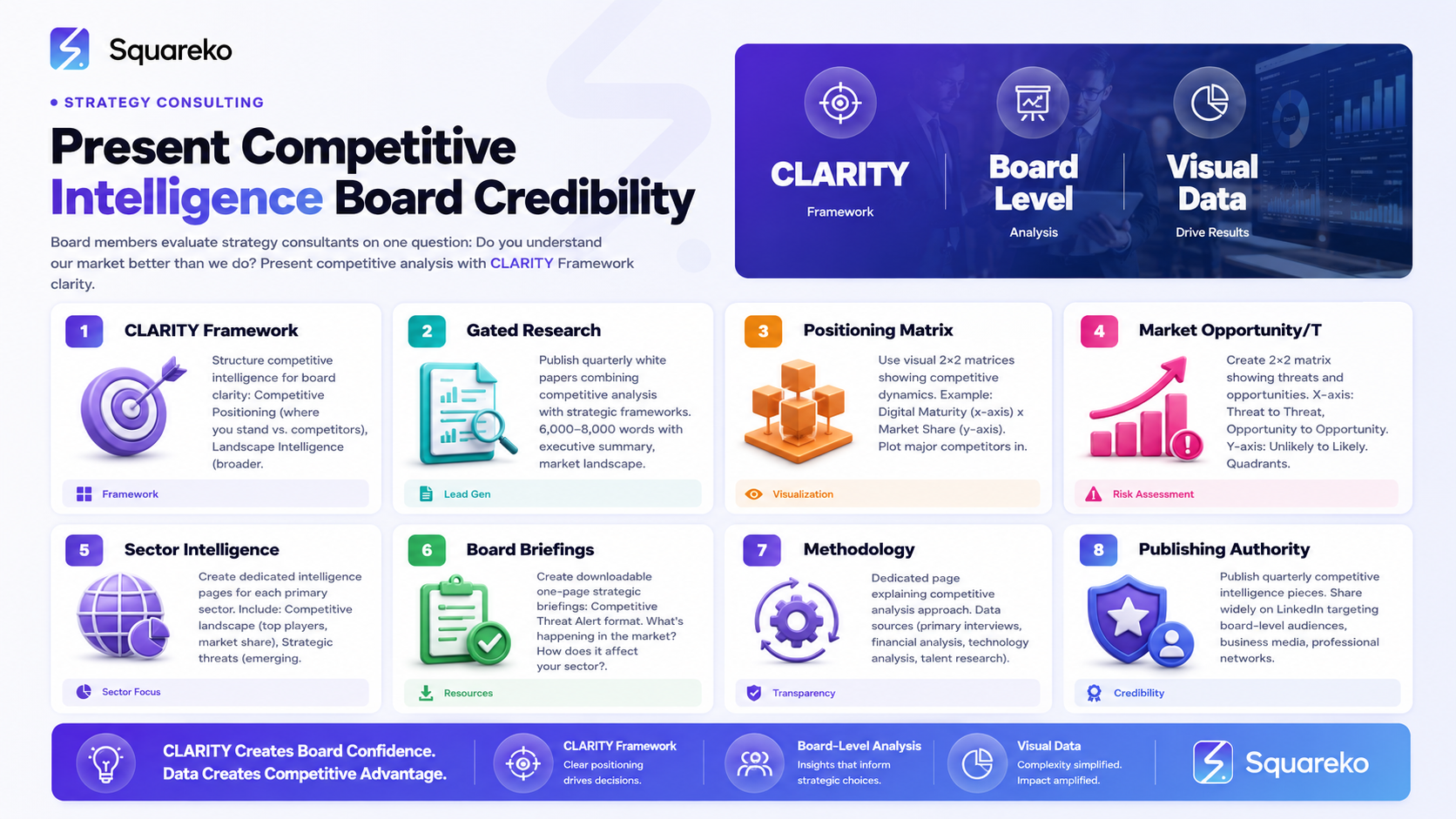
CLARITY Framework for strategic analysis: Competitive positioning → Landscape intelligence → Assumption validation → Recommendation clarity → Insight novelty → Tactical alignment → Year-1 outcomes
Gated research white papers: Publish detailed competitive intelligence as gated downloads capturing executive contact details for lead generation.
Board-level presentation resources: Create downloadable strategy briefings, competitive comparison charts, and sector-specific intelligence reports positioned as board resources.
Competitive methodology visibility: Explain your competitive analysis methodology explicitly; boards want to understand how you identify opportunities and threats.
Sector-specific intelligence pages: Create dedicated intelligence sections for each primary sector showing market dynamics, competitive threats, and strategic implications
Visual competitive analysis: Use charts, matrices, and comparative visuals to communicate complex competitive positioning clearly
Publication integration: Link published strategic commentary and business media content that demonstrates competitive market understanding
Competitive intelligence is your primary intellectual asset. A board member evaluating your advisory capability looks at one question first: Do you understand our market better than we do? Your ability to present competitive analysis with clarity, precision, and insight directly determines C-suite credibility.
Most strategy consultants bury competitive analysis in lengthy reports. Instead, your Squarespace website should prominently display strategic market intelligence using the CLARITY Framework—making complex competitive analysis immediately understandable to busy executives. This guide covers presentation strategy, methodology visibility, and board-level analysis structures that communicate exceptional strategic thinking.
Understanding Board-Level Competitive Intelligence
Board members evaluate competitive strategy consultants on a single criterion: Do they understand our market better than we do? This requires presenting intelligence that is:
Original: Not recycled third-party market research or consultant boilerplate. Board members want your independent analysis and proprietary insights.
Timely: Current market dynamics, recent competitive moves, emerging threats—not historical data. Markets evolve quickly; your competitive intelligence must reflect current conditions.
Actionable: Intelligence oriented toward decision-making. What should the board do as a result of this competitive understanding?
Sector-specific: Generic competitive analysis carries no weight. Your intelligence must demonstrate deep sector expertise—knowing the specific companies, market dynamics, and competitive threats unique to their industry.
Confidential: Intelligence that competitors don't have access to. This might be proprietary research, primary interviews, or analysis based on your engagement experience across multiple companies in the sector.
Your website must communicate that you deliver this calibre of competitive intelligence. Most strategy consultants fail to showcase intelligence quality prominently.
CLARITY Framework for Strategic Analysis Presentation
The CLARITY Framework structures competitive intelligence for board-level clarity:
C — Competitive Positioning: Where does your client stand relative to primary competitors? Visual positioning matrix showing competitive dynamics clearly.
L — Landscape Intelligence: What are the broader market dynamics shaping competition? Market growth, consolidation trends, technology disruption, regulatory shifts.
A — Assumption Validation: What are the key assumptions underlying competitive positioning? Which are valid? Which are changing?
R — Recommendation Clarity: Based on competitive analysis, what should the board do? Specific, actionable strategic recommendations.
I — Insight Novelty: What insight do you bring that the client doesn't already possess? The intelligence that justifies the engagement.
T — Tactical Alignment: How does competitive strategy align with execution capability? Is strategy realistic given organisational capabilities?
Y — Year-1 Outcomes: What should success look like in year one? Measurable competitive positioning improvements, market share gains, customer acquisition, etc.
Implementing CLARITY Framework on Your Website
Create a dedicated "Our Approach" or "Methodology" page that explicitly references the CLARITY Framework. Explain each element briefly with a competitive intelligence example. Show how this framework guides your engagements.
Better yet, reference CLARITY Framework consistently in case studies and white papers, demonstrating the framework applied to real competitive situations.
Competitive Intelligence Content Architecture
Structure your website to display competitive intelligence prominently:
Homepage Intelligence Section
Include a section on your homepage explicitly addressing competitive intelligence capability. Example:
"Strategic Market Intelligence for Board-Level Decision-Making"
Brief positioning statement:
We provide competitive intelligence and strategic market analysis that helps boards understand market positioning, competitive threats, and growth opportunities with unprecedented clarity. Our analysis combines proprietary sector research, primary executive interviews, and quantitative competitive benchmarking.
Link to featured competitive intelligence resources.
Resources/Intelligence Section
Create a dedicated "Strategic Intelligence" or "Market Research" section featuring:
Current Market Intelligence Pieces:
"Financial Services Market Disruption: Regulatory Trends, Technology Threats, and Competitive Opportunities"
"Retail Sector Strategic Outlook: Digital Transformation Acceleration, Consumer Behaviour Shifts, and Competitive Repositioning"
"Technology Sector Competitive Positioning: Market Consolidation, Emerging Competitors, and Strategic Response Frameworks"
Each intelligence piece includes:
Competitive landscape analysis with visual positioning matrix
Market dynamic explanation with data/evidence
Specific competitive threats and opportunities
Strategic implications for companies operating in that sector
Sector-Specific Intelligence Pages
Create dedicated intelligence pages for each primary sector. Structure each with:
Market Overview: Current market size, growth rate, key segments, competitive dynamics
Competitive Positioning: Primary competitors, competitive differentiation points, market share analysis
Strategic Threats: Emerging competitors, technology disruption, regulatory threats, customer consolidation
Strategic Opportunities: Market segments experiencing growth, adjacent market entry opportunities, consolidation targets
Competitive Response Frameworks: Typical strategic responses to competitive pressure in that sector, how leading companies are repositioning
Gated Research White Papers Strategy
Gated white papers are your primary lead generation mechanism whilst building competitive intelligence authority.
White Paper Architecture for Competitive Intelligence
Create quarterly white papers combining competitive analysis with strategic frameworks:
Q1 White Paper Example:
Title: "Digital Transformation Strategy in Financial Services: Market Disruption, Competitive Response, and Board-Level Strategic Implications"
Length: 6,000–8,000 words
Structure:
Executive summary (1 page): Key competitive disruptions and strategic imperatives
Market landscape (2 pages): Digital disruption trends, competitive dynamics, regulatory response
Competitor analysis (3 pages): How leading banks are responding to digital threats, competitive positioning changes
Strategic frameworks (2 pages): How to evaluate digital transformation strategy, decision frameworks for boards
Implementation roadmap (1 page): Year-1 priorities and success metrics
White Paper Promotion Strategy
Gated download: Capture name, email, company, title in exchange for PDF access
Organic ranking: White papers rank for long-tail competitive intelligence keywords
Media promotion: Share through LinkedIn (targeting board-level audiences), business media, professional networks
Case study linkage: Reference white paper research in case studies and service pages
Creating Authority Through Original Research
Commission original research that competitors cannot claim:
Research ideas:
Annual competitive intelligence study surveying 150+ company boards on competitive concerns
Sector benchmarking study: "How FTSE 100 Financial Services Companies Are Responding to Digital Disruption"
Technology adoption study: "AI Implementation Strategies in Sector: A Competitive Benchmark"
Original research generates press coverage, business media citations, and profound authority signals that you understand your market at depth.
Board-Level Intelligence Briefings
Create downloadable strategic briefings designed for board-level consumption.
One-Page Strategic Briefing Template
Competitive Threat Alert: [Sector] [Specific Threat]
Format:
The Threat: What's happening in the market? What's the specific competitive or market development?
Impact on [Your Sector]: How does this threat specifically affect companies operating in your sector?
Competitive Response: How are leading competitors responding? What strategic moves are underway?
Board-Level Implications: What should boards do? What decisions require attention?
Action Items: Specific next steps for board consideration
Examples:
"Competitive Threat Alert: Rising Private Equity Consolidation in Retail Distribution"
"Market Opportunity Alert: AI Adoption Trends Creating Competitive Differentiation in Financial Services"
"Regulatory Threat Alert: ESG Regulation Evolution Reshaping Competitive Dynamics in Energy"
Quarterly Intelligence Digest
Create a quarterly "Competitive Intelligence Digest" summarising major market developments, competitive moves, and strategic implications. Make it free and downloadable.
Structure:
Executive summary (1 page)
Market developments (3 pages)
Competitive moves (3 pages)
Strategic implications and board-level considerations (2 pages)
This positions you as an active, current observer of market dynamics—precisely what board members seek in a strategic advisor.
Competitive Methodology Presentation
Board members want to understand how you conduct competitive intelligence. Transparency about methodology builds credibility.
Methodology Page Structure
Create a dedicated page explaining your competitive analysis approach:
1. Data Sources Explain where you source competitive intelligence:
Primary executive interviews (your engagement network)
Published financial analysis and earnings calls
Technology/product competitive analysis
Customer research and satisfaction data
Employee and talent market research
Technology stack and innovation analysis
Board/investor sentiment (when accessible)
2. Analysis Framework Explain how you structure competitive analysis:
Competitive positioning matrices (market dynamics x strategic capability)
Threat/opportunity identification
Competitive response scenario analysis
Strategic differentiation assessment
Market share and wallet share analysis
3. Intelligence Quality Standards Explain your standards for intelligence credibility:
Primary source preference over secondary analysis
Multiple data source triangulation
Regular intelligence updating (not static analysis)
Sector expert validation
Client feedback integration
4. Confidentiality Protocols Explain how you protect competitive information:
Anonymisation practices (never revealing client-specific information)
Competitor information handling standards
Regulatory compliance (especially antitrust considerations)
Client-specific intelligence segregation
This transparency demonstrates professional rigour and builds trust with board-level prospects.
Sector-Specific Intelligence Pages
Create dedicated intelligence presentation pages for each primary sector.
Financial Services Intelligence Page
Structure:
Competitive landscape (top 10 players, market share)
Digital disruption trends (fintech, embedded finance, regulatory technology)
Competitive positioning matrix (legacy banks vs. emerging fintech)
Strategic threats (emerging competitors, customer defection, regulatory change)
Strategic opportunities (adjacent revenue streams, new customer segments)
Board-level strategic questions (what boards should be asking about competitive positioning)
Visual elements:
Market positioning matrix (incumbents vs. new entrants, traditional vs. digital)
Market growth chart (segment growth rates)
Competitive threat assessment (threat level x likelihood grid)
Technology Sector Intelligence Page
Structure:
Competitive landscape (major players, emerging competitors, market consolidation trends)
Technology disruption analysis (AI, cloud, quantum, new development paradigms)
Product/platform competitive analysis (feature comparison, user adoption, competitive differentiation)
Talent market dynamics (engineering talent concentration, competitive employee value propositions)
Investor/valuation trends (what commands premium valuations in current market)
Board-level strategic implications
Retail Sector Intelligence Page
Structure:
Competitive landscape (traditional retailers, e-commerce, direct-to-consumer)
Consumer behaviour evolution (digital preference, sustainability, convenience)
Distribution channel disruption (omnichannel, direct-to-consumer, marketplace sales)
Competitive positioning (price vs. premium, digital vs. physical, speed vs. sustainability)
Technology competitive advantage (data/personalisation, supply chain visibility, labour efficiency)
M&A activity and consolidation trends
Visual Competitive Analysis on Squarespace
Competitive intelligence is often complex. Visual presentation makes analysis immediately accessible.
Competitive Positioning Matrix
Use Squarespace image blocks or embedded graphics to display competitive positioning matrices:
Example: Digital Maturity x Market Share
Create a 2x2 matrix showing:
X-axis: Digital transformation maturity (low to high)
Y-axis: Market share (low to high)
Quadrants: Industry leaders (high digital, high share), digital challengers (high digital, low share), traditional incumbents (low digital, high share), struggling players (low digital, low share)
Plot major competitors in appropriate quadrants. This single visual communicates significant competitive strategy insight.
Market Opportunity/Threat Matrix
Create a 2x2 matrix showing:
X-axis: Threat/Opportunity (threat to threat, opportunity to opportunity)
Y-axis: Likelihood (unlikely to likely)
Quadrants: Imminent threats (likely, high threat), emerging opportunities (likely, high opportunity), potential risks (unlikely but severe), speculative opportunities (unlikely but transformational if they occur)
Competitive Response Timeline
Use a timeline graphic showing:
Competitive moves over time
Market developments (regulatory changes, technology shifts, consolidation)
Customer behaviour shifts
Your client's strategic response opportunities
Timeline graphics make complex competitive dynamics easy to follow.
Talent/Capability Comparison Chart
Create comparative charts showing:
Engineering talent scale (headcount by major companies)
Product feature comparison (competitor A vs. B vs. C across key features)
Market coverage (geographic reach, customer segments, industry verticals)
These comparative visuals communicate competitive positioning instantly.
Building Authority Through Market Intelligence
Competitive intelligence is your primary authority signal. Use it to build professional credibility.
Publishing Strategy
Publish quarterly: Release a major competitive intelligence piece every quarter
Share widely: Share through LinkedIn (targeting board-level audiences), business media, professional networks
Build backlinks: Get your research cited in business publications, industry journals, professional networks
Media commentary: Use your research to pitch business media commentary pieces
Speaking Strategy
Use competitive intelligence research to build speaking visibility:
Pitch conference presentations based on your research findings
Deliver industry panel discussions focused on competitive positioning
Present research findings to professional associations and board forums
Thought Leadership Integration
Integrate competitive intelligence throughout your thought leadership:
Blog posts referencing your sector research
White papers incorporating competitive analysis
Case studies showing how you identified competitive opportunities
Framework documentation using competitive examples
Over time, consistent competitive intelligence publication builds perception that you understand your market better than anyone else—precisely the positioning that wins C-suite engagements.
CTA Block 1: Strategic market intelligence and competitive analysis are core to C-suite consulting credibility. Squareko helps strategy consultants present competitive intelligence with visual clarity and strategic precision on Squarespace. Let's discuss how to showcase your competitive expertise.
FAQs
-
Present competitive intelligence using the CLARITY Framework: (1) Show competitive positioning visually (matrices, charts), (2) Explain landscape dynamics clearly (market trends, regulatory changes, technology disruption), (3) Validate key market assumptions, (4) Provide clear strategic recommendations, (5) Share unique insights competitors don't have, (6) Show how strategy aligns with execution capability. Use visual analysis extensively; boards process visual competitive positioning faster than written analysis.
-
CLARITY is a framework for presenting competitive intelligence clearly: Competitive Positioning → Landscape Intelligence → Assumption Validation → Recommendation Clarity → Insight Novelty → Tactical Alignment → Year-1 Outcomes. It guides structure of competitive analysis from positioning through to measurable outcomes, ensuring strategic analysis is clear, actionable, and board-appropriate.
-
Gate if: You're building an email list and running explicit lead generation. Gated PDFs capture executive contact details. Publish freely if: You're competing on intellectual authority and want to appear in AI search responses to strategy questions. Free publication generates backlinks, media citations, and broader thought leadership reach. Most strategy consultants benefit from publishing flagship research freely and gating supplementary intelligence reports.
-
Publish consistently: (1) Quarterly competitive intelligence white papers, (2) Sector-specific research and benchmarking studies, (3) Published business media commentary (Financial Times, Harvard Business Review), (4) Regular thought leadership content referencing competitive analysis, (5) Speaking at industry conferences on competitive positioning topics. Authority builds through consistent demonstration of market understanding over time.
-
Positioning matrices (2x2 grids showing competitive dynamics), market share charts, competitive threat assessments, timeline graphics showing competitive moves, comparative capability charts, and customer segment maps all communicate competitive positioning clearly. Use visual analysis extensively; most boards grasp visual competitive analysis far faster than written analysis.
-
Create dedicated intelligence pages for each primary sector. Structure each page with: (1) Competitive landscape (major players, market dynamics), (2) Strategic threats (disruption, emerging competitors, consolidation), (3) Strategic opportunities (growth areas, adjacent market entry), (4) Competitive response frameworks (how companies respond to competitive pressure). Include visual positioning analysis, market data, and strategic implications specific to that sector.
CTA Block 2 :
Ready to build a competitive intelligence presentation strategy for your strategy consulting practice? Squareko specialises in helping strategy consultants showcase market analysis, competitive positioning, and board-level intelligence with clarity and visual precision on Squarespace.
Make it stand out
Whatever it is, the way you tell your story online can make all the difference.

Author Bio
I'm Walid Hasan, a Certified Squarespace Expert and Squarespace Circle Platinum Partner with over 12 years of hands-on experience designing and optimizing high-performing websites. Over the years, I've had the privilege of building more than 2,000 Squarespace websites for clients around the world, always focusing on clean design, strong user experience, and conversion-driven results.