How Roofing Contractors Showcase Projects and Build Homeowner Trust on Squarespace
Introduction:
When a homeowner searches for a roofing contractor, they're not simply looking for someone to install new materials. They're making one of the largest financial and safety-critical decisions in home ownership. Your website's portfolio is where trust is built or lost in the first 30 seconds.
A well-structured Squarespace portfolio demonstrates competence, reliability, and attention to detail. More importantly, it addresses the homeowner's primary concerns: Can this contractor handle my roof type? What does quality workmanship actually look like? Will my investment be protected? This guide shows you exactly how to structure a roofing portfolio that converts site visitors into qualified leads.
Key Takeaways
Portfolio structure matters more than volume: 8–12 high-quality projects, organised by roof type and job category, outperform galleries with 100 mediocre images
Before/after documentation is non-negotiable: Homeowners making significant financial decisions need clear visual proof of transformation and attention to detail
Drone photography establishes professionalism: Aerial perspectives of completed roofs create authority and allow viewers to assess scale and quality from multiple angles
Material-specific showcases build confidence: Displaying examples of slate, tile, flat roofing, and commercial projects helps prospects envision their own roof type completed
Review strategy must match project value: Storm damage repairs and full replacements warrant detailed testimonials and case studies, not single-sentence reviews
Case studies beat isolated photos: Grouping projects with story, process, and homeowner feedback converts browsers into serious leads
Trust signals require layering: Warranties, certifications, team credentials, and project timelines work together to reduce buyer hesitation
Why Roofing Portfolio Quality Directly Impacts Conversion
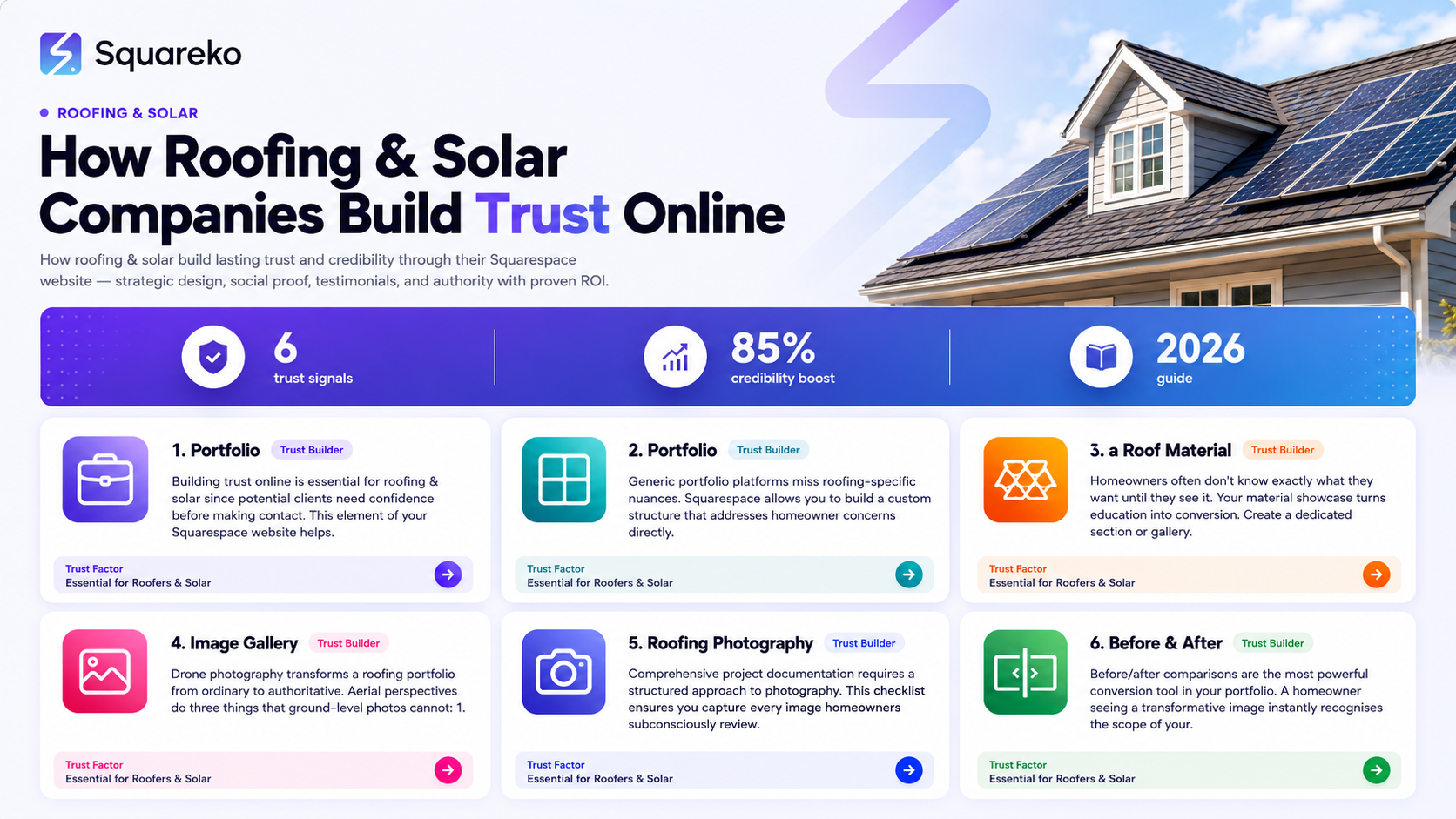
Your roofing portfolio isn't decorative. It's the primary sales tool for a service where homeowners cannot easily assess quality themselves.
Unlike purchasing a product with clear specifications, homeowners evaluating roofing work must trust visual evidence and professional presentation. When a prospect visits your Squarespace site, they ask themselves:
Does this contractor have experience with my roof type?
How does finished work actually look under inspection?
What's the attention to detail in flashing, sealing, and edging?
Has this contractor handled projects similar to mine?
A poorly organised gallery full of phone-quality images answers no to all four questions. A thoughtfully structured portfolio with drone photography, material-specific categories, and detailed case studies answers yes—and that's when qualified leads start appearing in your inbox.
Research into high-ticket home services shows that prospects spending £8,000–£40,000 on a roof typically review 5–7 contractors' portfolios before requesting quotes. Your portfolio isn't competing for attention; it's competing to remain in consideration.
Essential Roofing-Specific Portfolio Elements
Generic portfolio platforms miss roofing-specific nuances. Squarespace allows you to build a custom structure that addresses homeowner concerns directly.
Organise by roof type first, then project size. A homeowner with a slate roof doesn't care about your tile work—yet. Display slate projects first to someone searching your site with that roof. Use Squarespace's portfolio filtering or category navigation to let visitors self-select relevant examples.
Roofing projects fall into distinct categories:
New builds: Full roof installation on new construction (lower budget variability, cleaner photography)
Full replacements: Removal of old roofing and complete new installation (highest complexity, best before/after impact)
Storm damage repairs: Targeted repairs after weather events (common lead source, emphasises speed and crisis management)
Flat roofing: Commercial and residential flat roof systems (completely different visual presentation and installation method)
Slate, tile, and specialty materials: Premium roofing with longer timelines and higher craftsmanship visibility
Each category should include 2–3 projects as examples. Aim for 8–12 total portfolio pieces across all categories rather than 40+ generic images. Quality and relevance trump volume.
Building a Roof Material Showcase System
Homeowners often don't know exactly what they want until they see it. Your material showcase turns education into conversion.
Create a dedicated section or gallery set featuring each material type you install:
Asphalt shingles: Show colour variations, granule detail close-ups, and pitched roof installations. Include a project timeline photo sequence (bare deck → underlayment → shingle installation → finished roof). This is the most common material and deserves clear representation.
Slate roofing: Highlight the premium nature with drone overview shots, close-ups of slate texture and colour variation, and comparison photos showing consistency across the roof plane. Slate commands higher budgets and attracts homeowners willing to invest. Show why.
Tile roofing: Mediterranean, Spanish, and clay tiles offer visual drama. Feature full-roof drone shots, detail photos of flashing and ridge tiles, and any architectural integration with the home's structure. Tile roofing frequently involves curved lines and decorative elements; drone photography captures these beautifully.
Flat roofing: Commercial properties and modern residential designs use flat systems. Show membrane options, edge detailing, drainage features, and scale (flat roofs often involve larger square footage). Include a commercial project example if you serve that market.
Green or living roofs: If you offer specialty systems, these demand their own category. Showcase vegetation establishment timelines and environmental benefits alongside traditional structural photography.
For each material, include:
Full-roof overview (drone shot preferred)
Material detail at 3–5 feet distance (texture, colour, sealing visible)
Installation-phase photos (if available)
A this is what quality looks like close-up (perfect nailing, flashing, colour consistency)
Drone Photography and Aerial Imagery for Roofing Projects
Drone photography transforms a roofing portfolio from ordinary to authoritative. Aerial perspectives do three things that ground-level photos cannot:
Demonstrate full scope: A single drone shot conveys the entire roof plane, allowing homeowners to assess scale and complexity. A steep pitch, complex angles, or extensive square footage becomes immediately clear.
Show quality across the entire surface: Ground-level photos show isolated sections. Drone shots reveal whether workmanship is consistent across the entire roof—a critical trust signal.
Establish professional credibility: Roofing contractors using drone technology appear more established, detail-oriented, and modern. This perception translates directly into willingness to request quotes.
Legal and practical considerations:
In the UK, drone operations are regulated by the Civil Aviation Authority. Key rules:
Obtain a Small Unmanned Aircraft Operator's Permit (SUOP) or PfCO (Professional Flyer Certificate) if flying drones commercially
Do not fly within 50 metres of people or congested areas (requires advanced permission)
Always obtain property owner permission before flying near residential areas
Fly only in clear weather and daylight
Keep the drone in line of sight at all times
If you operate your own drone, this certification demonstrates professionalism to clients. If you hire a specialist drone photographer, ensure they carry proper insurance and certification. The investment (typically £150–400 per project) generates leads and pricing power that justifies the cost.
Best practices for roofing drone shots:
Capture the roof at mid-morning or mid-afternoon for balanced lighting (no harsh shadows from sun angle)
Take multiple angles: directly overhead, 45-degree perspective shots, and side views that show pitch and dimension
Photograph completed roofs after rain removal (clean surfaces photograph better)
Include 1–2 drone shots per project in your portfolio gallery
Roofing Photography Shot List: What to Capture
Comprehensive project documentation requires a structured approach to photography. This checklist ensures you capture every image homeowners subconsciously review when evaluating your work.
Pre-project photos:
Full roof overview from ground level (before work begins)
Close-up of existing roof condition (showing deterioration, damage, or age)
Aerial drone shot of original roof (if possible)
Detail of problem areas (missing shingles, water staining, flashing issues)
During-project photos:
Roof deck exposed (showing structural condition)
Underlayment installation beginning
Installation in progress (multiple angles showing technique)
Flashing installation detail (valleys, penetrations, edges)
Team working (optional; shows professionalism and scale of operation)
Post-project photos:
Complete roof overview from ground level (immediately after completion)
Aerial drone shot of finished roof (professional and comprehensive)
Close-up of material detail (colour, texture, nailing pattern)
Ridge and peak details (shows attention to finishing)
Edge and fascia details (reveals trim quality)
Flashing details at valleys, chimneys, and vents (these are leak-prone areas; showing quality work builds confidence)
Guttering and drainage integration
Optional but impactful:
Team photo on completed roof (safety-conscious, professional presentation)
Homeowner testimonial video (30–60 seconds, recorded on-site or at home)
Installation timeline sequence (showing progression from bare deck to finished roof)
Volume guidance: Capture 60–80 images per project. This sounds excessive until you realise a roofing installation involves hundreds of linear metres of material, multiple penetrations, and numerous angles. Your final portfolio will select 12–18 images per project; the selection process during editing determines which images tell the strongest story.
Before/After Documentation and Case Study Structure
Before/after comparisons are the most powerful conversion tool in your portfolio. A homeowner seeing a transformative image instantly recognises the scope of your work.
Structure each before/after pair strategically:
Wide angle before and after: Shows the entire roof, surrounding landscape, and home architecture. Homeowners recognise their own property scale in these images.
Material detail before and after: Close-ups (6–12 inches away) showing material condition transformation. Deteriorated shingles or exposed wood become pristine new material.
Problem area before and after: If the project addressed a specific issue (missing section, leak source, damaged flashing), document it clearly. This section showed water staining and deterioration (before) → Replaced with sealed flashing and new material (after).
Drone perspective before and after: Aerial shots showing the full roof transformation are dramatic and memorable.
Convert photos into case studies:
A case study moves beyond images to include narrative, decision context, and results. On Squarespace, use a portfolio item with:
Project title (location and scope: Full slate roof replacement, Edinburgh)
Project summary (2–3 sentences: scope, material choice, timeline)
The challenge (what problem did the homeowner face? Weather damage? Aging roof? Structural concerns?)
The solution (what you installed, why that material, specific techniques used)
The result (completion timeline, warranty offered, homeowner comment)
Homeowner testimonial (if available; quote plus name and city)
This structure transforms a gallery into a narrative. Homeowners reading a case study form stronger trust than those viewing images alone.
Review Acquisition and Display for High-Ticket Projects
Roofing projects exceed £5,000–£40,000, depending on scope and materials. At this investment level, homeowners place substantial weight on previous client feedback.
Your review acquisition strategy must match project value. A £2,000 gutter clean-up might generate a two-sentence review. A £25,000 slate roof replacement should generate a detailed testimonial or case study-style review.
Immediate post-project outreach (critical):
Within 3–5 days of project completion, while the homeowner is most satisfied:
Send a personal message (SMS or email) thanking them and requesting feedback
Provide a direct link to your review platforms (Google Business, Trustpilot, or Squarespace reviews)
Make review-leaving as frictionless as possible (one click; no registration required)
For projects over £15,000, follow up with a phone call asking if they'd be willing to provide a longer written testimonial
Incentivise substantive reviews:
For major roofing projects, consider offering:
A discount voucher for future services (if the review exceeds 100 words)
A donation to a local charity (in the homeowner's name) for a detailed testimonial
Entry into a monthly drawing for Amazon gift cards (for all reviewers)
These incentives are allowed by Google and Trustpilot if clearly disclosed. They encourage homeowners to take time writing detailed feedback rather than leaving one-word reviews.
Display strategy on Squarespace:
Embed a reviews block on your homepage and services page (shows social proof immediately)
Link testimonials to specific projects in case studies (Sarah's review of her slate roof replacement appears on that project page)
Feature 3–5 video testimonials on your homepage (video reviews carry 8–10x more weight than text)
Rotate testimonials monthly to show freshness and continued client satisfaction
Display star ratings prominently (average rating in the header, full ratings distribution in a reviews section)
For high-ticket roofing projects, a single 100-word positive review converts more prospects than 20 generic Great service! comments.
-
Use Squarespace's portfolio or gallery feature (found under the "Community" or "Services" category depending on your plan). Create one portfolio page per project, uploading 12–18 images per project. Use descriptive titles ("Full slate roof replacement, Edinburgh—storm damage repair") and write 150–200 words of case study detail. Organise portfolio items by category using Squarespace's built-in filtering—this lets visitors sort by roof type, project size, or problem addressed. Ensure each portfolio item links to your services page or contact form.
-
Absolutely. These are completely different projects in homeowners' minds. A homeowner needing a £2,000 repair browses differently than one budgeting £20,000 for replacement. Create distinct portfolio categories: "Repairs and spot fixes" (smaller scope, quicker turnaround, lower cost) and "Full replacements" (larger scope, longer timeline, warranty detail). Within each category, subdivide by roof type. This organisation helps prospects self-identify relevant examples and increases perceived relevance.
-
Aim for 8–12 complete projects in your main portfolio, with 12–18 images per project. This provides enough variety to showcase your range without overwhelming visitors. More important than quantity is the strategic selection of images: before/after pairs, drone shots, material detail, flashing/edge work, and installed appearance. A tightly curated portfolio of 10 high-quality projects outperforms a bloated gallery of 40 mediocre images.
-
In order of impact: (1) detailed case studies with client testimonials, (2) certification and licensing information prominently displayed, (3) warranties with written documentation visible, (4) professional drone photography, (5) material manufacturer partnerships or endorsements, (6) team credentials and years in business, (7) before/after documentation, (8) detailed project timelines showing reliability. Layer all of these on your Squarespace site to build comprehensive trust.
-
Roofing pricing varies dramatically by scope, material, and location. Displaying fixed pricing creates credibility issues when your actual quotes differ. Instead, create a downloadable guide titled "Roofing cost guide for homeowners" (with material cost ranges and labour averages). Offer it via your contact form, which captures leads while providing transparent pricing information. This approach balances transparency with professional flexibility.
-
Storm-damaged roofs are sensitive. Photograph from ground level and via drone (if safe). Focus on damage patterns—missing shingles, exposed wood, debris—showing the scope of the problem. Capture detail photos of affected areas. Once repairs are complete, photograph the same angles showing restoration. Storm damage work is compelling before/after material that justifies high budgets to prospects facing similar situations. Always obtain homeowner permission before displaying their property online.
-
Yes. Use Squarespace's SEO panel for each portfolio item: include your focus keyword in the item title, write a descriptive meta description (150–160 characters), and add alt text to every image using descriptive roofing keywords. Link each portfolio item to relevant services pages and blog posts. This internal linking structure helps search engines understand your site's architecture and improves rankings for roofing-specific searches.
-
Add new portfolio items every 30–45 days, or post at least 4–6 new projects annually. Fresh content signals active business, keeps your site updated in search results, and provides new case studies for prospects. As you add projects, retire older ones (save them in a "previous work" archive if desired). A portfolio with the most recent completion dates visible builds stronger credibility than one showing projects from three years ago.
Conclusion
Your roofing portfolio is the single most important sales tool on your website. Homeowners making five-figure financial and safety-critical decisions spend more time reviewing your work than reading testimonials or pricing pages.
A portfolio structured around homeowner psychology—addressing their specific roof type, showing installation quality through drone photography and detail images, providing before/after case studies, and layering trust signals—converts site visitors into qualified leads.
The competitive advantage belongs to contractors who treat portfolio development as central to their marketing strategy, not an afterthought. Invest in professional drone photography, develop detailed case studies, acquire substantive client reviews, and organise your work by material type and project category. Within 3–6 months, you'll see increased lead quality, shorter sales cycles, and pricing power that justifies the portfolio investment.
Get Started with Your Roofing Portfolio Today
Ready to build a Squarespace site that converts homeowners into clients? Squareko specialises in creating high-conversion portfolios for roofing contractors and home service professionals.
Get a free Squarespace consultation with Squareko. We'll review your current portfolio (or help you build one from scratch), ensure your trust signals are properly displayed, and optimise your site structure for lead conversion.

From custom website design to SEO strategy, we help businesses launch a site that looks professional and performs better.

About the Squareko Editorial Team
I'm Walid Hasan, a Certified Squarespace Expert and Squarespace Circle Platinum Partner with over 12 years of hands-on experience designing and optimizing high-performing websites. Over the years, I've had the privilege of building more than 2,000 Squarespace websites for clients around the world, always focusing on clean design, strong user experience, and conversion-driven results.