How Real Estate Agents Use Squarespace to Build Their Personal Brand and Win More Business
Introduction
Right now, clients don't just hire agencies—they hire the agents they trust. If you're a real estate professional serious about standing out from the crowd, building a strong personal brand is no longer optional. It's essential.
Your personal brand is what separates you from other agents in your market. It's the reason clients ring you first, why past clients refer their friends to you, and why buyers and sellers choose to work with you specifically. A well-crafted personal brand backed by a professional website can dramatically accelerate your business growth.
This guide shows you how to build a compelling personal brand and create a website that converts visitors into clients.
Key Takeaways
Personal branding is now the primary differentiator for estate agents—clients choose the agent, not just the agency
Five core brand elements drive new business: your story, local expertise, market knowledge, community involvement, and proven track record
Your website must showcase who you are, what you specialise in, and why clients should work with you specifically
Local content strategy (neighbourhood guides, market reports, community updates) establishes you as the go-to expert in your area
Squarespace combines design, functionality, and ease of use to help you build a professional personal brand website without needing a developer
Many successful agents maintain their own branded presence alongside their agency—it's a smart competitive move in modern property selling
A well-designed personal brand website increases inquiries, improves conversion rates, and builds long-term client loyalty
The Personal Brand Advantage for Estate Agents
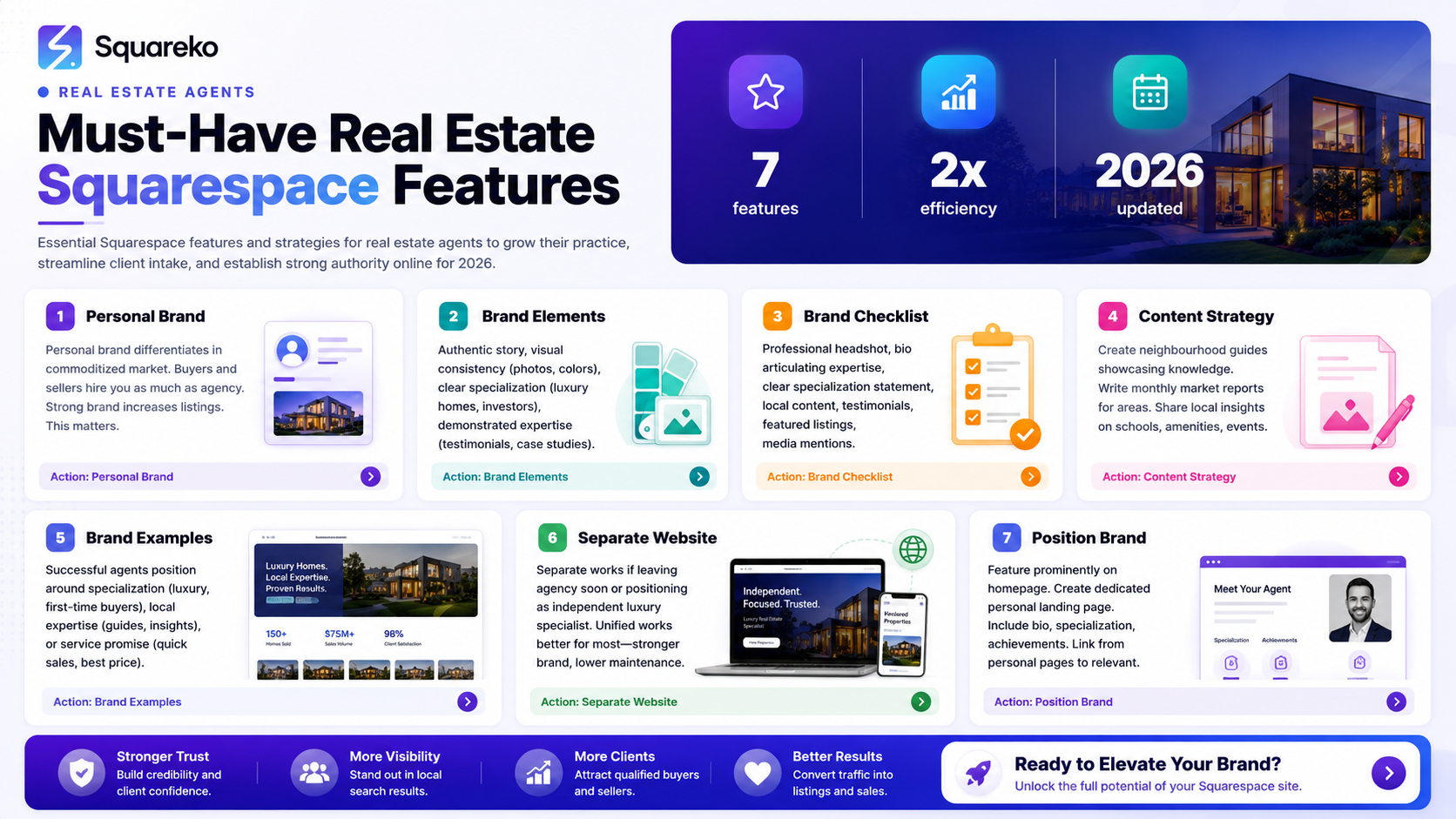
The property market has transformed. Clients now research online, read reviews, and check personal presence before contacting agents. This means your personal brand is the primary differentiator. Clients ask Which agent should we work with? not just Which agency?
A strong personal brand does several things simultaneously:
Builds trust through consistent, authentic communication
Establishes authority by showcasing your local market knowledge
Differentiates you from other agents in your area
Creates multiple touchpoints with potential clients (website, blog, social media, email)
Generates qualified leads from people who already trust you before they contact you
The agents winning the most business today aren't necessarily working for the biggest agencies. They're the ones with the strongest personal brands—the agents who've become known for their expertise, their approach, and their results.
Consider this: a buyer searching for property agent in Bristol on Google doesn't just see your agency listing. They see your personal website, your LinkedIn profile, your Google reviews, and your blog content. This multi-channel visibility significantly increases the likelihood they'll contact you directly instead of a competitor. Your personal brand is that consistent, recognisable presence across all these touchpoints.
Five Core Elements of a Winning Estate Agent Personal Brand
Building a personal brand that actually drives business requires these five essential elements:
1. Your Agent Story and Local Expertise
Your story is powerful because it's genuine. Maybe you grew up locally, specialise in period properties or luxury homes, or have helped hundreds of families through difficult sales. These details matter and differentiate you.
Your local expertise is equally crucial. Clients want to work with someone who truly knows their area—not just as a sales territory, but as a place to live. Can you talk knowledgeably about the best schools, transport links, restaurants, and community facilities? That's the kind of expertise that builds trust. When you can answer questions about specific neighbourhoods in detail, recommend restaurants by neighbourhood, or explain transport options to major employment hubs, you demonstrate genuine commitment to the area beyond sales targets.
2. Market Knowledge Content
Create content demonstrating expertise: neighbourhood guides, market updates, video walkthroughs, blog posts answering buyer/seller questions, and case studies. This builds reputation and gives potential clients reasons to visit your site regularly.
3. Community Involvement Showcase
Real estate professionals who are active in their local communities build deeper relationships and stronger reputations. Whether you sponsor local events, sit on community committees, or volunteer with local charities, showcasing this involvement on your website demonstrates that you're genuinely invested in your area.
This can be as simple as adding a "Community" section to your website with photos and descriptions of local events you've supported, or highlighting partnerships with local businesses. Document your involvement with school fetes, community gardens, local business associations, charity fundraisers, or neighbourhood improvement initiatives. This authentic engagement signals to potential clients that you care about your community beyond closing sales transactions.
4. Testimonial and Track Record Display
Social proof is one of the most powerful conversion tools. Feature client testimonials, case studies from notable transactions, transaction statistics (homes sold, time on market, prices achieved), and video testimonials. The more specific and detailed these are, the more credible they become.
5. Social Media Integration
Your brand should be consistent across platforms. Include social media links and calls to action on your website. Social media allows you to stay in touch with past clients, share updates, and build community. LinkedIn articles reach professionals and referral sources. Instagram reaches followers with fresh content. Consistent activity keeps you visible and attracts new contacts through social sharing.
Your Personal Brand Checklist
Before you build (or rebuild) your personal brand website, use this checklist to ensure you're covering all the fundamentals:
Core Pages and Content:
Agent Story Page – A compelling introduction that covers who you are, your background, your approach, and why clients should choose you
Local Area Expertise Content – Detailed guides or information about the specific neighbourhoods and areas you specialise in
Market Commentary – Regular updates, blog posts, or videos demonstrating your knowledge of the local property market
Track Record Showcase – Clear evidence of your results (testimonials, statistics, case studies)
Community Connection – Information about local involvement, partnerships, and community contributions
Technical and Design:
Professional photography
Clear calls to action on every page
Mobile-responsive design
Fast loading times
SEO optimisation (headings, meta descriptions, alt text)
Marketing and Integration:
Social media profile links
Email newsletter signup
Video content
Regular blog or news updates
Legal and Professional:
Privacy policy
Professional disclaimers
Professional email address
Building a Local Area Content Strategy
Establish your personal brand through content focused on your local market. Start by identifying 3-5 specific neighbourhoods where you specialise. Depth beats breadth—better to be the expert in three areas than have shallow coverage of ten. Choose areas where you have genuine personal knowledge and completed transactions.
Create Neighbourhood Guides
For each area, create a comprehensive guide covering: character and community feel, typical property types, local schools and education, transport links and journey times, key amenities, price trends over recent years, and distinctive features that make the area special.
Publish Regular Market Reports
Monthly or quarterly updates on local trends keep your site fresh, demonstrate expertise, and attract search traffic. Include average prices, time on market, price trends, notable sales, and market commentary.
Share Community Stories
Publish content about local events, community initiatives, and interesting stories from your area. This positions you as someone who's genuinely invested in the community, not just trying to make sales. Feature local business owners you've worked with, highlight community achievements, celebrate neighbourhood history, or document seasonal changes that make your area special. These stories build emotional connection and demonstrate authentic community roots.
Repurpose Content Across Platforms
Create comprehensive content (neighbourhood guides, market reports), then repurpose: blog post summary, 3-4 social media posts, video content, email distribution to past clients, and LinkedIn shares. This maximises the value of each content piece.
Examples of Strong Personal Brands
The Local Expert: Specialises in a specific neighbourhood with deep local knowledge. Website includes about section with local stories, neighbourhood guides, monthly market updates, sold galleries, and community involvement. Result: "go-to agent" for that area, strong referral business, premium pricing.
The Specialist: Deep expertise in property type (period homes, luxury, investment). Website features clear specialisation messaging, educational content, case studies, and buying guides. Result: attracts serious buyers seeking expertise, commands premium positioning.
Should You Have Your Own Website Separate from Your Agency?
This is a question many ambitious agents ask, and the answer depends on several factors:
Key advantages: Complete control over presentation, no agency approval needed for updates, SEO value for your name, long-term asset ownership, multiple client touchpoints, and potentially better conversion than generic agency templates.
Potential challenges: Time commitment for regular maintenance, hosting costs (minimal with Squarespace), possible agency policy restrictions, and need to position it as complementary rather than competitive with your agency site.
The Smart Approach
Many successful agents solve this by having both:
An agency profile that complies with agency requirements and drives clients to the main office
A personal brand website that showcases their expertise, builds their personal audience, and drives leads directly to them
This dual approach works particularly well if you're independent or work for an agency that supports personal branding. Your personal website becomes a complement to your professional presence, not a competitor.
If your agency doesn't allow personal websites, you can still build your personal brand through:
LinkedIn profile optimisation
Regular social media activity
Speaking engagements and local involvement
Writing articles and guest posts
Building an email list of past clients and contacts
However, owning your own website is the gold standard because it's the only channel you completely control.
How to Position Your Personal Brand Website
A professional personal brand website combines several essential components:
Core Strategy: Define what makes you unique, clarify your target market, and communicate your distinctive value proposition consistently across all pages and content.
Design and User Experience: Choose professional templates, feature quality photography prominently, create clear calls to action, and ensure mobile responsiveness and fast loading times.
Content Development: Build a content calendar that includes monthly market updates, quarterly neighbourhood guides, video content, and regular blog posts that demonstrate your expertise.
Lead Generation: Integrate optimised contact forms, lead magnets (downloadable guides, market reports), email newsletter signup options, and clear conversion pathways throughout your site.
Ongoing Maintenance: Update content regularly (at least monthly), monitor analytics to understand visitor behaviour, refine your messaging based on performance data, and stay active with your network.
-
Yes, with important caveats. If your agency allows it, a personal brand website is a significant competitive advantage. It gives you complete control over how you're presented, helps you build a personal audience, and creates an asset that follows you if you change agencies. However, check your employment contract first—some agencies have policies about agent websites. If yours does, focus on optimising your LinkedIn profile, social media, and building relationships in other ways. A personal website should complement your agency presence, not undermine it.
-
Define your unique value proposition (what makes you different, your specialisation, your ideal client). Communicate consistently across website, social media, and client conversations. Demonstrate local market knowledge, share your story, showcase results, and stay visible to your network through content, community involvement, and relationship building.
-
A winning personal brand website combines: compelling agent story, clear positioning on specialisations, strong social proof (testimonials and results), educational content, professional design and photography, mobile responsiveness, multiple calls to action, and regular fresh content including market updates and neighbourhood guides.
-
Yes. Squarespace is user-friendly for non-technical users. Choose a professional template and customise with your content, photos, and branding. For professional design work, photography, or strategic planning, a web designer can accelerate the process.
-
Add new content at least monthly to keep your site fresh for search engines and give clients reasons to return. This can be a blog post, market update, or photo gallery. Consistency and demonstrating active market engagement matter more than frequency.
-
Combine SEO optimisation (target local keywords), regular social media sharing, email signature links, referral requests from past clients, and local business directory listings. A consistent content strategy around local market topics is highly effective for attracting organic search traffic.
-
Yes, if you can commit to monthly updates. A blog attracts search traffic, demonstrates expertise, keeps your site fresh, and gives clients reasons to stay connected. If blogging isn't feasible, focus on strong neighbourhood guides and testimonials instead.
Conclusion
Your personal brand is one of your most valuable business assets. In a competitive property market, it's often the difference between agents who win steady business and those who struggle for leads. The agents succeeding most today aren't waiting for the agency to do the marketing—they're actively building their own audience, demonstrating their expertise, and positioning themselves as the agents people want to work with.
A professional personal brand website is the foundation for this work. It's where you tell your story, showcase your expertise, and convince potential clients that you're worth choosing. It's where you build trust before anyone ever rings you.
Squarespace makes building this website accessible to every agent, whether you're working for a large agency or running your own operation. It gives you professional design, powerful tools, and the ability to manage your content without needing a developer.
The best time to start building your personal brand was yesterday. The second best time is today.
Ready to Build Your Personal Brand Website?
Building a professional personal brand website is one of the most effective ways to stand out in your market and win more business. Start today with a clear strategy, compelling content, and consistent execution.
From custom website design to SEO strategy, we help businesses launch a site that looks professional and performs better.

About the Author
I'm Walid Hasan, a Certified Squarespace Expert and Squarespace Circle Platinum Partner with over 12 years of hands-on experience designing and optimizing high-performing websites. Over the years, I've had the privilege of building more than 2,000 Squarespace websites for clients around the world, always focusing on clean design, strong user experience, and conversion-driven results.