How Financial Consultants Showcase Their Track Record and Expertise on Squarespace
Key Takeaways How Financial Consultants Showcase Their Track Record and Expertise on Squarespace
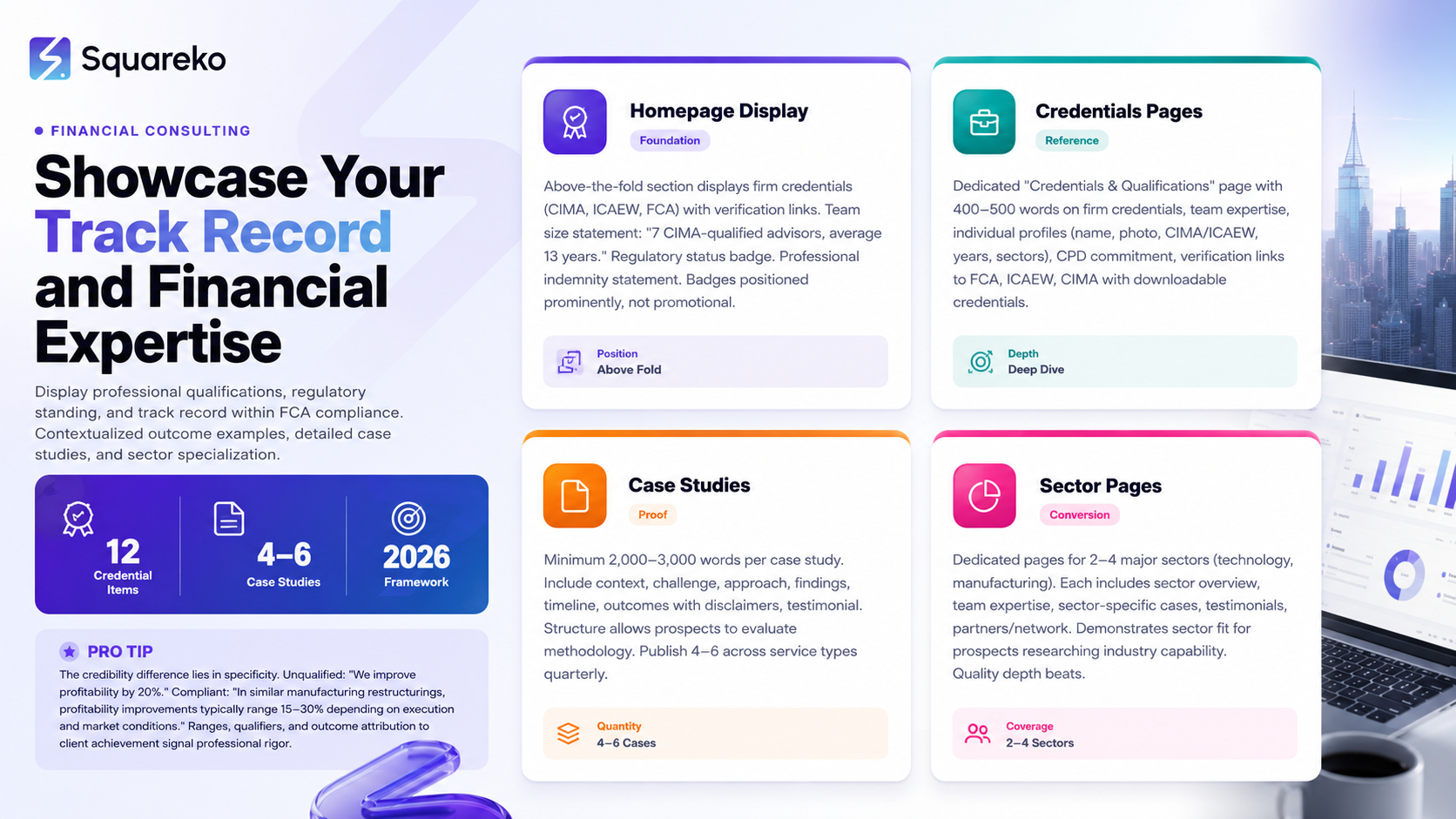
Professional credentials (CIMA, ICAEW, CFA, FCA) must be prominently displayed with verification links
Track record showcase requires FCA-compliant language: contextualized outcomes rather than unqualified performance claims
Sector specialization pages demonstrate fit for prospects researching industry-specific expertise
Case studies are the most credible expertise proof; detailed structure matters more than volume
Team expertise should be showcased at individual level, not just firm level
12-item credentials checklist ensures compliant, comprehensive expertise demonstration
The credibility of a financial consulting website hinges on visible, verifiable evidence of expertise and track record. High-value clients evaluating advisors for substantial engagements need proof that the consultant has solved similar problems for similar clients in their sector. Yet showcasing track record requires careful navigation of FCA financial promotion rules, professional standards, and accuracy requirements.
The difference between effective expertise showcase and regulatory non-compliance is often subtle: unqualified performance claims ("We improve profitability by 20%") violate FCA rules; contextualised outcome examples ("In similar manufacturing restructurings, our clients typically achieved 15-25% cost reduction") demonstrate capability compliantly.
This guide covers the framework for showcasing professional qualifications, displaying track record within FCA compliance, and structuring expertise demonstration that builds credibility with high-value consulting prospects.
Professional Qualification Display Strategy
Homepage Credential Architecture
The homepage must immediately communicate professional qualifications. Strategy:
Above-the-fold qualification section:
A dedicated section in the first visual area of your homepage (before scrolling) should display:
Firm-level credentials (CIMA, ICAEW, FCA regulation status)
Team size and average experience ("Team of 7 CIMA-qualified advisors, average 13 years' experience")
Key team member credentials (Name + title + CIMA/ICAEW/CFA)
Regulatory standing (FCA firm reference number with link)
Professional body memberships (links to register verification)
This section should not appear promotional—it's factual credibility foundation.
Example homepage structure:
HEADING: "FCA-Regulated Financial Advisory"
Body text: "Qualified team of CIMA and ICAEW advisors specialising in fractional CFO services, M&A advisory, and business restructuring. 47 years combined financial advisory experience. Regulated by the FCA (Firm Ref: 123456). Members of ICAEW and CIMA. Protected by £5m professional indemnity insurance."
With badge row: CIMA Logo ICAEW Logo FCA Logo
On Squarespace, use the "Columns" block to position credential badges side-by-side. Add links from logos to verification sources:
CIMA logo → CIMA member directory
ICAEW logo → ICAEW register
FCA logo → FCA register (with firm reference number)
Credential Pages with Deep Verification
Create a dedicated "Credentials & Qualifications" page providing comprehensive evidence of expertise:
Page structure:
Firm credentials section (400-500 words)
FCA regulation details (regulated activities, firm reference)
Professional body memberships (ICAEW full member status, CIMA corporate member status)
Professional indemnity insurance (underwriter, cover limit, scope)
Awards and recognition (industry awards, client choice awards)
Team expertise breakdown (300-400 words)
Number of CIMA-qualified advisors
Number of ICAEW members
Average years in financial advisory
Sector specialisations represented in team
Individual advisor credentials (600-800 words)
Each key advisor: name, photo, title, specific qualifications (CIMA, ICAEW, CFA, etc.)
Years in industry, sector specializations
Key achievements (relevant to their profile)
LinkedIn profile link (for verification)
Continuing professional development (300-400 words)
Commitment to ongoing training
CPD hours completed annually
Professional standards adherence
Thought leadership activities (speaking, publishing)
Verification links (concise section)
FCA register link (with firm reference number)
ICAEW register link
CIMA register link (for corporate members)
Professional indemnity insurance certificate (or summary)
Squarespace implementation: Use text blocks and "Summary" blocks to structure detailed information clearly. Include downloadable credential verification documents (PDFs linked from this page).
Team Member Profile Pages
Each key advisor should have an individual profile page accessible from the team page:
Profile page components:
Professional photo (professional headshot, consistent style across team)
Title and role (e.g., "Managing Director, M&A Advisory")
Professional qualifications (CIMA, ICAEW, CFA, FPA, etc.)
Include year of qualification where relevant
Links to professional body register verification
Years of experience
Total years in financial advisory
Years with current firm
Roles held in previous positions
Sector expertise (e.g., "Specialises in technology sector M&A, manufacturing restructuring")
Notable achievements
Major engagements advised (anonymised)
Deals handled (transaction size ranges)
Thought leadership (speaking engagements, published articles)
Educational background (university, degree, professional qualifications)
Professional affiliations (ICAEW full member, CIMA member, FPA member)
External links
LinkedIn profile (increases trust; LinkedIn verification adds credibility)
Published articles or research
Speaking engagement details
On Squarespace, team member pages work well as part of the "Team" or "About" section, with individual bios in custom pages or collection items.
FCA-Compliant Track Record Showcase
Language Framework for Compliant Claims
The FCA requires financial promotion claims to be fair, clear, and not misleading. For track record, this means contextualising outcome claims rather than stating them as absolutes.
Compliant vs. non-compliant language:
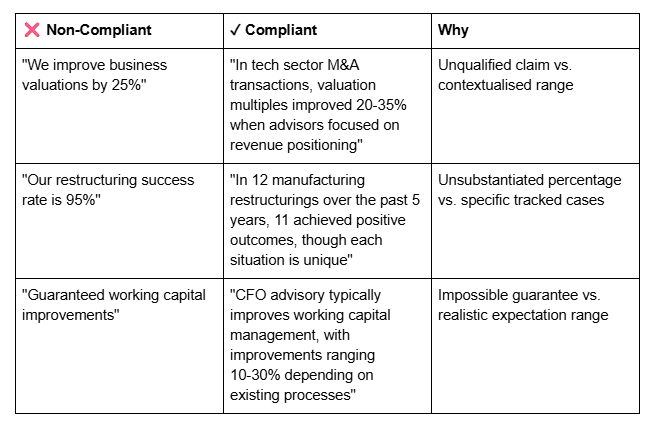
Key compliant language patterns:
Qualifiers: "Typically," "often," "in similar situations," "generally"
Context: "In tech sector M&A," "for mid-market manufacturers," "when engaged early in process"
Range: "15-25%" rather than "20%"
Attribution: "Client achievement" rather than "our guarantee"
Disclaimer: "Results depend on implementation and market conditions"
Performance Claims Framework
If displaying performance metrics or client outcomes, use this framework:
Structure for compliant performance display:
Situation context (client situation, challenges)
Industry sector
Approximate company size
Specific challenges addressed
Engagement approach (how you tackled the problem)
Methodology
Team involvement
Engagement timeline
Specific outcome (with appropriate qualification)
Measurable result ("Cost reduction of £150,000 annually")
Percentage improvement if appropriate ("15% reduction in operating costs")
Timeline to achievement
Appropriate disclaimer (always included)
"Results achieved depend on client implementation and market conditions"
"Past performance is not a reliable indicator of future results"
"Each engagement is unique; outcomes vary"
Historical Performance Disclaimer Placement
Include performance disclaimers prominently, not hidden:
Placement strategy:
Near case studies: Above portfolio/case study section: "The outcomes described below represent client achievements in specific situations. Each engagement is unique, and results depend on implementation and market conditions."
Near testimonials: Above testimonial section: "Testimonials represent client experiences from specific engagements. Results are not typical and individual outcomes vary."
On credentials page: "Past performance and client outcomes do not guarantee future results."
On Squarespace, use "Quote" blocks or highlighted text blocks for disclaimers so they're visually distinct and noticed.
Sector Specialization Architecture
Sector-Specific Service Pages
Create dedicated service pages for each major sector you serve. This demonstrates sector specialization and allows prospects to evaluate fit:
Sector page structure (e.g., "Technology Sector M&A Advisory"):
Sector overview (400-500 words)
Technology sector characteristics
Common M&A dynamics in tech
Sector-specific challenges and considerations
Regulatory/compliance nuances for tech M&A
Sector expertise statement (150-200 words)
Years of experience in tech M&A
Number of tech sector deals advised
Key sector specialists on team
Sector-specific understanding and network
Sector-specific case studies (2-3 detailed case studies)
Anonymous tech company M&A case studies
Sector-relevant challenges addressed
Tech sector-specific outcomes
Deal sizes, timelines, complexity factors
Sector testimonials (3-5 tech sector client testimonials)
Filter general testimonials to show only tech sector clients
Highlight sector-specific value delivered
Sector partners/network (optional, if relevant)
Tech sector accountants and advisors you work with
Tech investment community connections
Sector associations or networks
Process for tech M&A (sector-specific engagement detail)
How tech M&A advisory differs from other sectors
Timeline for typical tech transactions
Key milestones and deliverables
Tech-specific due diligence considerations
CTA (sector-specific call-to-action)
"Discuss your tech sector M&A opportunity"
Link to contact form with sector pre-selected
Sectors to prioritise: Create detailed pages for 2-4 sectors where you have genuine demonstrated expertise. Avoid attempting comprehensive coverage across 20+ sectors—depth in 3-4 sectors builds more credibility than shallow coverage across many.
Sector-Specific Credential Display
Within each sector page, display sector-specific team expertise:
Which advisors specialise in this sector
Their track record in the sector (anonymised)
Relevant certifications or recognition in the sector
Thought leadership in the sector
Case Study Design for Credibility
Case Study Structure for Maximum Credibility
High-value consulting clients evaluate detailed case studies. Structure each case study comprehensively:
Case study components:
Title (specific to situation)
E.g., "Mid-Market Manufacturing Company: Operational Restructuring and Cost Reduction"
Avoid generic titles; specificity signals credibility
Client snapshot (100-150 words)
Company size (revenue, employee count)
Industry and sector
Challenge/situation (concise)
Outcome headline
Background and challenge (300-500 words)
Detailed situation description
Client context (anonymised company, described by industry/size)
Specific challenges identified
Why advisory was needed
Timeline/urgency context
Engagement approach (400-600 words)
Methodology and framework used
Key activities and analysis performed
Team involved (names and roles)
Engagement timeline and phasing
Client collaboration/implementation approach
Key findings (300-400 words)
Major diagnostic insights
Problems identified
Opportunities recognised
Strategic recommendations
Implementation and outcomes (400-600 words)
Specific actions taken
Timeline to implementation
Measurable results achieved
Cost savings or improvements quantified
Lasting impact (follow-up outcomes)
Challenges overcome
Client testimonial (100-200 words)
Quote from client (typically CFO or finance director)
Specific value highlighted
Advice to other companies considering similar engagement
Name and title (with permission)
Engagement details (concise box)
Service provided
Duration
Team size
Key deliverables
Industry/sector
Total length: 2,000-3,000 words per case study (longer than typical web content, but appropriate for detailed credibility showcase)
Case Study Frequency and Refresh
Publishing strategy:
New case studies: 4-6 new case studies annually
Sector coverage: Ensure case studies represent all major service sectors
Geographic coverage: Include cases across different geographic markets if relevant
Company size diversity: Case studies across startup, mid-market, enterprise scales
Refresh cycle: Update featured case studies every 12-18 months; archive older cases
Testimonial integration: Seek client permission for identified testimonials; update regularly
On Squarespace, case studies work well as a custom collection ("Portfolio," "Case Studies," "Project Showcase") allowing filtering by sector, company size, or service type.
Individual Advisor Profiles
Profile Completeness for EEAT
Individual advisor profiles build the "Experience and Expertise" elements of Google's EEAT ranking factors. Complete profiles matter for both credibility and SEO.
Profile elements:
Professional photo (high-quality headshot)
Full name and title
Professional qualifications (CIMA, ICAEW, CFA, etc.)
Year of qualification
Links to verification
Education (university, degree)
Years of experience (total and in current role)
Sector expertise (specific sectors)
Speaking/thought leadership
Published articles or research
Speaking engagements
Media appearances
Professional affiliations
ICAEW member status
CIMA member status
Industry association memberships
Key achievements
Notable deals or engagements
Awards or recognition
Client feedback/testimonials
Contact method (email or contact form)
LinkedIn profile link
Professional memberships/credentials (external links for verification)
12-Item Credentials Checklist
Use this checklist to ensure comprehensive expertise and credential display on your Squarespace site:
Professional Credentials (Items 1-4)
1. Homepage displays firm-level professional credentials (CIMA, ICAEW, FCA) with verification links
2. Dedicated "Credentials & Qualifications" page with detailed credential information
3. Individual team member profile pages showing specific qualifications (CIMA, ICAEW, CFA)
4. Professional indemnity insurance information displayed prominently (underwriter, cover limit)
Track Record and Outcomes (Items 5-8)
5. Case studies use FCA-compliant language (contextualised outcomes, appropriate disclaimers)
6. Performance disclaimer displayed prominently near case studies and testimonials
7. At least 3-4 detailed case studies covering major service types
8. Case studies include specific outcomes quantified where appropriate (with disclaimers)
Sector Specialization (Items 9-10)
9. Dedicated pages for each major sector served (technology, manufacturing, etc.)
10. Sector pages include sector-specific case studies and team expertise
External Verification (Items 11-12)
11. Links to professional body registers (ICAEW, CIMA, FCA) for verification
12. Team member LinkedIn profile links for credibility verification
Frequently Asked Questions
-
Detailed case studies (2,000-3,000 words) outperform brief ones significantly. High-value clients reviewing case studies want sufficient context to evaluate fit and capability. Brief 200-300 word case studies appear superficial and hurt credibility. Invest in depth.
-
Ranges (15-25%) are more credible than specific percentages (20%) because they acknowledge outcome variability. Ranges also satisfy FCA compliance better by implicitly including disclaimers about variability.
-
Only with explicit written client consent. Most clients consent to sector and anonymity but not to name attribution. Anonymous case studies ("Mid-market technology company") are fully credible while respecting client confidentiality.
-
Review credentials annually. Update immediately when team members gain new qualifications (CIMA achievement, CFA certification), when professional body memberships are renewed, or when professional indemnity insurance is renewed.
-
Use concise 150-200 word team directory on main team page, with links to full 500-800 word individual profiles. This allows quick scanning for prospects while providing depth for those researching specific advisors.
-
Only if claims are accurate and verifiable. "Award-winning" requires having won the award. "Award-nominated" requires nomination documentation. "Industry-recognised" requires third-party verification. Avoid superlatives without evidence.
Showcase expertise that converts high-value clients. Squareko builds Squarespace financial consulting websites that present credentials, track record, and sector specialization in ways that build trust while maintaining FCA compliance.

From custom website design to SEO strategy, we help businesses launch a site that looks professional and performs better.

Author:
Walid Hassan, Squareko
I'm Walid Hasan, a Certified Squarespace Expert and Squarespace Circle Platinum Partner with over 12 years of hands-on experience designing and optimizing high-performing websites. Over the years, I've had the privilege of building more than 2,000 Squarespace websites for clients around the world, always focusing on clean design, strong user experience, and conversion-driven results.