Build Loyal Customers for Your Boutique with Squarespace
Introduction
Building a loyal customer base is the cornerstone of long-term success for any boutique business. Rather than constantly hunting for new customers, creating an environment where repeat purchases are natural keeps your revenue stable and your business thriving. When your customers become advocates who return regularly and recommend your boutique to others, you've discovered the most sustainable growth strategy available.
Squarespace makes this achievable. The platform offers built-in tools specifically designed to help you build loyal customers through email campaigns, member areas, abandoned cart recovery, and personalised communication. Whether you're selling handcrafted jewellery, sustainable fashion, or curated home goods, the retention strategies in this guide will help you reduce customer churn and increase lifetime value. Let's explore how to transform one-time buyers into loyal advocates for your boutique.
Key Takeaways
Email marketing is essential: Squarespace Email Campaigns let you segment customers and send personalised offers that encourage repeat purchases
Welcome sequences matter: Automated welcome series introduce new customers to your brand values and build trust from the first interaction
VIP programs drive loyalty: Member areas on Squarespace create exclusive spaces where returning customers feel valued and appreciated
Content keeps customers engaged: Regular blog posts and updates remind customers why they love your boutique and prompt return visits
Post-purchase follow-up is crucial: Thank-you sequences and personalised messages transform transactions into relationships
Referral incentives amplify growth: Rewarding customers for sharing your boutique multiplies acquisition without expensive advertising
Cart recovery prevents lost sales: Abandoned cart emails recover revenue from interested customers who didn't complete their purchase
Why Customer Loyalty Matters More Than You Think
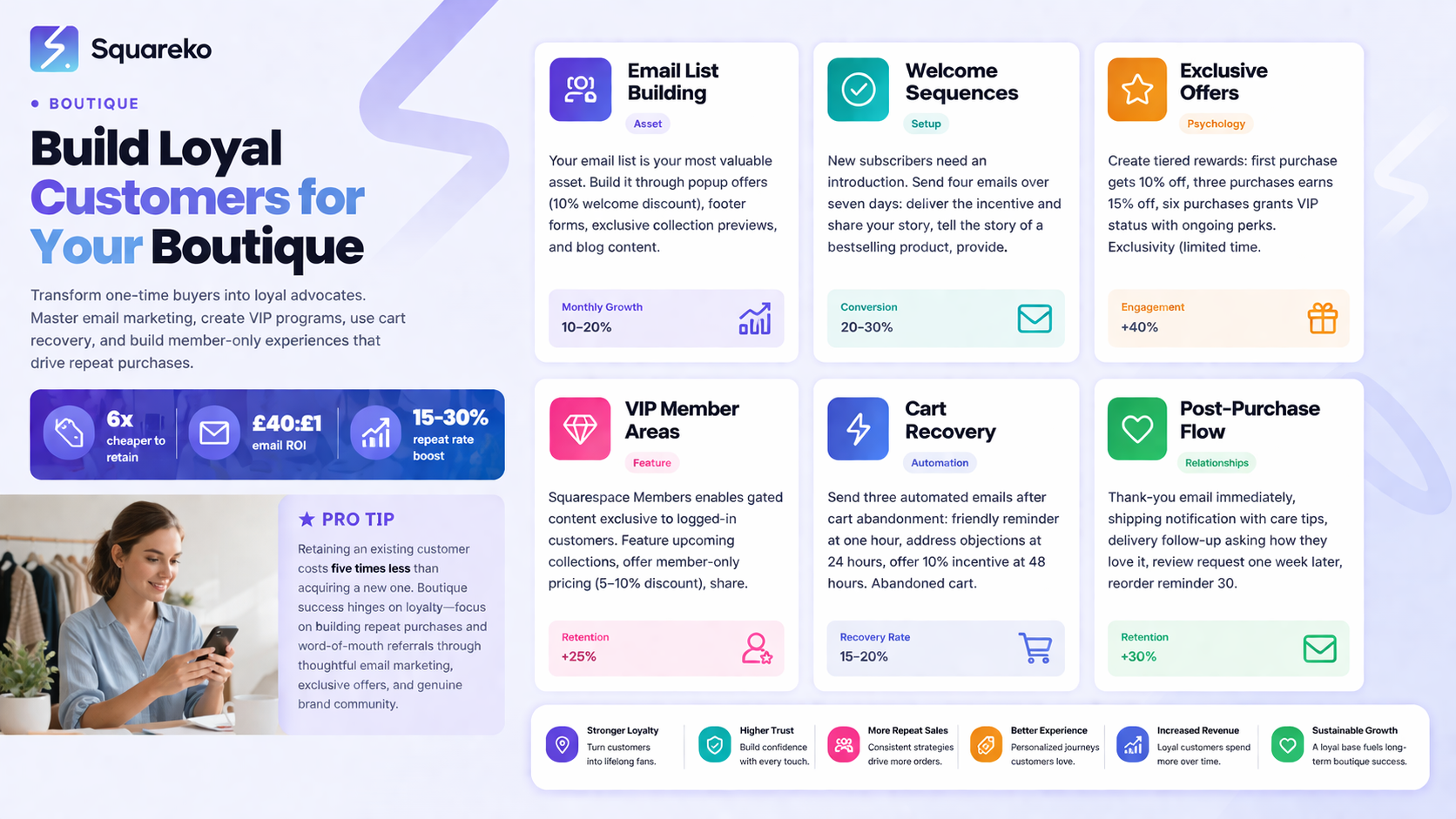
For boutiques, customer loyalty isn't just a nice-to-have—it's the difference between thriving and barely surviving. Studies show that retaining an existing customer costs five times less than acquiring a new one. For boutiques, where margins are often tighter than large retailers, this difference becomes the deciding factor between profit and loss.
Here's what happens when you focus on loyalty:
Increased lifetime value: Loyal customers spend more over time. A customer who purchases from your boutique twice a year for five years generates dramatically more revenue than a one-time buyer.
Reduced marketing costs: When customers return without expensive paid advertising pushing them back, your customer acquisition cost plummets.
Built-in word-of-mouth marketing: Satisfied loyal customers naturally recommend your boutique to friends and family. This referral traffic is cheaper and more trustworthy than any paid campaign.
Competitive resilience: During economic uncertainty, loyal customers stick with the businesses they love. You're insulated from the boom-bust cycle that affects businesses relying on one-time transactions.
Product feedback and insights: Regular customers provide invaluable feedback about what works, what doesn't, and what they'd love to see next. This intelligence guides better purchasing decisions.
When your boutique has a strong base of repeat customers, you can confidently plan inventory, make longer-term decisions, and invest in growth knowing your revenue foundation is solid.
Build Your Email List with Strategic Website Tactics
Your email list is your most valuable marketing asset. Unlike social media where algorithms control who sees your content, email reaches customers directly in their inbox. For boutique owners, building this list should be a priority from day one.
Squarespace makes list-building easy through several built-in features:
Popup Email Signups
Create a popup that appears when visitors land on your site or are about to leave. Offer something compelling in return: Join our insider list for 10% off your next purchase or Get early access to our new collection. Keep it simple—name and email is all you need initially.
Footer Email Forms
Include an email signup form in your footer that's visible on every page. This lower-friction option works best for visitors who've decided to trust you but haven't yet converted to customers.
Welcome Discount Gates
On your homepage, feature a banner offering a welcome discount (10–15% is standard) exclusively to new email subscribers. Squarespace lets you deliver this discount code automatically via email, immediately rewarding the signup.
Landing Pages for Collection Launches
When you're launching a new collection or running a special campaign, create a dedicated landing page that highlights the offer. Gate early access or pre-order information behind an email signup. Customers excited about your collection will happily trade their email address.
Blog Call-to-Actions
Throughout your blog content, include invitations to join your email list. In a post about seasonal jewellery trends, for example, you might say: Get weekly style tips and exclusive offers delivered straight to your inbox.
Pro tip: Segment your signup forms by interest. If you're building a campaign around a specific collection, ask subscribers which category interests them most. This segmentation makes your later emails far more relevant and improves open rates.
Automate Welcome Series to Create Instant Connection
A welcome series is a sequence of automated emails that new subscribers receive immediately after joining your list. This is your chance to make a brilliant first impression and establish the relationship foundation.
Structure Your Welcome Sequence
Email 1 (Sent Immediately): Deliver the promised incentive (discount code, early access, etc.) and introduce yourself and your boutique story. Why did you start this business? What makes your products special? Keep this email warm and personal, not salesy.
Email 2 (Day 3): Share the story behind one of your bestselling products or collections. Include a photo and explain what makes it unique. Link to the product page but don't hard-push the sale. You're building trust and helping the customer understand your values.
Email 3 (Day 5): Offer practical value that has nothing to do with selling. If you run a sustainable fashion boutique, share tips for making garments last longer. If it's jewellery, explain how to care for different materials. This positions you as a helpful expert, not just someone trying to extract money.
Email 4 (Day 7): Invite the subscriber to reply and share their own story. Ask questions: What's your style personality? or What brings you to our boutique? This makes the series conversational and gives you insights for future personalisation.
Squarespace allows you to set this entire sequence up once, then it runs automatically for every new subscriber. You can adjust send times based on subscriber time zones for maximum opens.
Personalisation That Works
Squarespace email campaigns let you insert subscriber names and other data into email copy. "Hi Sophie" performs better than "Hi there." If you've captured collection interests during signup, you can make each email feel more relevant. A subscriber interested in jewellery won't receive recommendations for your fashion line.
Offer Exclusive Deals for Repeat Customers
One of the most effective ways to encourage repeat purchases is offering rewards that feel exclusive. Your loyal customers should feel like they're part of an inner circle.
Exclusive Launch Access
When you're introducing new collections, give your email subscribers first access 48 hours before your general audience. Send an email with subject lines like First dibs on our Spring collection—for subscribers only. This creates urgency and makes subscribers feel valued for their loyalty.
Birthday and Anniversary Offers
Capture customer birthdates during purchase and automatically send a birthday discount email (e.g., "15% off for you on your special day"). This personalised touch drives surprising conversion rates and costs you nothing beyond the discount margin.
Tiered Loyalty Incentives
Structure your offers based on purchase history:
After first purchase: 10% off next order
After three purchases: 15% off next order
After six purchases in a year: Join VIP status with ongoing perks
This ladder encourages progression and makes customers feel like they're being rewarded for loyalty.
Flash Sales for Email Subscribers Only
Once weekly or fortnightly, send a flash sale email featuring a limited-time discount (24–48 hours) on specific items. This creates urgency, drives repeat visits, and makes your email list feel valuable compared to following you on social media.
Seasonal Exclusive Collections
Create limited-edition items available only to email subscribers. "This collection drops exclusively for our list on Friday" combines scarcity with exclusivity. If you make only 50 units, subscribers know they need to act fast.
The key psychology here is exclusivity. When customers feel they're getting something others can't, the perceived value of your offers increases dramatically, and repeat purchase rates climb.
Create VIP Member Areas to Foster Belonging
Squarespace Members allows you to create gated areas of your website accessible only to logged-in customers. This feature is transformative for building loyalty because it makes your most valuable customers feel like they belong to something special.
What to Include in Your Member Area
Exclusive product previews: Let members see upcoming collections before general release. Nothing builds anticipation like early access.
Member-only pricing: Offer a permanent small discount (5–10%) on all purchases for VIP members. This incentivises registration and makes members feel acknowledged.
Educational content: Share behind-the-scenes content showing how products are made, artisan interviews, or styling guides exclusive to members. Content is valuable and costs nothing to create.
Order history and wishlists: Let members view past purchases and save items for later. This reduces friction for repeat purchases and helps customers rediscover products they loved.
Special member-only events: Host member-exclusive virtual shopping events, Q&A sessions with designers, or pop-up sale previews. These experiences deepen belonging.
Member forums or community: Some boutique owners create spaces where members share photos of themselves using the products or styling tips. This community aspect is powerful for retention.
The Psychology of Membership
When customers register for an account and become "members," they cross a psychological threshold. They've invested slightly more effort into your business. They're now "part of the club." This small friction point paradoxically increases loyalty because of the psychological principle of commitment—people value what they've invested in.
Use Your Squarespace Blog as a Loyalty Engine
Your Squarespace blog serves two crucial functions for loyalty: it reminds existing customers why they love your boutique, and it gives Google reasons to send you organic traffic from potential new customers.
Content Ideas That Drive Repeat Visits
Style guides and outfit inspiration: Share ideas for combining products across your range. "5 Ways to Style Our Sustainable Linen Shirt" might feature combinations with items from different collections, reminding readers to browse beyond their usual purchases.
Educational how-to content: Teach your audience something valuable related to your products. Jewellery boutique? Explain gemstone care. Fashion? Share seasonal layering techniques. Home décor? Offer interior design principles. These posts build authority and trust.
Behind-the-scenes stories: Interview your suppliers, showcase your team, or document product sourcing trips. These stories make your boutique human and memorable.
Trend forecasts: Every quarter, share what you're predicting in your industry. These posts position you as an expert and give customers reasons to return for insights.
Customer spotlights: Feature photos and stories from customers who've styled or used your products. This builds community and makes other customers feel seen.
Seasonal buying guides: The Ultimate Guide to Summer Accessories or Transitioning Your Wardrobe from Autumn to Winter. These posts align with customer purchase cycles and drive seasonal sales.
Email Promotion of Blog Content
Every time you publish a blog post, send an email to your list with a link. "We've published our latest style guide, and we think you'll love it." This drives traffic back to your website, signals to Google that your content is valuable, and gives subscribers another reason to stay engaged with your brand.
Aim to publish one substantial blog post every two weeks. This frequency is manageable for most boutique owners and gives you something to email about regularly.
Recover Revenue with Abandoned Cart Emails
Approximately 70% of online shopping carts are abandoned before purchase. These are customers who've decided they want something from your boutique but haven't completed the transaction. Abandoned cart emails recover a significant portion of this lost revenue.
Setting Up Your Abandoned Cart Sequence
Squarespace allows you to automate abandoned cart recovery natively:
Email 1 (1 hour after abandonment): Send a friendly reminder with an image of the items left behind, the total price, and a button to complete the purchase. Keep tone light: "Did you forget something? Your cart is waiting!"
Email 2 (24 hours after abandonment): If they haven't purchased, send a second reminder. This time, address potential objections. Maybe they were concerned about shipping costs—clarify your shipping policy. Mention your return policy to ease concerns.
Email 3 (48 hours after abandonment): Send a final reminder with a special incentive: "Complete your order and receive 10% off." This creates urgency with a deadline: "Offer valid through tomorrow at midnight."
Why Abandoned Cart Emails Work
Abandoned cart emails have average open rates around 40% and conversion rates around 15–20% (far higher than typical marketing emails). Customers have already warmed to your products. You're not convincing them to want something—you're simply reminding them they wanted it and removing final friction.
For boutiques, abandoned cart recovery is often the simplest, highest-ROI email marketing tactic available. A boutique with £10,000 in monthly abandoned cart value could recover £1,500–£2,000 monthly through a simple three-email sequence.
Master Post-Purchase Communication
The period after a customer makes a purchase is crucial. How you communicate shapes whether they become a one-time buyer or a loyal repeat customer.
The Post-Purchase Sequence
Order confirmation (immediately): Beyond the functional details (order number, shipping address), personalise this email. "We're thrilled you chose our sustainable collection! Your items will be carefully packed and shipped by tomorrow."
Shipping notification (when dispatched): Include tracking information, but also add value. Link to a blog post on care instructions, or share a styling tip for the item they purchased.
Delivery follow-up (3 days after delivery): Ask how they're loving their purchase. Include a link to share photos on social media (with a branded hashtag). Mention your return policy if applicable, creating confidence.
Review request (1 week after delivery): Request a product review, and incentivise it gently: "Leave a review and get 5% off your next purchase." Authentic customer reviews build trust for future shoppers.
Reorder reminder (30 days after delivery): For consumable products (candles, skincare, etc.), send a reminder email 30 days after purchase, suggesting it might be time to reorder. For fashion and jewellery, send seasonal recommendations instead.
The Psychology of Thank-You Pages
After a customer completes purchase, they're redirected to a thank-you page. Use this moment:
Warmly thank them by name
Provide order details and next steps
Invite them to join your VIP member area (if not yet a member)
Offer a special "thank you" discount valid for a future purchase (e.g., "Use code THANKYOU15 for 15% off your next order")
Link to your most popular blog posts or social media accounts
This page reinforces the positive feeling of having made a purchase and begins establishing the repeat-purchase habit immediately.
Build Referral Strategies That Actually Work
Your existing customers are your most credible marketing channel. When someone recommends your boutique to a friend, that recommendation carries far more weight than any advertisement.
Incentivised Referral Programs
Create a simple structure: "Refer a friend, you both get 10% off." Squaresco's partners at Squarespace can help you implement referral codes or links unique to each customer.
Make the mechanics frictionless:
Provide a pre-written message customers can copy-paste or share directly
Create a unique referral link for each customer
Track referrals automatically
Apply credits or discounts immediately upon successful purchase
Word-of-Mouth Prompts
In your post-purchase communication, explicitly ask for referrals: Love what you've bought? Tell a friend! Forward this email or share using the button below. This simple request increases referral rates significantly.
Social Proof and Community Building
Encourage customers to tag your boutique in social media posts wearing or styling your products. Repost the best user-generated content on your own channels, tagging the customer. This social proof encourages their friends to explore your boutique.
Hashtag campaigns work well: Share your photos using #[YourBoutiqueName] for a chance to be featured on our Instagram. This creates a sense of community and gives customers another reason to engage with your brand.
Referral Tiers
For higher-value referrals, offer tiered rewards. Refer three friends and get a £20 credit. Refer five friends and get £50 off. These tiers encourage multiple referrals from your best advocates.
Frequently Asked Questions
-
Most boutiques find success with one to two emails per week. This includes welcome series, promotional emails, blog announcements, and special offers. Your frequency should match your content quality—if every email provides genuine value or an exclusive offer, customers appreciate higher frequency. If emails are generic or overly salesy, one per week is safer. Monitor unsubscribe rates; if they spike after increasing frequency, dial it back. Segment your list so uninterested subscribers can opt down to weekly summaries instead of unsubscribing entirely.
-
The psychology of discounting is nuanced. A 10–15% welcome discount for new customers is standard and effective. For loyalty rewards, smaller is often better—5–10% conveys exclusivity without training customers to expect constant sales. The rarest discounts (offered perhaps once quarterly) create greater impact than perpetual 20% sales. The key is consistency: if you always discount, the customer's anchor price becomes the discounted amount. For boutiques, exclusivity (limited time, members-only) often drives more loyalty than percentage discounts alone.
-
Track repeat customer rate (percentage of revenue from customers making two or more purchases), customer lifetime value (average revenue generated per customer over their lifetime), and email metrics (open rates, click rates, conversion rates). Segment customers by acquisition channel to see which sources produce the most loyal customers. Set a baseline now, then measure monthly. Improve repeat customer rate by just 5% year-on-year—this drives compounding growth and dramatically improves profitability. Tools like Squarespace's built-in analytics dashboard help you monitor these metrics without additional software.
-
Squarespace Members creates gated content but doesn't natively support recurring subscription billing (monthly charges for access). However, you can use Squarespace's membership features combined with an email loyalty program to create membership benefits without subscriptions. Alternatively, if you want a true subscription offering, you'd integrate a third-party app like Subbly or Membership software. For most boutiques, the gated member area with exclusive access to sales, content, and products creates sufficient perceived value without requiring monthly recurring charges.
-
Don't prematurely remove inactive subscribers. Set a reactivation campaign: after six months of no opens, send a "We miss you!" email with a special incentive (e.g., "It's been a while. Here's 20% off to welcome you back."). If they don't engage after that, consider removing them from your main list. However, keep them on a quarterly "We thought you'd like this" newsletter. Sometimes life circumstances change and customers return unexpectedly. A good rule: after 12 months of complete inactivity, remove inactive subscribers, but annually review these segments to see if new engagement warrants reactivation attempts.
-
Absolutely. Personalised recommendations increase conversion rates significantly—typically by 15–30%. If a customer purchased your sustainable linen shirt once, highlight new arrivals in that category. If they bought jewellery, recommend complementary pieces. Squarespace email campaigns allow segmentation by purchase history, and many email service integrations enable basic product recommendation engine. Even simple personalisation ("Based on your love of our minimalist aesthetic, check out our new collection") outperforms generic "new arrivals" emails. Start with what you can track manually, then layer in tools as you scale.
-
Fast, genuine responses preserve loyalty even after mistakes. If a customer complains about a product or experience, reply within 24 hours (ideally via their preferred channel). Acknowledge their frustration without defensiveness, explain what happened, and offer a concrete solution (replacement, refund, future discount). Follow up after resolution to confirm satisfaction. Customers who have problems resolved fairly often become more loyal than those who never experienced problems. Publicly celebrate positive customer service on your blog and social media (with permission) to reinforce that you care about relationships, not just transactions.
Ready to Build Your Boutique Website with Squarespace?
Building customer loyalty is a long-term investment that compounds over time. The strategies outlined here—email marketing, exclusive offers, member areas, and consistent communication—work best when implemented as an integrated system rather than isolated tactics.
Squarespace was purpose-built for boutique owners who want to sell beautifully and build relationships simultaneously. Its native email campaigns, Members feature, and abandoned cart recovery put professional-grade retention tools in your hands without requiring technical expertise or expensive integrations.
At Squareko, we specialise in building Squarespace websites for boutique owners across the UK. We help you set up these loyalty systems from day one, ensuring your website works as hard as you do to turn customers into advocates. Whether you're launching a new boutique or optimising an existing Squarespace site, our team understands the unique challenges and opportunities in the boutique retail space.
Ready to transform your website into a customer loyalty engine? Explore our boutique web design services at squareko or get in touch to discuss your specific goals. Your loyal customer base is waiting to be built.
From custom website design to SEO strategy, we help businesses launch a site that looks professional and performs better.

About Bio
Written by squareko
I'm Walid Hasan, a Certified Squarespace Expert and Squarespace Circle Platinum Partner with over 12 years of hands-on experience designing and optimizing high-performing websites. Over the years, I've had the privilege of building more than 2,000 Squarespace websites for clients around the world, always focusing on clean design, strong user experience, and conversion-driven results.