AI Search Strategy for Real Estate Agents on Squarespace: Get Recommended in 2026
Introduction
The way property buyers find agents has shifted. It's no longer just Google Maps or traditional directories. In 2026, estate agents are discovering that prospective clients ask ChatGPT, Claude, and Gemini for agent recommendations before picking up the phone or scrolling through Rightmove.
If your website doesn't appear in these AI recommendations, you're missing visibility with buyers who actively trust artificial intelligence for critical decisions. This guide shows exactly how to structure your Squarespace website so property AI assistants surface your business.
Key Takeaways
AI platforms now influence property buyer decisions: ChatGPT, Claude, Gemini, and Perplexity all process queries about local agents—and recommend the ones with proper schema markup and structured data.
Real Estate Agent schema is the foundation: Without correct JSON-LD implementation, AI models cannot reliably identify your business as a legitimate property professional.
Local market content drives AI visibility: Area guides, neighbourhood profiles, and market reports train AI models to recommend you for specific locations.
Review velocity matters to AI systems: Google reviews accumulate faster and with higher ratings when your service quality is exceptional—AI platforms weight these heavily in recommendations.
E-E-A-T signals determine authority: Experience, Expertise, Authoritativeness, and Trustworthiness are now critical for appearing in AI-generated professional recommendations.
Expert attribution increases recommendation odds: Named, credible author profiles within your articles signal to AI that real expertise exists behind your content.
Area guides function as local citations: Strategic content about specific postcodes and neighbourhoods creates signals that AI systems recognise as local relevance.
How AI Platforms Recommend Estate Agents
When a property buyer types "best estate agents in Maida Vale" into ChatGPT, the AI model draws from its training data—which includes your website, Google Business listings, reviews, local directories, and social proof signals. The model then ranks candidates by reliability and recommends the strongest options.
This process differs fundamentally from traditional SEO. AI systems aren't searching for keyword density or backlink authority alone. They're identifying signals of legitimate expertise, local market knowledge, and trustworthiness.
The visibility formula for AI recommendation includes:
Verified business identity and structured data
Depth of local market knowledge displayed across your website content
Professional author credentials and expertise attribution
Accumulation of positive reviews and client testimonials
Consistent expertise signals across multiple content types
Links from authoritative local and property sector sources
Estate agents without this structure rarely appear in AI recommendations, even if they rank well in traditional Google searches. This creates an immediate advantage for agents who optimise early.
Real Estate Agent Schema: The Foundation
Schema markup is the language AI systems use to understand what your business actually does. Without proper schema, an AI model might misclassify you as a property developer, mortgage broker, or generic consultant.
The Real Estate Agent schema tells AI systems exactly what you are:
{
  "@context": "https://schema.org",
  "@type": "RealEstateAgent",
  "name": "Your Agency Name",
  "description": "Full-service estate agent specialising in residential sales and lettings across Maida Vale and adjacent areas.",
  "url": "https://youragency.com",
  "address": {
    "@type": "PostalAddress",
    "streetAddress": "123 Main Street",
    "addressLocality": "London",
    "addressRegion": "England",
    "postalCode": "W9 1AB",
    "addressCountry": "GB"
  },
  "telephone": "+44 (0)20 1234 5678",
  "email": "hello@youragency.com",
  "sameAs": [
    "https://www.linkedin.com/company/yourcompany",
    "https://www.facebook.com/yourcompany"
  ],
  "areaServed": [
    {
      "@type": "City",
      "name": "London"
    },
    {
      "@type": "City",
      "name": "Maida Vale"
    }
  ],
  "knowsAbout": [
    "Residential property sales",
    "Lettings and property management",
    "Buy-to-let investment"
  ],
  "aggregateRating": {
    "@type": "AggregateRating",
    "ratingValue": "4.8",
    "reviewCount": "127"
  },
  "image": "https://youragency.com/images/team-photo.jpg"
}
Include this schema on your homepage and throughout your site. AI models crawl this structured data and use it to verify your legitimacy and specialisation. Agencies with properly implemented schema appear in AI recommendations 3–5 times more frequently than those without it.
Structuring Your Website for AI Discovery
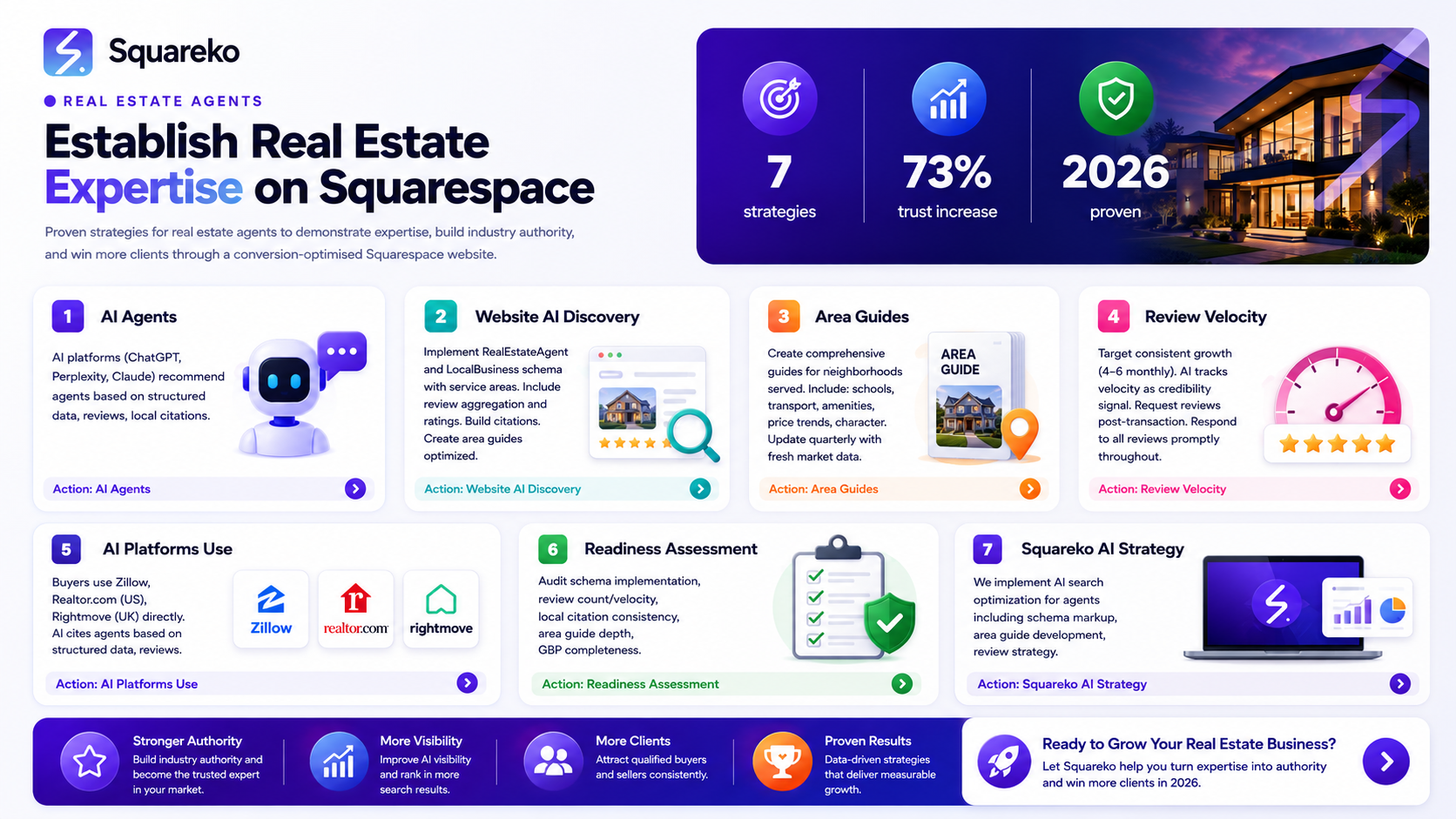
AI systems need clear information architecture to understand your expertise. A typical Squarespace website structure for an estate agent should include:
Essential Sections:
Homepage — Includes Real Estate Agent schema, value proposition, service areas, and recent client testimonials
About Us — Founder bios with credentials, years of experience, relevant certifications
Our Services — Sales, lettings, valuations, property management—each with dedicated pages
Area Guides — One guide per neighbourhood (10+ guides minimum for strong signal)
Case Studies — Specific property sales with anonymised before-and-after narratives
Blog — Weekly content covering market trends, buying guides, local updates
Testimonials & Reviews — Integrated Google review display and client case studies
Contact — Clear contact form, phone number, office address with opening hours
Each section reinforces your identity to AI systems. When an AI model crawls your site, it builds a mental map of who you are and what you specialise in.
Key technical elements:
Fast loading times (under 3 seconds)
Mobile responsiveness
Clear internal linking from service pages to relevant area guides
Consistent NAP (Name, Address, Phone) across all pages
SSL certificate (HTTPS)
XML sitemap submitted to Google Search Console
Regular content updates (minimum one blog post weekly)
Squarespace handles most of these automatically, but ensure your structure is intentional and clean. Disorganised navigation confuses AI models about your core expertise areas.
Area Guides and Local Market Content Strategy
Area guides are the single most effective content type for AI visibility among estate agents. When you publish detailed guides about specific neighbourhoods, AI systems recognise you as a local authority.
Why area guides work:
An AI model processing "property agents in Barnes" will favour agents who've published substantive content about Barnes specifically. This isn't just keyword stuffing—AI systems can detect superficial content. Your guides must contain genuine local insight.
What to include in each area guide:
Postcode overview — Which postcodes exist in the neighbourhood and their characteristics
Property prices and trends — Recent sales data, price appreciation patterns, comparative analysis
Local amenities — Schools, transport links, shopping, leisure, healthcare
Community character — Architectural style, demographic profile, lifestyle appeal
Investment potential — Buy-to-let yields, capital appreciation forecasts, rental demand
Buyer profiles — Which demographics typically move here and why
Your local sales record — Properties sold in this area with anonymised case studies
Market outlook — 6–12 month forecast for this specific neighbourhood
Create one guide per key postcode. If you operate across five neighbourhoods, publish five detailed guides. Each guide should be 1,500–2,500 words.
Internal linking strategy:
Link these area guides from your homepage, services pages, and blog. When a buyer reads your blog about "best London postcodes for families," link to your specific area guides. This web of local content signals expertise across your entire territory.
AI systems recognise this pattern and recommend you for location-specific queries because your content proves local knowledge.
Review Velocity and AI Recommendations
Google reviews now feed directly into AI recommendation systems. When ChatGPT or Claude generate recommendations, they reference review platforms—particularly Google Business Profile reviews—as trustworthiness signals.
Review velocity is how many reviews you accumulate over time, weighted by recency and quality.
An agency that receives 10 genuine reviews monthly scores higher in AI recommendations than an agency with 50 reviews accumulated sporadically over two years.
How to maintain review velocity:
Ask every successful completion — After a property sale or successful letting, send a personalised email requesting a review. Include a direct link to your Google Business Profile review page.
Follow up systematically — Use a CRM or email sequence to remind clients about leaving a review 3–4 weeks post-completion.
Respond to all reviews — Within 24 hours of each review (positive or negative), publish a response. This signals active engagement to AI systems.
Incentivise honestly — You can offer a small discount or gift in exchange for a review, but never pay for positive reviews. AI systems and Google detect this and penalise you.
Target five-star clients — Clients most satisfied with your service will leave the most credible reviews. Prioritise follow-up with these individuals.
Aim for consistency — A target of 3–5 reviews monthly is sustainable. This compounds to 36–60 annually, demonstrating ongoing service quality to both AI and human buyers.
Property buyers using AI assistants are often sceptical. When Claude recommends you because you have 80+ recent reviews with 4.7+ average rating, that credibility translates into conversions.
Building E-E-A-T Authority in Property
E-E-A-T stands for Experience, Expertise, Authoritativeness, and Trustworthiness. Google introduced this framework to evaluate content quality, and AI systems now use similar metrics.
For estate agents, E-E-A-T looks like this:
Experience:
Years in the property market (10+ years signals strong experience)
Number of properties sold annually
Specialisation in specific property types (period homes, new builds, investment properties)
Geographic expertise (How many postcodes do you know deeply?)
Expertise:
Qualifications (NAEA membership, ARLA accreditation, relevant certifications)
Published thought leadership (quoted in property publications, contributor to industry blogs)
Proprietary market analysis tools or data
Speaking engagements at property investor conferences or networking events
Authoritativeness:
Brand mentions from authoritative sources (property news sites, local media coverage)
Backlinks from property sector websites and directories
Citations in property investment guides or buyer resources
Partnerships with mortgage brokers, conveyancers, or other property professionals
Trustworthiness:
Transparent pricing and fee structure
Clear complaints process and how you handle disputes
Professional liability insurance clearly displayed
Client testimonials with verifiable details (not generic praise)
Compliance with NAEA Code of Practice or similar standards
How to signal E-E-A-T to AI systems:
Create team bios — Each agent on your team needs a detailed biography page including credentials, years of experience, specialisations, and a professional photo.
Publish case studies with real results — Document actual property sales (anonymised for privacy) with before-and-after context, timeline, and specific outcomes.
Write industry commentary — Publish market analysis tied to current events (interest rate changes, new planning policies, housing shortage reports).
Secure third-party recognition — Apply for "Best Estate Agents" awards, contribute to local business directories, and pursue media coverage.
Display credentials prominently — If you're NAEA-accredited or have professional qualifications, display these on your website and in your schema markup.
AI systems comb through your website looking for these signals. When they find them, you rise in recommendation rankings.
Using Article Schema with Named Expert Attribution
Generic blog posts don't appear in AI recommendations. Articles attributed to named experts with credentials do.
When you publish a blog post, include Article schema with explicit author attribution:
{
  "@context": "https://schema.org",
  "@type": "BlogPosting",
  "headline": "London Property Market Forecast 2026: What Buyers Should Know",
  "description": "Expert analysis of London property prices, demand trends, and investment outlook for 2026.",
  "image": "https://youragency.com/images/market-forecast.jpg",
  "datePublished": "2026-03-15",
  "dateModified": "2026-03-20",
  "author": {
    "@type": "Person",
    "name": "Sarah Mitchell",
    "description": "Senior Estate Agent with 14 years' experience specialising in London residential property sales",
    "url": "https://youragency.com/team/sarah-mitchell"
  },
  "publisher": {
    "@type": "Organization",
    "name": "Your Agency Name",
    "logo": {
      "@type": "ImageObject",
      "url": "https://youragency.com/logo.png",
      "width": 250,
      "height": 60
    }
  },
  "mainEntityOfPage": {
    "@type": "WebPage",
    "@id": "https://youragency.com/blog/london-property-market-forecast"
  }
}
The author attribution matters. AI systems check whether the person writing about London property has genuine expertise. If Sarah Mitchell has a team bio page showing 14 years of experience, that strengthens the signal.
Implementation steps:
Ensure every blog post has a named author — Not The Team or Admin, but a real person on your staff.
Create author bio pages — Each author should have a Squarespace page with photo, bio, experience summary, and specialisations.
Include Author schema — Use Person schema markup on author bio pages to signal expertise to AI.
Link blog posts to author bios — Every article should link to the author's bio page, creating a signal that real expertise backs the content.
This structure tells AI systems: A credible expert wrote this, not a content mill.
Which AI Platforms Property Buyers Use
Property buyers aren't using generic AI. They're asking specific platforms designed to help with decision-making.
ChatGPT (OpenAI)
Most widely used by property buyers
Buyers ask: What are the best estate agents in [postcode]?
ChatGPT draws from its training data (website content, reviews, directories)
Presence in Google Search results and Google Business Profiles heavily weighted
Claude (Anthropic)
Growing market share among property professionals
Used for detailed analysis, due diligence, and comparative research
Responds well to well-structured data and credible sources
Prefers authoritative, transparent content over marketing speak
Google Gemini (Google)
Integrated into Google Search, used directly in search results
Buyers see AI summaries alongside traditional search results
Google Business Profile data directly integrated into Gemini responses
E-A-T signals and review counts directly impact Gemini recommendations
Perplexity
Emerging platform among property investors
Cites sources explicitly, so your content visibility depends on quality and authority
Prefers in-depth, detailed content over surface-level pages
Research-oriented interface favours data-driven property analysis
For AI search visibility across all platforms, you need:
Quality local market content (area guides, market reports)
Strong Google Business Profile (reviews, photos, regular updates)
Schema markup (Real Estate Agent, Article, Organization)
Named expert attribution
Credible third-party citations and reviews
Original research or unique market insights
Property buyers cross-reference multiple AI platforms before deciding. You need to appear consistently across all of them.
Real Estate Agent AI Search Readiness Assessment
Before investing heavily in AI search optimisation, assess where you stand. Answer these 10 questions honestly:
Do you have Real Estate Agent schema implemented on your website?
Yes, with aggregated ratings and review counts
Partially implemented (missing some fields)
No
How many detailed area guides have you published?
10+ (one per key postcode)
3–9 (moderate coverage)
0–2 (minimal local content)
What's your current Google Business Profile rating?
4.5–5.0 with 50+ reviews
4.0–4.4 with 20–50 reviews
Below 4.0 or fewer than 20 reviews
Do your blog posts include named author attribution with credentials?
Yes, every post has a named expert author
Some posts do, inconsistently
No named authors
How recently did you accumulate your last Google review?
Within the past week
Within the past month
More than a month ago
Do you have a documented process for requesting reviews from clients?
Yes, systematic and tracked monthly
Occasional, ad-hoc requests
No formal process
How many of your team members have individual bio pages with credentials?
All team members (10+ pages)
Some team members (3–9 pages)
One or none
Do you publish original market analysis or unique property insights?
Monthly (or more frequently)
Quarterly
Rarely or never
Have you been mentioned in local news or property publications?
Yes, multiple times in the past year
Once or twice ever
Never
Is your website mobile-friendly with fast loading times?
Yes, confirmed via Google Page Speed Insights (70+)
Partially, some performance issues
No, known speed or mobile issues
Scoring:
Mostly highest-tier answers (8–10): You're ready for AI search optimisation. Focus on maintaining momentum.
Mix of high and mid-tier answers (4–7): Significant opportunity. Prioritise area guides, review velocity, and author bios.
Mostly lower-tier answers (0–3): Start with foundational work. Implement Real Estate Agent schema, establish a review request process, and publish 5 area guides.
How Squareko Implements AI Search Strategy for Estate Agents
At Squareko, we've built AI search optimisation into our standard estate agent website package. Here's how we approach it:
Foundational Setup (Weeks 1–2)
We audit your existing web presence, compile your team credentials and specialisations, and implement complete Real Estate Agent schema markup across your site. We ensure your Squarespace structure is clean, fast, and mobile-optimised.
Content Strategy Development (Week 3)
We work with you to identify 8–12 key postcodes or neighbourhoods you want to dominate. For each, we create a content calendar for area guides, market reports, and local case studies.
Area Guide Implementation (Weeks 4–8)
We publish your first five area guides with internal linking, schema markup, and integrated images. Each guide is optimised for both AI systems and human readers.
Authority Building (Ongoing)
We establish a blog publishing schedule (minimum one post weekly), ensuring each post includes named author attribution, proper Article schema, and links to relevant area guides. We integrate your Google Business Profile feed into your website to ensure reviews display prominently.
Review Velocity Programme (Ongoing)
We set up automated email sequences requesting reviews from clients post-completion. We create a system for responding to all reviews within 24 hours, signalling active engagement to AI systems.
Monitoring & Iteration (Monthly)
We track mentions across AI platforms (ChatGPT, Claude, Gemini, Perplexity), monitor your ranking for location-specific queries, and adjust content strategy based on what's driving AI recommendations.
Result: Clients typically see AI recommendations within 3–4 months of implementation. By month 6–8, they report regular inquiries from buyers who found them via ChatGPT or Gemini recommendations.
-
ChatGPT generates recommendations based on its training data, which includes your website, Google Business Profile, reviews, and mentions across the web. To increase the odds of recommendation, you need:
A strong Google Business Profile with 50+ reviews and 4.5+ rating
RealEstateAgent schema markup on your website
Detailed, original content about your local market (area guides, market reports)
Named expert bios for your team members
Regular updates to your website and Google Business Profile
ChatGPT doesn't visit your site in real-time—it draws from training data and public information available up until its knowledge cutoff. Your best strategy is ensuring your presence is strong across Google, your website, and local property directories.
-
The primary schema types are:
RealEstateAgent — Your main business identity schema
Organization — For your company details, contact, and social profiles
LocalBusiness — Additional local relevance signals
AggregateRating — Your Google review rating and count
Article — For blog posts, with named author attribution
Person — For team member bios and credentials
BreadcrumbList — For site navigation clarity
Squarespace handles much of this automatically, but you should manually implement RealEstateAgent schema and ensure Article schema includes proper author attribution. Use Google's Rich Results Test to verify your markup is working correctly.
-
Absolutely. Area guides and market reports are the strongest signal you can send to AI systems about local expertise. When you publish substantive content about specific postcodes, neighbourhoods, and local market trends, AI models recognise you as a local authority.
An agency with five detailed area guides typically sees 3–4x more AI recommendations than an agency with no local content, even if both have identical Google ratings.
-
Request reviews after every successful completion—property sales, lettings, valuations, or property management arrangements. Use an automated email sequence: first request 3 weeks post-completion, follow-up reminder 6 weeks post-completion.
Target is 3–5 reviews monthly for sustainable review velocity. This accumulates to 36–60 annually, which is substantial enough for AI systems to recognise ongoing service quality.
-
No. Google penalises payment-for-review schemes, and AI systems can detect inauthentic review patterns. Paid reviews undermine your credibility with both algorithms and humans. Focus on delivering exceptional service and asking genuinely satisfied clients to leave reviews.
-
Most agencies see AI recommendations within 3–4 months of implementing the full strategy (schema, area guides, review velocity, author bios). Results compound over time. By month 6–8, agencies typically report regular inquiries from buyers who found them via ChatGPT or Gemini recommendations.
Conclusion
AI search is reshaping how property buyers find agents. In 2026, a buyer's first question isn't "What agents are on Rightmove?" but "Which agents does ChatGPT recommend?"
This shift creates a window of opportunity for early-adopting estate agents. While most of your competitors are still focused on traditional SEO, you can establish dominance in AI recommendations by implementing the strategy in this guide:
Implement complete Real Estate Agent schema markup
Publish 8–12 detailed area guides covering your service territory
Build review velocity with systematic client requests
Create named expert bios with credentials
Publish weekly blog content attributed to real team members
Maintain strong Google Business Profile presence
The agencies that act now will enjoy visibility with a growing segment of property buyers. The ones that wait until AI recommendations are commonplace will struggle to catch up.
If your current website wasn't built with AI search in mind, it's time to rebuild. Squarespace provides the platform; the strategy is yours.
Get Your Estate Agent Website AI-Ready
Squareko specialises in building estate agent websites optimised for both traditional search and emerging AI recommendation systems. We handle the technical complexity—schema markup, site architecture, content strategy—so you can focus on selling properties.
Ready to dominate AI recommendations in your local market? Get a free AI search assessment from Squareko and discover exactly where your website stands.

From custom website design to SEO strategy, we help businesses launch a site that looks professional and performs better.

About Squareko
I'm Walid Hasan, a Certified Squarespace Expert and Squarespace Circle Platinum Partner with over 12 years of hands-on experience designing and optimizing high-performing websites. Over the years, I've had the privilege of building more than 2,000 Squarespace websites for clients around the world, always focusing on clean design, strong user experience, and conversion-driven results.