AI Search Strategy for Chiropractors on Squarespace in 2026
AI Search Strategy for Chiropractors on Squarespace in 2026
Search is changing. Google still matters. But ChatGPT, Perplexity, Claude, and other AI models now answer healthcare questions directly, without sending users to websites. When someone asks ChatGPT "is chiropractic safe for lower back pain," the AI generates an answer. It might cite your website. Or it might cite competitors. Or it might recommend seeing a GP instead. You have no control. What you do have is the ability to be the source AI systems choose to cite. This requires a different strategy than traditional search optimization. You must establish yourself as an authoritative, credentialed chiropractor in your location, for your specialisms, in formats that AI systems prefer to cite. This guide walks you through that strategy in 2026.
Key Takeaways
AI search systems reward GCC-registered chiropractors more heavily than unregistered practitioners; your GCC registration is a powerful trust signal that increases likelihood of appearing in AI-generated health answers
GEO (entity establishment) strategy—clearly establishing your clinic location, specialisms, and credentialing on your website and across the web—makes AI more likely to recommend you locally
AEO (Answer Engine Optimization) content targets questions people ask AI systems directly: "is chiropractic effective," "how to find a qualified chiropractor," "what can a chiropractor treat," written in AI-preferred formats
Schema markup (Chiropractor type, MedicalOrganization, FAQPage) signals your credentials to AI systems and improves citation likelihood
Your Squarespace website must establish clear entity signals: your GCC registration, location, years of practice, specialisms, credentials, and clinic contact information
How AI Systems Handle Health Queries and Why GCC Registration Matters
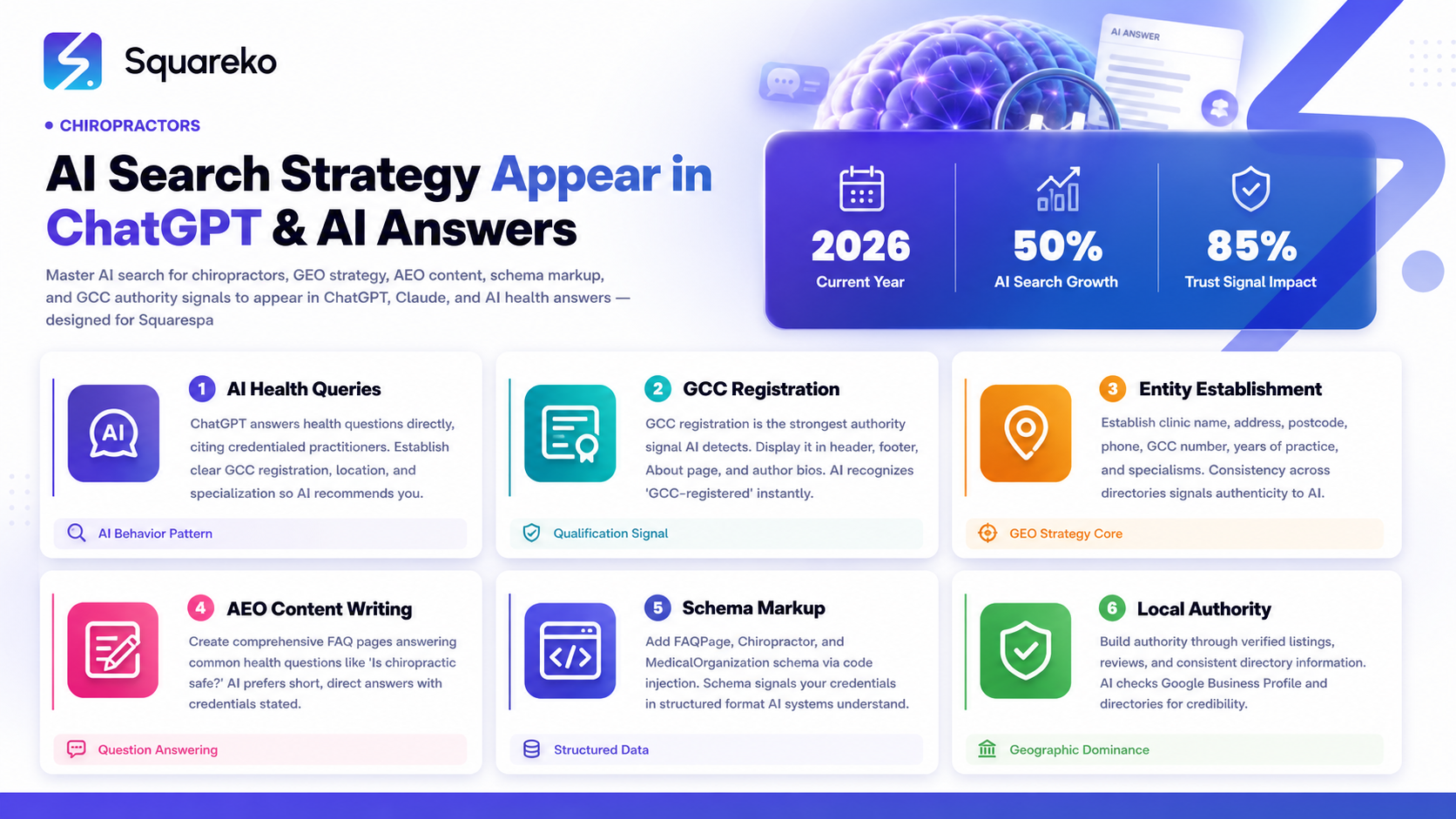
AI models are extremely cautious with health information. GPT, Claude, Perplexity, and others are trained to avoid giving medical advice and to defer to qualified healthcare professionals. When someone asks "does chiropractic help back pain," modern AI doesn't generate speculative answers. It cites sources. It mentions when views differ. It directs users to consult a qualified practitioner.
The key phrase: "qualified practitioner."
GCC registration is a powerful signal of qualification. The General Chiropractic Council is the statutory regulator of chiropractic in the UK. To register, you must meet rigorous educational and ethical standards. An AI system scanning the web sees a chiropractor with "GCC-registered" in their bio and immediately understands: this person is officially credentialed.
Non-registered chiropractors (those who trained outside the UK, haven't sought GCC registration, or are unqualified to register) don't have this signal. AI systems are more skeptical of their claims. They're less likely to cite them.
Your GCC registration isn't just a legal requirement. It's a competitive advantage in AI search.
How AI Systems Prefer to Get Health Information
AI models are trained on:
Published clinical research and peer-reviewed literature
Regulatory body guidelines (NICE, GMC, GCC standards)
Authoritative healthcare websites (Mayo Clinic, NHS, professional associations)
Credentialed practitioner websites (those with clear credentials and regulatory oversight)
FAQPage schema markup and structured data
They avoid:
Anonymous websites with no clear authority
Unverified health claims
Websites making prohibited claims
Practitioners with no verifiable credentials
Your Squarespace website should signal authority in all the ways AI systems understand.
GEO (Entity Establishment) Strategy for Chiropractic
GEO stands for "Geographic Entity Optimization." It's about making it crystal clear to AI systems: who you are, where you practice, what you treat, and what qualifies you to do it.
The Core Elements of Your Entity
1. Your Name and Location Your Squarespace site should clearly establish
Full clinic name
Physical address (not just "London" — include postcode)
Phone number
Email
This seems obvious, but many chiropractic websites are vague about location. An AI system scanning your site should instantly know "this is [Your Name], a GCC-registered chiropractor at [Specific Address] in [Town]."
2. Your GCC Registration Number Display your GCC registration number prominently:
In your header or footer
On your About page
In your author bio on blog posts
Format it clearly: "GCC-registered chiropractor (GCC Reg: [Number])"
3. Your Qualifications and Years of Practice List your credentials:
Bachelor's degree in chiropractic (and university)
Postgraduate certifications (sports chiropractic, pediatric chiropractic, etc.)
Years of practice (e.g., "15+ years of clinical experience")
AI systems weight established practitioners more heavily than new practitioners.
4. Your Specialisms Be specific about what you treat:
Lower back pain and lumbar dysfunction
Neck pain and cervical spine conditions
Sports injuries and athletic performance
Pregnancy-related musculoskeletal pain
Don't claim to treat everything. Specialization signals authority.
5. Your Practice Location and Coverage Area Make it clear:
"We serve patients in [Town/Region]"
"Conveniently located at [Address]"
If you serve multiple locations or offer telehealth, make that explicit.
Implementing GEO on Your Squarespace Site
Create an About page that establishes your entity clearly:
"I'm [Your Name], a GCC-registered chiropractor with [X years] of experience in treating lower back pain, neck dysfunction, and sports injuries. I graduated from University with a degree in chiropractic in [Year]. I'm based at [Full Address] in [Town], where I've served patients since Year. My GCC registration is [Number]. I specialize in [your specialisms]."
Every blog post author bio should reinforce this:
"Your Name is a GCC-registered chiropractor in Town with a specialty in specialism. GCC Reg: Number."
Your Google Business Profile, local directories, and social media should all match this information word-for-word. Consistency signals authenticity to AI systems.
AEO Content: Writing for AI Answers
AEO stands for "Answer Engine Optimization." It's not SEO. It's optimizing your content to be cited by AI answer engines like ChatGPT and Claude when someone asks a question.
Questions AI Systems Are Asked About Chiropractic
People ask AI systems:
"Is chiropractic safe for back pain?"
"How do I find a qualified chiropractor near me?"
"What can a chiropractor treat?"
"What's the difference between a chiropractor and a physiotherapist?"
"Can chiropractors treat neck pain?"
"Is spinal manipulation evidence-based?"
"How much does a chiropractic appointment cost?"
These are high-volume questions. If your content answers them clearly, concisely, and with proper credentials, AI systems will cite you.
Writing AEO Content: Best Practices
Be Direct and Concise AI systems prefer short, direct answers. Don't write 500 words to answer "is chiropractic safe." Write 150 words with the key answer in the first sentence:
"Yes, chiropractic is generally considered safe when performed by a GCC-registered, qualified chiropractor. Some patients experience mild soreness after an adjustment, similar to exercise soreness, but serious complications are rare."
State Your Credentials in Your Answer AI systems need to know who's answering. Always include: "As a GCC-registered chiropractor with [X] years of experience, I can tell you..."
Cite Evidence or Guidelines Reference published research, NICE guidelines, or professional standards: "According to NICE, spinal manipulation may help manage lower back pain in certain cases."
Acknowledge Limitations AI systems reward practitioners who are honest about what they can and can't do: "Chiropractic focuses on musculoskeletal conditions. If you suspect a serious underlying medical condition, consult your GP first."
Use Clear Formatting AI systems scan headings, lists, and structured sections. Use:
H3 headings for questions
Bullet points for key information
Short paragraphs (3-4 sentences max)
Content Ideas for AEO
Create pages specifically answering common AI questions:
"Is Chiropractic Safe?" — Address safety concerns, mention GCC regulation, discuss what to expect
"How to Find a Qualified Chiropractor" — Explain GCC registration, credentials to look for, questions to ask
"What Can Chiropractors Treat?" — List conditions within scope, mention what's outside scope
"Chiropractic vs. Physiotherapy: What's the Difference?" — Objective comparison without claiming superiority
"What Happens During a Chiropractic Adjustment?" — Detailed explanation of the process
"How Much Does a Chiropractic Appointment Cost?" — Transparent pricing information
Each page should be 400-600 words, directly answering the question in the first paragraph, and credentialed with your GCC information and years of experience.
Schema Markup and Structured Data for Chiropractor Entities
Schema markup is HTML code that tells search engines and AI systems what your content is about. For a chiropractor, the most important schema types are:
Chiropractor Schema
{
  "@context": "https://schema.org",
  "@type": "Chiropractor",
  "name": "[Your Full Name]",
  "givenName": "[First Name]",
  "familyName": "[Last Name]",
  "jobTitle": "Chiropractor",
  "description": "[Brief bio - GCC-registered, specialisms, years of practice]",
  "address": {
    "@type": "PostalAddress",
    "streetAddress": "[Full Address]",
    "addressLocality": "[Town]",
    "addressRegion": "[Region]",
    "postalCode": "[Postcode]",
    "addressCountry": "GB"
  },
  "telephone": "[Phone]",
  "email": "[Email]",
  "sameAs": [
    "[Your Google Business Profile URL]",
    "[Your LinkedIn profile]"
  ],
  "image": "[Your professional photo URL]",
  "knowsLanguage": "English",
  "areaServed": "[Towns/regions you serve]",
  "hasCredential": {
    "@type": "EducationalOccupationalCredential",
    "credentialCategory": "professional license",
    "name": "GCC Registration",
    "identifier": "[Your GCC number]"
  },
  "memberOf": {
    "@type": "ProfessionalService",
    "name": "General Chiropractic Council",
    "url": "https://www.gcc-uk.org"
  }
}
Medical Organization Schema (for Clinics)
If you operate a clinic, use Medical Organization:
{
  "@context": "https://schema.org",
  "@type": "MedicalBusiness",
  "name": "[Clinic Name]",
  "description": "[What your clinic does]",
  "address": {
    "@type": "PostalAddress",
    "streetAddress": "[Address]",
    "addressLocality": "[Town]",
    "postalCode": "[Postcode]"
  },
  "telephone": "[Phone]",
  "email": "[Email]",
  "medicalSpecialty": "Chiropractic",
  "staff": [
    {
      "@type": "Chiropractor",
      "name": "[Practitioner Name]"
    }
  ]
}
FAQPage Schema (Critical for AEO)
AI systems love FAQPage schema. It signals structured Q&A content:
{
  "@context": "https://schema.org",
  "@type": "FAQPage",
  "mainEntity": [
    {
      "@type": "Question",
      "name": "Is chiropractic safe?",
      "acceptedAnswer": {
        "@type": "Answer",
        "text": "Yes, when performed by a GCC-registered chiropractor..."
      }
    }
  ]
}
-
No. In 2026, traditional Google search will still dominate, but AI-powered search (ChatGPT, Claude, Perplexity) is growing rapidly. Chiropractors should optimize for both. A website optimized for AI search is also optimized for traditional search (schema, clear credentials, entity signals all help SEO). You're not choosing between one or the other. You're building a website that works for both.
-
Critical. GCC registration is one of the strongest authority signals AI systems can detect. An AI system scanning the web immediately understands that a GCC-registered practitioner is officially credentialed. Without GCC registration, you're at a severe disadvantage in AI search. If you're not registered but practicing in the UK, AI systems will be skeptical of your claims.
-
Quality over quantity. Publish one excellent, comprehensive FAQ page about your specialty. That single page, with proper schema markup and clear credentials, is more valuable than dozens of mediocre posts. If you do publish regularly, aim for one AEO-focused post per month.
-
Yes, but it requires strong local authority. You need: GCC registration, clear clinic location with postcode, complete Google Business Profile, schema markup, and a track record of local presence (Google reviews, directory listings). AI systems prioritize local results when someone asks for practitioners "near me," but only if they can verify your location and credentials.
-
Yes. AI systems prefer: FAQ pages (FAQPage schema is ideal), direct Q&A content, concise answers with clear credentials, content citing evidence or guidelines. Long-form blog posts are less likely to be cited directly, though AI may draw from them. Short, direct answers to common questions are most citation-worthy.
-
Do both. Update existing posts to include your GCC registration and credentials in the author bio. Create new, dedicated AEO pages specifically designed to answer common questions. For example, if you have a blog post "Understanding Back Pain," create a separate FAQ page "5 Questions About Back Pain Chiropractors Are Asked." The FAQ page is more AI-friendly.
-
Manually test. Search your specialty in ChatGPT, Claude, or Perplexity. See if your name or clinic appears in the generated answer. Check if a link to your website is included. This manual testing is the most reliable way to know if AI systems are citing you. Google Search Console doesn't yet track AI citations comprehensively.
-
Don't choose. SEO (search engine optimization) targets traditional search results. AEO (answer engine optimization) targets AI-generated answers. A website optimized for AEO is typically also better optimized for SEO. Both benefit from: clear entity information, good schema markup, FAQPage content, credentialed authors. Build for both simultaneously.

From custom website design to SEO strategy, we help businesses launch a site that looks professional and performs better.

About the Author
I'm Walid Hasan, a Certified Squarespace Expert and Squarespace Circle Platinum Partner with over 12 years of hands-on experience designing and optimizing high-performing websites. Over the years, I've had the privilege of building more than 2,000 Squarespace websites for clients around the world, always focusing on clean design, strong user experience, and conversion-driven results.