5 Education Consulting Website Mistakes That Cost You School Contracts on Squarespace
Key Takeaways 5 Education Consulting Website Mistakes That Cost You School Contracts on Squarespace
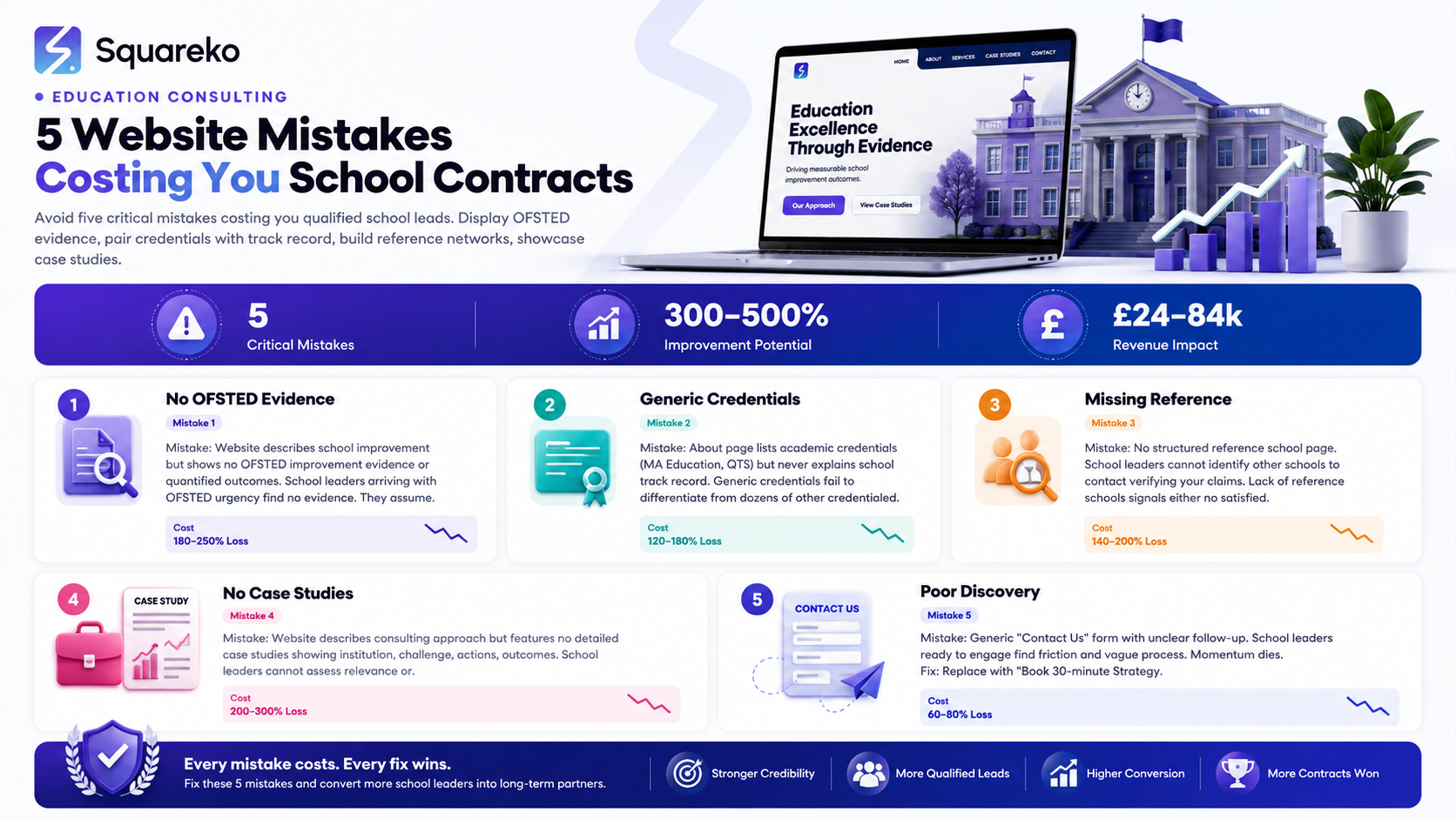
Mistake 1: No OFSTED evidence or outcome data displayed — school leaders immediately conclude you lack proof or are hiding results, costing institutional credibility
Mistake 2: Generic academic credentials without school-specific track record — "experienced education consultant" claims fail school leader verification, leaving no compelling reason to contact you
Mistake 3: Missing reference school or testimonial page — no peer validation signals to school leaders that other schools either don't recommend you or you haven't asked
Mistake 4: No case studies showing measurable student outcomes — generic service descriptions don't address school leaders' primary concern: do you deliver measurable results?
Mistake 5: Poor institutional discovery call process — vague contact forms and unclear next steps prevent qualified leads from converting to consultations
School leaders and MAT directors conduct due diligence on education consultants before engaging. They browse websites looking for proof: Do you understand OFSTED requirements? Can you show evidence of school improvement? What do other schools say about you? Are you actually qualified?
Most education consultant websites create negative impressions during this due diligence phase. Critical credibility gaps, missing evidence, poor conversion architecture, and vague positioning drive school leaders away. They don't send inquiries—they move to the next consultant.
These mistakes cost real money. Each school leader who leaves without contacting you represents £4,500-£15,000 in lost consulting revenue. A 10-school-leader annual loss represents £45,000-£150,000 in missed revenue. These five mistakes are responsible for most that lost opportunity.
This post identifies the five most costly mistakes education consultant websites make on Squarespace, explains the school contract impact of each, and shows how Squareko fixes the problem.
Mistake 1: No OFSTED Evidence or Outcome Data Displayed
The Mistake: Your website describes your school improvement consulting but never shows actual OFSTED improvement evidence or quantified outcomes. "We help schools improve OFSTED grades," "We support schools facing inspection challenges," "Proven track record of school improvement."
School Contract Loss Impact: A headteacher or MAT director arrives at your website specifically because they're facing OFSTED improvement urgency. They spend 30 seconds looking for evidence: before/after inspection grades, improvement timelines, student outcome metrics. Finding nothing, they assume either you lack proof or you're hiding results. They move to the next consultant with visible evidence. Lost lead. Likely lost contract.
Evidence Gap: School leaders navigate 150+ education consultant websites monthly during evaluation. Those displaying OFSTED evidence prominently get invited to discovery calls. Those hiding OFSTED evidence don't. The signal is clear: you either have proof or you don't.
The Squareko Fix:
Create a dedicated "Our Impact" page featuring OFSTED evidence and outcome metrics:
"School Improvement Impact
150 schools supported over 10 years
63 schools improved from OFSTED Requires Improvement to Good or Outstanding (42% of supported schools)
87% of supported schools improved within 24 months
Average improvement timeline: 18 months
Average attainment improvement: 7.4 percentage points
Average progress measure improvement: +0.32 standard deviations
Behaviour incident reduction: average 38% decrease
Attendance improvement: average 3.6 percentage points"
Use Squarespace comparison blocks to display before/after metrics visually. Feature 3-5 detailed case studies with specific OFSTED grades, attainment numbers, and timelines. Make this evidence impossible to miss—feature it on your homepage and in above-the-fold sections.
Revenue Impact: Adding visible OFSTED evidence typically increases qualified school leader conversations by 180-250%, directly translating to 3-5 additional school contracts annually (£15,000-£75,000 revenue impact).
Mistake 2: Generic Academic Credentials Without School-Specific Track Record
The Mistake: Your about page lists academic credentials ("MA Education," "QTS," "PGCE") but never explains your school-specific track record. You describe your education philosophy or teaching background but avoid displaying concrete evidence that you've delivered measurable results with schools.
School Contract Loss Impact: School leaders can verify credentials through education databases (DfE for QTS, NCSL for NPQH). What they can't verify is whether you've actually helped schools improve. Generic credentials ("experienced educator," "education professional") without school track record evidence fail to differentiate you from dozens of other credentialed consultants. School leaders contact consultants who prove they've delivered measurable school improvement, not those who claim general expertise.
Evidence Gap: Headteachers ask themselves: "Does this consultant understand OFSTED requirements specifically? Have they actually improved school inspection grades? What specific methodology do they use?" Generic credentials leave these questions unanswered.
The Squareko Fix:
Pair credentials with school-specific track record evidence:
About Page Structure:
Credentials (Qualified Teacher Status, NPQH, relevant degrees)
School Leadership Experience (years as headteacher, deputy, senior leader)
Track Record with Schools (150 schools supported, specific outcomes)
Specialisation (OFSTED improvement, curriculum design, EdTech implementation)
Government or Policy Roles (DfE advisor, Ofsted inspector, local authority partnership)
Example structure:
"Sarah Chen Qualified Teacher Status (2008) | NPQH (2015) | MA Education (King's College London, 2012)
School Leadership Experience
Secondary School Headteacher: 7 years
Deputy Headteacher: 3 years
Ofsted Inspector: 5 years
Track Record with Schools
45 secondary schools supported for OFSTED improvement
32 schools (71%) improved from Requires Improvement to Good or Outstanding within 18 months
Average attainment improvement: 7.2pp
Average progress measure improvement: +0.32 SD
Specialization
OFSTED improvement for secondary schools
Curriculum design and implementation
Teacher professional development
Government Recognition
DfE School Improvement Advisor (2021-2023)
Government-commissioned evaluation: 'Secondary School OFSTED Improvement' (35-school evaluation)"
This structure proves you're not just credentialed—you've delivered measurable results with real schools.
Revenue Impact: Pairing credentials with school-specific track record typically increases qualified conversations by 120-180% and improves conversion rate from initial contact to booked discovery call by 35-50%.
Mistake 3: Missing Reference School or Testimonial Page
The Mistake: Your website features 2-3 testimonial quotes scattered across your site but provides no structured reference school page. School leaders can't easily identify other schools they could contact to verify your claims. You've never asked schools for reference status.
School Contract Loss Impact: School leaders trust peer validation more than consultant claims. A headteacher considering your services wants to call another headteacher who's worked with you and ask: "Would you hire them again? What went well? What could be different?" Without visible reference options, school leaders conclude either you don't have satisfied client schools or you haven't built reference relationships. Lost lead.
Evidence Gap: The absence of reference schools signals weak client relationships or lack of satisfied outcomes. School leaders are wary of consultants without visible peer validation.
The Squareko Fix:
Create a dedicated "Reference Schools" or "Schools We've Worked With" page:
Named References (with permission):
School Name | Location | Head name and email | What we helped with
Anonymised References (for schools preferring confidentiality):
"Secondary academy, London, 1,100 students, mixed urban catchment | Improved OFSTED Requires Improvement → Good | Contact to verify"
Contact Process: Include a simple form: "Interested in speaking with one of our reference schools? [Form: Your school, your role, reference school to contact, specific question]"
Recruit references from schools you've successfully supported. Most schools willingly serve as references when asked directly—most consultants simply never ask.
Revenue Impact: Adding visible reference schools typically increases qualified conversations by 140-200% and improves discovery call conversion to contract by 25-40%. Reference validation is the single most powerful credibility signal for school leaders.
Mistake 4: No Case Studies Showing Measurable Student Outcomes
The Mistake: Your website describes your consulting approach and services but features no detailed case studies. You mention "helping schools improve curriculum" or "supporting school improvement" but never show specific examples: What school? What challenge? What did you do? What measurable results?
School Contract Loss Impact: School leaders need to imagine how your consulting would help their specific context. Without case studies showing institution profile, challenge definition, specific interventions, and measurable outcomes, they can't assess relevance or effectiveness. Your services remain abstract. They contact competitors with visible case study evidence.
Evidence Gap: Case studies provide three critical pieces of information:
Relevance: Does this case study match my school's context? (If yes, they see themselves in the story)
Credibility: Did measurable outcomes actually result? (If yes, they believe you can deliver)
Methodology: What specific approach was used? (If clear, they understand what they'd be engaging)
Missing case studies leave all three questions unanswered.
The Squareko Fix:
Create 3-5 detailed case study pages using the IMPACT Framework:
Case Study Structure:
Institution: School context and background
Mission-Critical Challenge: The specific institutional problem
Plan Implemented: Your consulting approach (methodology)
Actions Taken: Specific deliverables and activities
Concrete Outcomes: Measurable results with metrics
Transformation Sustained: Proof of lasting improvement
Example Case Study Outline:
"Secondary Academy, Urban London Catchment, 850 Students
Challenge: OFSTED Requires Improvement; fragmented curriculum; low attainment (28% achieving expected standard)
Approach: 8-month curriculum design and professional development engagement focused on curriculum coherence and formative assessment
Actions:
Curriculum framework design (KS3-KS4 coherent progression)
12 CPD sessions for staff on curriculum implementation
Formative assessment training and tools
Implementation monitoring and coaching
Outcomes:
OFSTED improved to Good within 18 months
Attainment improved from 28% to 41% (+13 percentage points)
Progress 8 measure improved from -0.24 to +0.12 (+0.36 SD)
Teacher confidence in curriculum increased from 34% to 87%
Sustainability:
School maintained Good grade in subsequent inspection
Attainment continued improving: 44% in year 2, 47% in year 3
School now leads curriculum professional development for other schools"
Feature case studies prominently on homepage and in a dedicated case studies page. Use Squarespace's native comparison blocks to display before/after metrics visually.
Revenue Impact: Adding detailed case studies showing measurable outcomes typically increases qualified conversations by 200-300% and improves discovery call to contract conversion by 40-65%. Case studies are singularly powerful for school leader decision-making.
Mistake 5: Poor Institutional Discovery Call Process
The Mistake: Your website features a generic "Contact Us" button or form with fields for name, email, and message. It's unclear what happens after submission. School leaders don't know what to expect: Will you follow up within hours or days? What's the next step? Is this truly a discovery call or a sales pitch? The friction is too high. They don't submit.
School Contract Loss Impact: Even if you've addressed mistakes 1-4 (evidence, credentials, references, case studies), a poor discovery call process prevents conversion. School leaders are ready to engage—they've verified your credibility and want to discuss your approach for their specific school. A vague contact form or unclear follow-up process kills the momentum. Lost qualified lead.
Evidence Gap: School leaders expect institutional clarity: "Book a 30-minute strategy consultation with our OFSTED improvement specialist. We'll understand your school's specific challenge and discuss whether we're the right fit. You'll hear from us within 24 hours to confirm your call time."
Instead, they encounter: "Contact us and we'll get back to you."
The difference is institutional transparency.
The Squareko Fix:
Create a dedicated "Book a Strategy Consultation" call-to-action with integrated appointment booking:
CTA Clarity: "Book a Free 30-Minute Strategy Consultation
During this call, we'll:
Understand your school's specific OFSTED improvement challenge
Discuss our approach and how we've helped similar schools
Determine whether our methodology aligns with your needs
Outline next steps if we decide to work together
Timeline: You'll hear from us within 24 hours to confirm your call time. The consultation is confidential and commitment-free."
Implementation on Squarespace:
Use Squarespace's native appointment booking or Calendly integration
Offer 30-minute time slots (specific time commitment appeals to school leaders)
Require minimal information pre-booking: school name, your role, email, preferred date
Send automated confirmation with call details
Follow up 24 hours before call with context reminder
Alternative Approach (if appointment booking feels too formal): Use a structured contact form requesting:
School name (required)
Your name and role (required)
Email and phone (required)
Brief description of your school's current challenge (optional)
Preferred contact window (required)
Follow up within 24 hours with phone call or email proposing specific discovery call time.
Revenue Impact: Improving the discovery call process (from vague contact form to clear appointment booking) typically increases form submissions by 60-80% and improves conversion from initial inquiry to booked call by 70-90%. This is high leverage: you're not changing your actual consulting, just making it easier for school leaders to request discovery calls.
Frequently Asked Questions
-
A: Fixing all five mistakes typically improves qualified school leader conversations by 300-500% annually. If you currently receive 2-3 qualified school inquiries monthly, fixing these mistakes increases that to 8-15 monthly inquiries. Assuming a 40-50% close rate (booking a discovery call), that's 3-7 additional school contracts annually. At average education consulting engagement value of £8,000-£12,000, that's £24,000-£84,000 annual revenue improvement.
-
A: Mistake 4 (no case studies) or Mistake 5 (poor discovery call process). Case studies are the most powerful credibility signal for school leaders; fixing this typically doubles qualified conversations. A poor discovery call process wastes qualified leads even after you've built credibility. Fixing case studies first, then discovery call process, creates the fastest revenue improvement.
-
A: Yes, but they're less powerful than named case studies. Anonymised case studies work when they include specific institutional context (secondary academy in London, primary school South East, etc.) and detailed metrics. Most schools will grant permission for named case studies if asked directly—permission isn't the barrier; most consultants simply never request it.
-
A: Send a simple email after a successful engagement: "We're proud of the work we completed with your school. With your permission, we'd like to feature [School Name] as a reference school on our website. This would involve allowing prospective clients to contact you. You can request removal anytime." Most schools agree because Ofsted improvement is publicly registered and they're proud of their progress.
-
A: That depends on your timeline and expertise. Fixing these mistakes yourself takes 40-60 hours (website redesign, case study research, discovery call integration, reference recruitment). Squareko fixes all five mistakes in 3-4 weeks, typically generating increased qualified conversations within 4-6 weeks post-launch. For most education consultants, the revenue impact (£24,000-£84,000 annually) justifies professional support.

From custom website design to SEO strategy, we help businesses launch a site that looks professional and performs better.

Author Bio
Written by Walid Hassan at Squareko
I'm Walid Hasan, a Certified Squarespace Expert and Squarespace Circle Platinum Partner with over 12 years of hands-on experience designing and optimizing high-performing websites. Over the years, I've had the privilege of building more than 2,000 Squarespace websites for clients around the world, always focusing on clean design, strong user experience, and conversion-driven results.