10 Must-Have Pages Every Professional Services Website Needs on Squarespace
Introduction
A professional services website is not a brochure. It's a trust-building system designed to convert prospects into clients
Whether you're a solicitor, accountant, management consultant, or financial advisor, your website performs a specific function: it reassures prospective clients that you're competent, trustworthy, and worth hiring. The 10 must-have pages for professional services website pages on Squarespace are the backbone of client acquisition. Success depends on having the right pages, in the right order, saying the right things to build trust and drive conversions.
This guide outlines the essential pages every professional services website needs on Squarespace. Complete, well-structured websites attract more qualified leads
Page 1: Home Page – First Impression and Credibility Launchpad
Your home page has one job: convince a visitor that they've come to the right place.
For professional services, this means immediate credibility signals. Within three seconds, a prospective client should understand what you do, who you serve, why you're different, and what happens next.
What to include:
Clear value proposition – We reduce tax liability for entrepreneurs by an average of £8,400 annually
Client logos or sector names – We serve 40+ property developers
Trust badges – Regulated accreditations (FCA, ICAEW, Law Society marks)
Social proof snapshot – Key testimonial or case study result
Call-to-action above the fold – Book a free consultation
Services preview – 3–5 core services linked prominently
Why it matters: Your home page is where bounce decisions happen. Professional services sites need to earn trust instantly through clarity and credibility signals.
Page 2: About / Our Team – Personal Connection Builds Trust
The "About Us" page is not about you—it's about your client's confidence in you. This is where prospects ask: Can I trust this person with my case, finances, or business strategy?
What to include:
Founder/Principal profiles – Why they started the firm, what problem they solve
Individual team member pages – Full credentials, ICAEW membership, FCA reference, Law Society registration
Firm history – Years in business (longevity signals expertise)
Philosophy or approach – How you differ from competitors
Professional memberships – Law Society, ICAS, BACP, industry bodies
Team photos – Real, recent, professional photos (poor quality undermines credibility)
Why it matters: Prospects base hiring decisions on who they'll work with. Team member pages also rank for "[Name] + [Service]" searches, expanding your SEO footprint.
Page 3: Services – Clarity Without Jargon
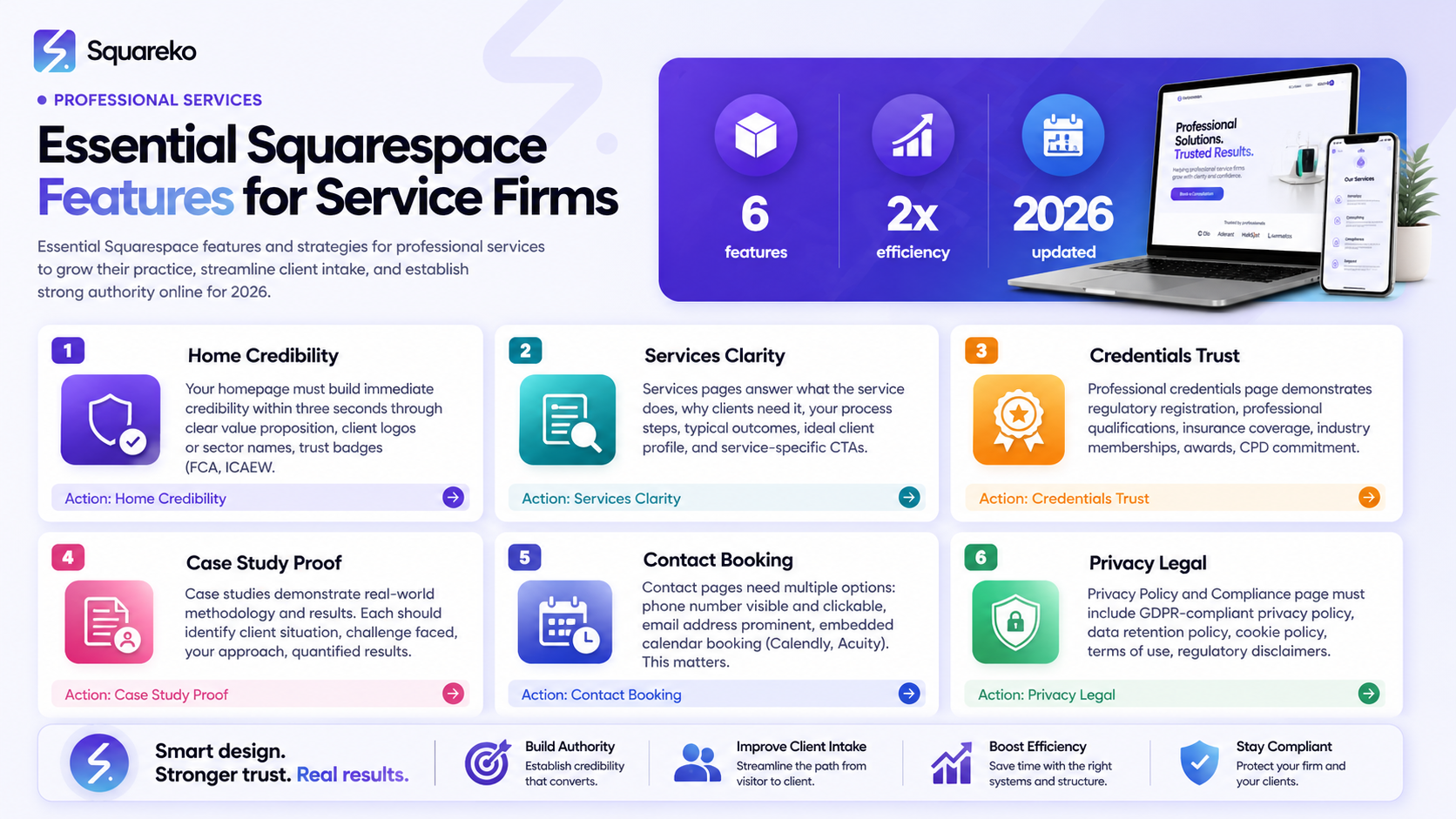
Professional jargon is a barrier to understanding. Your Services page should answer: Do I need this? What happens if I hire you? What's the process?
What to include:
3–6 primary service pages – One page per core service
Plain-English descriptions – Explain what the service does and why clients need it
Clear process – "First, audit. Second, identify opportunities. Third, implement."
Who it's for – "Ideal for SMEs with £2m–£10m turnover"
Expected outcomes – "A tax strategy reducing liability by up to 30%"
Service-specific CTAs – Each service page links to booking or enquiry form
Why it matters:Services pages attract high-intent prospects. Clarity and confidence drive conversions.
Page 4: Credentials Page – The Regulatory Trust Builder
Professional services are regulated. Your credentials page demonstrates compliance and expertise.
What to include:
Regulatory body registration – FCA registration number, Law Society reference, ICAEW membership
Professional qualifications – Chartered status, specialist accreditations
Insurance – Professional indemnity insurance cover amount
Industry memberships – Law Society, ICAEW, ICAS, BACP, IFA, CII
Awards and recognition – Sector awards where applicable
CPD commitment – "All partners undertake 15+ hours CPD annually"
Compliance statement – GDPR compliance, data handling practices
Why it matters: For solicitors, accountants, and financial advisors, this page often tips the hiring decision. Transparency in credentials builds confidence and signals professionalism.
Page 5: Case Studies – Proof Your Methods Work
Case studies demonstrate that you deliver results. Professional services live on reputation, and case studies move prospects from skepticism to conviction.
What to include:
Client situation – "Mid-market manufacturing firm, £8m turnover"
Challenge – "Paying £120k annually in corporation tax with no strategy"
Your approach – "Restructured ownership and implemented business investment relief"
Results – "Reduced tax liability to £68k—saving £52k over 3 years"
Client quote – Real testimonial (anonymised if necessary)
Timeframe – "Implemented over 6 months"
Why it matters: Case studies show methodology and real-world results. They convert prospects at high rates and perform well in search engines.
Create 5–8 case study pages with quantified results (£ saved, % improvement). Always include specific outcomes. Anonymise client names where necessary—this is normal for professional services.
Page 6: Testimonials / Reviews – Third-Party Authority
Your clients' claims about you carry more weight than your own claims. A dedicated Testimonials page consolidates social proof and addresses the key objection: How do I know this firm is any good?
What to include:
Video testimonials – 30-second clips of real clients (most persuasive)
Written testimonials – 50–100 word quotes with client name, title, and firm
Star ratings – Aggregate reviews from Google, Trustpilot
Specific results – Reduced our tax burden by £40k
Variety – Testimonials from different sectors and firm sizes
Why it matters: Third-party validation is more credible than your own marketing claims. Feature prominent testimonials on your Home page and link to the full Testimonials page. Refresh regularly—old testimonials signal stagnation.
Page 7: Blog / Resources – Long-Term SEO and Authority Building
A blog is essential for professional services. It's your long-term SEO asset and authority platform.
A professional services blog achieves two things:
Attracts organic search traffic – Blog articles rank for long-tail keywords and send qualified prospects
Establishes authority – Consistent, expert content positions you as a thought leader
What to include:
Industry insights – Recent regulation changes, tax updates, legal precedent
How-to guides – Steps to set up a trust or Claiming R&D tax relief
Client FAQs answered – Common prospect questions with answers
Sector news – How changes affect your clients
Case study-style articles – Anonymised scenarios that teach and build authority
Consistent publication – Weekly or fortnightly posts (consistency matters for SEO)
Why it matters: A professional services firm without a blog misses its strongest organic growth channel. Search engines reward fresh, relevant content.
Page 8: Contact & Booking – Friction-Free Conversion
Your Contact page is where intent becomes conversion. It must be simple, visible, and trustworthy.
What to include:
Multiple contact options – Phone number, email, contact form, live chat
Embedded booking link – Calendly or Acuity Scheduling embedded directly (no extra clicks)
Office address and map – Physical location builds credibility
Response time expectation – We respond within 24 hours
Privacy reassurance – Your information is secure and never shared
Team member routing – Allow prospects to choose their consultant with photos and bios
Why it matters: Friction kills conversions. Make contact and booking seamless and accessible from every major page.
Page 9: Privacy Policy & Compliance – Legal Foundation and Trust Signal
This page is essential and also signals trust. A thorough Privacy Policy reassures clients that you take their data seriously.
What to include:
Privacy Policy – GDPR-compliant, clear data collection and use explanation
GDPR commitment – Explicit UK compliance details
Data retention policy – How long client records are kept
Cookie policy – Cookie disclosure if applicable
Terms of use – Website usage governing terms
Disclaimers – Important for financial or legal services
Confidentiality statement – Reassure clients about privilege and confidentiality
Why it matters: Missing or vague privacy policies undermine trust. A thorough, professional Privacy Policy signals competence and compliance.
Store at /privacy and /terms and link from your footer for easy access.
Page 10: FAQ Page – AI Search Readiness and Client Education
An FAQ page serves dual purposes: it answers common client questions and optimises for AI search (ChatGPT, Perplexity).
What to include:
Pricing questions – Do you offer fixed fees? or What's a typical cost?
Process questions – How long does a case take? or What information do you need?
Service suitability – Who should use this service? or What's the difference?
Credentials and trust – Are you regulated? or What's your indemnity cover?
Logistics – Can we meet virtually? or Do you charge for consultations?
Comparisons – What's the difference between a solicitor and barrister?
Why it matters: FAQs answer real prospect objections, drive long-tail search traffic, and improve AI search visibility. AI engines (ChatGPT, Perplexity) pull FAQ content to answer user queries.
Use Squarespace's Accordion block with 8–12 questions. Structure each answer in 2–3 sentences for scannability.
-
Yes. Blogging is the single most effective long-term marketing investment for professional services firms. Blog articles drive organic search traffic, establish authority, and address common objections before prospects even contact you. A firm that publishes one article per week will see measurable organic traffic growth within 3–6 months. Firms without blogs miss this growth entirely.
-
This depends on your market positioning. Large firms typically don't list prices (fees are complex and bespoke). Mid-market and boutique firms often benefit from transparency. Consider publishing a pricing guide: "Typical service X costs £2,500–£5,000" or "Fixed fees start at £1,500." This filters unqualified prospects and builds trust through transparency. At minimum, offer a free consultation where you can discuss fees.
-
The Credentials and Testimonials pages. Prospects hiring a financial advisor are making a trust decision first. Regulatory compliance (FCA registration), qualifications (Chartered Financial Planner status), and third-party validation (testimonials) are what convince clients. The Home page and About pages come second. Services pages come third (most advisors offer similar services; trust is the differentiator).
-
Absolutely. Your "team" page should feature you prominently, with a professional photo, full credentials, and your biography. Many solo practitioners hesitate to appear small, but authenticity builds trust. Clients would rather hire a solo expert than a large firm where they're a number.
-
Add at least one new testimonial quarterly and one new case study every 6 months. Outdated social proof signals that you're not actively winning new clients. Refresh testimonials at least annually. If your most recent testimonial is from 2021, prospective clients may doubt your current capability.
-
Visibility and redundancy. Include your phone number in the header (clickable on mobile), in the footer, and on the Contact page. Include your email address in two places minimum. Use a contact form for prospects who prefer email but want to provide context. Embed a booking tool if possible. The easier it is to contact you, the more qualified enquiries you'll receive.
-
Yes, where possible. Even if you don't publish exact fees, a "Pricing Guide" or "Typical Investment" section reduces prospects' anxiety and filters those with unrealistic budgets. For high-touch services (legal, consulting), fees vary widely—but saying "Initial consultations are free, with fees ranging from £1,500–£10,000+ depending on complexity" is transparent and professional.
-
Important, but not essential. Video of your team (introductions, service overviews) builds warmth and humanises your firm. Client testimonial videos are highly persuasive. But video is not required. Well-written content, strong case studies, and client testimonials work well without video. If you do use video, keep it professional and under 90 seconds.
Conclusion
A professional services website with these 10 pages is not just complete—it's competitive. It signals professionalism, transparency, and client focus. It builds trust and converts.
Most professional services firms have gaps: missing case studies, unclear credentials, or buried contact information. These gaps cost money. Every prospect who bounces is a lost fee.
The firms that win treat their website as a strategic business asset. They invest in structure, clarity, and conversion. They make it easy for prospects to say yes.
Audit your current website: Which of these 10 pages do you have? Which need improvement? Where are the gaps?
Ready to Build Your Professional Services Website?
Squareko specialises in designing websites for professional services firms—solicitors, accountants, financial advisors, and consultants.
We'll audit your current site with these 10 pages as the foundation. We'll structure it for search visibility, optimise for conversion, and ensure your website attracts the clients you deserve.
Book a free website audit. We'll show you exactly what's working and what needs to change.
From custom website design to SEO strategy, we help businesses launch a site that looks professional and performs better.

About the Author
I'm Walid Hasan, a Certified Squarespace Expert and Squarespace Circle Platinum Partner with over 12 years of hands-on experience designing and optimizing high-performing websites. Over the years, I've had the privilege of building more than 2,000 Squarespace websites for clients around the world, always focusing on clean design, strong user experience, and conversion-driven results.